
Right Isosceles Triangle: Definition and Solved Examples
Updated on April 29, 2026
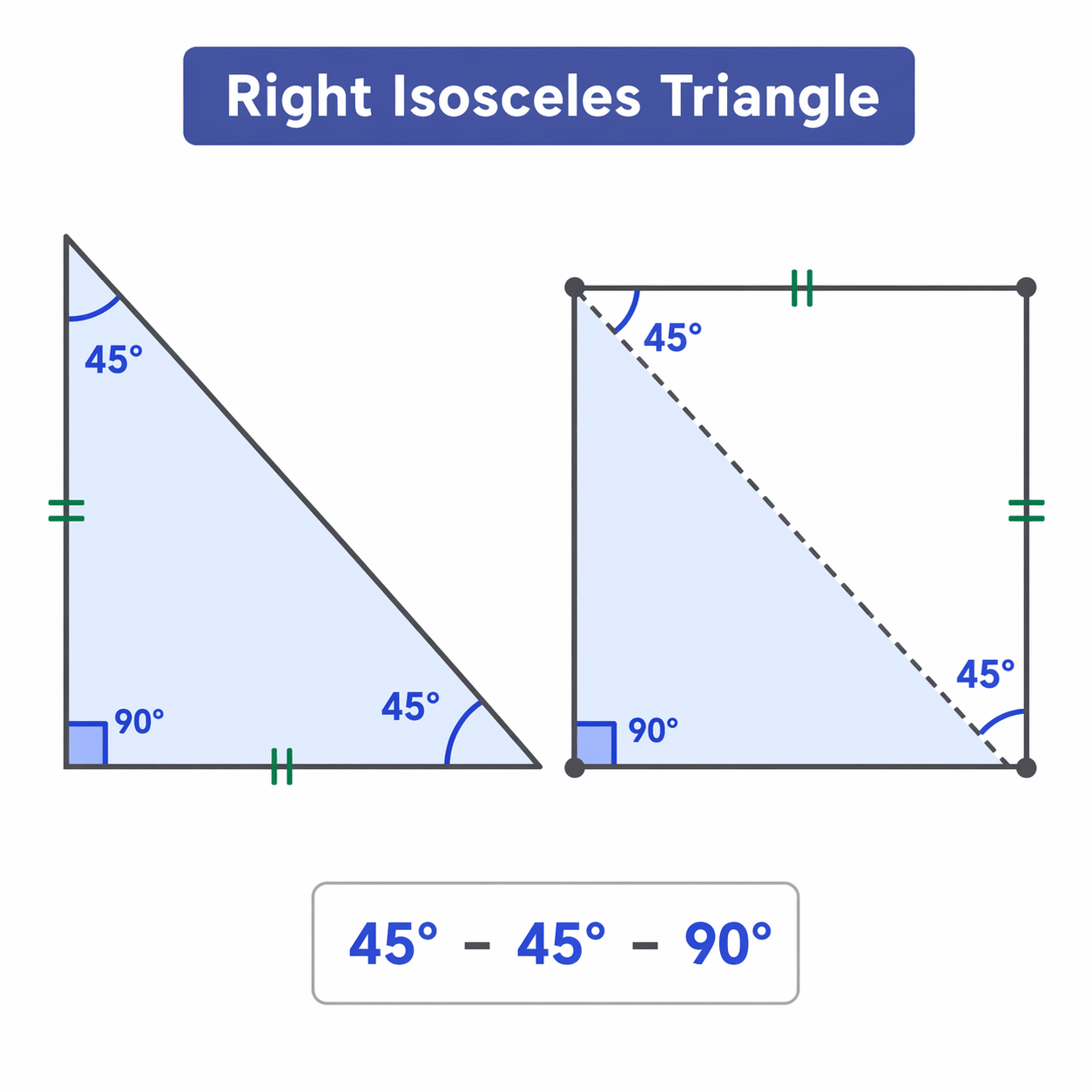
A right isosceles triangle is a specific type of triangle that combines the features of a right-angled triangle and an isosceles triangle. This polygon contains one angle measuring exactly 90 degrees and two congruent sides, known as legs, that meet at that right angle. Because the sum of all interior angles in any triangle must equal 180 degrees, the remaining two angles in a right isosceles triangle are always equal to 45 degrees each.
The geometry of a right isosceles triangle is highly symmetrical, making it a fundamental shape in both architectural design and advanced mathematical proofs. It is often referred to as a 45-45-90 triangle because its internal angle measures are fixed, regardless of the overall size of the shape. This consistency allows students to use specific ratios and formulas to find missing side lengths or areas without needing complex trigonometric tables.
In practical terms, a right isosceles triangle represents exactly half of a square when divided by a diagonal line. This relationship to the square is why the legs are always equal in length and why the hypotenuse has a unique, predictable relationship to those legs. Understanding this triangle is a key step for students moving from basic geometry into algebra and physics, as it introduces the concept of irrational numbers like the square root of two.
What is right isosceles triangle?
A right isosceles triangle is defined as a triangle with one right angle (90 degrees) and two sides of equal length. The two equal sides are the legs of the triangle, while the third and longest side is the hypotenuse. Because the two legs are congruent, the angles opposite them are also congruent, meaning the two acute angles must each measure 45 degrees to satisfy the triangle angle sum theorem.
Expert Math Tutors for Every Level
Connect with professional and certified educators who provide specialized support for every grade level, from elementary school basics to advanced algebra
Properties of a Right Isosceles Triangle
The properties of a right isosceles triangle distinguish it from other triangles by ensuring a perfect balance between its side lengths and internal angles.


Help your child reach their full potential!
Answer a few quick questions about your child’s learning, and we’ll recommend next steps.
These characteristics remain constant for every triangle of this type, providing a reliable framework for solving geometric problems. Key properties include the fact that the altitude drawn from the right angle vertex to the hypotenuse also serves as the perpendicular bisector and the median of the hypotenuse.
- One internal angle is exactly 90 degrees, forming the right angle.
- Two internal angles are exactly 45 degrees, making them congruent acute angles.
- The two sides that form the right angle, called the legs, are equal in length.
- The side opposite the 90-degree angle is the hypotenuse and is the longest side.
- It possesses one line of reflection symmetry that passes through the right angle and the midpoint of the hypotenuse.
- The sum of the interior angles is always 180 degrees (45 + 45 + 90).
- The ratio of the sides is always 1 : 1 : √2.
Isosceles Right Triangle Formula
Mathematics provides specific formulas for calculating the hypotenuse, area, and perimeter of a right isosceles triangle based on the length of its legs. Let “a” represent the length of one of the two equal legs. Because the triangle is a right triangle, it follows the Pythagorean Theorem (a² + b² = c²), but since a and b are equal, the theorem simplifies to 2a² = c². These formulas are essential tools for students to quickly determine dimensions in construction, drafting, and engineering tasks.
Hypotenuse of a Right Isosceles Triangle
The hypotenuse formula for a right isosceles triangle is c = a√2, where “c” is the hypotenuse and “a” is the length of a leg. This formula is derived directly from the Pythagorean Theorem; when you have two sides of length “a,” the square of the hypotenuse is a² + a², which equals 2a². Taking the square root of both sides gives the result a√2. This means the hypotenuse is always approximately 1.414 times longer than either of the legs. If a student knows the length of the hypotenuse but needs the leg length, they can simply divide the hypotenuse by √2.
Area of a Right Isosceles Triangle
The area of a right isosceles triangle is calculated using the formula Area = (1/2) × a², where “a” is the length of a leg. This is a variation of the standard triangle area formula (1/2 × base × height). In a right isosceles triangle, one leg serves as the base and the other congruent leg serves as the height because they are perpendicular to each other. By squaring the leg length and dividing by two, you find the total surface area contained within the triangle’s boundaries. This formula is particularly useful because it only requires knowing one side length to find the complete area.
Perimeter of a Right Isosceles Triangle
The perimeter of a right isosceles triangle is the total distance around its three sides, expressed by the formula P = 2a + a√2, which can also be written as P = a(2 + √2). This formula accounts for the two equal legs (a + a) and the hypotenuse (a√2). For students and builders, this calculation is vital for determining the amount of material needed to border a triangular space. If the measurement of the leg is 10 units, the perimeter would be 20 + 10√2, or roughly 34.14 units. This standard formula ensures accuracy across all types of units, whether metric or imperial.
Solved Examples on right isosceles triangle
Practicing with solved examples helps students understand how to apply the formulas for side length, area, and perimeter in different scenarios. These problems often involve converting between the leg length and the hypotenuse or finding the total area when only the hypotenuse is known. By following step-by-step solutions, learners can visualize the relationship between the fixed 1 : 1 : √2 ratio and real-world numerical values. Reviewing these examples builds confidence in handling the square root of two and other algebraic expressions used in geometry.
Example 1
Problem: Find the hypotenuse of a right isosceles triangle if each of its equal legs measures 7 cm. Solution: To find the hypotenuse (c), we use the formula c = a√2. Here, the leg length (a) is 7 cm. Substituting the value into the formula, we get c = 7 × √2. Using the approximation for √2 (1.414), the calculation is 7 × 1.414 = 9.898. Therefore, the length of the hypotenuse is approximately 9.9 cm.
Example 2
Problem: Calculate the area of a right isosceles triangle with legs that are 10 inches long. Solution: The formula for the area is Area = (1/2) × a². Given that the leg (a) is 10 inches, we square this value to get 100. Then, we multiply by 1/2: Area = 0.5 × 100 = 50. The total area of the triangle is 50 square inches. This demonstrates how the area is exactly half of the square that would be formed by the two legs.
Example 3
Problem: If the hypotenuse of a right isosceles triangle is 12√2 units, find the perimeter. Solution: First, find the leg length (a) by using the relationship c = a√2. Since 12√2 = a√2, we can see that a = 12 units. Now, use the perimeter formula P = 2a + c. Substituting the values: P = (2 × 12) + 12√2 = 24 + 12√2 units. To get a decimal value: 24 + (12 × 1.414) = 24 + 16.968 = 40.968 units. The perimeter is approximately 40.97 units.
Example 4
Problem: A triangle has an area of 32 square meters and is a right isosceles triangle. Find the length of its legs. Solution: Use the area formula Area = (1/2) × a² and set it to 32. This gives the equation 32 = (1/2)a². Multiplying both sides by 2 results in 64 = a². Taking the square root of both sides, we find that a = 8. Thus, each leg of the triangle is 8 meters long. This example shows how to work backward from a known area to find missing dimensions.
FAQ
What are the angles of a right isosceles triangle?
The angles of a right isosceles triangle are always 90 degrees, 45 degrees, and 45 degrees. The 90-degree angle is the right angle formed by the intersection of the two equal legs. Because the triangle is isosceles, the two angles opposite the equal sides must also be equal to each other. Since the total degrees in any triangle is 180, subtracting the 90-degree right angle leaves 90 degrees to be shared equally between the remaining two angles. This results in two 45-degree angles, which is why this shape is frequently called a 45-45-90 triangle in math textbooks. These fixed angles are a defining characteristic of the shape.
How do you find the hypotenuse of a right isosceles triangle?
To find the hypotenuse of a right isosceles triangle, you multiply the length of one of the equal legs by the square root of two (√2). This relationship is expressed as c = a√2. This shortcut is possible because the triangle is a special case of the Pythagorean Theorem where the two legs are identical. For example, if a leg is 5 units, the hypotenuse is 5√2, which is approximately 7.07 units. If you only know the area, you can first find the leg length and then apply the hypotenuse formula. This consistent ratio allows for quick calculations in geometry without needing to measure every side manually.
Is a right isosceles triangle always a 45-45-90 triangle?
Yes, in Euclidean geometry, a right isosceles triangle is always a 45-45-90 triangle. The definition of a right triangle requires one angle to be 90 degrees. The definition of an isosceles triangle requires at least two sides to be equal, which consequently means the two angles opposite those sides must be equal. Given that the sum of all angles must be 180 degrees, the only way for two angles to be equal while the third is 90 degrees is for each of them to be exactly 45 degrees (180 – 90 = 90; 90 / 2 = 45). Therefore, the terms “right isosceles triangle” and “45-45-90 triangle” are used interchangeably to describe this specific geometric figure.
What is the formula for the area of a right isosceles triangle?
The formula for the area of a right isosceles triangle is Area = (1/2) × a², where “a” represents the length of one of the congruent legs. This formula is a simplified version of the general area formula for any triangle, which is half of the base multiplied by the height. In a right isosceles triangle, the two legs are perpendicular, so one naturally acts as the base and the other as the height. Since they are the same length, multiplying them gives a², and taking half of that value provides the area. This makes it very easy to calculate the space inside the triangle if you know just one side length.
Can a right triangle have two equal sides?
Yes, a right triangle can have two equal sides, and when it does, it is specifically called a right isosceles triangle. In this configuration, the two equal sides are the legs that form the 90-degree angle. It is important to note that the hypotenuse can never be equal to either of the legs because, in a right triangle, the side opposite the largest angle must be the longest side. Therefore, only the two legs can be congruent. This specific type of triangle is very common in geometry problems and is used to introduce them to the properties of square roots and the symmetry found in geometric shapes.


Math & reading from 1st to 12th grade
Looking for homework support for your child?

Choose kid's grade

Math & Reading for Grades 1–12
Build real confidence for your child with a Brighterly math or reading tutor.