Counting Money Worksheets 1st Grade
Updated on November 19, 2026
Counting money starts with knowing what each coin is worth and then adding the values in a sensible order. These worksheets give first graders printable practice identifying U.S. coins and bills and finding the total value of a group of money, and the worked examples below show how to count each group.
Review the examples with your child, then download the PDFs for independent practice. Children who mix up coin values can get patient 1st grade math help from a tutor who works through one coin at a time.
Counting Money Worksheets 1st Grade: Examples


The worksheets use pictures of coins and paper money, so children match each picture to an amount before adding. Keep these values in mind: a penny is 1¢, a nickel is 5¢, a dime is 10¢, a quarter is 25¢, and a dollar bill is $1, which equals 100¢.
Download Counting Money Worksheets 1st Grade PDF
Related worksheets


Build counting money skills at home
A Brighterly tutor can walk your child through coin values and counting money step by step.
Examples of Counting Money Problems
These three problems show the strategy children use on the worksheets: start with the coin of greatest value, then count on.
Example 1: Dimes and pennies
3 dimes and 4 pennies
- Count the dimes by tens: 10¢, 20¢, 30¢.
- Count on the pennies by ones: 31¢, 32¢, 33¢, 34¢.
- The total is 34¢.
Example 2: Dimes, nickels, and pennies
1 dime, 2 nickels, and 3 pennies
- Start with the dime: 10¢.
- Count on the nickels by fives: 15¢, 20¢.
- Count on the pennies by ones: 21¢, 22¢, 23¢. The total is 23¢.
Example 3: Is there enough money?
Sam has 1 quarter, 1 dime, and 2 pennies. A sticker costs 40¢. Does Sam have enough?
Count the quarter and dime first: 25¢ + 10¢ = 35¢. Then count on 2 pennies: 36¢, 37¢. Sam has 37¢, which is less than 40¢, so he is 3¢ short.
Common mistakes to watch for
- Counting every coin as 1¢. A dime is worth 10¢, even though it is the smallest coin.
- Choosing a coin by size. A nickel is larger than a dime but worth only 5¢.
- Counting in a random order. Starting with the greatest value and counting on makes mistakes easier to catch.
- Leaving off the cent sign. The answer is 37¢, not just 37.
What students practice with these worksheets
- Recognizing U.S. coins and bills
- Knowing the value of each coin
- Finding the total value of a group of money
- Deciding whether an amount covers a price
Because every problem combines recognizing a coin with adding its value, children practice reading the picture and doing the math at the same time. Counting out loud as they go helps parents and tutors see exactly where a child gets stuck.
Counting Money Worksheets 1st Grade FAQ
How do you count money for 1st grade?
Sort the coins from greatest value to least value. Say the value of the first coin, then count on from there with each coin that follows. For example, with 1 dime and 3 pennies, count 10¢, then 11¢, 12¢, 13¢. Counting out loud and touching each coin once keeps children from skipping a coin or counting one twice.
What is each coin worth?
A penny is worth 1¢, a nickel is worth 5¢, a dime is worth 10¢, and a quarter is worth 25¢. A dollar bill is worth $1, which is the same as 100¢. Children can write coin values on a small chart and keep it beside them while they work, then rely on memory as the values become familiar.
Why is a dime worth more than a nickel if it is smaller?
A coin’s value does not depend on its size. The dime is the smallest U.S. coin, yet it is worth 10¢, while the larger nickel is worth 5¢. Looking at the name and picture on each coin, not its size, helps children decide the value. Sorting real coins into a nickel pile and a dime pile makes this clear.
How can children count mixed coins more easily?
Group the same coins together, then count each group with the matching pattern: by tens for dimes, by fives for nickels, and by ones for pennies. Begin with the greatest value and count on from there. For 2 dimes and 1 nickel, count 10¢, 20¢, 25¢. Short pattern practice before each worksheet makes the counting feel automatic.
How can parents practice counting money at home?
Use a small jar of real coins and ask your child to make a given amount, such as 27¢, or to count a handful you pull out. Play store with small price tags under 50¢ and let your child decide whether the coins cover the price. Keep sessions short and have your child explain each step out loud.


Problems with the Topic of Money in Math?
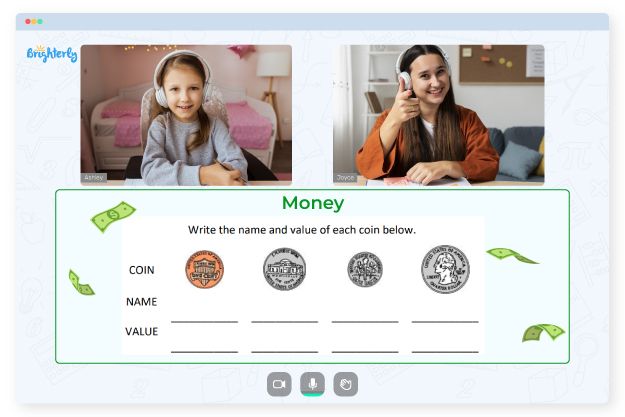
- Does your child need extra help with the topic of money in math?
- An online tutor may be the answer.
Choose kid's grade

Is your child struggling with the topic of money in math? Start working with an online tutor.
Book FREE lesson