Printable Money Worksheets 2nd Grade in PDF
Updated on October 19, 2026
Money worksheets for 2nd grade help students apply addition, subtraction, comparison, and problem-solving skills to everyday money situations. Brighterly’s printable activities introduce children to working with cents and dollars, combining money amounts, comparing values, solving purchase problems, and finding simple change.
Students should already be developing confidence in recognizing and counting common coins. If your child specifically needs practice finding the total value of pennies, nickels, dimes, quarters, and dollar bills, use Brighterly’s counting money worksheets 2nd grade. The worksheets on this page move beyond counting alone and use money in a broader range of Grade 2 math problems.
Money Worksheets Grade 2: Examples
Free printable Brighterly’s money worksheets for Grade 2 use familiar situations involving prices, purchases, coins, and dollar amounts. Students may need to find the value of a purchase, combine two amounts of money, compare prices, determine how much money remains, or calculate simple change.
For example, if one item costs 35¢ and another costs 40¢, students can add the amounts to find a total cost of 75¢. In another problem, they might compare 65¢ and 80¢ to determine which amount is greater.
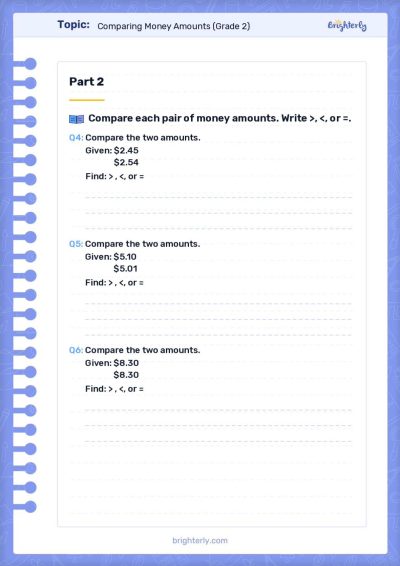
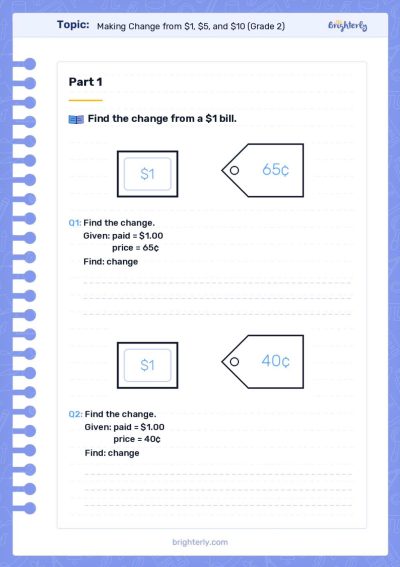
2nd Grade Money Worksheets [Download for Free]
Download and print Brighterly’s free money worksheets for 2nd grade for practice at home or in class. The activities help children connect familiar money situations with addition, subtraction, comparison, and problem-solving skills they use throughout Grade 2.
For a broader overview of what children learn at this stage, Brighterly’s 2nd grade math skills guide explains how money math fits alongside place value, measurement, arithmetic, and other core topics.
If money problems reveal wider difficulties with addition, subtraction, place value, or problem-solving, a 2nd grade math tutor can provide personalized practice based on the skills your child needs to strengthen.


See how well money math adds up
A quick quiz can reveal which second grade math skills need practice
Working With Money in 2nd Grade
Second graders begin using what they know about coins and dollars to solve broader mathematical problems. Instead of only identifying or counting money, they can compare different amounts, add prices, subtract money spent, and reason about how much money is needed for a purchase.
Students also strengthen the relationship between cents and dollars. Since one dollar equals 100 cents, children can begin moving between amounts such as 75¢, $1.00, and $1.25 while solving practical problems.
Add Money Amounts
Adding money allows students to apply familiar addition strategies to prices and purchases. A child might calculate the total cost of two items or combine several amounts written in cents.
For example, if a notebook costs 45¢ and a pencil costs 30¢:
- 45¢ + 30¢ = 75¢
Students who need more focused practice with this skill can use adding money worksheets.
Subtract Money Amounts
Money problems also give children a real-life reason to practice subtraction. Students may need to find how much money remains after a purchase or determine the difference between two prices.
For example, if a child has 90¢ and spends 35¢:
- 90¢ − 35¢ = 55¢
This reinforces subtraction while helping students understand that spending reduces the amount of money available.
Compare Money Values
Students can compare two money amounts using greater than, less than, or equal to. This requires them to focus on value rather than simply counting how many coins or bills are shown.
For example, 85¢ is greater than 70¢ even if the 70¢ amount is represented by more individual coins.
Comparing money builds on the same place-value reasoning children use when comparing ordinary numbers.
How to Make Change in 2nd Grade
Once students can add and subtract money amounts, they can begin working with simple change. Making change means finding the difference between the amount paid and the cost of an item.
- Find the price of the item.
- Identify how much money was paid.
- Subtract the price from the amount paid.
- The difference is the change.
Making Change Example
A pencil costs 65¢ and a student pays with $1.00. Since one dollar equals 100 cents:
- 100¢ − 65¢ = 35¢
The student should receive 35¢ in change.
Money Word Problems for 2nd Grade
Money word problems ask students to decide what calculation is needed rather than giving them an operation directly. They might need to find the total cost of several items, compare prices, calculate how much money remains, or determine simple change.
For example:
Leo has $1.00. He buys a snack for 40¢. How much money does he have left?
- 100¢ − 40¢ = 60¢
Leo has 60¢ left.
Problems like this connect reading comprehension with addition and subtraction. They also help children see why the arithmetic skills they learn in school are useful outside the classroom.
Benefits of Money Worksheets for 2nd Grade
Connect Addition and Subtraction With Real Life
Money problems give arithmetic a familiar purpose. Instead of adding or subtracting isolated numbers, students can calculate prices, spending, totals, and change.
This helps children understand where Grade 2 arithmetic can appear outside a worksheet or school lesson.
Strengthen Place Value
Working with cents and dollars reinforces relationships between ones, tens, and hundreds. Students learn that 100 cents make one dollar and can compare amounts based on their numerical value.
This is closely connected with the place-value skills children develop throughout second grade.
Develop Comparison Skills
Comparing prices requires children to decide which amount of money is greater, smaller, or equal. They learn not to judge value based on the number or physical size of coins shown.
Practice Problem-Solving
Money word problems require students to identify relevant information and choose an operation before calculating. A child may need addition to find a total purchase price or subtraction to determine how much money remains.
Build Early Financial Understanding
Simple activities involving spending and change introduce children to the idea that money has a limited value and that purchases affect how much remains.
Parents can expand this learning through everyday activities such as comparing supermarket prices or letting children make small purchasing decisions. Brighterly’s guide to teaching kids about money offers age-appropriate ideas for building these habits.
How to Practice Money Math With a Second Grader
Begin with situations your child already understands. Use price tags on toys or household objects and ask which item costs more or how much two items would cost together.
Next, give your child a fixed amount of play money and create simple purchasing problems. Ask whether they have enough money to buy an item, how much they would spend, and how much would remain.
Once addition and subtraction are comfortable, introduce simple change problems using amounts up to $1.00 or another range appropriate for your child.
Frequently Asked Questions
What Skills Do Money Worksheets for 2nd Grade Cover?
Money worksheets for 2nd grade help students practice adding and subtracting money amounts, comparing values, solving simple purchase and money word problems, and finding change. These activities apply core Grade 2 arithmetic and place-value skills to everyday money situations.
What Is the Difference Between Money Worksheets and Counting Money Worksheets for 2nd Grade?
Counting money worksheets focus on identifying coins and bills and finding the total value of a group of money. Money worksheets for 2nd grade have a broader focus that includes addition, subtraction, comparing amounts, purchases, money word problems, and simple making change.
Do Second Graders Learn to Make Change?
Second graders can begin practicing simple making-change problems using familiar money amounts. They find the amount paid, subtract the purchase price, and interpret the difference as the change that should be returned.
How Does Money Math Help With Addition and Subtraction?
Money gives students real-world situations where addition and subtraction have a clear purpose. Children can add prices to find a total, subtract spending from an amount they have, or calculate the difference between a payment and a purchase price.
How Can I Practice Money Math With My Second Grader at Home?
Create a pretend store with simple price tags and use play or real money. Ask your child to compare prices, add the cost of two items, decide whether they have enough money, and calculate how much remains after a purchase.
Are Brighterly Money Worksheets for 2nd Grade Free to Download?
Yes. Brighterly provides free printable money worksheets for 2nd grade that families and teachers can use for additional money-math practice at home or in class.


Need help with Money in Math?

- Is your child having difficulty keeping up with money in math?
- Consider lessons with an online tutor.
Choose kid's grade

Does your child need help understanding money in math? Start learning with an online tutor.
Book FREE lesson