
Transformations Worksheets
Updated on August 31, 2026
At the heart of transformation geometry lies the distinction between rigid motions — which preserve shape and size — and non-rigid changes like dilations, which alter scale.
Transformations worksheets are essential tools for high school students learning to manipulate geometric figures on a coordinate plane through translations, reflections, rotations, and dilations.
Students who confuse rotation rules with reflection rules, or who mis-apply dilation scale factors, benefit from a geometry tutor who can clarify the visual logic of each transformation type.
Download Transformations Worksheet PDFs
Select from our high-quality printable resources to help students practice translations, reflections, rotations, and dilations with precision across a variety of coordinate and geometric contexts.
Transformations Worksheets PDFs: Examples
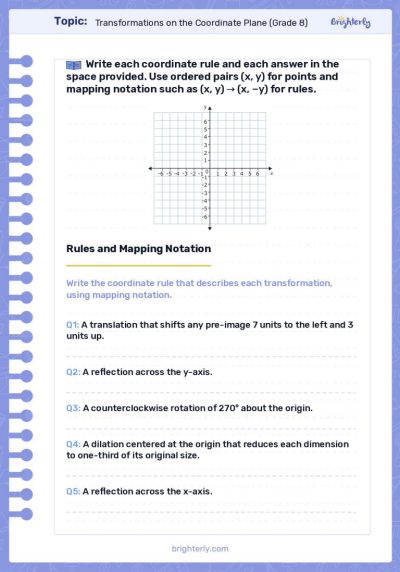
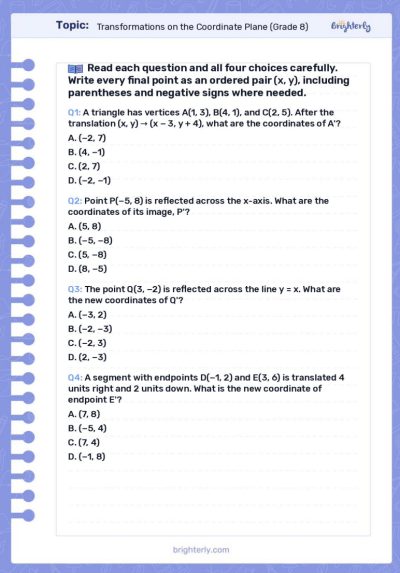
More coordinate geometry worksheets
Reinforce your transformation skills with these related resources — covering coordinate plane line relationships, special triangle properties preserved under rigid motions, angle measurements before and after transformation, and area and perimeter invariance in congruence-based problems.
- parallel and perpendicular lines worksheets
- special right triangles worksheets
- measuring angles worksheets
- area and perimeter worksheets
- geometry worksheets


Help your child reach their full potential!
Answer a few quick questions about your child’s learning, and we’ll recommend next steps.
Benefits of Transformations Worksheets
Engaging with transformations worksheets provides a significant educational advantage as students transition from basic shape recognition to sophisticated geometric analysis.
By working through coordinate plane exercises, learners develop a robust understanding of how algebraic mapping rules translate into physical movements — shifts, flips, turns, and scalings.
Mastering rigid motions is fundamental for proving congruence, while dilations introduce the concepts of similarity and scale factors used across trigonometry and calculus.
These activities bridge abstract equations and visual representation, allowing students to predict the outcomes of complex transformation compositions.
Furthermore, these worksheets help students identify invariant properties — side lengths, angle measures, and parallelism — which are essential for logical proofs.
Consistent practice also prepares students for real-world applications in computer-aided design, physics, and digital animation, where spatial transformations model motion and structural change.


Math & reading from 1st to 12th grade
Looking for homework support for your child?

Choose kid's grade

Math & Reading for Grades 1–12
Build real confidence for your child with a Brighterly math or reading tutor.