Brilliant vs Khan Academy: Complete Comparison 2026
reviewed by Florence Khitsane
Updated on January 24, 2026
When I first looked at Brilliant vs Khan Academy, I noticed a lot of families start looking for other options because their kid needs something different. I mean, more help, more of a challenge, or just something that fits them better. That’s why I took a closer look at how these platforms really stack up.
Key points
- Brilliant is good for curious, self-paced learners, and Khan Academy works well for filling learning gaps.
- Brilliant focuses on interactive STEM learning with puzzles, visual simulations, and short hands-on lessons that develop problem-solving skills and conceptual understanding.
- Khan Academy offers mastery-based learning through structured video tutorials, written articles, and interactive quizzes.
- Brighterly includes structured math worksheets and reading worksheets aligned with US standards, plus math tests and reading tests to monitor progress and adapt lessons.
- Khan Academy provides official test prep and AI tutoring via the Khanmigo AI tool.
Exploring alternatives?

Brilliant vs Khan Academy: Comparison
The main difference between Khan Academy and Brilliant is how they teach. Khan Academy focuses on structured, video-based mastery learning. While Brilliant uses interactive puzzles and visual problem-solving to help things click. One’s great for filling learning gaps; the other is better for curious, go-at-your-own-pace learners.
Brilliant |
Khan Academy |
|
| Best for | Building problem-solving skills, deepening intuition, and supplementing formal education. | Filling knowledge gaps and standardized test preparation. |
| Age group | From 13 and up | From preschool to early college |
| Focus | Active, interactive learning for STEM subjects (math, science, data analysis, etc.) | Mastery learning system with video tutorials and practice exercises across multiple subjects (math, science, history, grammar, finance, etc.) |
| Learning formats | Interactive problem-solving: short lessons built around puzzles, visual simulations, and hands-on manipulation. | Video tutorials, written articles, and extensive interactive practice exercises (quizzes, tests). |
| Free trial | 7 days | 100% free |
| Progress tracking | Tracks Daily Streaks and progress; employs XP (experience points) and gamified leagues. | Progress is tracked through quizzes, Unit Tests, Course Challenges, and Mastery Challenges. |
| Notable features | Bite-sized lessons (for 15 minutes a day), and access to content offline. | Official test prep (SAT, AP, PSAT); Khanmigo (an AI-powered tutor), and global access. |
Brighterly: Why parents choose live learning
Looking, for instance, at Khan Academy vs Brighterly, the biggest difference is the personal support kids get. While Khan Academy gives free, go-at-your-own-pace lessons, Brighterly is a full reading and math program. It features live 1:1 tutoring, built to help kids nail the basics, boost confidence, and keep moving forward.

Brighterly reading and math lessons made just for your kid
Brighterly reading lessons are customized to each child’s level and pace. Live tutors walk kids through each step. They help struggling readers catch up and ensure advanced learners remain challenged. Lessons adjust on the fly, working on understanding, reading smoothness, and remembering stuff long-term.
Free math and reading practice
Brighterly includes math worksheets and reading worksheets that reinforce concepts from live lessons. The materials are structured, colorful, and aligned with US standards. Therefore, children can practice independently at home.
Progress tracking
Math tests and reading tests show what kids are good at and what needs work. Tutors use these results to adapt lessons. That way, they ensure that each student makes steady progress and gains mastery over core skills.
So, why choose Brighterly?
Brighterly combines personalized 1:1 instruction, structured lessons, and detailed progress tracking. It’s perfect for families who want more than just do-it-yourself learning.


What does Brilliant stand for?
Learning by doing, not memorizing
When comparing Brilliant vs Khan Academy, I immediately think of Brilliant’s active learning philosophy. It’s fundamentally different from most online learning platforms that rely on passive video lectures or textbooks.
Instead, Brilliant’s interactive lessons combine clear explanations, hands-on problems, puzzles, visual simulations, and instant feedback instead of just memorizing stuff. This method helps figure things out on your own and develop a real, deep understanding of how things work.
Basically, the platform’s great for anyone from teens to adults. It’s meant to build intuition and problem-solving instincts with short, easy-to-digest lessons that can be done in around 15 minutes a day.
While Brilliant doesn’t offer live teachers or certificates, it does excel in making STEM subjects easy to get into, fun, and useful. It’s especially valuable for developing critical thinking and analytical skills.
90+ STEM courses to explore
Is Brilliant a good way to learn math? Yes. Its courses cover algebra, geometry, calculus, etc. But, there’s more to come:
Math |
Foundational math (algebra, geometry), advanced math (calculus, linear algebra), and mind-bending math (number theory, infinity, Bayesian probability). |
Computer science |
Thinking in code (Python), programming with variables and functions, and algorithmic thinking. |
Science |
Scientific thinking, circuits, quantum mechanics, data analysis, how AI works, etc. |
Logical reasoning |
Logic, reasoning with logic, and mathematical thinking. |
Discrete, self-guided practice
Overall, Brilliant’s modular learning paths take students from the basics to advanced topics in an organized way. Specifically, it gives personalized course suggestions, tracks your progress, and keeps daily streaks.
Speaking of Khan Academy vs Brilliant, I recommend the latter for skill-building for students, professionals, and lifelong learners, because it works well for self-paced learning or extra practice. However, Brilliant doesn’t offer much learning support or guidance, let alone live reading and math tutors. It’s rather more of a self-service knowledge base.
How does Brilliant work?
Brilliant offers interactive online courses crafted by award-winning teachers for learning math, computer science, physics, and other STEM subjects. With lots of thought-provoking topics, it focuses on interactive problem-solving with fun, easy-to-follow content for all ages. Available for learning on the go, Brilliant has reached over 10 million learners since 2012.
How much is Brilliant?
Brilliant subscription cost varies depending on the plan. It starts with $4.99 a month if you sign up for a yearly plan. Or, if you go month-to-month, it will come out to $8.99. However, the price may vary from country to country, so please check it yourself first. The yearly plan renews automatically, although you may cancel anytime.
First off, there’s a free mode available at Brilliant for 7 days. With it, you can try the Daily Challenge and see the intro for every course. But full access to all courses is only available in the premium plans.
Brilliant’s subscription model offers you to sign up either monthly or annually. Either way, you get access to:
- Full course collection
- Full Daily Challenges archive
- No in-app purchases or ads
- Your progress syncs between the mobile app and web
- Offline access on mobile.
Note: It’s highly recommended to try Brilliant vs any other ed platform using its free trial first, since Brilliant doesn’t provide any refund.
What does Khan Academy stand for?
- Personalized mastery learning system
- Official test prep and College Board partnerships
- Khanmigo: The AI-powered assistant
Personalized mastery learning system
This Brilliant vs Khan Academy review shows us that Khan Academy is based on mastery learning. I mean, where students work to really understand a topic before moving on. The platform’s adaptive technology spots what students are good at and where they’re struggling.
- Over 10,000 short video tutorials cover a variety of different subjects, usually taught on a digital blackboard.
- Extra practice problems give instant feedback, hints, and links to the right videos.
- Mastery challenges are personalized quizzes that review previously learned concepts. They also help students remember what they’ve learned and track how they’re doing in each course.
- Learners earn ‘energy points’ and badges, and teachers/coaches get dashboards to track progress, see where students get stuck, and adjust lessons.
Official test prep and College Board partnerships
Another difference in Brilliant vs Khan Academy is that the latter is the official partner of the College Board (the folks who make the SAT and AP exams). So, you can take free, full-length prep courses for the SAT (math and reading & writing), PSAT/NMSQT, AP Exams (like Calculus, Bio, Chem, and more), LSAT, and MCAT. Its AP courses are also aligned with College Board standards. Thus, they offer solid, focused content for students aiming to earn college credit.
This indeed is a unique feature of the platform, yet if you strive for some more options, check out Khan Academy alternatives.
Khanmigo: The AI-powered assistant
Khanmigo is Khan Academy’s latest feature – an AI-powered tutor and teaching helper made to personalize learning.
It’s built on large language models like GPT-4, and doesn’t just hand out answers. Instead, it guides students with limitless patience, asking probing questions to help them figure out answers on their own. All in subjects like math, science, and coding. (Well, to me, it’s definitely something that a Brilliant math review, in particular, lacks!)
Khanmigo works like a teacher’s sidekick, quickly generating lesson plans, quizzes, hooks, exit tickets, and rubrics. That does cut down on busywork!
What subjects does Khan Academy offer?
Math |
Early math (counting, arithmetic), middle school and high school (algebra I & II, geometry, trigonometry), and advanced topics (pre-calculus, AP calculus, differential equations, linear algebra, multivariable calculus). |
Science |
Physics, biology, chemistry, environmental science, and cosmology. |
Computing |
Computer science (algorithms, AP principles), computer programming (intro to JS, HTML/CSS, SQL), etc. |
Arts & humanities |
US history, world history, US government and civics, art history, and music. |
Economics & finance |
Macroeconomics, microeconomics, finance, and capital markets. Plus, comprehensive courses on personal finance and financial literacy. |
ELA |
Reading comprehension, vocabulary, and grammar, with content aligned to specific grade levels (2nd to 10th grade). |
Life skills |
Financial literacy, growth mindset, college admissions guidance, and career planning. |
Note: Khan Academy has a huge range of academic content for learners from Pre-K through early college. In the context of the Brilliant vs Khan Academy comparison, the curriculum of the latter keeps growing and includes partnerships with organizations like NASA and The Museum of Modern Art.
What is Khan Academy used for?
- Catching up on missed skills. It’s mainly used to give targeted help to students who’ve fallen behind. Its adaptive tech pinpoints exactly where a student is stuck (e.g., a high schooler struggling with a 6th grade math concept) and gives the right practice to catch up before moving ahead.
- Extra practice and homework help. Students use it to review class lessons, practice tricky topics, and get instant help that a teacher can’t always give after school. The self-paced video lessons are perfect for students who want extra help at home.
- Flipped classroom. Teachers in thousands of schools worldwide use Khan Academy to implement the ‘flipped classroom’ model. Students watch the videos at home, then use class time for teamwork, problem-solving, and extra help from the teacher. That way, teacher time with students is more useful.
- Test prep. It’s a free, essential resource for prepping for big exams like the SAT, AP, LSAT, and MCAT, with content made in partnership with the test creators.
- Education for everyone. As a non-profit, its lessons are translated into many languages. Offline versions are sent to areas with limited internet or low resources.
Can Khan Academy replace school? Definitely not. However, it still offers a huge library of instructional videos, practice exercises, and personalized learning tools that cover academic subjects from elementary school to early college level.
Why is Khan Academy free?
Khan Academy is free since it’s a US non-profit (501(c)(3)). Its mission is to give anyone, anywhere, access to a top-notch education for free. The platform is funded entirely through donations and charitable support. Besides, being a non-profit ensures that the mission of education is never compromised by a for-profit motive.
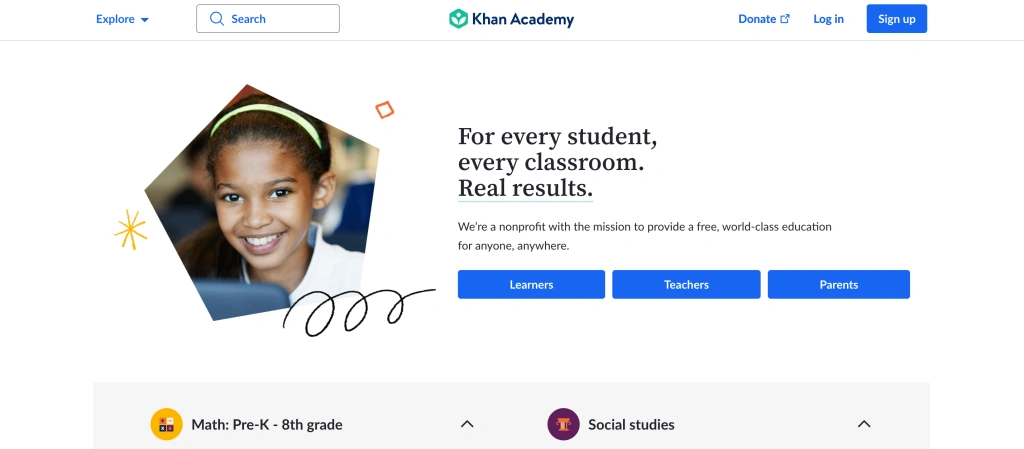
Exploring the Brilliant vs Khan Academy cost, I learned that the latter is funded by big foundations (like the Gates Foundation), companies (like Google), and millions of donations from everyday users. So, Khan Academy makes it clear they don’t run ads or sell your info, so the platform stays safe, private, and just about learning.
Note: Although the vast library of content is always free, new features that require significant resources (like the AI tutor Khanmigo) may come with a low-cost subscription to support maintaining the main platform’s free status and ongoing improvement.
Brilliant vs Khan Academy Reddit & Trustpilot reviews
Comparing user reviews of Khan Academy vs Brilliant, I must say that the latter is great for a fun way of teaching STEM, with a big focus on problem-solving, and a super easy go-at-your-own-speed setup. However, it doesn’t go deep enough to count as full classes and can feel pricey.
Khan Academy, on the other hand, earns praise for free and nicely organized lessons and clear explanations. But some topics are missing, and it lacks real teacher support.
Brilliant reviews
The good stuff
The platform’s biggest strength – according to Brilliant vs Khan Academy Reddit and TrustPilot reviews – is its highly interactive and hands-on methodology. They love it for making tricky STEM stuff actually fun and interesting. People also like that it helps build problem-solving skills and thinking for yourself.
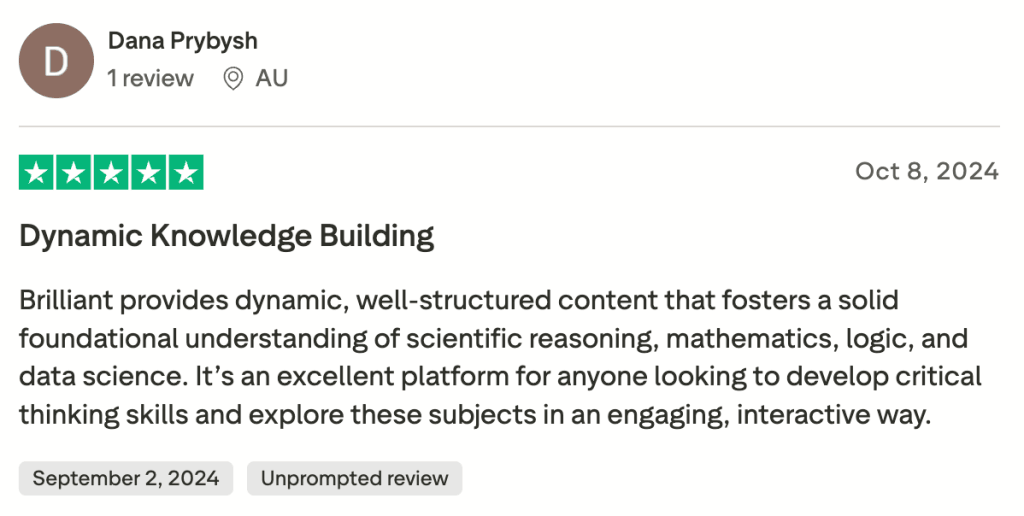
The content is consistently lauded for its high quality of problems and puzzles. And all that is pretty effective for a wide range of learners, they say, from beginners to advanced students seeking a challenge.
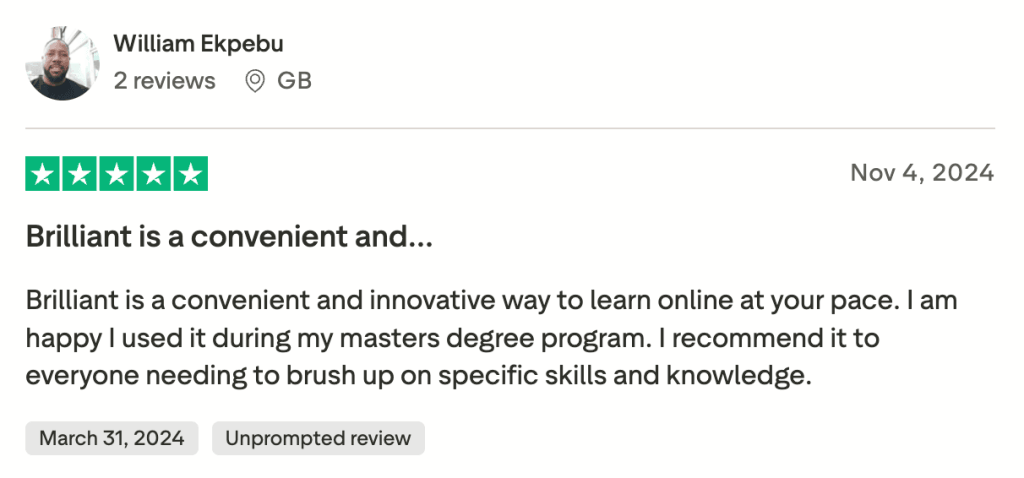
Additionally, Brilliant is commended for its concise explanations and flexibility. It’s totally self-paced, easy to use, and you can even go offline with the mobile app.
Brilliant vs Khan Academy reviews complaints
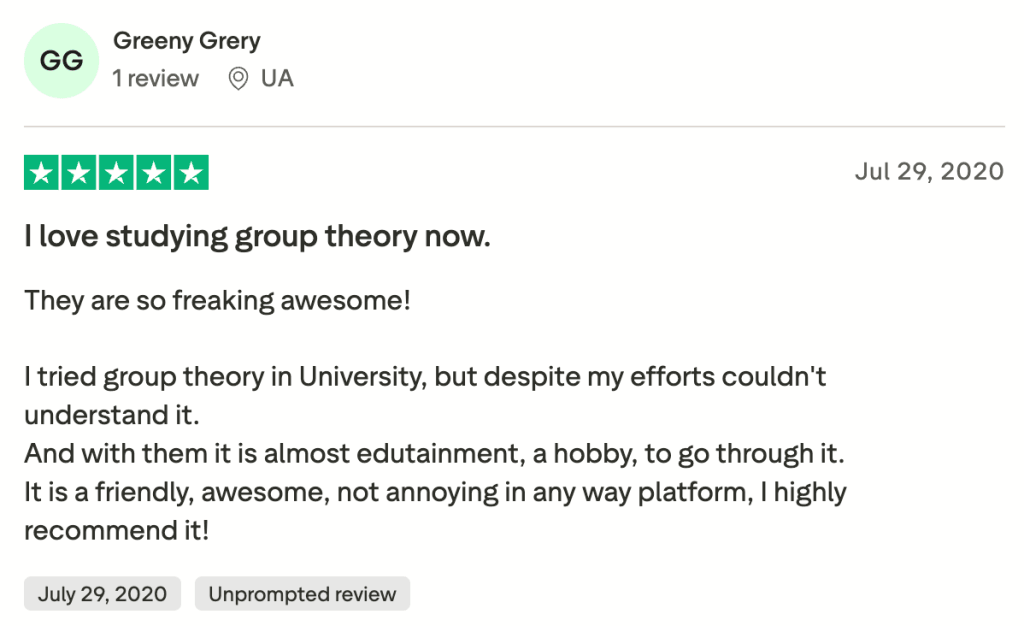
The biggest downside is that Brilliant isn’t really a full-on learning program and works best as extra practice. Many people call it ‘edutainment’, like Greeny Grery on TrustPilot.
Sometimes the lessons jump from easy to tough too quickly without enough explanation or practice. Many feel the courses don’t go deep enough to really build a strong foundation (this Reddit feedback proves it).
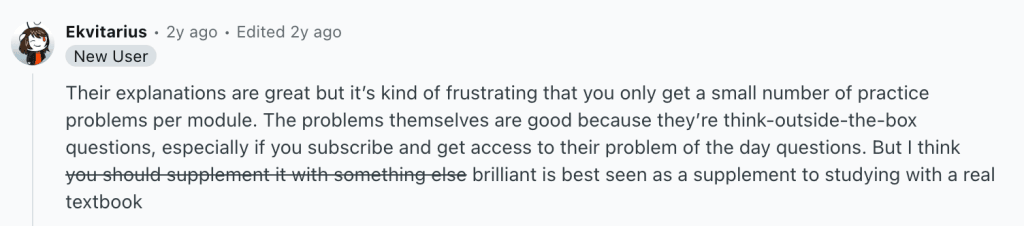
Cost is another issue. A lot of people on Reddit, in particular, think the subscription is pricey, especially since almost similar stuff may be free on Khan Academy.

Also, there’s no completion certificate. And that can be a bummer if you want it for the resume or something.
Lastly, some users have had trouble with subscriptions. Cancellations are tricky, billing mistakes happen, and they have a no-refund policy.
Khan Academy reviews
Pros & highlights
The biggest perk of Khan Academy is that it’s totally free and runs as a real non-profit. Anyone can learn without worrying about hidden fees or ads, as shared on TrustPilot.
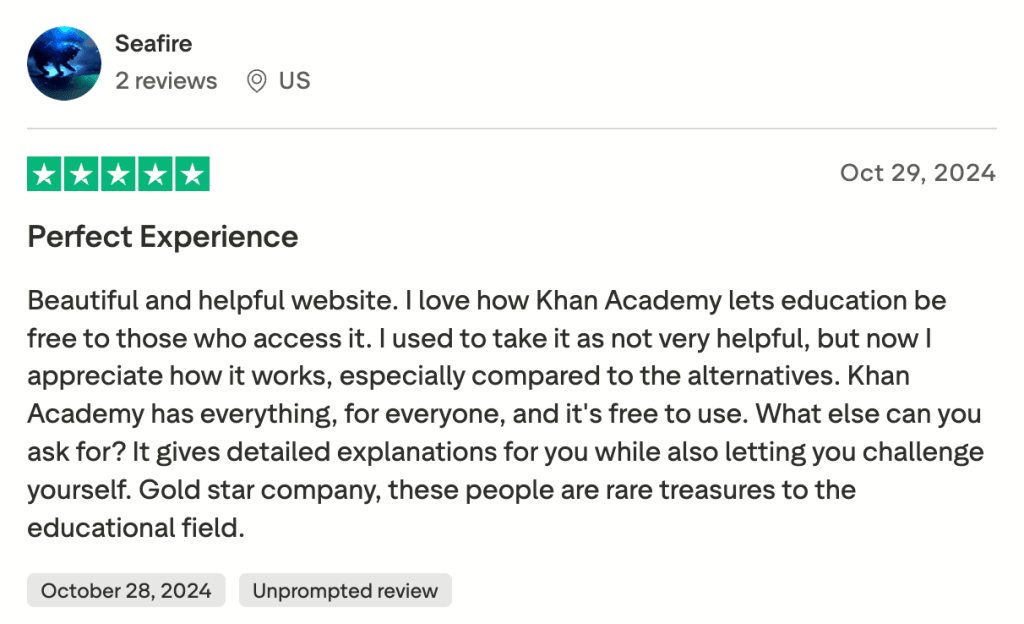
People also love its vast library of high-quality content, especially the well-organized math and science courses. It does work great for kids who need extra help in class or adults looking to brush up or prep for tests like the SAT, as this Khan Academy vs Brilliant Reddit claims.

The videos are clear and easy to follow. The platform is set up for practice-based learning with tons of exercises and instant feedback. Therefore, students can work at their own speed and focus on what they need to improve. Plus, the interface is super simple and easy to navigate.
BTW, you can check what experiences parents share in Khan Academy reviews article.
Khan Academy reviews complaints
What is the weakness of Khan Academy? Well, it does have some. From what people say on TrustPilot and Reddit, the downsides mostly come from the fact that it’s not a full-on learning solution. A lot of users point out that there’s no real human interaction (no live teachers or one-on-one help). Most people see it as a supplement, not a full curriculum. It’s even more so for more advanced college-level stuff.
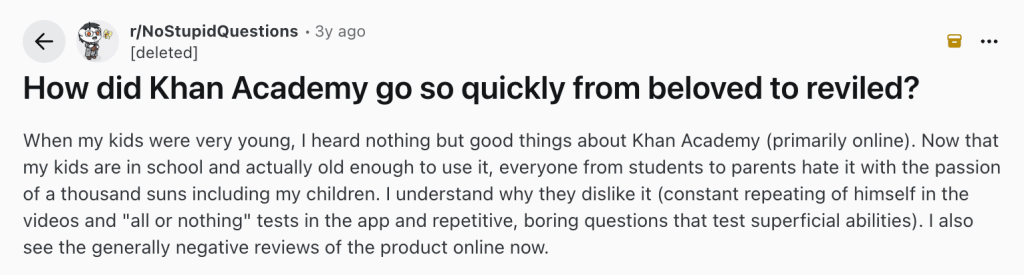
Some users say on Reddit that the mastery system gets annoying. They complain that the ‘all-or-nothing’ unit tests make you redo everything just for one mistake.
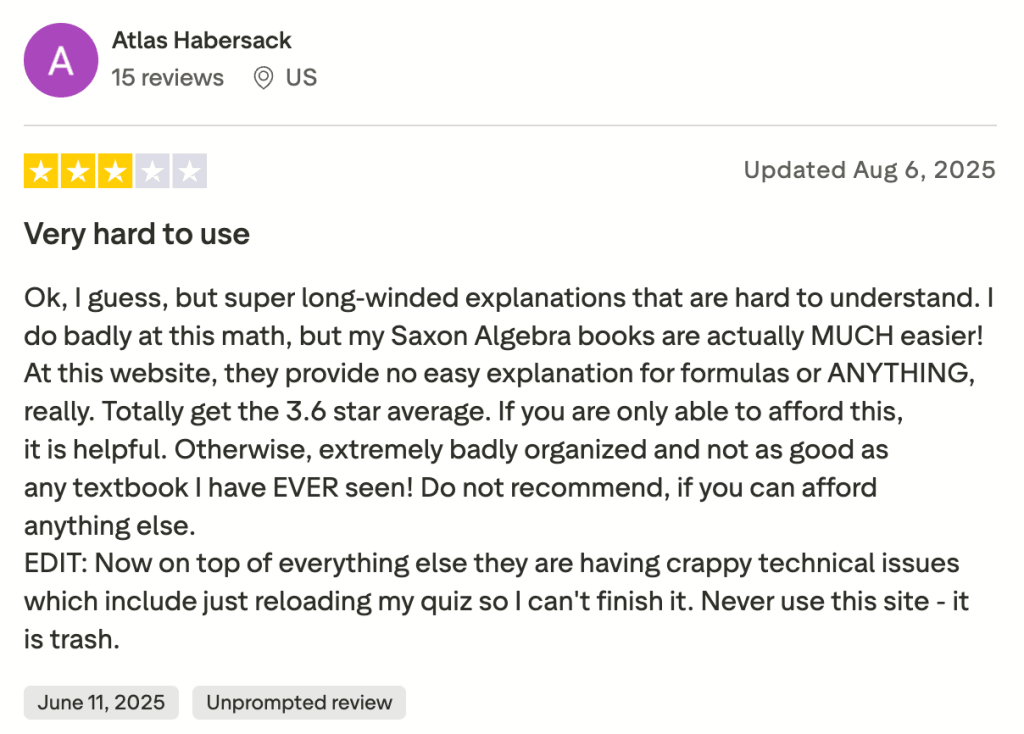
Others on TrustPilot think the videos and practice questions get repetitive or too complicated. That forces them to merely memorize answers instead of really getting the material.
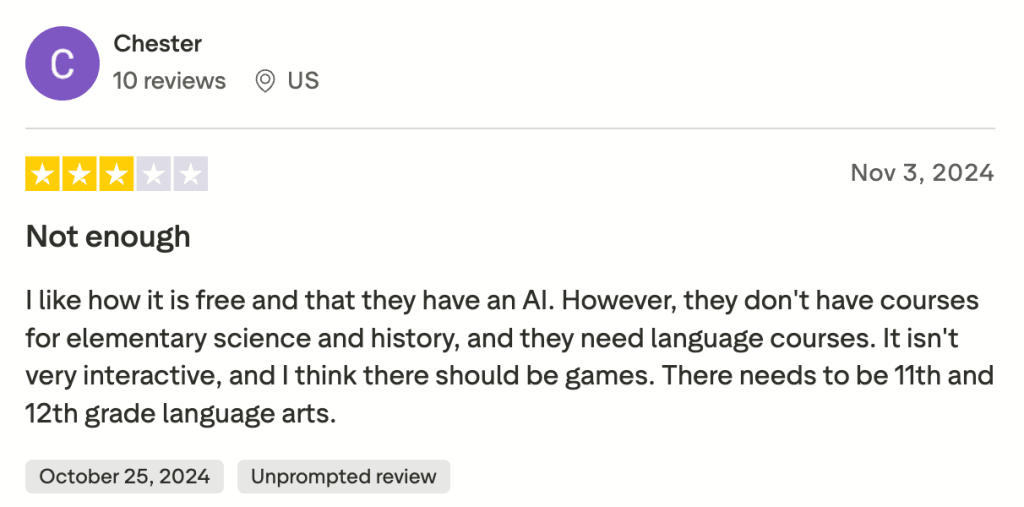
And finally, the course list isn’t super complete. It’s missing stuff like foreign languages and music appreciation, another TrustPilot claims.
Khan Academy vs Brilliant: Main difference
The main difference between Khan Academy vs Brilliant lies in methodology and cost.
- Khan Academy is a free, non-profit platform that uses video-based mastery learning across a wide academic range, including official test prep and AI-powered tutoring.
- Brilliant, meanwhile, is a paid service focused on active, problem-based STEM learning through interactive puzzles, visual simulations, and critical thinking.
Aside from how they teach and what they cost, the two platforms also differ in who they’re for, what they’re for, and how they teach.
- Khan Academy serves learners from early grades through college. It offers structured lessons that back up what’s taught in school and help with test prep. All great for catching up, extra practice, or guided studying.
- Brilliant, in contrast, targets teens, professionals, and lifelong learners. I mean those who strive to build reasoning and problem-solving skills by exploring instead of being taught directly. Its short, interactive lessons promote hands-on discovery and conceptual understanding. Thus, it’s the best choice for those who enjoy self-paced, curiosity-driven learning in math, science, and computer science.
Which is better: Brilliant vs Khan Academy?
The ‘better’ platform depends entirely on your learning goals, budget, and preferred style of instruction.
- If you prioritize free access or official SAT/AP test prep, then try Khan Academy.
- When looking for fixing existing learning gaps, personalized 1:1 teaching aligned to US state standards, and live human tutor support, then go for Brighterly.
- And if you require active learning and developing critical thinking, then try Brilliant.
If you want a foundation-first approach and confidence built on human connection, then choose Brighterly math and reading platform.
And you’ll never know unless you try! So, feel free to book free lesson at Brighterly and enjoy personalized 1:1 tutoring.
Other platforms comparison
Still deciding between learning platforms? These detailed comparisons also cover the pros, cons, and everything in between:
- Best Brains vs Kumon: Which Is Better
- Reading Eggs vs ABCmouse: What You Need to Know Before Choosing


When your child struggles with finding the right words, you feel it too. As a math tutor with years of teaching practice for kids, I’ve gathered 15 best vocabulary learning apps that help boost speaking confidence and grades at school. Key points: Customized, adaptive experience with spaced repetition is a must for the best free […]

Nov 25, 2025

How often do you use story prompts for kids? If the answer is rarely, you’re missing a tool that helps a lot. Whether teaching elementary or middle school students, prompts can spark imagination and interaction. Read on to discover various story ideas for kids that can make learning enjoyable and meaningful. Key points: Children’s story […]

Nov 25, 2025
Math & reading from 1st to 9th grade
Exploring alternatives?
Take a short quiz!
Choose kid's grade