How To Know If Your Child Is Gifted?
reviewed by Franz Jerby Delos Santos
Updated on April 9, 2026
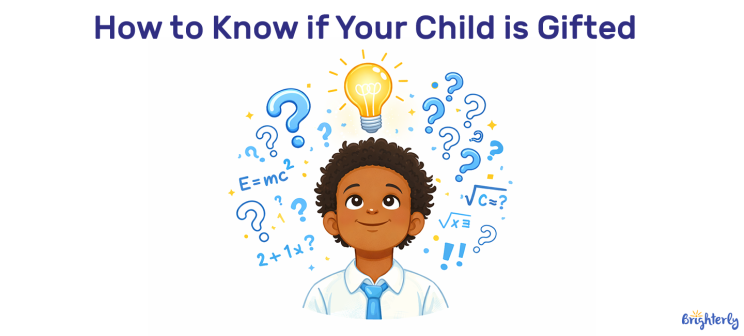
Deep questions and intense curiosity are only a few of the signs of kids’ giftedness, a trait affecting kids’ growth and social life. But how to know if your child is gifted and ensure them proper support? Look at specific signs, resort to testing, and respond to their curiosity adequately. This article will shed some light on key matters, signs to look for, and steps a parent can take.
Key Points
- The giftedness of a child lies in how the child thinks and processes information, resulting in their capability to perform better than others.
- Key signs of a gifted kid include unstoppable curiosity, rapid learning, advanced use of language, and great emotional depth, if compared to peers.
- Even though signs appear as early as age 2-3, they become clearer in kindergarten and elementary school.
- Gifted testing relies on abilities and achievement tests, while personalized learning and enrichment programs can be effective ways to support gifted children.
What Does It Mean When A Child Is Gifted?
The National Association for Gifted Children (NAGC) determines giftedness as an outstanding capability of students to perform or learn at greater levels across different subjects when compared to other kids of the same age. The giftedness lies in how they process, connect, and use information.
The Difference Between Gifted And Smart
Nevertheless, understanding the characteristics of gifted children does not stop parents and teachers from misinterpreting the idea. One can easily confuse a gifted kid with a smart, hardworking student.
| A Smart Kid | A Gifted Kid |
| Knows answers and solutions | Asks questions and goes deeper |
| Has a genuine interest | Is passionate and absorbed in topics |
| Answers as requested | Goes beyond instructions |
| Needs repetition to learn | Gets upon 1-2 experiences |
| May love the school | Can find school boring |
| Keeps at it to get a result | Things may be easy, so they look for a challenge |
| Thinks by breaking problems into smaller steps | Thinks and connects information intuitively |
| Teachers usually like them | May challenge the authority |
What To Do If Your Child Is Gifted?
Upon recognition that a kid is talented, the next question is “What’s next?” Even though parents may feel uncertain, they can make a significant difference for a kid.
They can offer support, nurture intellectual curiosity, and provide academic opportunities, not to mention an adequate environment.
The primary strategies are enrichment programs and personalized learning.
“In developing gifted children, parents should develop an environment in which their child's talents are recognized and valued, while avoiding the added pressure of obsessive-compulsive thinking about mistakes.”


Enrichment Programs And Resources
For gifted children, a standard classroom can be disengaging. There, they may feel tasks as repetitive and pacing as slow. That’s where enrichment programs come into play to answer these gaps.
As a parent, you can provide a kid with different enrichment options:
- Acceleration on a specific subject. You can support moving ahead a grade level in math, for example.
- Pull-out programs within schools. They are specialized classes for gifted kids, focused on higher-level thinking, creativity, or specific projects.
- Extracurricular activities and or summer camps. They may refer to robotics, coding, writing, STEM subjects, humanities, or arts.
Note: If you apply this strategy, link enrichment to the specific abilities of your kid and don’t forget to collaborate with the school and develop an individualized learning plan.
How Personalized Learning Supports Gifted Children
Firstly, personalized learning may be a decent approach to support gifted learners, as it allows parents to satisfy their children’s curiosity. Secondly, if an enrichment program may bring stress or inconvenience, personalized learning would offer flexibility to study from home.
“If your child zones out in class but loves learning at home, the problem is likely the schoolwork, not the kid.”

Can 1:1 Tutoring Offer Support?
Personalized tutoring is one of the personalized learning strategies a parent can use. The crucial factor here is a professional tutor who adjusts learning to kids’ preferences. With tutoring, a kid can get greater freedom to explore topics and subjects more deeply.
For example, at Brighterly, an online tutoring platform, before starting any program, we provide a special diagnostic math test or reading test for a kid.
Based on their results, our tutors create customized lesson plans to target their specific needs and goals.
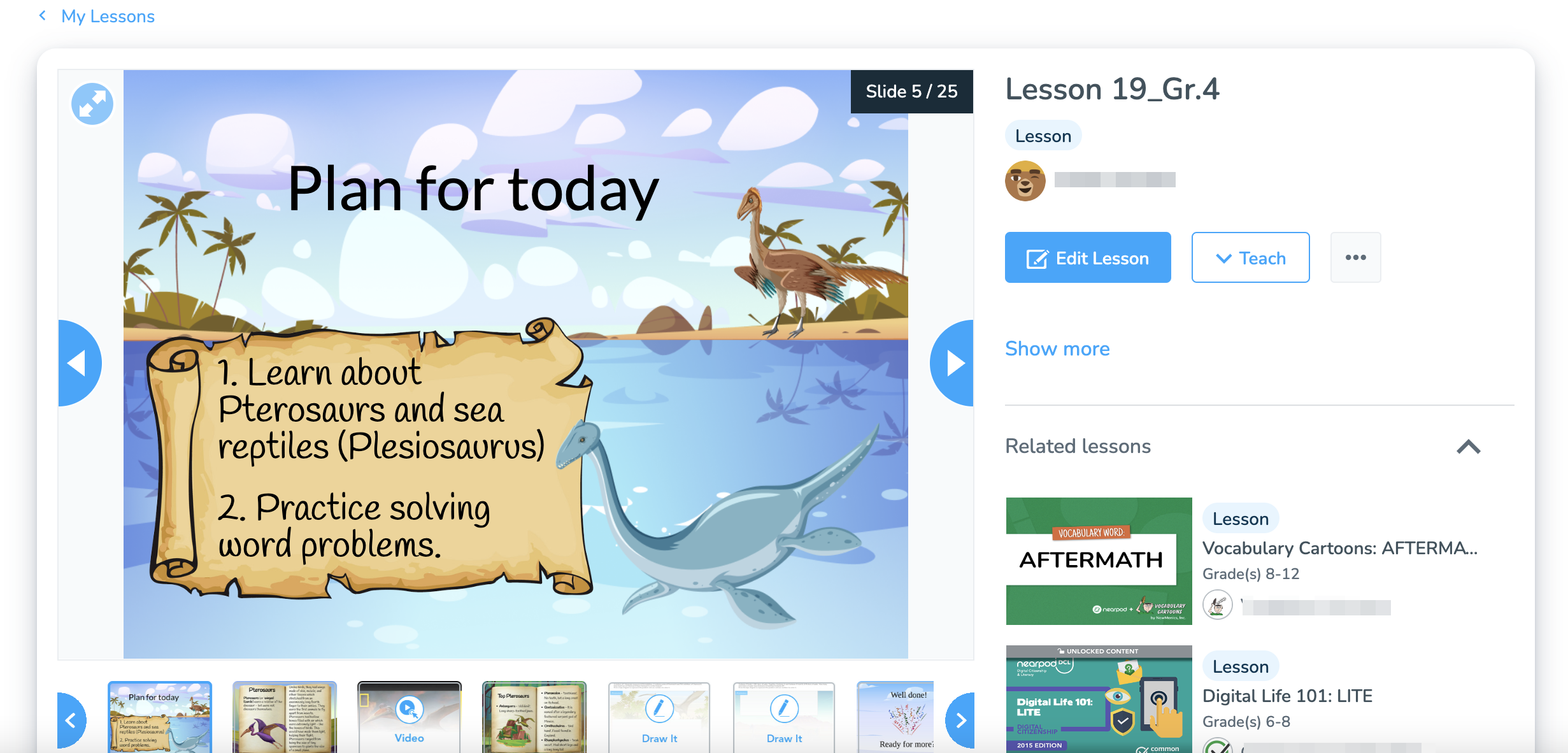
Besides, we try to make the lessons interactive and challenging, using a variety of topics, their depth, and engaging activities to meet a lesson goal.
- For instance, if your kid solves math easily, our math program for kids would focus on more advanced concepts or apply new math to show how to use math concepts in real life.
- For the reading program, our tutors would focus on storytelling techniques and creative activities to inspire critical thinking and support the interests of your kid.
As a result, under such an approach, tutors can adapt lessons to the individual child’s pace, learning needs, and even interests.
Signs Of A Gifted Child
- An unstoppable curiosity, an urge to ask questions, and go beyond the surface
- An ability to learn and grasp new concepts quickly
- A solid comprehension and problem-solving, especially after minimal explanation
- An ability to maintain deep focus on specific interests and topics
- A great memory and accuracy of data and facts
- Creative and original thinking in finding solutions
- An unexpected emotional intensity, depth, sensitivity, and empathy
- An unusual sense of humor and early understanding of irony and wordplay
- High level of self- and social awareness
- A desire or preference for complexity or challenge
- May be advanced in some areas, yet just okay in others
Importantly, talented children are not always model students. They may be disruptive or mask their abilities to fit into society. Besides, they may show only a few of all these traits.
If you already see a few signals in the pursuit to answer the “Is my child gifted?” question, the testing can be the next step.
“The biggest myth about gifted kids is that they will always get great grades and be easy to teach.”

Signs Of Giftedness By Age
As you probably already have guessed, giftedness doesn’t happen overnight. It tends to show up early, but for parents, it becomes clearer as a child grows.
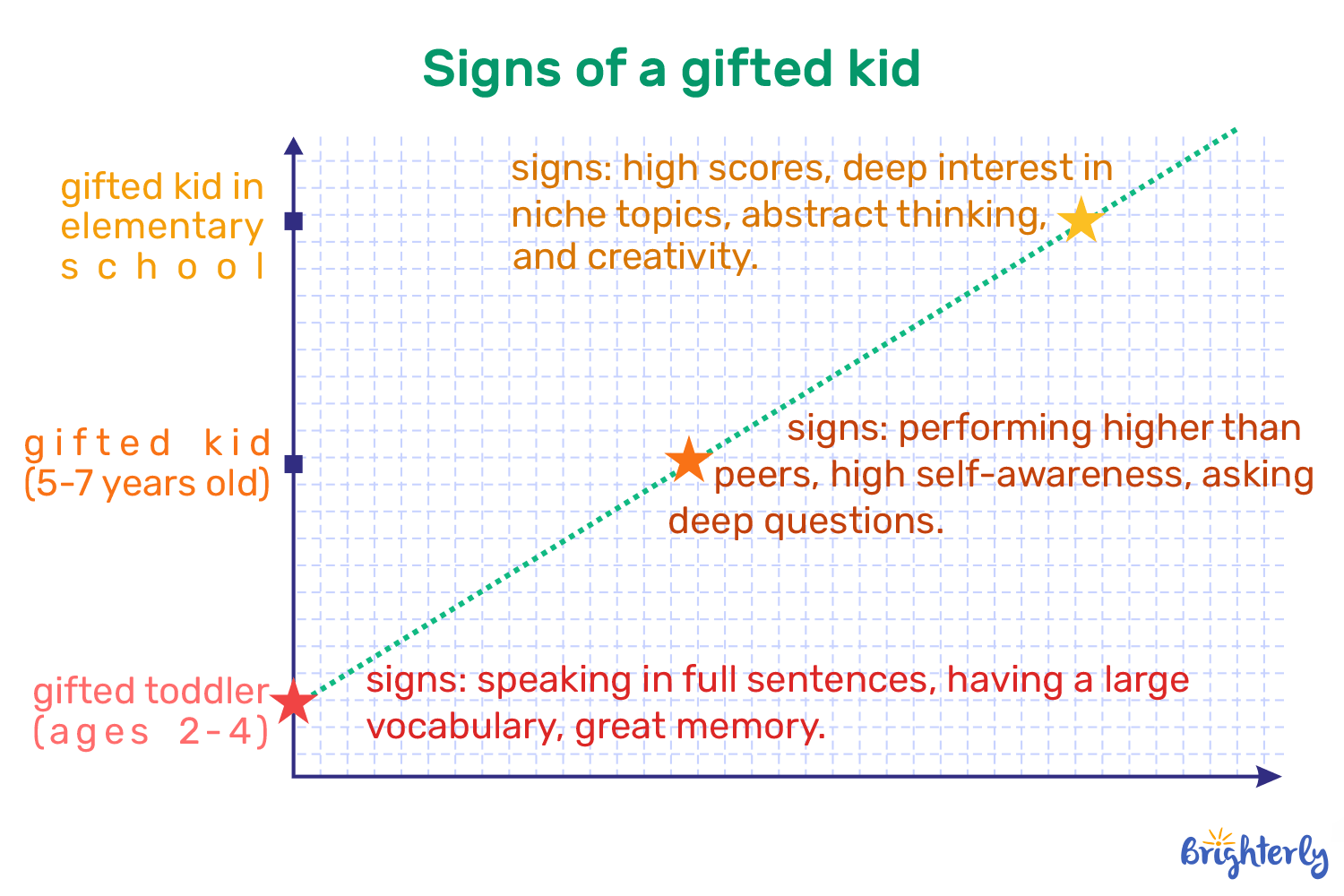
Gifted toddlers are great at reading and speaking from early on; signs of gifted kids at 6 years old are high self-awareness and being better than their peers, while signs of giftedness in elementary school refer to deeper research and creativity.
Signs Of A Gifted Toddler (Ages 2-4)
- Achieves speech milestones quite early
- Uses great vocabulary for their age
- Easily remembers their experiences
So, what should parents of gifted toddlers pay attention to? Their sense that the kid does things differently, or in a more unusual way.
One of the major signs of gifted toddler is that they frequently hit language milestones significantly early.
- For instance, a talented kid may speak in full and complex sentences, understanding verb-noun agreement, before their second birthday.
Other than that, another sign is that a kid would use an unusually large vocabulary. It’s often supported by a kid’s avid interest in books and stories, numbers, or music.
Note: According to the Cleveland Clinic, a medical Institution, early reading is also one of the signals of hyperlexia, a condition that may result in language challenges.
Also, you can’t ignore the fact that great memorization is among the signs of intelligence in toddlers. They may learn the alphabet, numbers, and shapes faster than expected.
“Early reading can be a sign, as the saying goes, 'Most gifted children were early readers, but not all early readers are gifted.”
Signs Of Giftedness In Preschoolers (Ages 5-7)
- Contrast in skills between a talented learner and classmates
- Rising level of self-awareness of a kid
- Desire to spend time with older kids
- Questions become philosophical
In school, the signs your child is gifted can be clearer as they start to communicate with peers. Nevertheless, giftedness doesn’t always mean great academic performance.
Teachers often have the best position to observe the giftedness. Why? They see how kids do in the class. What are good examples?
- Signs of a gifted child at 5 years old are a display of natural ability for math, allowing understanding of basic concepts or solving problems beyond the typical kindergarten level.
- Signs of a gifted child 6 years old are reading fluently and grasping math concepts like place value or early multiplication. In contrast, their peers would only transition from decoding to fluent reading.
Besides, at this age, they become more aware of their skills and their differences, making them lean towards older peers or adults. Their questions become deeper and more philosophical.
Note: If gifted kids show exceptional qualities in other domains, signs may refer to creative thinking, imaginative play, or music.
Signs Of Giftedness In Elementary School (Ages 8-12)
- Either clear or hidden by a kid
- Grades and scores may be high
- Abstract thinking and a deep interest in niche topics
- Hiding talents to blend in
In elementary school, the traits of a gifted child may be even easier to see. However, such kids can do a good job of hiding them due to social reasons.
What about academic success? Gifted children may get the highest score as they face standardized grade-level assessments and seem to demonstrate more advanced math or reading skills.
Outside a classroom or even school, they develop expertise in niche topics and subjects like history, coding, or astronomy.
Lastly, they may feel unchallenged or misunderstood, so they can start to express it via their hobby or style. Later, such kids can pay less attention to their academic performance, but focus on what they like, for instance, math in nature, robotics, or engineering.
Should You Have Your Child Tested For Giftedness?
If you see some of the signs, from curiosity to desire for deep research, in your kid, you should at least consider testing. Sure, much depends on goals and expectations. So ask yourself, what do you expect from testing, and what do you want to do with its results?
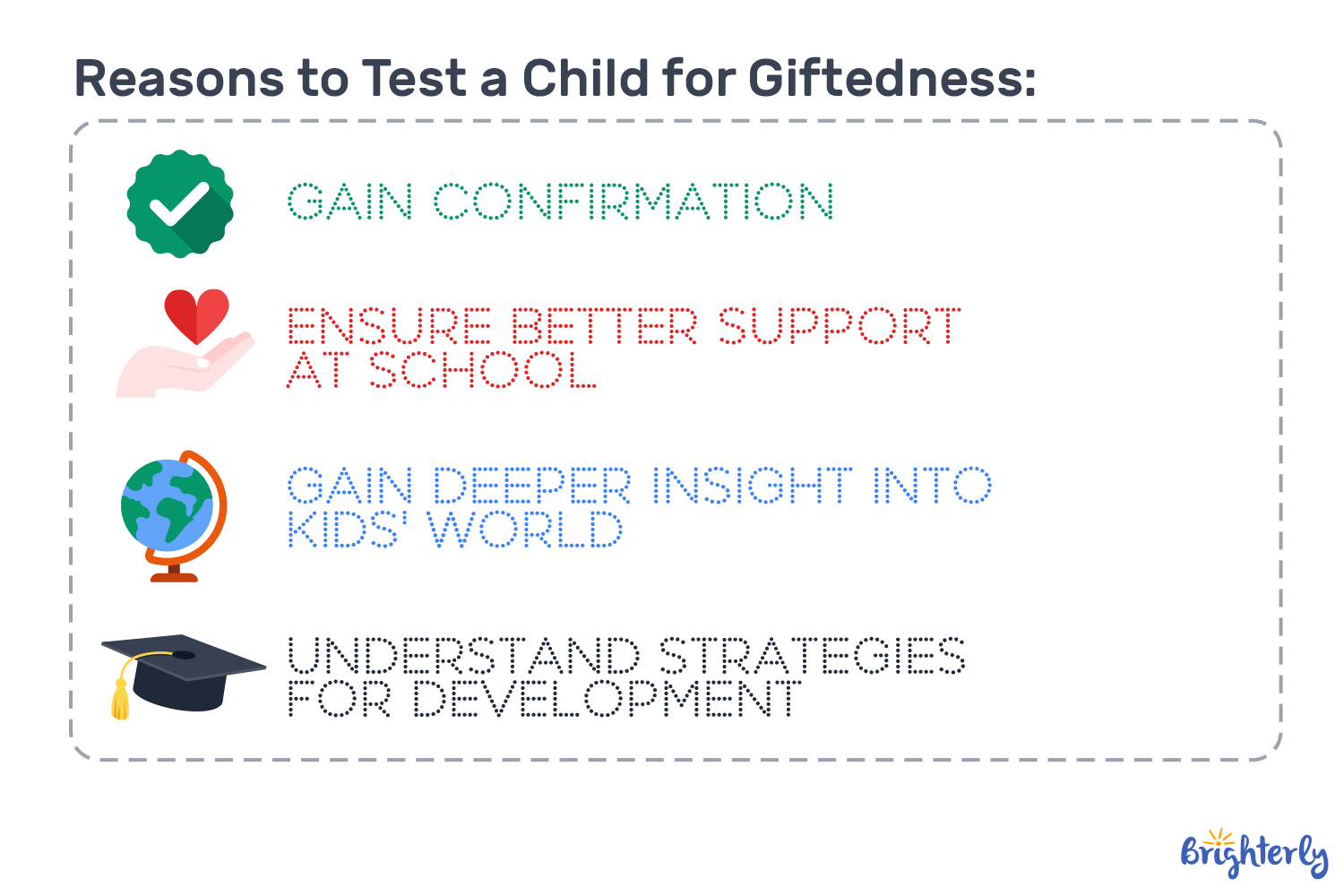
In any case, the answers are likely to give some clarity and understanding on how to support a kid or find strategies to ensure their growth.
When To Consider Testing?
Testing is generally a good idea if you see that giftedness affects their school performance, emotional well-being, or is necessary to enter specific programs. Another reason is that parents see a gap between what they produce at home and school.
What is a proper time for testing? It appears that the results of formal testing are reliable and prognostic if taken between 6 and 12 years old.
Note: If you want to do a test at an earlier age, before 6, the evaluation of IQ may not be accurate or predictive, as the consensus suggests.
Types Of Tests To Identify Giftedness
Depending on the goal, a parent can resort either to gifted testing or gifted assessment. They are literally the answer to the “How to know if your child is gifted?” question.
The difference between them lies in the scope, format, and comprehensiveness of the test.
- Gifted testing is concerned with a standardized test within a certain format, wording, and time limits.
- Gifted assessment is a more complete way to test giftedness, as it implies a trained professional who makes the evaluation based on testing and analysis of broader factors.
“You really need a wide perspective and frequent talks with teachers, otherwise you miss the full picture of what the child is going through.”

Achievement Tests
At the same time, if you want to start with a gifted testing, you should know that they differ as well.
Achievement tests determine what a child has already learned and if they perform at a level that is significantly beyond the level of their peers. They may focus on specific subjects or broader topics. What are common tests in this regard?
- Iowa Test of Basic Skills: a standardized assessment to cover academic subjects.
- Stanford Achievement Test (SAT-10): to measure multiple areas regarding academic achievement.
- Screening Assessment for Gifted Elementary and Middle School Students (SAGES-3): developed specifically for talented kids.
- Test of Mathematical Abilities for Gifted Students (TOMAGS): to analyze kids’ mathematical reasoning.
- MAP growth: an adaptive test that can be good to identify kids who perform above their level.
Ability Tests
They are IQ and cognitive abilities tests, the most common tools to understand gifted child traits. They aim to measure cognitive skills, from reasoning to processing speed. They are crucial to understand how a kid thinks, but are limited in showing their abilities in the arts or creativity.
- Wechsler Intelligence Scale For Children (WISC): a common individual IQ test covering verbal comprehension, visual-spatial reasoning, fluid reasoning, working memory, and processing speed.
- Stanford-Binet Intelligence Scales (SB): great for the kids whose giftedness is quite evident.
- Cognitive Assessment System (CAS): useful to assess kids who are simultaneously gifted and have specific learning needs.
What To Expect From The Process
Usually, a certified educator or clinical psychologist is responsible to conduct testing. It should take at least one session that lasts from one to three hours.
During a test, you can expect a kid to take a series of tasks that assess different cognitive abilities, from reasoning to processing speed. After the assessment, a parent usually gets a report that interprets the results and provides recommendations for home or school.
Note: For kids, testing is not a stressful experience and may be rather engaging.
Conclusion
As gifted kids think and experience the world differently, they may perform better than their peers. There, recognizing their giftedness can give parents the chance to provide necessary support.
There you have different options. One of them is testing, the other one is answering their curiosity. And for that, you may want to resort to enrichment strategies or personalized learning.
If more challenge is something that your child needs, Brightery tutors can adapt to their pace and level. Wonder how? Start with a diagnostic test or book a free session to know more.
FAQ
What Are The Early Signs Of Giftedness?
The early signs of giftedness relate to intense curiosity, great learning speed, ability to use advanced vocabulary, and outstanding memory. It makes them reach certain learning concepts early and allows them to excel in linguistic and vocabulary skills development. Besides, gifted kids at a young age may show a high level of focus and sensitivity and be attentive for a long period of time.
How Do I Test My Child For Giftedness?
For gifted testing, you can use IQ tests, focusing on cognitive abilities (like WISC or Stanford-Binet), and achievement tests like SAGES or MAP growth, targeting subjects and areas. You can also use gifted assessment, a more comprehensive approach under a specialist.
At What Age Can You Tell If A Child Is Gifted?
You can see that a child is gifted as early as they are 2-3 years old, noticing advanced language skills and intense curiosity. Between ages 6 and 12, you can use IQ tests, look at their cognitive and research abilities, or how they perform compared to other kids.
What Is The Difference Between Gifted And Smart?
The key difference is in how they think. If smart kids tend to know answer and solutions upon learning, gifted kids ask deeper questions and get complex concepts with minimal teaching.
What Are The Six Types Of Gifted People?
The types represent the following profiles: the Successful (a complaint high-achiever), the Challenging (creative but disruptive), the Underground(one who hides abilities), the Dropout (a disengaged kid), the Twice-Exceptional (a gifted kid with a learning difference), and the Autonomous Learner(an independent learner).
What Does ADHD Look Like When Gifted?
A gifted kid with ADHD, also called twice-exceptional, can show a great focus on topics they are passionate about, but struggle with routine tasks or controlling their impulses. Another thing is that they may appear inconsistent and be easily distracted.


Looking for a BrightCHAMPS review that will answer all your questions? This article contains relevant, up-to-date parents’ feedback, key features, and important details to help you decide if BrightCHAMPS is the right platform for you. Key Points Range of features: 9/10. BrightCHAMP provides students with a good selection of features for STEM subjects, and the […]

Apr 08, 2026

Studocu remains a popular platform among high schoolers and university students. But is it actually safe and worth using? In this guide we analyze online Studocu reviews from different sources to see what its users have to say about that, so that you have real feedback to rely on in your decision. Score summary Core […]

Apr 09, 2026
Math & reading from 1st to 9th grade
Looking for homework support for your child?

Choose kid's grade

Math & Reading for Grades 1–9
Build real confidence for your child with a Brighterly math or reading tutor.