Phonemic Awareness Activities That Actually Build Reading Skills (2026 Guide)
reviewed by Janice S. Armas
Updated on May 8, 2026

Key Points:
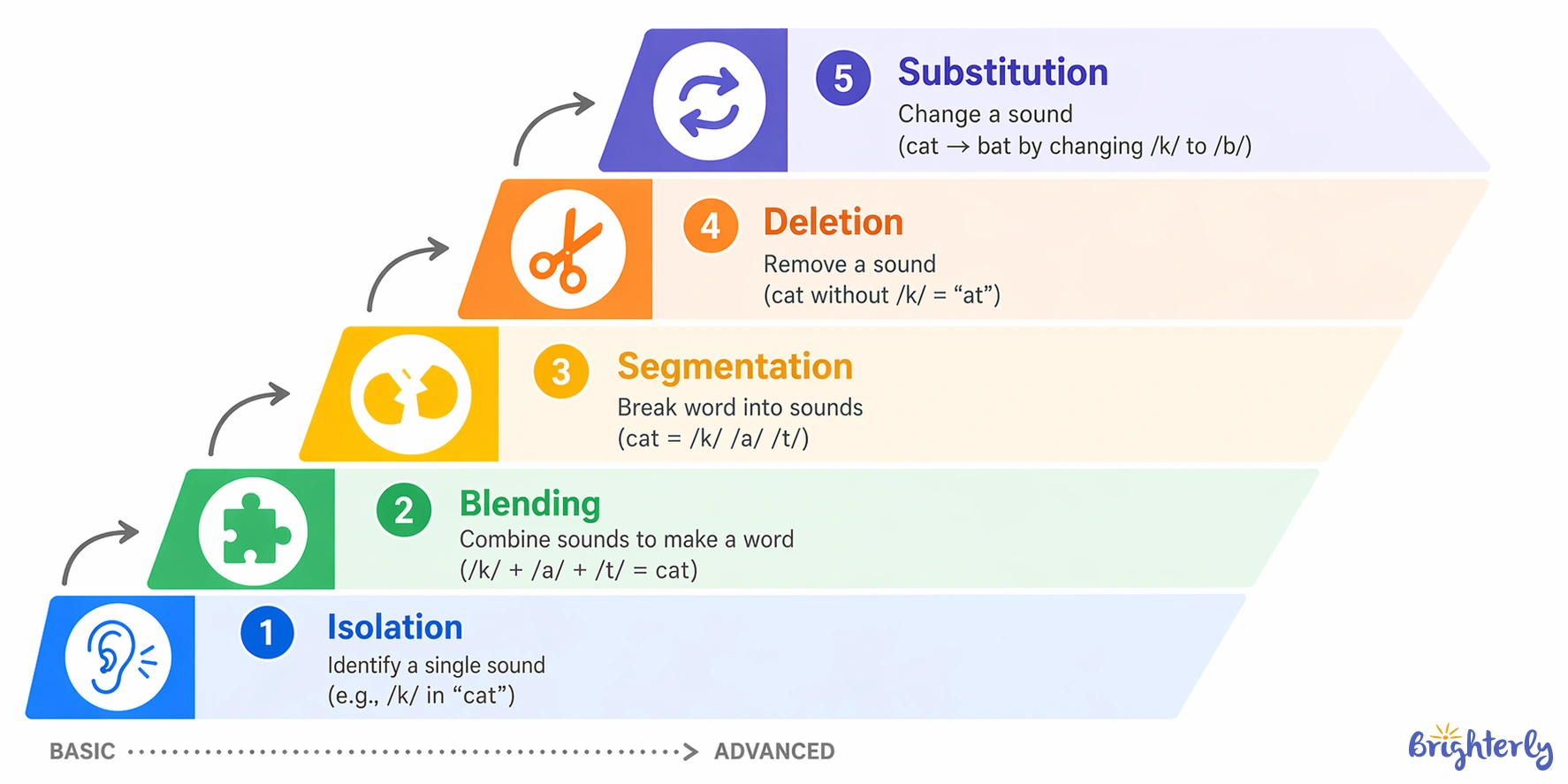
Phonemic awareness activities are games and exercises. They help children hear, identify, and manipulate individual sounds in spoken words – and they’re often what makes reading finally click. The five skill types to know: isolation, blending, segmentation, deletion, and substitution. Best part is that all of them work at home, in the car, or at the kitchen table from preschool through 2nd grade – no prep, no fuss.
What Is Phonemic Awareness?
Phonemic awareness is the ability to hear, identify, and manipulate individual sounds, called phonemes, in spoken words. It works purely with sound. No letters, no pages, no pencils needed.
Parents often mix up phonics, phonemic awareness, and phonological awareness, and that’s completely understandable. Think of it as three circles, one inside the other:
- Phonological awareness – the biggest circle. It’s the general ability to notice sound patterns in language, like clapping syllables in “ba-na-na” or spotting that “cat” and “hat” rhyme.
- Phonemic awareness – sits inside that circle and zooms in on individual phonemes, the smallest units of sound, like the /k/ in “cat.” It also includes larger sound units such as syllables and onset-rime patterns (e.g., “c-at”, “b-all”).
- Phonics – the next step outside the sound world entirely. It connects those sounds to written letters on the page through letter-sound correspondence.
The order matters. A child hears sounds before they read letters. Phonemic awareness comes first, before teaching phonics. However, mastering both can benefit when practicing with a phonemic or phonics tutor.
Why does it matter in this case? A 2024 study in the International Journal of Research and Scientific Innovation conducted by Francis Kwame Anku puts it simply: explicit phonemic awareness instruction significantly improves reading. Especially for struggling readers. Children who can’t hear sounds in words will struggle to decode them on the page. So, the sooner you start practicing these skills, the easier reading becomes for your child.
Explore Brighterly Learning Experience
Learn exactly how Brighterly helps students thrive through expert sessions, online tools, and proven feedback from thousands of satisfied parents
Phoneme Isolation Activities
Phoneme isolation activities teach children to identify a single sound in a spoken word – the first sound in “sun,” the last sound in “cup,” or the middle sound in “sit.” This skill unlocks everything that follows: blending, segmenting, and eventually decoding written words. Kids who practice isolation early build a much stronger foundation for reading.
Sound Scavenger Hunt
Send your child on a mission around the house. Pick a target sound, say, /s/, and challenge them to find five objects that start with it. No materials needed, just curiosity. This activity builds sound isolation in a way that feels like play, not practice.
Initial Sound Sorting
Gather a handful of small objects or picture cards and sort them by their first sound. A sock, a sun, and a spoon go in one pile. A ball, a book, and a bug go in another. Kids handle real objects and make real decisions, which helps the skill stick.
Last Sound Hunt
Play the isolation game in reverse. That means, challenge your child to identify the last sound in a word. “What’s the last sound in ‘cup’?” – /p/. “What about ‘bus’?” – /s/. Last sounds are trickier than the first ones, which makes this a perfect next step once the Sound Scavenger Hunt feels easy.
I Spy with Sounds
Change the classic game rules. Instead of “I spy something red,” say “I spy something that starts with /b/.” Your child scans the room and guesses. No prep, no materials, just a sharp ear and a playful mood.
These phonemic awareness activities for older students work beautifully at home. If you spot their effect for your kid, note that our certified tutors at Brighterly build every lesson around exactly this kind of practice. For kids who need extra support, our online reading program pairs each child with a 1-on-1 tutor, aligned with US state standards.
Does Your Child Need Extra Reading Support?
Our certified tutors build every lesson around your child's exact skill gaps.
Phoneme Blending Activities
Phonemic awareness blending activities teach kids to separate sounds and fuse them to create a word. It’s what turns “/d/ /o/ /g/” into “dog” and sounds out into actual reading.
Mystery Bag
Fill a bag with small objects: a spoon, a rock, a coin, a leaf. Without showing what’s inside, pull one out and describe it in sounds: “/r/ /o/ /k/.” Your child blends the sounds and guesses the object.
Blending I-Spy
Instead of describing color or shape, give sound clues: “I spy something that starts with /w/ and ends with /l/.” Your child scans the room and blends the sounds to find the answer.
Human Dictionary
You become the dictionary, your child becomes the decoder in one of the most fun phonemic awareness activities for kids. Say a word in slow motion: “/d/ /o/ /g/” and challenge your child to blend it into the real word. Start with simple three-sound words and work up to longer ones. Kids love the feeling of “cracking the code.”
Silly Blend-It Song
Pick any simple tune your child already loves and swap the lyrics for sound sequences. Sing “/b/ /u/ /s/… what’s that word?” and wait for the giggle that comes when they figure it out.
Phoneme Segmentation Activities
If blending is putting sounds together, segmentation is the opposite – breaking a word apart into individual sounds, also known as segmenting sounds. Say “jump” and pull out /j/ /u/ /m/ /p/. Four sounds, one word.
Clap and Count
Simple, physical, and surprisingly effective. Say a word out loud and clap once for every sound, not every syllable, every sound. “Fish” gets two claps: /f/ /i/ /sh/. “Stop” gets four: /s/ /t/ /o/ /p/. Kids who struggle to sit still love this one – it turns a listening task into a full-body activity.
Sound Boxes (Elkonin Boxes)
Draw a row of connected squares on paper, one box per sound. Say a word, and your child pushes a small counter, coin, or block into each box as they say each sound. “Frog” fills four boxes: /f/ /r/ /o/ /g/. Seeing and touching make the abstract concrete. This is one of the most effective phonemic awareness classroom activities for early literacy.
Play Dough Wordplay
Roll out a small snake of play dough for each sound in a word. Say “ship” – your child makes three snakes: /sh/ /i/ /p/. Then squish them together to “blend” the word back. Kids who need hands-on learning respond incredibly well to this. Plus, play dough never feels like homework.
Missing Sound Cards
Write a simple word on a card, but leave one sound blank: “_at” or “b_g.” Read the card aloud and ask your child to fill in the missing sound. The challenge of figuring out what’s missing sharpens sound awareness faster than straightforward repetition ever does.
Phoneme Deletion and Substitution Activities
- Deletion means removing a sound from a word, say “plant” without the /p/, and you get “lant.”
- Substitution means swapping one sound for another; change the /k/ in “cat” to /b/ and you get “bat.”
These skills typically click in kindergarten and 1st grade.
Block Removal
Line up three or four blocks on a table, one for each sound in a word. Say “smile” – five blocks, five sounds. Now ask your child to remove the block for /s/ and say what’s left.
Karate Chop
Grab nothing – just bring energy. Say a word and have your child repeat it, then “karate chop” a sound away with their arm. “Say ‘black’ – now chop off the /b/!” The movement locks the concept into the body and brings special benefit for kinesthetic learners.
Sound Spinners
Make a simple spinner with different consonants around the edge. Pick a base word like “hot” and spin. Whatever sound the spinner lands on replaces the first sound land on /d/ and “hot” becomes “dot,” land on /p/ and it becomes “pot.” Kids crack up when they land on sounds that make silly or nonsense words. Laughter, it turns out, is great for learning.
Phoneme Flip Book
Make a small flip book with a different initial sound on each page. Flip to /b/ – “bat.” Flip to /r/ – “rat.” Flip to /s/ – “sat.” One sound change, but the whole word changes meaning. For extra practice, our phonemic awareness worksheets cover deletion and substitution at every level, all aligned with US state standards.
Ready to Build Real Reading Skills?
Our 1-on-1 tutors follow US standards and make every lesson count.
Phonemic Awareness Activities by Age and Grade
Phonemic Awareness Activities for Preschoolers (Ages 3-5)
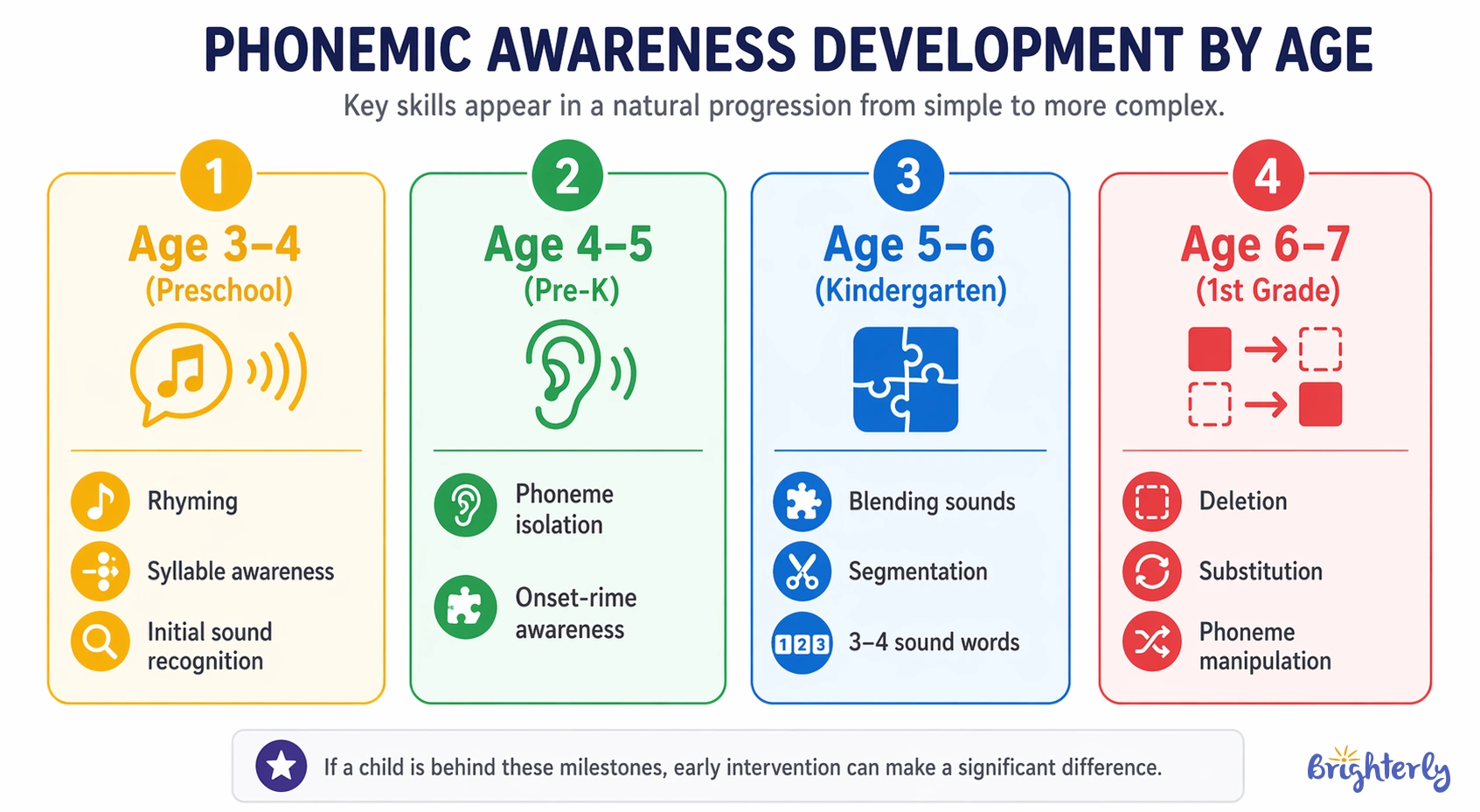
Preschoolers aren’t ready for deletion or substitution, but rhyming, syllable clapping, and first-sound spotting? Perfect fit. Start with Sound Scavenger Hunt, I Spy with Sounds, and Clap and Count. All three need zero materials and slip easily into everyday moments – a car ride, bath time, a walk outside.
Phonemic Awareness Activities for Kindergarten
During kindergarten, kids work with CVC words – short, three-sound words like “big,” “hop,” and “wet” – and start connecting sounds to actual reading. Human Dictionary, Sound Boxes, and Blending I-Spy all hit the sweet spot for this age.
By the way, our tutors at Brighterly align every kindergarten lesson with US state standards, so your child practices exactly the right skills at exactly the right time. Learn more about our reading comprehension program.
Phonemic Awareness Activities for 1st Grade and Beyond
First graders are ready for the hard stuff: deletion, substitution, and full phoneme manipulation. Block Removal, Karate Chop, Sound Spinners, and Phoneme Flip Book all target these advanced skills. Older students who still struggle with blending or segmenting can revisit earlier activities, too; there’s no shame in going back to basics.
Note: If in doubt about your children’s current phonemic skills, addressing this specific 1st grade reading tutor can be a good choice.
Tips for Practicing Phonemic Awareness Activities at Home
You don’t need a classroom to build strong phonemic awareness. A few smart habits make all the difference.
- Keep sessions short. Ten to fifteen minutes a day works better than an hour on weekends. Young brains absorb more in short, frequent bursts, so little and often wins every time.
- Make it part of everyday life. The car, the bath, the grocery store, all perfect practice spots. “How many sounds in ‘milk’?” costs nothing and takes ten seconds. These micro-moments add up fast.
- Follow your child’s lead. If they love dinosaurs, use dinosaur words. If they’re obsessed with a particular book, pull sounds from it. Learning sticks when it connects to something a child already cares about.
- Don’t correct – redirect. When your child gets a sound wrong, don’t say “no.” Say “great try – let’s listen again.” Keeping the mood light keeps them engaged longer.
- Mix it up. Clapping one day, I Spy the next, taking up a homeschool reading program the day after. This variety ensures kids don’t get bored.
- Find the gaps early. If you’re not sure where your child needs the most support, Brighterly’s diagnostic reading test identifies specific skill gaps so practice always hits the right target, not just the easy stuff.
Conclusion
Strong readers don’t happen by accident – they’re built one sound at a time. Regular, varied practice across sound isolation, blending, segmentation, deletion, and substitution gives your child the strongest possible reading foundation. Pick one of these activities to teach phonemic awareness and start learning today.
Frequently Asked Questions (FAQ)
What Are the 5 Phonemic Awareness Skills?
- Isolation: spot a single sound (“first sound in ‘map’?”)
- Blending: merge sounds into a word (/s/ /i/ /t/ = “sit”)
- Segmentation: break a word apart (“hop” = /h/ /o/ /p/)
- Deletion: drop a sound (“flat” without /f/ = “lat”)
- Substitution: swap one sound for another (/b/ in “big” → /d/ = “dig”)
At What Age Should Phonemic Awareness Start?
Earlier than most parents expect. Rhyming and syllable awareness can start at age 3. By 4–5, kids begin isolating first and last sounds. Kindergarten and 1st grade are the critical windows for blending and segmenting. If a child reaches 2nd grade without these skills, early intervention makes a real difference.
How Long Does It Take to Develop Phonemic Awareness?
It varies by child, but most kids develop core skills between ages 4 and 7. With consistent daily practice of 10-15 minutes, many children show noticeable progress within weeks. Struggling readers may need more targeted support and a longer timeline. The key word here is consistent – short and frequent beats long and occasional every time.
What Is the Difference Between Phonemic Awareness and Phonics?
They’re related but not the same. Phonemic awareness works entirely with no letters involved. Phonics connects those sounds to written letters. Think of it this way: phonemic awareness teaches a child to hear /k/ /a/ /p/. Phonics teaches them that those sounds are written as C-A-P. One skill feeds directly into the other.
How Do I Know If My Child Has Weak Phonemic Awareness?
Watch for these signs:
- Difficulty rhyming or recognizing words that sound similar
- Struggles to identify the first or last sound in simple words
- Can’t clap out syllables or count sounds in short words
- Reads slowly and guesses at words rather than sounding them out
- Spelling looks completely random with no sound connection
Can Phonemic Awareness Be Practiced at Home?
Absolutely, and it doesn’t require special materials or a teaching degree. Most of the phonemic awareness activities for parents in this guide need nothing but your voice and a few minutes. Car rides, bath time, and bedtime routines all work perfectly. Start with whatever feels most natural. Keep it playful. Your child won’t even realize they’re building a critical reading skill.

Cuemath offers 1:1 math and coding support, but it doesn’t work for kids who need help in other subjects. This guide compares the formats, subjects, and costs of 7 Cuemath alternatives for students with diverse requirements. Among Cuemath competitors, Brighterly offers US standards-aligned math, reading, and writing tutoring, while Khan Academy provides free, self-paced coverage […]

May 08, 2026
Semantic mapping is a method of teaching kids vocabulary by turning it into a visual picture. The goal of the method is to make the words children hear or see every day stick in their brains. Find out how it works, what types of it exist, and ways to try it at home. What Is […]

May 09, 2026
Math & reading from 1st to 12th grade
Looking for homework support for your child?
Choose kid's grade

Math & Reading for Grades 1–12
Build real confidence for your child with a Brighterly math or reading tutor.