Semantic Mapping: What It Is and How It Builds Vocabulary in Kids
reviewed by Laila A. Lico
Updated on May 9, 2026
Key Points
- Semantic mapping is a visual vocabulary strategy that shows how the main word connects to other related words.
- The method works because it uses the kid’s prior knowledge to link new words to the ones kids already know.
- Parents and teachers can use it to improve the child’s reading, writing, and help them build vocabulary.
- A standard semantic map includes the main word, its definition, synonyms, antonyms, and an example sentence.
- November 2025 research by Frontiers in Psychology shows that it’s easier for students to build vocabulary by seeing visual word connections rather than by trying to memorize words through repetition.
Semantic mapping is a method of teaching kids vocabulary by turning it into a visual picture. The goal of the method is to make the words children hear or see every day stick in their brains. Find out how it works, what types of it exist, and ways to try it at home.
What Is Semantic Mapping?
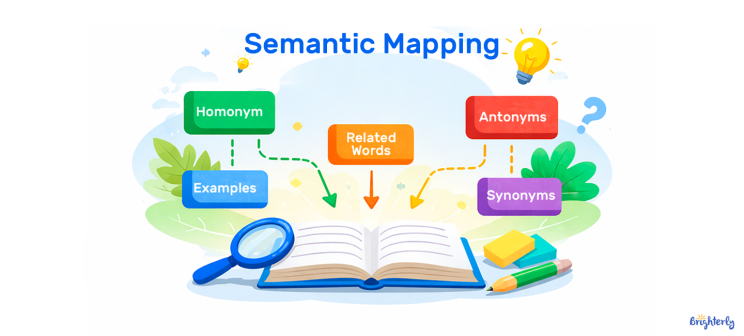
Semantic mapping is a visual-based method of teaching vocabulary through a graphic organizer that illustrates how a particular word relates to other words. So, instead of asking a child to just memorize a word by repeatedly writing or saying it, this method asks them to create a visual map of meaning for this word, surrounding it with other related vocabulary.
Basically, the method works because it relies on visual representation and on the kid’s prior knowledge, making it easier for the child to link the new word they are learning to the words they already know. Hence, there is a higher chance the kid will remember the new word more easily. Proving this statement, the research by Frontiers in Psychology, published in November of 2025, shows this method effectively improves vocabulary retention in primary school students, since: “When vocabulary is introduced through both verbal and visual formats such as images or stories, learners activate multiple memory channels, improving long-term retention”.
When defining semantic mapping instructions, Erik Chan, founder and CEO of PrettyFluent language app, says it’s one of the tools that works best for kids since it replicates processes happening naturally in the brain.
“Semantic mapping is one of the most effective tools we use, and it works perfectly for young kids, struggling readers, and language learners alike.”


Semantic Mapping Definition
By definition, semantic mapping is a visual, graphical strategy that allows illustrating relations between words, concepts, and ideas. It involves mapping the main word to related sub-concepts, helping kids to organize, learn, and extend vocabulary.
Researchers David Johnson and P. David Pearson introduced the method in the early 1980s, claiming that new information must connect to the existing knowledge for kids to retain it. In 1986, Susan D. Pittelman and Joan E. Heimlich released their work called “Semantic mapping: Classroom applications”, which formalized the procedure as a visual strategy for organizing knowledge.
How a Semantic Map Works
Semantic map places the main word in the center, surrounding it with related categories like definition, synonyms, antonyms, and examples of use. The idea behind it is to help kids develop layered understanding of vocabulary instead of expecting them to remember words without any context.
Explore Brighterly Learning Experience
Learn exactly how Brighterly helps students thrive through expert sessions, online tools, and proven feedback from thousands of satisfied parents
What Is a Semantic Map Used For?
Parents and teachers use semantic maps to help kids build vocabulary and improve reading comprehension and writing skills. Since these maps are basically graphic organizers, they allow students to perform information management, meaning structuring and visualizing their thoughts. A skill essential for both reading and writing.
Semantic Mapping for Vocabulary Building
Semantic maps are used when learning new vocabulary that is essential for understanding the text a kid is reading or listening to. Every time a kid creates such a visual organizer for an unfamiliar word, they add it to their vocabulary, enriching it. If you want to see how that works, you can start by using an online reading test to try this with your child at home.
Semantic Map for Reading Comprehension
Mapping new words and their related meanings is one of the literacy instruction techniques and reading comprehension strategies, which helps kids understand the entire text better. Creating such maps, they learn to focus on meaning, context, and word relationships when reading, rather than just skipping unknown words. This is especially helpful if your kid is an English language learner who may understand a word’s definition but not the whole context behind it. Also, it’s a great tool for teaching a kid how to summarize the story they just read based on main words and meanings.
Semantic Mapping in Writing
Semantic maps can be a great brainstorming tool when getting ready for a writing project. For example, before writing an essay for a specific topic, a kid can start with brainstorming related vocabulary and mapping it out. So, by the time the child gets to writing, they already have the word map in front of them, which they can use to prevent frustration caused by not knowing what to say next.
Semantic Mapping Activities for Kids
Semantic mapping activities you can try at home include topic mapping, concept sorting, and defining activity. None of these activities require prior or additional preparation. All you need is just a blank sheet of paper and a pen or anything else to write and draw with.
- Topic Mapping: Place a new word in the center of a map and ask a kid to think of related words out loud. Then ask them to divide these words into categories.
- Concept Sorting: Give a kid a list of words and ask them to create categories for these words. When they come up with the categories, ask them to map the words accordingly.
- Defining Activity: Take a word and ask a kid to create a map where they have to add these word’s definition, characteristics its meaning holds, synonyms, and antonyms.
Professionals to help your child build vocabulary
Brighterly online tutors apply different semantic mapping activities for teaching kids new words.
If you want a professional to teach your kid, our reading program tutors use semantic maps during one-on-one online sessions to teach vocabulary based on the child’s current reading level. If your child struggles with new words, our vocabulary tutors personalize practice according to their needs.
Types of Semantic Maps
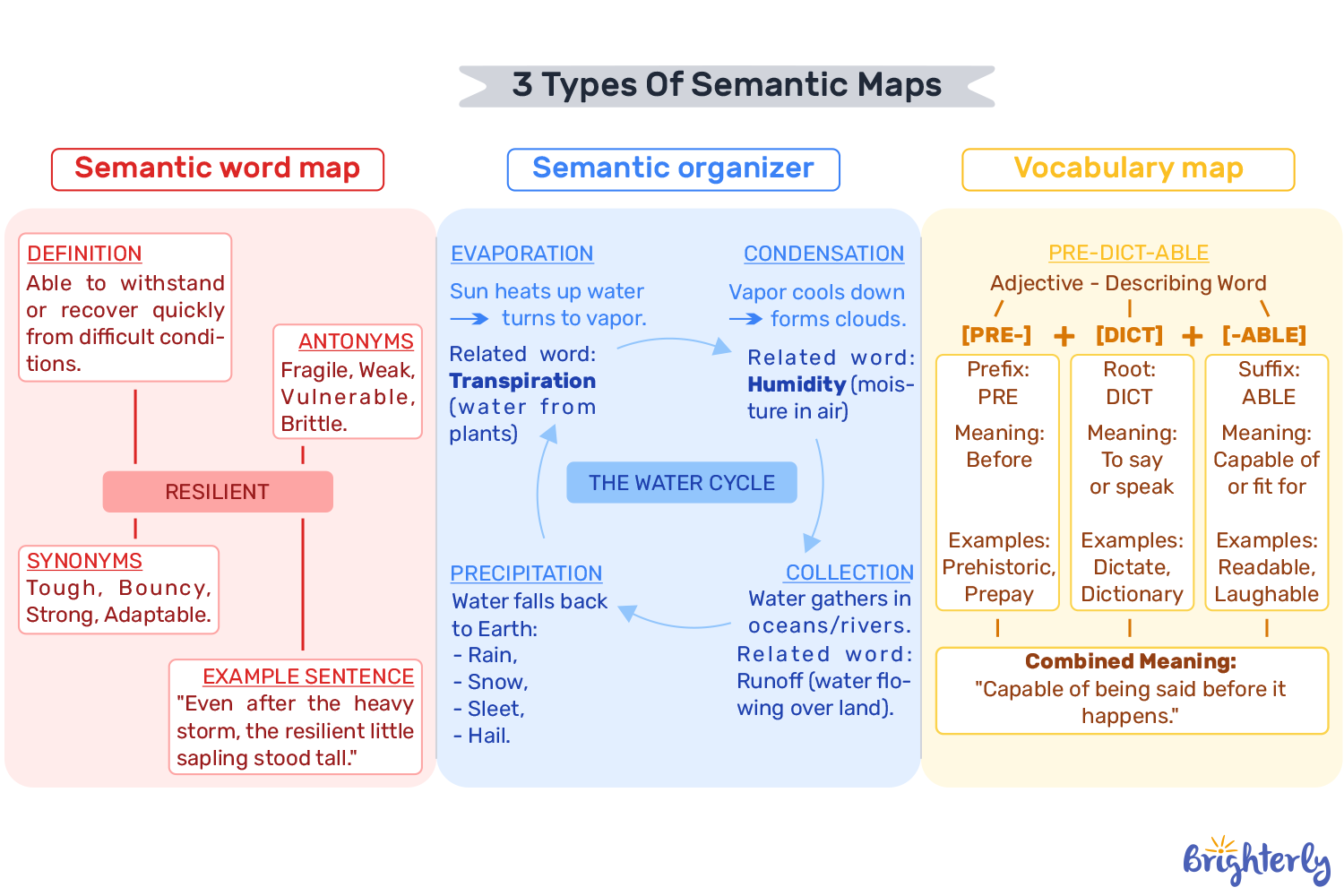
Depending on the goal of semantic mapping, there are different types of organizers with specific features you can use. They are semantic word maps, semantic organizers, and vocabulary maps. Each serves a specific purpose in the learning model. Pick one that suits your child’s needs best.
Semantic Word Map
This is the most standard and commonly used format. It focuses on the main word and its literal connections, like definition, synonyms, antonyms, and an example sentence. It is best to use it when your kid needs to master academic vocabulary before a test at school, for example, or if you’re looking for a fun vocabulary game for them to learn new words at home.
Semantic Organizer
A semantic organizer is what you use for broader topics. Instead of one word, it implies focus on the entire concept. For example, instead of using the word “water”, you take the concept of “the water cycle”. This is helpful when you want to teach a kid how words relate to each other within a much bigger picture.
Vocabulary Map
This mapping method includes more technical analysis of the language. Here, you teach a child to look at the word parts, like prefixes, suffixes, and roots. This is best for explaining to kids how words are built, which will help them gain more control over their ability to decode unfamiliar vocabulary in the future.
Here you can see a semantic map example for each of the three types we’ve covered.
Semantic Mapping Examples
Here are a couple of examples to see what a semantic map consists of. Both examples are in the form of tables to make the structure of a map as transparent as possible. The first example is for the word “labyrinth”.
| Word | Category | Definition | Synonyms |
Antonyms |
Example sentence |
| Labyrinth | Structure / Concept | A complicated irregular network of passages or paths in which it’s hard to find a way out. | Maze, web, entanglement | Gateway, clearing, straightaway | The hedges in the garden were shaped into a labyrinth where children loved to play. |
And here is an example for the word “canyon”.
| Word | Category | Definition | Synonyms |
Antonyms |
Example sentence |
| Canyon | Landform / Geography | A deep gorge, typically one with a river flowing through it, often with steep rock sides. | Gorge, ravine, chasm | Mountain, peak, plateau | The hikers stood at the edge of the canyon, looking at the river below. |
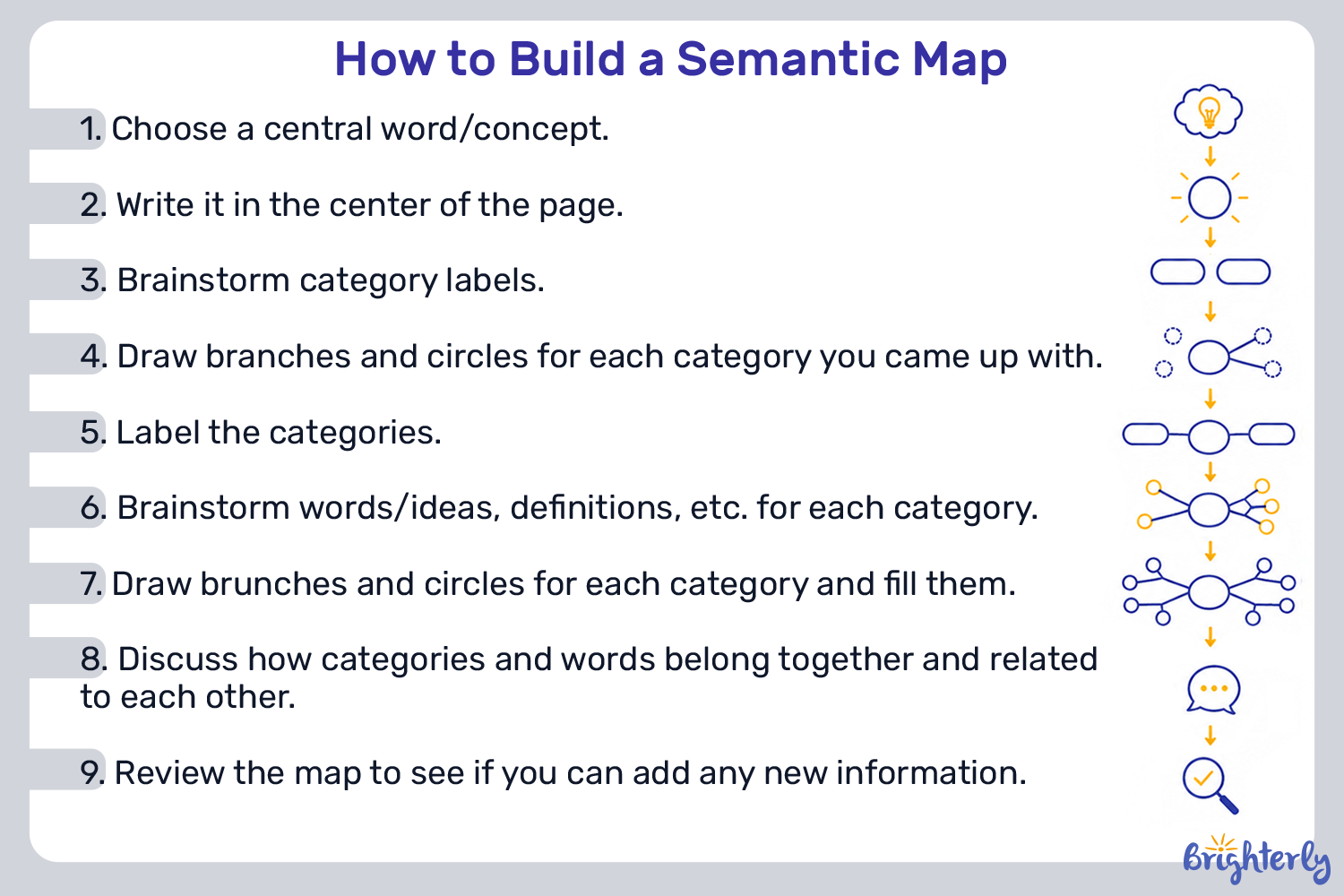
How to Create a Semantic Map Step-by-Step
- The process of creating a semantic map begins with selecting a central concept or word that will be placed in the middle.
- Then you need to brainstorm categories, depending on the type of map you’re creating.
- Finally, you add words, examples, or explanations to each category, discuss how they are connected to the main word or concept, and review everything.
You can also use a free printable semantic mapping template if you don’t want to draw the map yourself.
Benefits of Semantic Mapping for Children
The benefits of semantic mapping include activation of prior kids’ knowledge, building of word relationships, retention improvement, and reading comprehension enhancement. In general, this graphic organization tool helps children put concepts into categories and improve their language usage in reading, writing, and speaking.
- Activation of prior knowledge: The child has to use what they already know to understand a new word or concept.
- Building word relationships: The kid understands that language isn’t just a list of facts, but more of a web of related ideas, which is especially important for ELL learners.
- Retention improvement: Kids of all learning styles, but especially visual learners, remember the graphic map more easily than a text-only definition.
- Reading comprehension enhancement: When kids are no longer confused or frustrated by unknown words, they can focus on the story better, which leads to overall literacy development.
Get the benefits of semantic mapping
Our tutors tailor semantic mapping lessons to your child’s learning style to make sure they yield results.
Conclusion
Semantic mapping is one of the most effective and widely recognized vocabulary strategies available to parents and teachers today. And the reason for this is that it builds vocabulary through showing kids connections between words and concepts rather than pushing them to simply memorize words through repetition. You can try creating a semantic map with your kid at home to see how that goes. To start, it’s best to use the simplest standard map and pick words from a book your kid is currently reading, for example.
Frequently Asked Questions
What Is Also Known as a Semantic Map?
A semantic map is also known as a mind map, a graphic organizer, a word web, or a concept map. While the names may differ depending on where you read or hear about it, the core idea and goal of the method remains the same — to provide kids with a visual illustration of how words and concepts are related.
What Are the Three Steps of Semantic Mapping?
The three steps of semantic mapping are selection (identifying the central word), brainstorming (generating categories and related words/ideas), and drawing (turning what you brainstormed into a visual map). There can also be a fourth step, where you can review your map and think of what else you can add to expand it.
Can Semantic Maps Help Kids with Learning Differences?
Yes, semantic maps can help kids with learning differences. The visual structure of a map makes it easier for such kids to work with vocabulary, since they can immediately see how all the words and concepts connect rather than being frustrated by a long piece of text with unknown words.
At What Age Can Children Start Using Semantic Maps?
Children can start using simple, highly visual semantic maps as early as the preschool years (around ages 3–4). However, at that age, maps should rely on colorful pictures, stickers, or objects rather than words to make it entertaining for a child. For example, you can put a picture of an apple in the center of the page and ask them to draw related things, like an apple tree or an apple juice pack.
How Long Does it Take to Make a Semantic Map?
Making a semantic map usually takes from 5 to 10 minutes, if it’s a simple brainstorming session. However, if you’re aiming for a more complex, big map, it can take an hour or even more. It’s important not to rush a child when making it, so be patient and let them take their time.
What Subjects Besides Reading Use Semantic Maps?
Besides reading, teachers use semantic maps in subjects like Writing, Science, Social Studies, Math, Psychology, Economics, and Medicine. In general, any subject that involves complex ideas and related concepts that need to be visualized for better understanding benefits from a semantic organizer.

Phonemic awareness activities are games and exercises. They help children hear, identify, and manipulate individual sounds in spoken words – and they’re often what makes reading finally click. The five skill types to know: isolation, blending, segmentation, deletion, and substitution. Best part is that all of them work at home, in the car, or at […]

May 08, 2026
Online tutoring connects students with tutors remotely via video; in person tutoring takes place face to face at home or in a learning center. Choosing between online tutoring vs in person tutoring requires comparing several practical factors. This guide highlights the main differences between the two formats in terms of setup, requirements, cost, flexibility, and […]
May 09, 2026
Math & reading from 1st to 12th grade
Looking for homework support for your child?
Choose kid's grade

Math & Reading for Grades 1–12
Build real confidence for your child with a Brighterly math or reading tutor.