Questioning Reading Strategy: Step-by-Step Guide for Parents and Kids
reviewed by Laila A. Lico
Updated on December 24, 2025

Does your child read well but still struggles to understand the text? You’re not alone: in American middle schools, about two out of three students have trouble with reading comprehension. This is the reason why I, as a reading teacher, want to share with you a wonderful method – a questioning reading strategy. It’s a simple but really effective way to help kids dive into the text. Let’s start!
Key points
- The idea of the strategy is that a child learns to answer different types of questions about the text. These questions are used at three stages: before reading, during reading, and after reading.
- Before reading, the child looks at the title and tries to predict what the text will be about. During reading, they ask themselves small checking questions. After reading, they reflect on what they understood.
- There are also four main questioning techniques teachers recommend: open-ended, closed, probing, and reflective questions.
- Questioning strategies for reading comprehension is especially helpful for kids ages 5-13 who struggle with reading comprehension.
- Brighterly math and reading platform is a modern platform that teaches children how to work with a text in a deep and structured way, helping them understand it better.
What is questioning reading strategy?
The reading strategy questioning is a helpful way to teach a child how to really connect with a text. The idea is simple: your child learns to ask and answer different questions about what they are reading in the moment. According to this method, questions should appear at three stages: before reading, during reading, and after finishing the text.
Why is questioning reading strategy important for kids’ reading comprehension?
Questioning reading strategy is important because it helps kids truly feel and understand what they are reading. Instead of just reading words one by one, they learn to slow down, think, and make sense of the story. This method gently encourages a child to use their imagination, connect events, notice details, and use their own logic, and that’s what makes reading meaningful.
Why does questioning reading strategy for students work?
- Improves reading comprehension: Research shows that kids who ask questions while reading understand the text better than those who read passively.
- Develops critical and analytical thinking: When a child asks questions like: “Why did the character do that?”, “What is the author trying to say?”…they start thinking more deeply about the story.
- Helps focus: kids get less distracted because their brain is actively involved in the reading.
- Builds vocabulary: Because a child comes across a word they don’t know and asks about it, their vocabulary grows faster.
- Boosts confidence: Understanding the text gives children a sense of control and makes them feel proud of their reading.

Who can benefit from asking questions reading strategy?
- Kids ages 5-13. Each age group has its own level of question difficulty, but the strategy works for all children.
- Kids who struggle with reading comprehension. Psychologists and teachers often use it with children with reading difficulties (e.g., dyslexia), children with low attention spans and who read mechanically without understanding.
- Parents reading at home. This is one of the most effective methods for home reading practice.
How to teach the questioning strategies for reading at home?
Get tutoring help
Tutoring is a great way to help your child improve reading comprehension, especially if you don’t have the time to guide them through every step. A qualified tutor can teach your child different techniques to understand the main idea, spot important details, and ask the right questions while reading. And the best part is – they practice these skills immediately during the lesson.
Of course, it’s important to find a tutor who truly knows how to work with kids and can teach questioning reading comprehension strategy. If you’re not sure where to look, I recommend checking out the Brighterly platform!
How Brighterly helps kids learn to understand a text
Brighterly is a modern tutoring platform that helps American kids work through difficulties in math, reading and writing. Brighterly reading program is created to help children from K9 learn how to work with texts of different levels. Brighterly reading tutors teach kids not only how to read or understand a text, but also how to generate questions, meaning, and work with information from all sides.
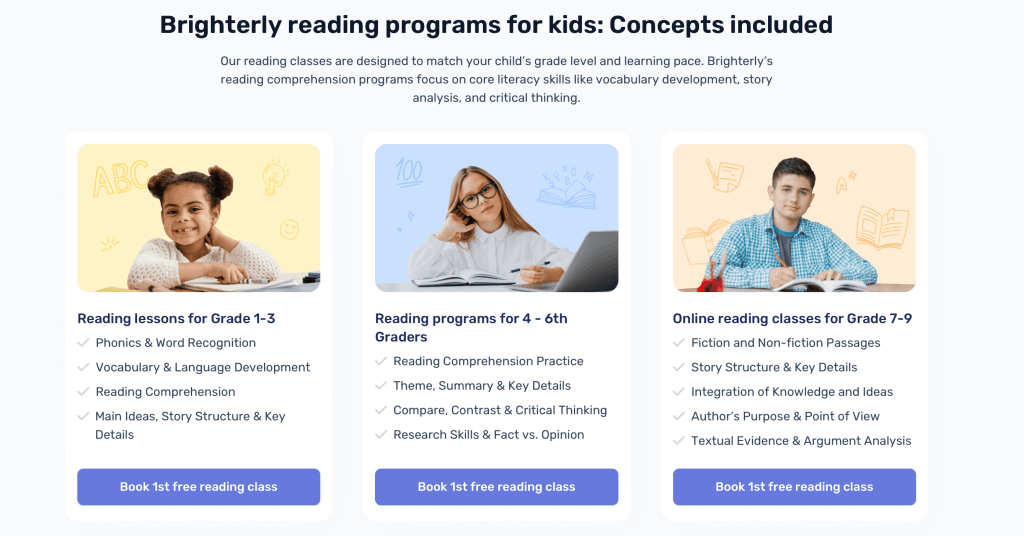
The learning process is interactive and fully individual. Every lesson is one-on-one with a tutor, so all the attention is on your child. The program is built around your child’s needs – that’s why before starting, kids take a short placement test to see their strong and weak sides.
By the way, you can also use some reading tests for free and check what your child struggles with at home.
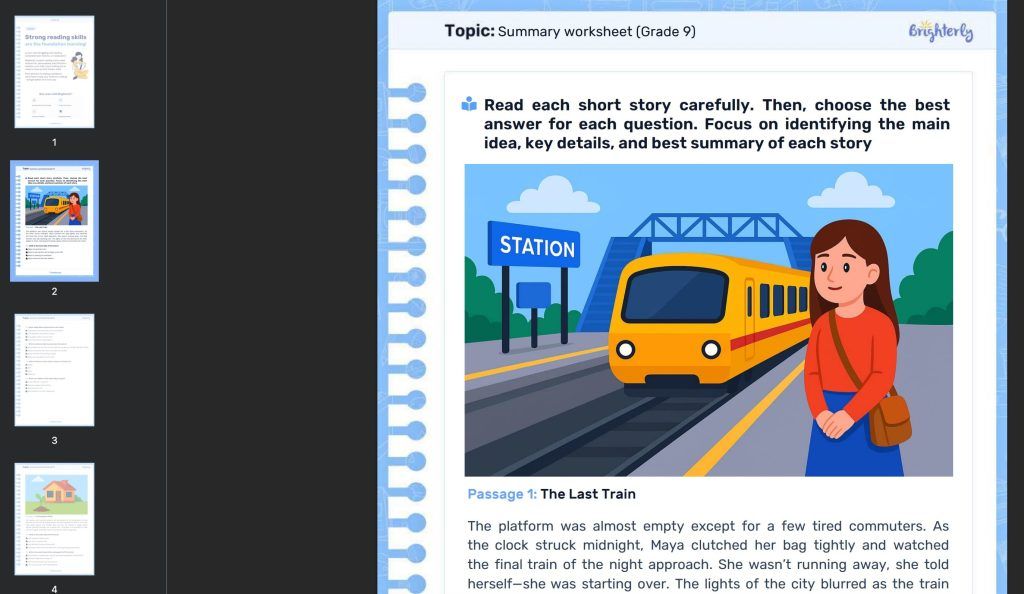
What about the learning process? I know for sure that its teachers really put effort into their lessons. They mix things up with animations, interactive tasks, and special worksheets.
By the way, they also have reading comprehension worksheets on the website – you can look through them or download them for free. And if you want to dive deeper into reading comprehension strategies, there’s a full article on their site. I think you’ll find it really helpful.
Plus, tutoring will definitely improve your child’s school performance – because all Brighterly lessons follow the US State Standards.


Read and talk out loud
It may sound obvious, but it works! Read and say your thoughts out loud. Parents, show your child an example. Pick a short part of a book and ask yourself questions out loud:
- “I wonder why the character did that?”
- “What might happen next?”
- “Could the story have been different if…?”
- “What is the main idea the author is trying to share?”
This way, the child sees that reading comprehension questions are just a natural part of reading. And you don’t even have to “teach” anything – your child will simply follow your example.

Make a question bookmark
If your child finds it hard to come up with questions, you can write some question-prompts right on a notebook cover or make a small bookmark with them:
- “Why…?”
- “What do you think…?”
- “What will happen if…?”
Here, I would also recommend teaching your child to use the four question categories: factual, inferential, evaluative, predictive.
Create “stop-and-think” pauses while reading
This method works well for kids who read fast but don’t really think about the text. Try making short pauses every 2-3 paragraphs and practice asking questions while reading. It helps train attention and reduces that “surface reading” habit.
Note: There’s also a more creative way. If you don’t want to interrupt the reading flow, your child can write down their creative questions in a notebook and discuss them with you late
The best way to use questioning as a reading strategy
One of the easiest and most effective ways to boost a child’s reading comprehension is asking questions before during and after reading. This approach keeps kids from getting lost in the text because they stay actively engaged at every stage. By answering questions along the way, children check their understanding and have a clear reason to read more carefully.
Ask questions before reading
This stage gets your child ready for the “big reading.” They look at the title, a short description, or the task, and start asking themselves questions: What might this text be about? What can I learn from it?
It works because at this point, the child already understands the topic, their brain starts making connections, and a logical chain of information begins to form. This preparatory step makes reading easier. Speaking from my own experience, it really helps with orientation and focus.
Questioning in reading
Teachers recommend that kids who struggle with comprehension pause while reading and ask clarifying questions to avoid confusion. This way, they read longer but learn to put all the information in order.
Why does this work? Because the reader stays focused, monitors their understanding, and reflects on meaning instead of just moving passively through the text.
Ask questions after reading
After-reading questions help kids reflect on the text and summarize it. At this stage, they can also ask discussion-type questions that develop their logical thinking. This step should not be skipped because it deepens understanding even more.
Note: For a quick check to see if the text was understood, you can use a framework like 5W1H. Ask and answer questions: Who? What? When? Where? Why? How?
What are the four main questioning techniques?
- Open-ended questions
- Closed questions
- Probing questions
- Reflective questions
For convenience, I’ll explain what these questions are and how they work in a table.
| How it works | Examples | |
Open-ended questions |
Questions that cannot be answered with just one word. They make the child analyze, draw conclusions, and look for evidence. |
– Why do you think the character did that? – What message is the author trying to send? |
Closed questions |
Questions with a short or specific answer (yes/no, fact, date). They help check basic understanding of the text. |
– Where does the story take place? – Did the character leave the house? |
Probing questions |
Deeper questions that encourage the child to think. They are a key part of questioning as a reading strategy. |
– What makes you think so? – Can you explain your reasoning? – What evidence in the text supports your idea? |
Reflective questions |
Questions that make the reader connect the text to their own experience, draw conclusions, and form their own opinion. |
– How would you feel in this situation? – What did you learn from the story? – Does this remind you of something in your life? |
Note: By using these different types of questions, you help your child improve all levels of reading comprehension: facts → analysis → interpretation → reflection.
Questioning reading strategy examples
I’ve tried to cover different aspects of questioning in this article, and now I’m providing a questioning reading strategy template with a basic set of questions that your child can use at various stages of reading.
Before reading
- What do I think this text will be about?
- What do I already know about this topic?
- What do I hope to learn?
- Why am I reading this text?
- What clues do the title, images, and headings give me?
During reading
- Why did the character do that?
- How does this section connect to what I read earlier?
- What is the main idea of this paragraph?
- Is there anything I don’t understand here?
- What evidence supports the author’s claim?
- What might happen next?
- What does this word mean in this context?
After reading
- What did I learn from this text?
- How would I summarize the main idea in my own words?
- Did the text answer the questions I had before reading?
- What message was the author trying to send?
- How does this text connect to my own experiences?
- What questions do I still have?
Higher-order thinking questions
Type |
Examples of how to generate questions |
| Analysis |
– Why is this detail important? – What is the author comparing here and why? |
| Evaluation |
– Do I agree with the author’s point? Why or why not? – Is the evidence strong enough? |
| Creation |
– How would I change the ending of this story? – What question would I ask the author if I could? |
Conclusion: Teaching questioning reading strategy
I hope, dear parents, you now understand that questioning the text reading strategy is not just a game – it’s a powerful tool for both understanding texts and developing thinking skills. You can use it at home, but the strategy takes time and patience. Your child might not give detailed answers right away, and that’s completely normal. Take it step by step and show them how to answer by setting an example yourself. Repetition is the key to success.
If you don’t have the time or ability to work consistently with your child, it’s worth considering tutoring. In this regard, the Brighterly platform can help. Its tutors are carefully selected and highly experienced and your child gets:
- a personalized program
- individual and interactive lessons
- professional mentors
- results tracking
If you want to see how it works with Brighterly, you can book free reading lesson. After that, you can decide which approach works best for your child.


Handwriting appearance can be a mirror of kids’ confidence in their thoughts — or just a result of their muscle memory and grip memory. Whatever the cause, if you’ve noticed your kid struggles with this, you’re in the right place to help them overcome the problem. As a tutor myself, I’ve gathered here my 10 […]
Nov 26, 2025
If you have doubts regarding active or interactive learning effectiveness, you’re in the right place. In this overview, you’ll find all the relevant interactive learning statistics, with key numbers and trends. Key stats Based on the introductory infographic, traditional lecturing failure rates are 55% higher compared to their active learner peers. 60% of kids perform […]

Nov 29, 2025
Math & reading from 1st to 9th grade
Looking for homework support for your child?

Choose kid's grade

Math & Reading for Grades 1–9
Build real confidence for your child with a Brighterly math or reading tutor.