What Is Number Sense in Math? How to Improve It (By Grade + Practice)
reviewed by Marvi M. Andres
Updated on March 5, 2026
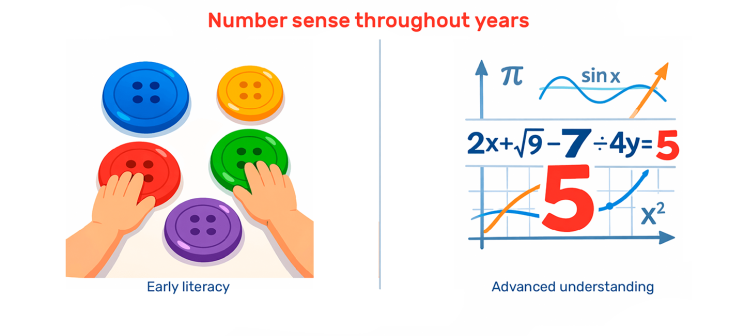
Number sense is a kid’s ability to understand, manipulate, and relate numbers. The lack of this skill can lead to counting on fingers, skip counting, and lengthy solving of math problems. That’s why it’s so important to understand what is number sense in math, and why building it during early childhood makes everything else click.
Key points
- Number sense is a child’s ability to understand quantities, recognize how numbers relate to one another, and predict how they change through math actions.
- As a result of a true understanding of the math logic, strong number sense allows kids to shift from counting on fingers toward mental math.
- The definition of number sense implies grade-level growth – skills progress from simple subitizing and physical counting in elementary school to analyzing data and using scientific notation in high school.
- Methods like one-on-one tutoring and targeted worksheets can help students master foundational concepts at their own pace.
What is a number sense in math?
Number sense is a kid’s skill to understand numbers and their quantities. It implies knowing how numbers relate to each other and how they change when you add or subtract them. A child with number sense understands that the symbol ‘5’ represents five physical objects and that 5 is larger than 2.
Why is number sense important?
This skill is important because it helps kids perform mental math and solve problems. It enables them to decide whether or not an answer is reasonable. Developing these skills in early life facilitates learning more difficult topics (like algebra) later. It also helps children feel comfortable and successful when they use math in their daily lives.
Note: Given the importance of number sense and how it affects kids’ academic and daily lives, many parents choose to seek professional tutoring aid and opt for the Brighterly math and reading platform, which can help every kid master it at their own speed.
Which activity is a key area of number sense?
Subitizing is a key activity required to build number sense. It means the ability to look at a small group of objects and immediately know how many there are without counting them one by one.
What are the 5 characteristics of the number sense?
Understanding quantity
Understanding quantity is literally knowing that a number represents a specific amount of items, that numbers are, in fact, names for quantities. When, for instance, a child sees the number three, they know it stands for three physical objects, like three blocks.


Number relationships
Recognition of patterns in the number sense definition math comprises knowing how different numbers work together. A child learns that, to create new totals, numbers can be broken apart or put together. When, for instance, they detect that six is made of five and one, they better learn the order of numbers and how they connect in a logical way.
Comparing totals when teaching number sense
Dealing with the size of numbers, a child is expected to look at two different groups and identify which one has more items and which has fewer. They should be able to tell, for example, that ten is larger than two, and as soon as they learn it, they’ll have a better understanding of the physical space and value that different numbers occupy.
Impact of changes
When kids start adding or taking away items, they spot that working with objects can result in a total larger or smaller number. Moreover, children begin to predict the results of these actions and realize how math moves and changes according to the actions they take.
Referents for numbers and quantities
It’s when a known amount is used to figure out an unknown one. If a child is to estimate how many blocks are in a large pile, they should use their knowledge of what ten blocks actually look like. Logical guesses about the real world around them start when kids get command of this skill.
How to teach number sense? 12 proven methods
- Working with a tutor
- Using worksheets
- Playing number games
- Subitizing practice
- Counting physical objects
- Using ‘ten-frames’
- Shopping math
- Using a number line
- Estimation challenges
- Analyzing data sets
- Mental math shortcuts
- Scientific notation
Working with a tutor
Best for: Grades K-8
Given that Brighterly’s math program relies on one-on-one math classes, it’s even more beneficial for teaching number sense to struggling students, in particular. Professional math tutors here identify what your kid lacks understanding of (like, say, they can’t recognize the value of a digit according to its position in a number), and focus precisely on that, step by step.
Brighterly employs an individualized approach, enabling a teacher to observe a student’s problem-solving steps in real-time. It also allows a tutor to correct mistakes immediately and explain the logic behind math operations. At their unique pace and getting full attention 1:1, every kid can master how numbers represent real amounts and how those amounts connect.
Note: A 2020 meta-analysis by J-PAL of 96 randomized controlled trials found that tutoring is one of the most effective ways to improve student achievement.
Using worksheets for developing number sense
Best for: Grades K-5
Brighterly also offers math worksheets that focus on visual representations of quantities in particular. With these free and printable worksheets, kids can practice ‘decomposing’ numbers – i.e., seeing how a large number is made of smaller parts.
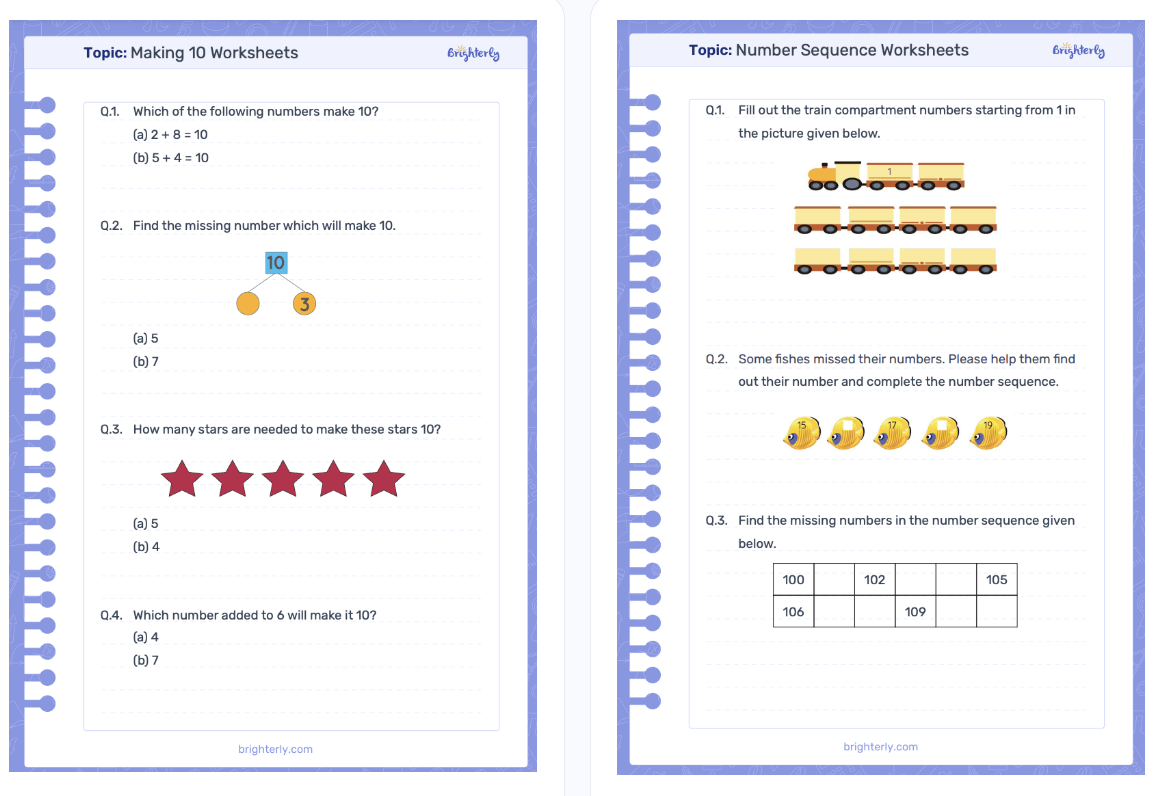
These worksheets use grids, dots, and number lines to demonstrate to students the physical distance between values. In addition to comprehending what is number sense in math for kids, doing these exercises also enhances the development of repetitive motor and cognitive skills.
The worksheets are organized by grade and difficulty level. As parents, you can use a written record of progress to track over time, although these free math tests can reveal even more about how it goes for your kid.
Note: Educators recommend the ‘CRA’ sequence – Concrete, Representational, Abstract – in which worksheets specifically represent an important ‘Representational’ step between touching blocks and writing pure numbers.
First and foremost, understanding what is number sense in elementary math implies recognizing that numbers have consistent values and specific relationships to one another. If children have difficulty with it, check out here how to address learning gaps in mathematics for specific techniques to identify and fix missing skills from earlier grades.
Playing number games
Best for: Grades K-5
Number games are typically used to train mental math and logic. When kids play games with two dice, for instance, they refine addition and subitizing – the ability to figure out a quantity without counting each dot.
You can find more specific gaming options in the Number Sense Games to, say, urge your kid to perform many calculations, the faster the better, and increase, therefore, their calculation speed. Such games also call for children to follow logical rules and sequences. They’ll later apply all these skills to solve multi-step math problems in the classroom.
Note: For more digital options, the best interactive math websites for kids can adjust game practice based on a student’s performance.
Subitizing practice
Best for: Grades K-5
At home, you can quickly show your child a flashcard with dots or a handful of cereal for just two seconds, and then hide it. Afterward, ask them to tell you the total amount they saw and remembered. It’ll help their brain perceive numbers as groups (not just a chain of single units), resulting in faster addition and a more natural feel for how numbers are organized.
Note: A 2021 study by Beth L. MacDonald & Anderson Norton of over 3,600 kindergarteners found that children with stronger subitizing abilities had much better arithmetic skills by 1st grade.
Counting physical objects
Best for: Grades K-5
Learning with physical items helps kids realize that every number corresponds to a real object. For such objects, you may take uncooked pasta shapes, small grapes, soft cotton balls, metal paperclips, rubber bands, or wooden popsicle sticks, and in the yard, it can be smooth stones or colorful autumn leaves.
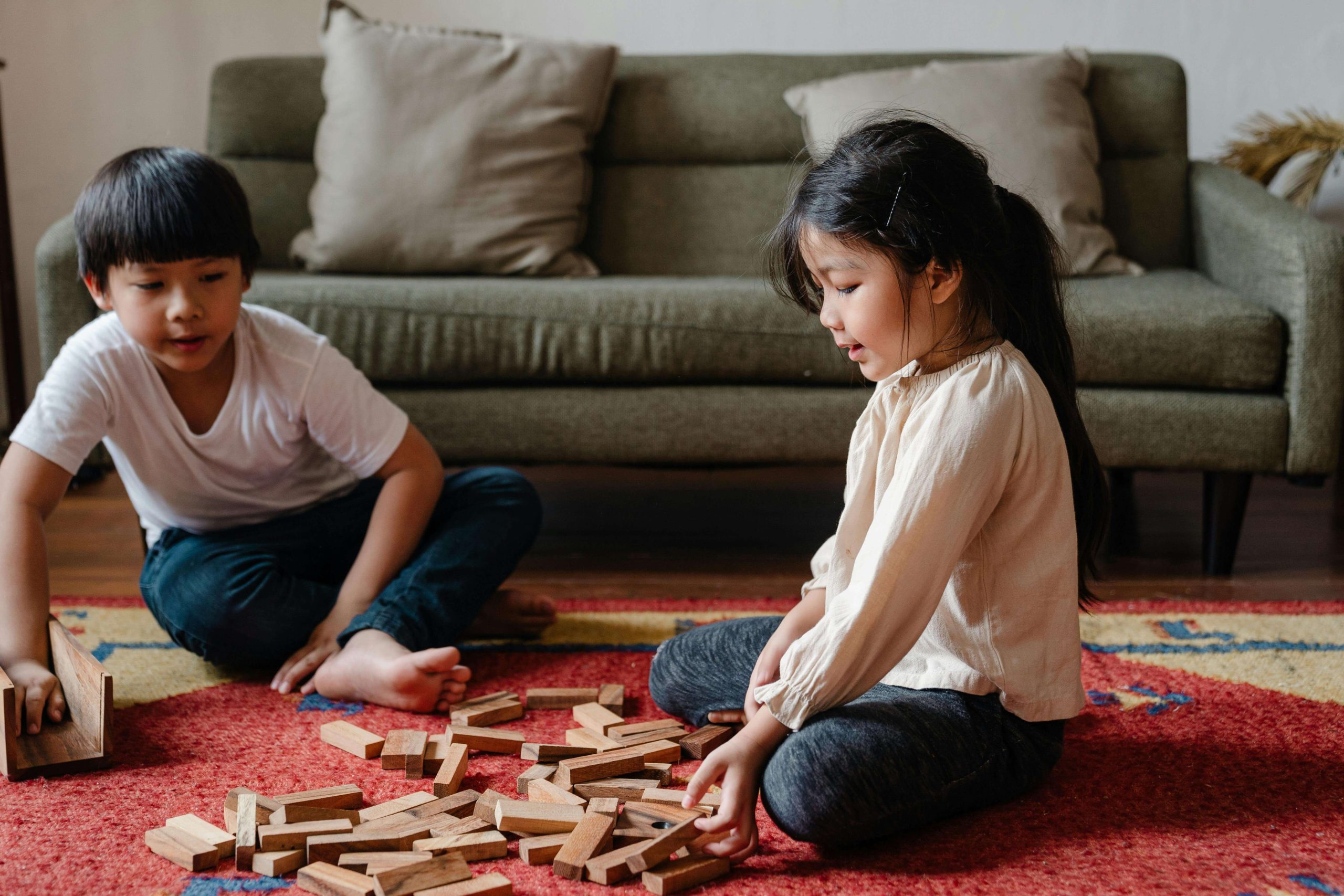
This basic method is called one-to-one correspondence. Ask your kiddo to move each object from one pile to another and say the name of the number. Such a physical action itself ensures they don’t skip any items or count the same item twice. Learning the abstract (like math, generally) with something they can see and feel is super effective.
Note: The ‘Early Math Matters’ study found that kindergarten number competence (rooted in one-to-one counting) strongly predicts math achievement by 3rd grade.
Using ‘ten-frames’
Best for: Grades K-5
A ten-frame is a simple grid with two rows of five squares. To represent numbers in it, you can place small items like coins or magnets into the squares. For instance, to show the number eight, you fill the top row and put three items in the bottom row. Now, your kid will see that eight is ‘five and three’ and also ‘two less than ten.’ Visual grids aid kids in interpreting number bonds and ultimately become good at mental math.
Note: The ten-frame was developed by researchers Van de Walle and Bobis and described in the 2011 study. They specifically pursued helping kids internalize benchmark numbers 5 and 10, which underpin mental calculation.
Define number sense during shopping math
Best for: Grades 6-8
In the grocery store, you can ask your child to help you find the best price or to count out five apples into a bag. For older kids, you can have them estimate the total cost of several items before they reach the checkout.
In real-world settings, children are more likely to faster perceive math as a useful tool for daily life.
Note: Have your child compare the ‘unit price’ on shelf tags, which typically shows the cost per ounce or per pound. That’s how they can learn that a larger and more expensive package can sometimes be a better value because it contains a greater quantity for the price.
Using a number line
Best for: Grades 6-8
When guiding your kid to figure out what does number sense mean, employing a number line makes them learn that numbers have a particular place in order as well as a physical distance from zero. You can draw a long line on the floor with tape and ask your kid to jump to specific numbers. They’ll then understand that when they move to the right, the totals increase, and if they move to the left, they decrease. It’s probably the simplest DIY-way to visualize at home how addition and subtraction actually work.
Note: For older kids, use an ‘open number line’ without pre-marked tick marks. To help them visualize relative proportions, ask your child to place a number (like 45) on a line that starts at 0 and ends at 100.
Estimation challenges
Best for: Grades 6-8
Estimation is a skill to make a logical guess about a quantity without exact counting. To work on it, for example, fill a jar with pasta or marbles and ask your child to guess the total. Before revealing the answer, ask them to explain if the total is likely closer to 10 or 100.
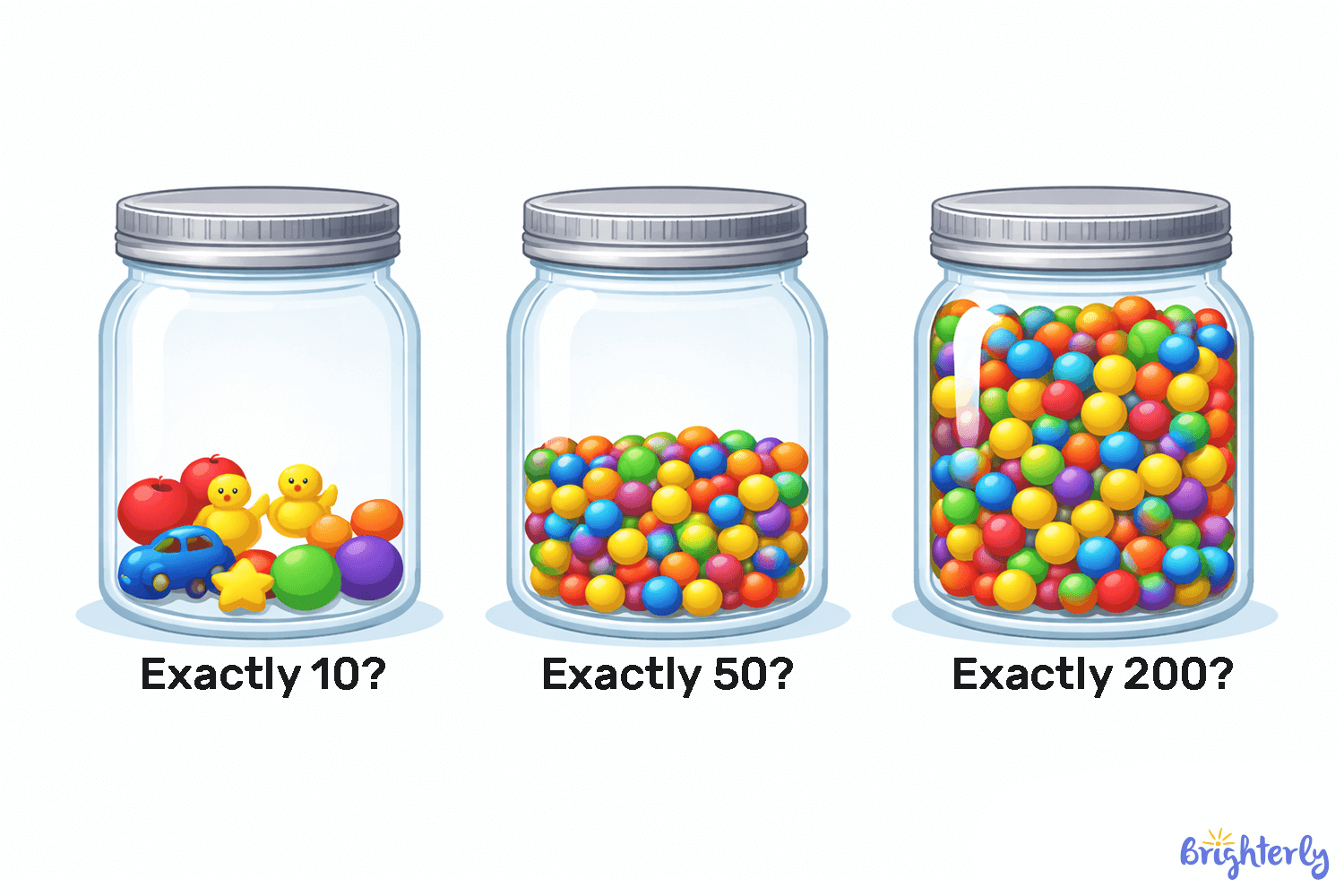
A resulting ‘feel’ for the size of numbers enables kids to distinguish when a math answer seems reasonable or incorrect.
Note: For less pressure (to be exactly right) and more logical thinking, focus on the ‘range’ instead of the exact number. It can be guessing a ‘floor’ and a ‘ceiling’ for the total (like saying there are more than 30 but fewer than 60 marbles, etc.).
Analyzing data sets with examples of number sense
Best for: Grades 9-12
For older students, number sense entails looking at groups of information in order to find patterns. Therefore, to train it together, you can look at, say, weather charts or sports statistics. Ask your child to find the ‘average’ temperature for the week. They can also identify which day had the highest rainfall. Such analysis of data teaches students how to interpret large amounts of information and what those abstract totals represent in a real-life context.
Note: Try tracking a household habit for a week, like minutes spent reading. Let your child create a simple graph to see if the numbers stay consistent or change somehow on weekends.
Mental math shortcuts to master number sense definition
Best for: Grades 9-12
Mental math shortcuts allow students to solve problems in their heads quickly and accurately. In that regard, you can teach your child to, say, ‘round’ numbers. For example, if adding 29 and 15, they can think of it as 30 and 14 instead.
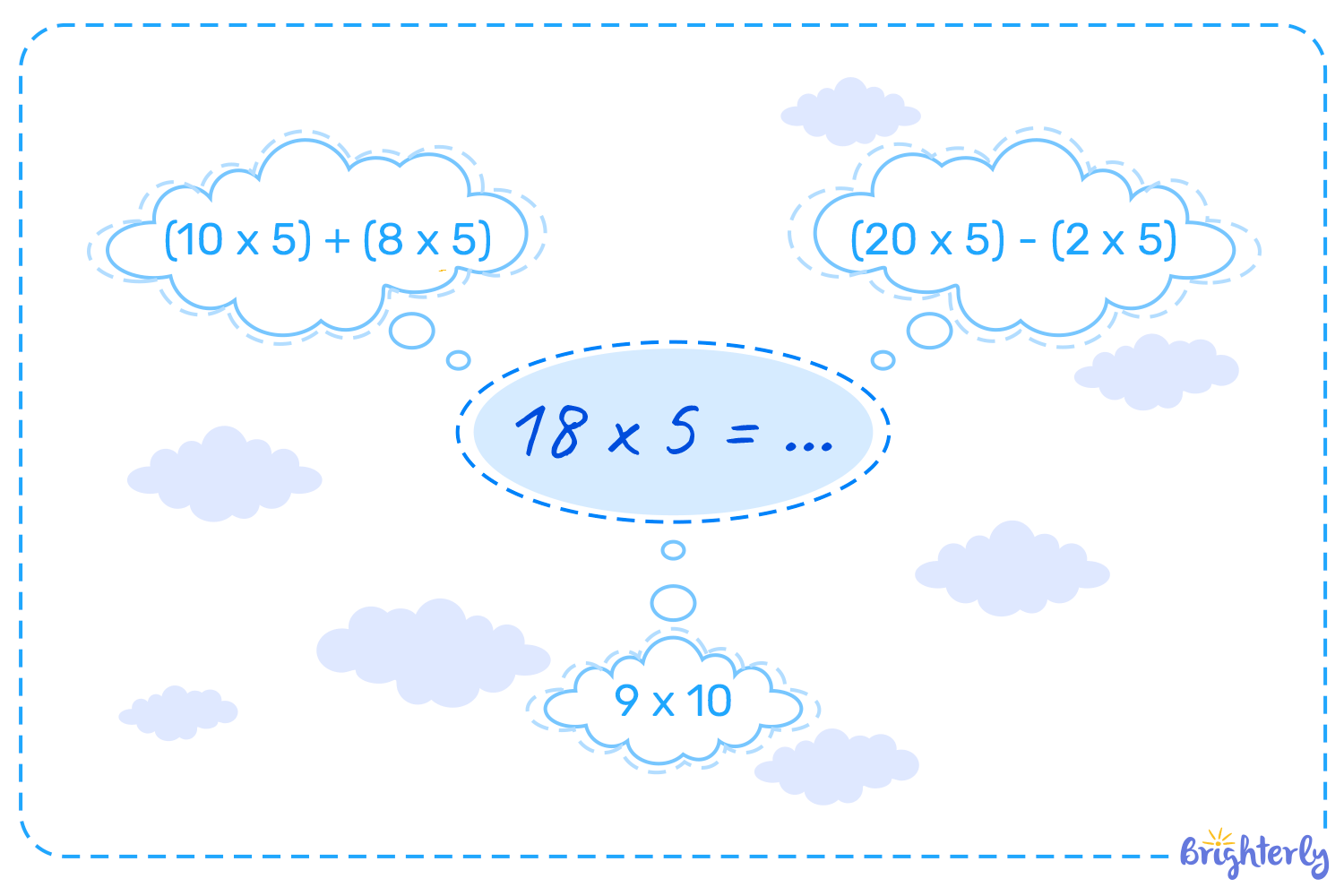
Similar shortcuts show that there are many ways to reach a correct answer and, therefore, encourage students to be flexible and creative with how they handle different quantities.
Note: Urge ‘number talks’ – ask your child to explain the specific steps they took in their head. Hearing their own logic out loud helps solidify their understanding of these mental patterns.
Number sense meaning practicing scientific notation
Best for: Grades 9-12
Scientific notation is a method used to write very large or very small numbers using powers of ten. It’s, in particular, useful for high school students learning about space or biology. You can practice it by looking up the distance to the sun or the size of a cell and rewriting those huge or tiny numbers in a shorter format. Students will ultimately better grasp the scale of things that are too big or too small to see.
Note: Focus on the ‘power’ part of the number. Explain that each increase in the exponent means the quantity is getting ten times larger.
What are the signs of poor number sense?
Poor number sense signifies that your kid remembers but doesn’t understand math yet. They might struggle to count backward or fail to discern that the order of objects doesn’t change the total count. Other signs include age-inappropriate use of fingers for simple additions or having trouble comparing two quantities to see which is larger without counting every single item.
Conclusion
Understanding what number sense is the first step in helping your child shift from simple memorization to true mathematical fluency. The practice methods covered above are accessible and direct tools for you to help your kids see the logic and beauty in numbers.
Given that every child learns at a different pace, providing them with professional support and a guarded space can facilitate the whole learning path.
Book free math lesson with Brighterly to see how personalized and joyful learning can help them truly thrive.


Identifying signs of reading comprehension problems in young learners early enables you to ensure that your child doesn’t fall behind or lose confidence on their academic path. If you recognize the described indicators, you’ll be able to provide targeted support before frustration sets in. Key points A child may possess high reading fluency (speed and […]

Mar 05, 2026
The hamburger paragraph is a visual writing strategy used to teach students how to organize a cohesive unit of thought. Without it, writing often becomes disorganized and vague. Find out how to ‘stack’ the ideas correctly and ultimately gain the confidence to communicate clearly at every academic level. Key points The structure of the hamburger […]

Mar 05, 2026
Math & reading from 1st to 9th grade
Looking for homework support for your child?
Choose kid's grade

Math & Reading for Grades 1–9
Build real confidence for your child with a Brighterly math or reading tutor.