What Is Voice in Writing? Tips to Help Your Child Develop It
reviewed by Marvi M. Andres
Updated on March 24, 2026
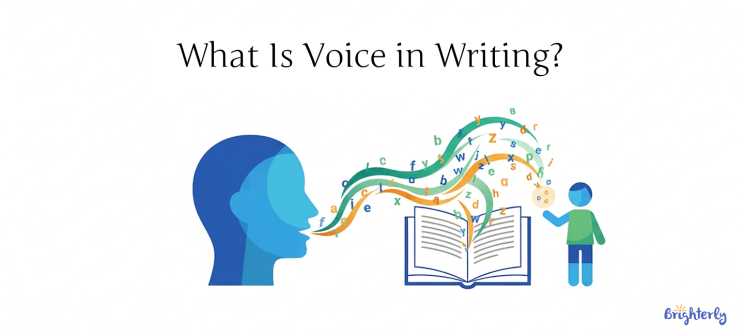
Your child’s writing should showcase their own worldview. When a young writer begins to use personality in their writing and transcends basic grammar, they find their voice. This guide explains what is voice in writing and how to help your student move from robotic compositions to compelling, emotional storytelling.
Key takeaways
- A piece of writing’s voice is its own “sound” and personality.
- It sets student work apart from formulaic or AI-generated material.
- Experimenting with word choice, phrase structure, and tone is necessary to develop a voice.
- Strong voices create a link between the reader and the narrator.
What does voice mean in writing?
Voice in writing means the mixture of tone, word choice, point of view, syntax, punctuation, and rhythm that makes up sentences and paragraphs. A novel may include multiple voices in writing, such as those of the characters, the narrator, and the author. You may defy standard grammar norms in favor of narrative value in order to establish your writing voice.
Developing this skill is often a natural next step once children become comfortable with language through word games for kids, which allow them to play with vocabulary without the pressure of a formal assignment. According to the National Writing Project, developing a personal voice is essential for student engagement and long-term literacy success.
Why is voice important in writing?
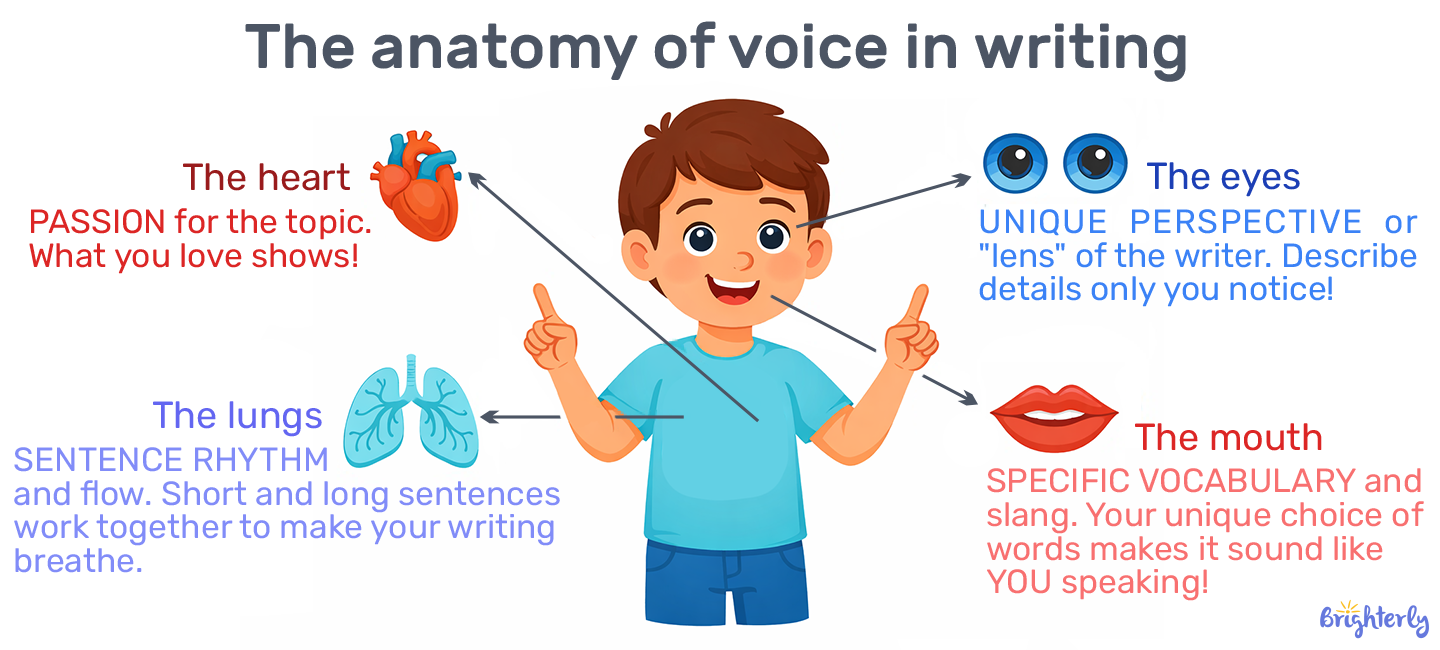
There is a reason that people have “all-time favorite authors.” Finding your voice is vital to gaining a loyal following. It’s just as important to have your voice as it is to have your story. Storytelling is determined by your purpose and your audience’s experience of the story. Novels are nothing more than a jumble of words if they lack a distinct voice.
It’s your distinct:
- Personality
- Character
- Passion
- Emotion
- Purpose
It is the lens through which you view the world and yourself. In your own unique voice, you set the tone and convey your message.
Writing voice vs no voice
Comparing a “voiced” text to a “voiceless” text is akin to contrasting a hand-drawn drawing with a photograph. One is personal, while the other is functional.
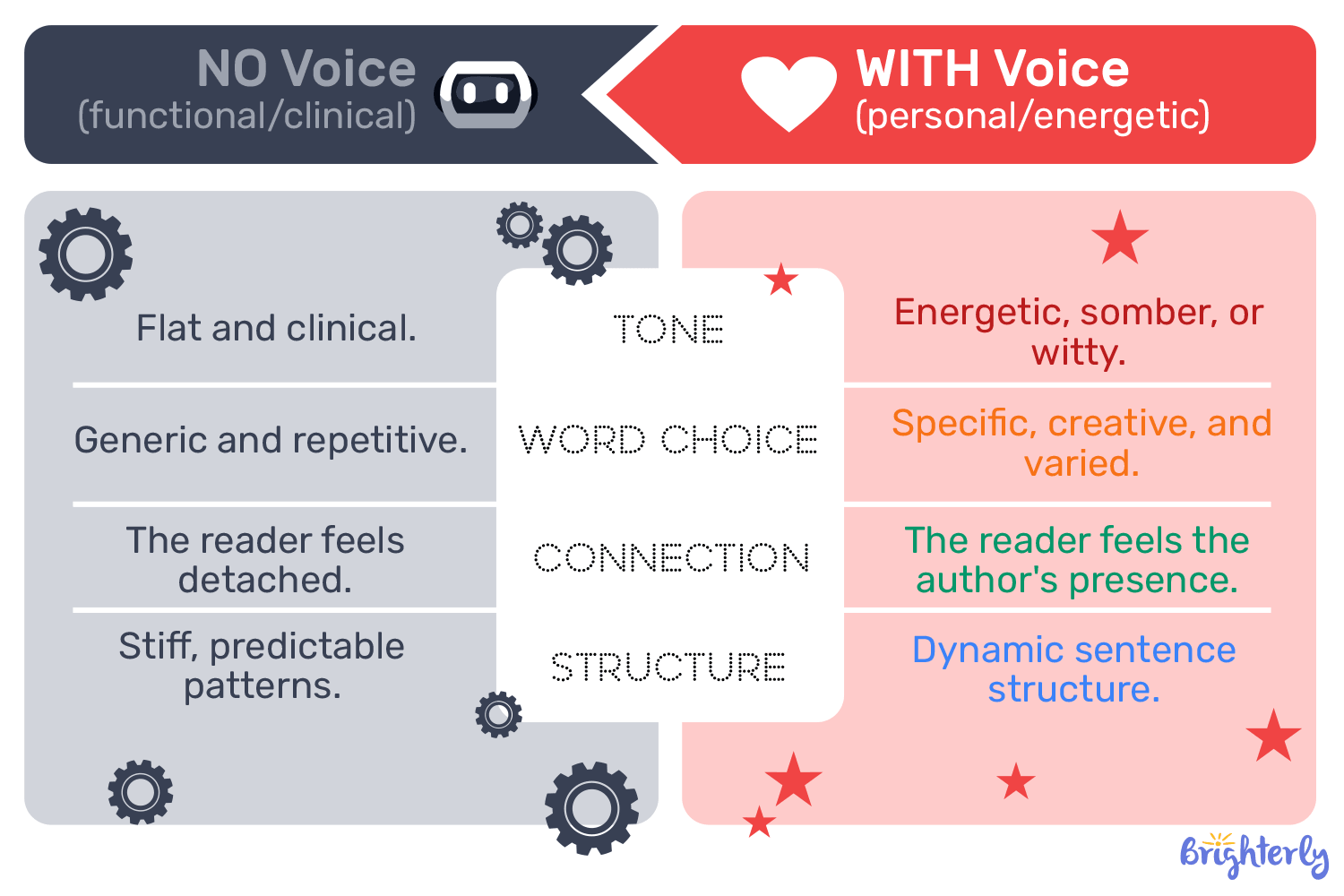
What makes a writer’s voice unique?
- Diction: Does the youngster favor flowery, eloquent language or straightforward, snappy words?
- Punctuation: Do they employ lengthy, flowing ideas or brief, urgent sentences?
- Perspective: What is their worldview? An hopeful voice sounds different than a cynical one.
Note: Thousands of small decisions combine to create a distinctive writer’s voice. It’s how a student chooses to describe a sunset or how they view a scenario in the third person.
Examples of voice in writing
Compare these two descriptions of a rainy day to help your child understand:
- No voice: Outside, it was pouring. The ground was damp. We were unable to visit the park.
- Strong voice: At last, the clouds broke, engulfing our plans for a picnic in a muddy chaos. Officially, the park was off-limits.
Our reading & writing test can help identify if your child is struggling with basic mechanics or if they are ready to start refining these stylistic elements. Each version conveys the same information but introduces a completely different narrator. These are clear voice in writing examples that demonstrate how personality changes a text.
If a child’s writing consistently lacks this “spark” or remains strictly functional despite age-appropriate instruction, it may be good to look for signs of reading comprehension problems, as a deep understanding of others’ voices is usually the precursor to developing one’s own.
Our expert tutors help kids turn basic sentences into expressive, engaging stories.
Help your child find their unique writing voice
Types of voice in writing
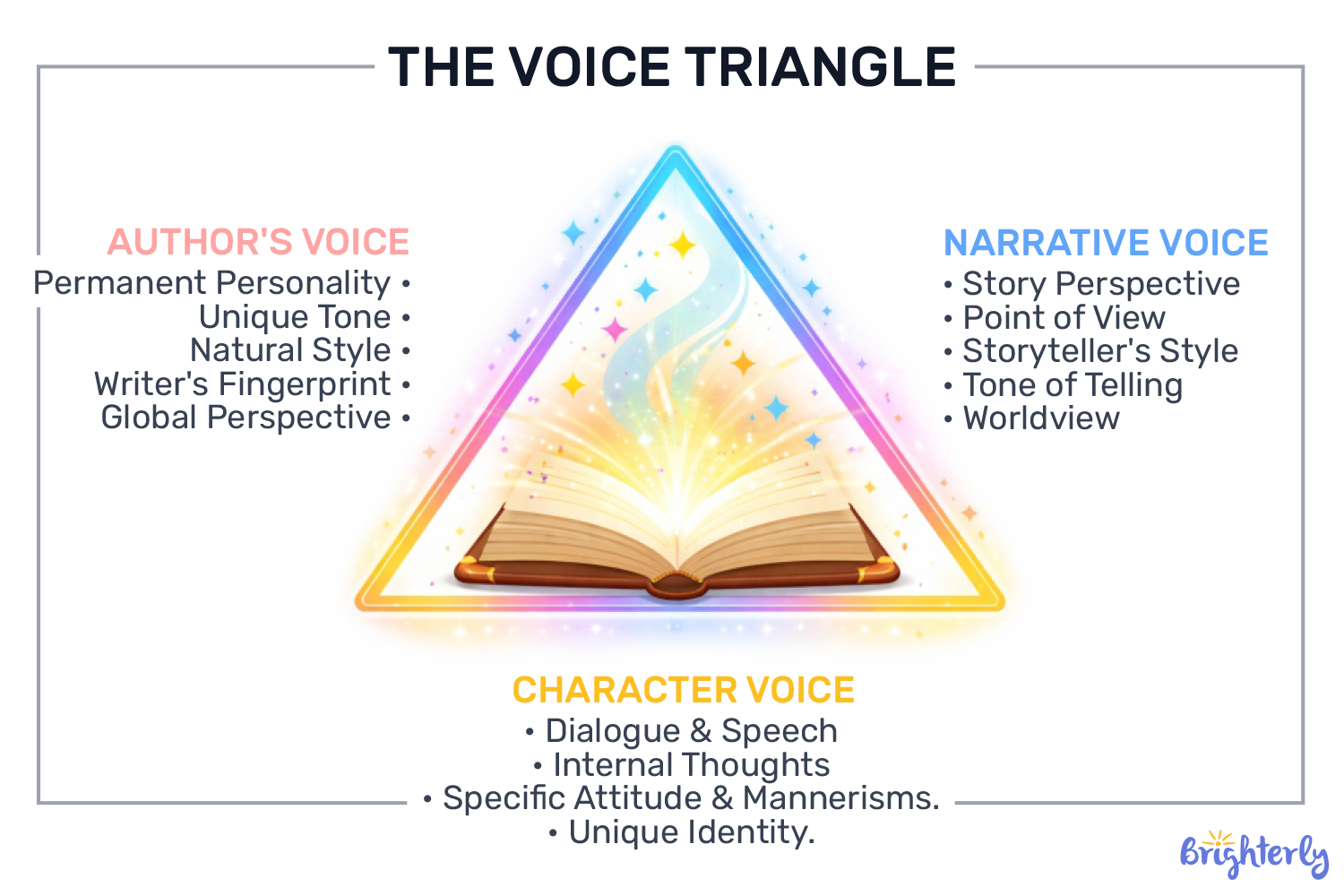
Narrative voice
An author’s narrative voice is how they tell a story from a particular point of view. The four types of narrative voice are first person, second person, third person limited, and third person omniscient.
- First person: Using pronouns such as “I” and “we,” the narrator is also a character.
- Second person: Through the use of the pronoun “you,” the reader becomes a character in the story.
- Third person limited: A third-person limited narrator exists outside the story and uses pronouns like “he,” “she,” and “they.”.
- Third-person omniscient: A third-person omniscient narrator is all-knowing and exists outside the story. The author or an unnamed entity could use third-person pronouns.
Narrators can have voices that are similar to those of the author or characters, or they can be completely distinct. A great way to practice this is through RAFT writing for kids, which stands for Role, Audience, Format, and Topic. By changing the “Role,” students can experiment with various narrative perspectives.
Narrative voice examples
- The narrator of “Best Friend” says, “You won’t believe what happened as we stepped into the ancient house.”
- The “Scientific” Narrator: “The subjects entered the structure at precisely 0800 hours, observing the disintegration of the flooring.”
Our expert tutors help kids turn basic sentences into expressive, engaging stories.
Help your child find their unique writing voice
Author’s voice
The voice of an author can be defined in many ways, from tone to word selection to punctuation. An author’s uniqueness lies in all his or her qualities.
Presented with a trip to the park, one writer may focus on the sun’s rays and the breeze’s effect on their character, while another might describe the people the character encounters. Described differently by the two writers, these descriptions contrast because of the difference in their worldviews.
In addition to Stephen King, some authors have instantly recognizable voices, regardless of the topic they are writing about. In his 60-plus books, he uses original characters, uses different storylines, and covers many different topics.
Author’s voice examples
The author voice of King remains undeniably common among them all, despite their differences. It was this recognizable voice that led to King’s pseudonym Richard Bachman being exposed in 1985, only eight years after he began writing under it. This serves as a primary author’s voice example in modern literature.
Character voice
The easiest type of voice to distinguish is the character voice. It is important that every character, even a minor one, has a distinct voice. The thoughts, personality, and speech of a character convey the character’s voice.
Dialog tags, an in-depth point of view (first person or third-person limited), and word choices reveal a character’s thoughts. They may act in ways that contradict their true motives, as well as their words.
Characters’ personalities are defined by their actions and words. Their characteristics reveal who they are and how they see the world. It is likely that two characters will interpret the same situation entirely differently.
The dialogue of a character can convey a wide range of information, such as their mood, age, life experience, health, and emotions. An old character may speak with an experience-worn voice. It is possible for a character to appear naive and preppy if he or she is young.
The thoughts, personality, and speech of a character convey their voice. To make characters feel real, parents can teach their children how to develop a character by giving them specific quirks, speech patterns, and motivations.
Character voice examples
A pirate character will use different words than a space captain. A pirate might say, “Ye best be moving,” while a captain says, “Initiate departure.”
How to find and develop your writing voice
- Read everything. Exposure to different voices helps kids see what is possible.
- Write as you speak. Have your child record themselves telling a story, then transcribe it.
- Pay attention to word choice. Instead of “good,” try “spectacular” or “solid.”
- Experiment with sentence structure. Mix short, punchy sentences with longer, flowing ones.
- Introducing various types of poetry for kids (like haikus or limericks) can help them find their rhythm and learn how to be concise or lyrical.
- Steer clear of the passive voice. To speed up the narrative, use active verbs.
- A 10-minute “free write”. Doing everyday practice is frequently recommended by our writing tutors to allow the unfiltered natural voice to emerge.
- Request feedback. Ask someone else, “Who do you suppose authored this?” after they have read the piece.
Note: Our Brighterly educational platform provides tools to help students refine these skills in a supportive environment. You can explore our study tips for kids to build a better writing routine.
Conclusion: What is your writing voice?
At Brighterly, we believe that every child has a story worth telling. A powerful writing voice is the vehicle for that. It is the combination of their personality, their chosen tone, and their courage to be themselves on paper. By practicing different ways to describe voices and experimenting with narration, your child will eventually stop writing for the grade and start writing for the reader.
FAQ
What does it mean to have a strong writing voice?
A strong writing voice means the writing is distinctive and consistent. The reader can identify the author’s perspective and feel an emotional connection to the text. It avoids the passive and generic “academic” drone.
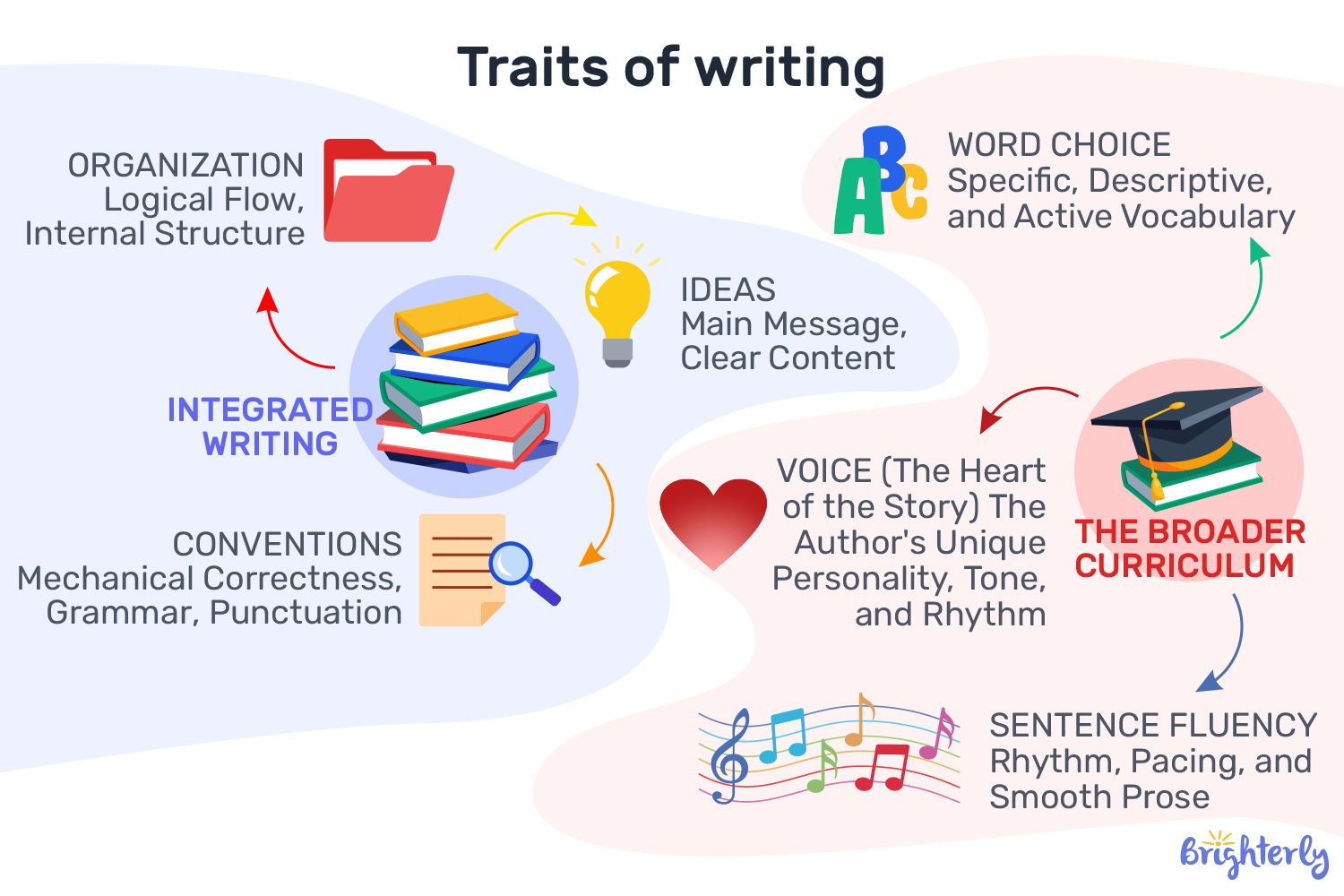
What are the six traits of writing voice?
The six traits of writing are:
- Ideas: The primary ideas and particulars that make your writing compelling to read.
- Organization: Your piece’s road plan; how you arrange the facts to get the reader from point A to point B.
- Voice: The individual behind the pen, which gives your writing a certain “human” quality that appeals to readers.
- Word choice. Is the skill of selecting just the appropriate verb or term to convey a clear message or a vivid mental image.
- Sentence fluency. Is the rhythm and flow of your writing, making sure that, when read aloud, your phrasing sounds melodious and natural.
What is the difference between writing style and writing voice?
Style is the technical “how” (grammar, syntax, formal vs. informal), whereas voice is the “who” (the personality and heart behind the words), yet the terms are frequently used interchangeably. Voice is the wearer; style is the attire.
What makes a good voice in writing?
An authentic voice is a good one. It gives the reader a sense of character and facilitates a clear understanding of the topic. It employs precise details and active verbs to make a story come to life.


A neurodivergent child faces way more challenges when learning, compared to other kids. That’s why such kids need special attention and additional help to get through their studies. Some parents struggle to provide such support because they simply don’t know their child is neurodivergent. To make sure this doesn’t happen, read this guide on the […]

Mar 23, 2026
Math & reading from 1st to 9th grade
Looking for homework support for your child?

Choose kid's grade

Math & Reading for Grades 1–9
Build real confidence for your child with a Brighterly math or reading tutor.