
What is a Right Scalene Triangle? Definition and Examples
Updated on April 29, 2026
A right scalene triangle is a specific type of three-sided polygon that combines the characteristics of both a right-angled triangle and a scalene triangle. This geometric shape contains one internal angle that measures exactly 90 degrees, which is known as a right angle, while the other two interior angles are acute and of different measures. Because it is a scalene triangle, all three of its sides have unequal lengths, and consequently, all three of its interior angles are unique.
In the study of geometry, the right scalene triangle is an essential figure used to demonstrate fundamental principles such as the Pythagorean theorem and basic trigonometric functions. The side located directly across from the 90-degree angle is always the longest side, referred to as the hypotenuse, while the other two sides are called the legs. This triangle is highly versatile in practical applications, appearing frequently in architectural designs, engineering blueprints, and physics problems involving inclined planes and vectors.
To identify a right scalene triangle, one must verify that no two sides are congruent and that the square of the longest side equals the sum of the squares of the two shorter sides. This configuration ensures that the triangle is asymmetrical, possessing no lines of symmetry or equal angles. Understanding the relationship between its unequal sides and its right-angle property allows students to solve complex spatial problems by breaking down shapes into manageable components for measurement and calculation.
What is right scalene triangle?
A right scalene triangle is defined as a triangle that possesses one 90-degree angle and three sides of entirely different lengths. In this classification, the term “right” indicates the presence of the 90-degree vertex, while “scalene” signifies that all three side measurements are unique.
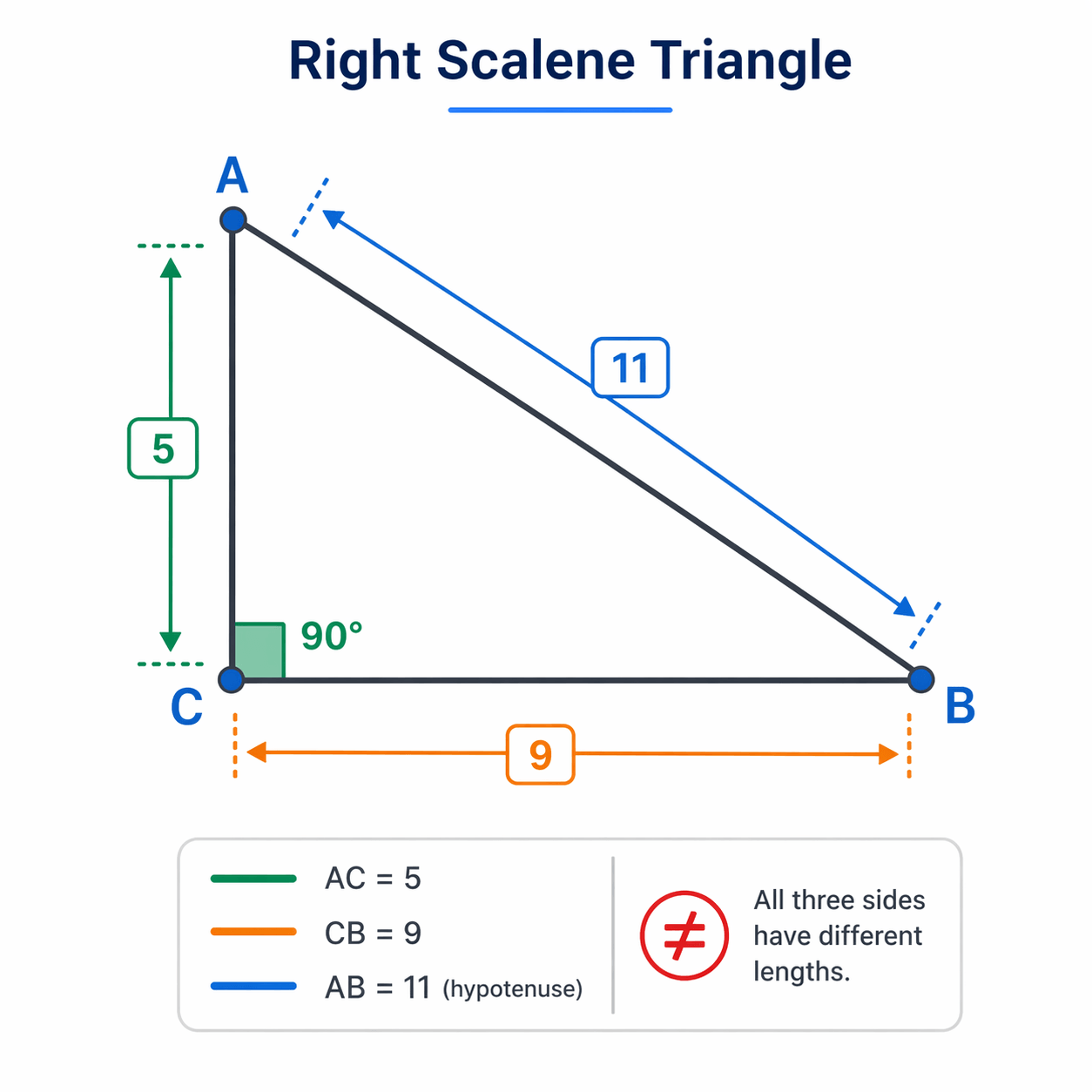
Because the sides are unequal, the three interior angles must also be unequal, resulting in a 90-degree angle paired with two different acute angles that sum to 90 degrees. This triangle represents a category of polygons where no symmetry exists, distinguishing it from right isosceles triangles where two legs are equal in length.


Help your child reach their full potential!
Answer a few quick questions about your child’s learning, and we’ll recommend next steps.
Expert Math Tutors for Every Level
Connect with professional and certified educators who provide specialized support for every grade level, from elementary school basics to advanced algebra
Properties of a Right Scalene Triangle
The primary properties of a right scalene triangle involve the distinct relationships between its unequal sides and its specific interior angle measurements. These properties ensure that every right scalene triangle follows the laws of Euclidean geometry while remaining asymmetrical in its physical form.
- One interior angle is exactly 90 degrees, making it a right triangle.
- All three sides (hypotenuse, base, and height) have different lengths.
- All three interior angles have different degree measures.
- The two acute angles are complementary, meaning they add up to 90 degrees.
- The longest side is always the hypotenuse, which is opposite the 90-degree angle.
- The triangle has no lines of symmetry and cannot be folded into matching halves.
- The sides always satisfy the Pythagorean theorem: a² + b² = c².
- The smallest angle is always opposite the shortest side, and the middle-sized angle is opposite the middle-sized side.
- It cannot be an equilateral or isosceles triangle because all sides and angles must be distinct.
Right Scalene Triangle Formulas
The mathematical formulas used for a right scalene triangle are designed to calculate its area, perimeter, and missing side lengths using the known values of its unequal sides and right angle. These formulas are standard across geometry and are vital for solving real-world measurement problems.
Area of a Right Scalene Triangle
The area represents the total space enclosed within the three sides of the triangle and is measured in square units. For a right scalene triangle, the simplest way to calculate area is by using the two legs that form the right angle, as one leg serves as the base and the other serves as the height. The formula is Area = 1/2 × base × height. In this context, the base and height are the two shorter sides (legs) of the triangle, not the hypotenuse. Alternatively, if all three sides are known but the height is not clearly identified, Heron’s Formula can be used to find the area by first calculating the semi-perimeter.
Perimeter of a Right Scalene Triangle
The perimeter is the total distance around the outside of the triangle, calculated by adding the lengths of all three unequal sides together. The formula is Perimeter = a + b + c, where “a” and “b” represent the legs and “c” represents the hypotenuse. If only two sides of a right scalene triangle are known, the third side must be found using the Pythagorean theorem before the perimeter can be calculated. This measurement is useful in practical tasks like determining the length of fencing or framing required for a triangular space.
Solved Examples on right scalene triangle
Applying formulas to specific numerical values helps clarify how the properties of a right scalene triangle function in practical calculations. These examples demonstrate the step-by-step process for finding area, perimeter, and missing side lengths.
Example 1: Finding Area with Base and Height
Consider a right scalene triangle with a base of 6 cm and a height of 8 cm. To find the area, we use the standard formula: Area = 1/2 × base × height. By substituting the values, we get Area = 1/2 × 6 × 8. First, multiply 6 by 8 to get 48. Then, divide by 2 to reach the final result. The area of this triangle is 24 square centimeters. This example assumes the 6 cm and 8 cm sides are the legs meeting at the right angle.
Example 2: Calculating Perimeter from Three Sides
Suppose a right scalene triangle has side lengths of 5 meters, 12 meters, and 13 meters. To find the perimeter, we add all three sides together using the formula: Perimeter = a + b + c. Substituting the values gives us Perimeter = 5 + 12 + 13. Adding 5 and 12 results in 17, and adding 13 to that sum results in 30. Therefore, the perimeter of the triangle is 30 meters. In this case, 13 is the hypotenuse because it is the longest side.
Example 3: Finding the Hypotenuse Using Pythagoras Theorem
If a right scalene triangle has legs measuring 9 inches and 12 inches, we can find the hypotenuse (c) using the formula a² + b² = c². Plugging in the numbers, we get 9² + 12² = c², which simplifies to 81 + 144 = c². Adding these results gives 225 = c². Taking the square root of 225 reveals that c = 15. The hypotenuse of the triangle is 15 inches long. Since 9, 12, and 15 are all different, this is confirmed as a right scalene triangle.
Example 4: Area Calculation Using Heron’s Formula
For a right scalene triangle with sides 3, 4, and 5, we can use Heron’s Formula to verify the area. First, find the semi-perimeter (s): (3 + 4 + 5) / 2 = 6. The formula is Area = √[s(s-a)(s-b)(s-c)]. Substituting the values, we get Area = √[6(6-3)(6-4)(6-5)], which becomes Area = √[6 × 3 × 2 × 1]. This simplifies to √36, which equals 6. The area is 6 square units. This matches the result of the standard formula (1/2 × 3 × 4 = 6), proving Heron’s Formula works for right scalene triangles.
FAQ
Can a right triangle be scalene?
Yes, a right triangle can be scalene, and in fact, most right triangles are scalene. A right triangle is classified as scalene whenever all three of its sides have different lengths. For instance, a triangle with sides measuring 3, 4, and 5 is a right triangle because it fits the Pythagorean theorem (9 + 16 = 25), and it is scalene because 3, 4, and 5 are all different numbers. The only time a right triangle is not scalene is when it is an isosceles right triangle, which happens when the two legs are exactly the same length.
What is the longest side of a right scalene triangle called?
The longest side of a right scalene triangle is always called the hypotenuse. This side is uniquely positioned directly opposite the 90-degree right angle. In any right-angled triangle, the hypotenuse is guaranteed to be longer than either of the other two sides, which are known as the legs. In a scalene version, the two legs will also be different from each other in length. The hypotenuse is the side used in the Pythagorean theorem as the “c” value (a² + b² = c²) and is the side associated with the sine and cosine trigonometric ratios.
Does a right scalene triangle have a line of symmetry?
No, a right scalene triangle does not have any lines of symmetry. A line of symmetry is a line that divides a shape into two identical mirror images. Because a scalene triangle has three sides of different lengths and three angles of different measures, there is no way to fold or divide it so that the two sides match perfectly. This lack of symmetry is a defining characteristic of scalene triangles. In contrast, an isosceles right triangle has one line of symmetry that passes through the right-angle vertex to the midpoint of the hypotenuse.
How do you find the area of a right scalene triangle without the height?
If the height of a right scalene triangle is not known, you can find the area using Heron’s Formula if you know the lengths of all three sides. First, you calculate the semi-perimeter (s) by adding the three sides together and dividing the sum by two. Then, you use the formula: Area = √[s(s-a)(s-b)(s-c)], where a, b, and c are the side lengths. Alternatively, if you know the lengths of two sides and the angle between them, you can use trigonometry (Area = 1/2 × a × b × sin C) to calculate the area accurately.


Math & reading from 1st to 12th grade
Looking for homework support for your child?

Choose kid's grade

Math & Reading for Grades 1–12
Build real confidence for your child with a Brighterly math or reading tutor.