
What is a Right Square Prism? Formula and Examples
Updated on April 29, 2026
A right square prism is a three-dimensional geometric solid that features two identical, parallel square bases connected by four rectangular lateral faces. It is a specific type of cuboid where the length and width of the base are equal, making the bottom and top surfaces perfect squares. This shape is commonly referred to as a square cuboid or a square box in informal settings.
The term right indicates that the lateral faces of the prism are perpendicular to the square bases, ensuring the structure stands perfectly upright without any tilt. Because the side faces meet the bases at 90-degree angles, the lateral edges also represent the actual height of the prism. This perpendicular alignment distinguishes it from oblique prisms, which appear leaned or slanted.
In the study of spatial geometry, the right square prism serves as an important intermediate shape between a general rectangular prism and a cube. While all cubes are right square prisms because they have square bases and 90-degree angles, a right square prism only becomes a cube if its height is also equal to the side length of its square base. Understanding this shape is essential for calculating volume and surface area in various architectural and engineering applications.
What is a Right Square Prism?
A right square prism is a polyhedron defined by having two congruent square bases and four rectangular side faces that are perpendicular to those bases. This geometric configuration ensures that the top base is positioned directly above the bottom base, creating uniform cross-sections throughout its entire height.
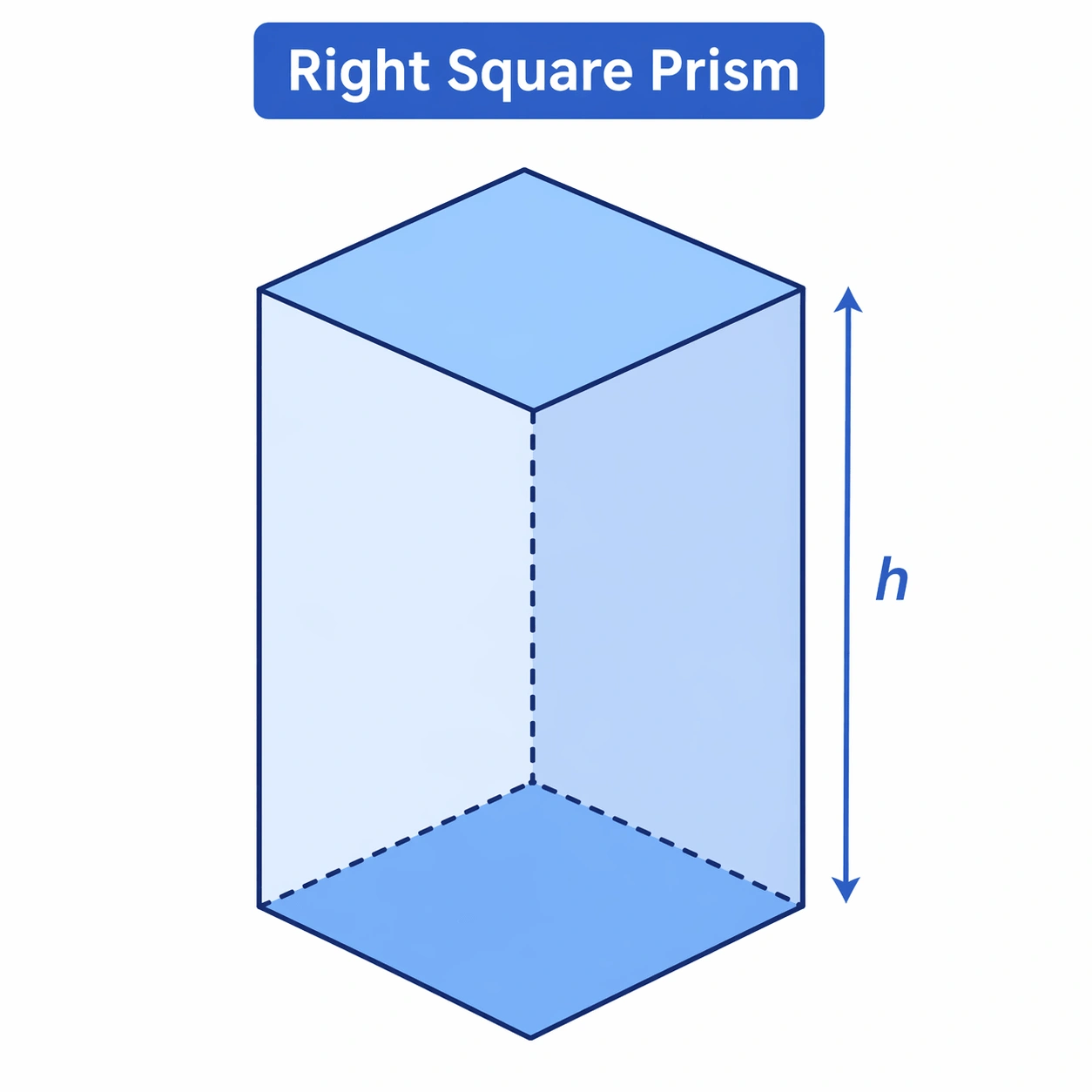
It is classified as a right prism because its lateral edges are perpendicular to the planes of its bases, and it is specifically a square prism because the polygons forming its bases have four equal sides and four right angles.


Help your child reach their full potential!
Answer a few quick questions about your child’s learning, and we’ll recommend next steps.
Expert Math Tutors for Every Level
Connect with professional and certified educators who provide specialized support for every grade level, from elementary school basics to advanced algebra
Properties of a Right Square Prism
The properties of a right square prism define its physical structure and help distinguish it from other polyhedra through specific counts of faces, edges, and vertices. These characteristics remain constant for any right square prism, regardless of its total size or the specific measurements of its height and base side lengths.
- It has exactly 6 faces: 2 identical square bases and 4 rectangular lateral faces.
- It contains 12 edges: 8 edges belong to the square bases and 4 are lateral edges representing the height.
- It possesses 8 vertices, which are the corner points where three edges meet.
- The opposite faces of the prism are parallel and congruent to one another.
- All lateral faces are rectangles and are perpendicular to the top and bottom square bases.
- The diagonals of the prism bisect each other, and consecutive angles between faces are supplementary.
- Every cross-section taken parallel to the base is a square identical to the base itself.
Right Square Prism Formulas
Mathematical formulas for a right square prism allow for the calculation of the space it occupies and the total area of its outer surfaces. In these formulas, let a represent the side length of the square base and h represent the height of the prism. Because the base is a square, the base area is always calculated as a squared, and the perimeter of the base is always 4 multiplied by a.
Volume of a Right Square Prism
The volume of a right square prism measures the total amount of three-dimensional space enclosed within its faces. The general formula for the volume of any prism is the area of the base multiplied by the height. For a square base with side length a, the area is a multiplied by a. Therefore, the volume formula is V = a²h. Volume is always expressed in cubic units, such as cubic centimeters (cm³) or cubic inches (in³).
Surface Area of a Right Square Prism
The total surface area of a right square prism is the sum of the areas of all six of its faces. This include the two square bases and the four rectangular lateral faces. The formula is derived by adding twice the base area (2a²) to the lateral surface area (4ah). This results in the complete formula: TSA = 2a² + 4ah. This measurement is vital for determining the amount of material needed to wrap or coat the exterior of a square box.
Lateral Surface Area of a Right Square Prism
Lateral surface area refers only to the area of the four side faces, excluding the top and bottom square bases. Since there are four identical rectangular faces, each with a width of a and a height of h, the area of one face is ah. Multiplying this by four gives the lateral surface area formula: LSA = 4ah. This calculation is used when only the sides of a structure, such as the walls of a square room, need to be measured.
Net of a Right Square Prism
A net is a two-dimensional pattern that can be folded to create a three-dimensional solid. The net of a right square prism consists of six flat shapes: two identical squares that act as the bases and four rectangles that form the lateral sides. When the prism is flattened, the four rectangles are typically arranged in a row, with the two squares attached to opposite sides of one of the rectangles. This visual representation helps students understand how the three-dimensional surface area is composed of individual two-dimensional shapes. By calculating the area of each shape in the net and adding them together, one can verify the total surface area formula.
Solved Examples on Right Square Prism
Applying formulas to specific measurements helps illustrate how to solve different practical geometry problems involving right square prisms. These examples demonstrate the step-by-step process for finding volume and surface area using the standard side length and height variables.
Example 1
Find the volume of a right square prism where the side of the square base is 5 cm and the height is 10 cm. First, identify the variables: a = 5 and h = 10. Use the volume formula V = a²h. Plugging in the values, we get V = 5² × 10, which is 25 × 10. The total volume is 250 cubic centimeters (cm³).
Example 2
Calculate the total surface area of a right square prism with a base side of 4 inches and a height of 12 inches. Here, a = 4 and h = 12. Use the formula TSA = 2a² + 4ah. First, calculate the base area part: 2(4²) = 2(16) = 32. Next, calculate the lateral area part: 4(4)(12) = 192. Adding them together, 32 + 192 = 224. The total surface area is 224 square inches (in²).
Example 3
A right square prism has a volume of 144 cubic meters and a height of 9 meters. What is the side length of its square base? Use the formula V = a²h and solve for a. 144 = a² × 9. Divide both sides by 9 to get 16 = a². Taking the square root of 16, we find that a = 4. The side length of the base is 4 meters.
Example 4
Determine the lateral surface area of a square prism with a base side of 6 cm and a height of 15 cm. Identify the variables: a = 6 and h = 15. Use the lateral surface area formula LSA = 4ah. Multiplying the values gives 4 × 6 × 15. This results in 24 × 15, which equals 360. The lateral surface area is 360 square centimeters (cm²).
FAQ
What is the difference between a right square prism and a cube?
While both shapes share many similarities, the primary difference lies in the relationship between their dimensions. A right square prism must have a square base and lateral faces perpendicular to that base, but its height can be any value. A cube is a special, highly specific type of right square prism where the height is exactly equal to the side length of the square base. This means that in a cube, all six faces are identical squares. In a general right square prism, only the top and bottom faces must be squares, while the four side faces are typically non-square rectangles. Therefore, every cube is a right square prism, but not every right square prism is a cube.
How many faces does a right square prism have?
A right square prism has a total of 6 faces. These faces are divided into two distinct groups based on their shape and position. The first group consists of the 2 identical square bases located at the top and the bottom of the figure. These bases are parallel to each other. The second group consists of the 4 lateral faces that connect the two bases. In a right square prism, these 4 lateral faces are always rectangles. Together, these 2 squares and 4 rectangles make up the 6 flat surfaces of the polyhedron. This face count is the same as that of a cube or a standard rectangular prism.
What is the difference between a right square prism and an oblique square prism?
The difference between a right square prism and an oblique square prism is the angle at which the lateral faces meet the bases. In a right square prism, the lateral faces are perpendicular to the bases, meaning they meet at a perfect 90-degree angle. This results in the top base being perfectly aligned directly above the bottom base. In an oblique square prism, the lateral faces are not perpendicular to the bases, causing the prism to appear tilted or slanted. While the bases of an oblique prism are still congruent squares, the side faces are parallelograms rather than rectangles, and the height of the prism is measured as the vertical distance between the bases rather than the length of a side edge.
Is a right square prism a rectangular prism?
Yes, a right square prism is a specific type of rectangular prism. By definition, a rectangular prism is a 3D shape with six faces that are all rectangles. Since a square is a special type of rectangle (one with four equal sides), a prism with square bases meets all the criteria of a rectangular prism. In geometry, this is often described as a hierarchical relationship: all right square prisms are rectangular prisms, but not all rectangular prisms are square prisms. A standard rectangular prism can have a base with different lengths and widths, whereas a square prism specifically requires those two dimensions to be equal.
What are the real-life examples of a right square prism?
Right square prisms are common in daily life because they are efficient for storage and structural stability. One of the most frequent examples is a standard cardboard shipping box that has a square bottom. Other examples include certain types of tissue boxes, building columns with square footprints, and skyscraper designs that maintain a square cross-section from the ground to the roof. You can also see this shape in tall batteries, some kitchen containers, and bar magnets. In nature and play, crystals with square ends and certain wooden building blocks also represent the geometry of a right square prism. Identifying these shapes helps students connect abstract geometry to the physical world around them.



Math & reading from 1st to 12th grade
Looking for homework support for your child?

Choose kid's grade

Math & Reading for Grades 1–12
Build real confidence for your child with a Brighterly math or reading tutor.