What is AM and PM? Meaning and Examples Explained
Updated on April 29, 2026
The abbreviations am and pm are labels used in the 12-hour clock system to distinguish between the two halves of a 24-hour day. These markers indicate whether a specific time occurs during the first 12-hour cycle or the second 12-hour cycle. By using these designations, individuals can clearly communicate times without needing to use the 24-hour format.
In the 12-hour system, the day is divided into two segments that each last 12 hours. The first segment begins at midnight and continues until the moment before noon, while the second segment begins at noon and continues until the moment before the next midnight. This method of timekeeping is widely used in daily life for scheduling school, work, and social activities in many countries around the world.
What is am and pm?
The terms am and pm are time indicators used in the 12-hour clock system to identify the two separate 12-hour periods that make up a full 24-hour calendar day. The 12-hour clock repeats the numbers 1 through 12 twice every day, so these abbreviations serve as the primary way to tell if a time is in the morning or the afternoon and evening.
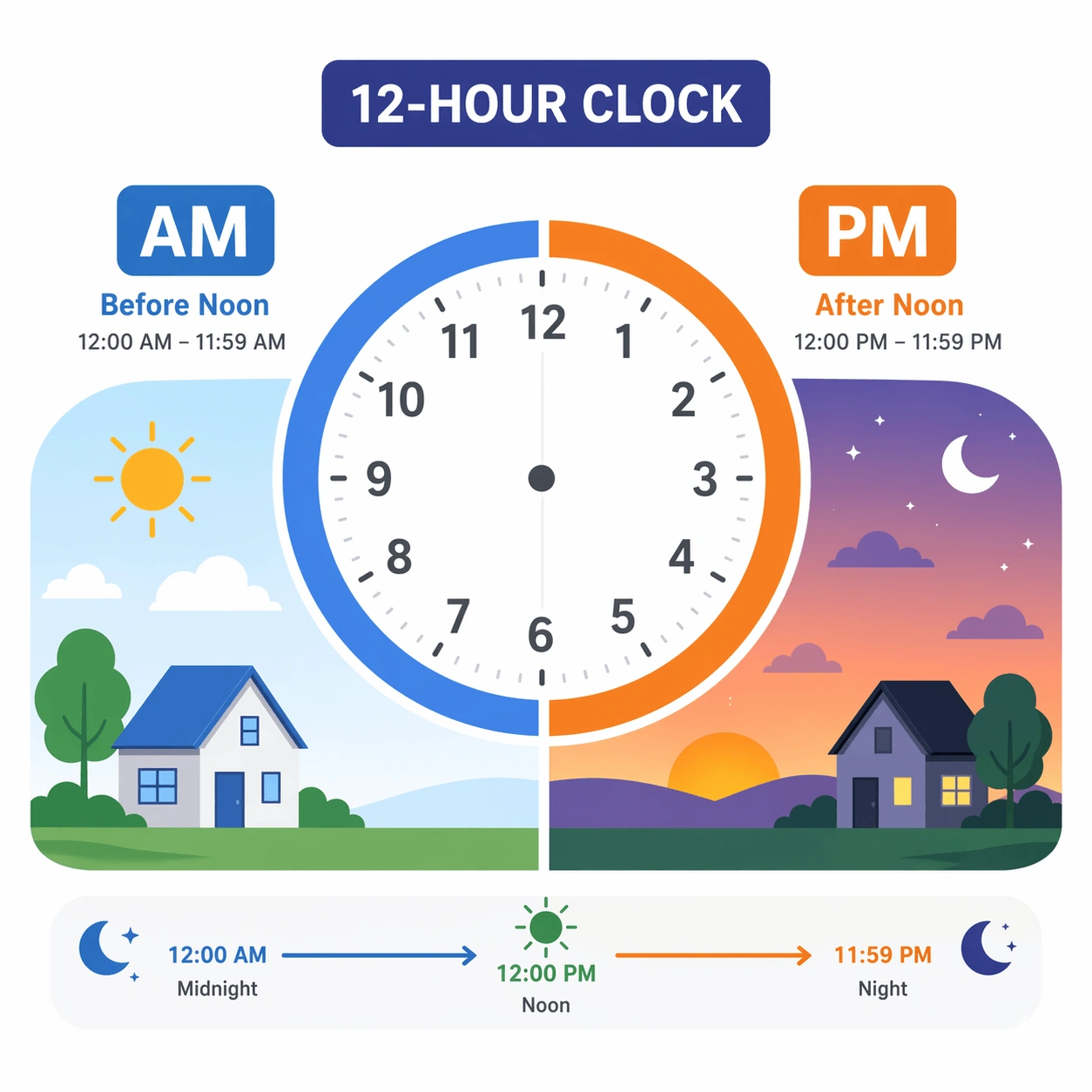
Quick Reference:
| Time | Meaning | Example |
| AM | Morning (after midnight) | 7:00 AM = 7 in the morning |
| PM | Afternoon/Evening | 7:00 PM = 7 in the evening |
| 12:00 AM | Midnight | Start of a new day |
| 12:00 PM | Noon | Middle of the day |
Help your child reach their full potential!
Answer a few quick questions about your child’s learning, and we’ll recommend next steps. 

Expert Math Tutors for Every Level
Connect with professional and certified educators who provide specialized support for every grade level, from elementary school basics to advanced algebra
Full Form of AM and PM
The full forms of these abbreviations are derived from Latin phrases that describe the position of the sun relative to the meridian, which is an imaginary line that passes through the sky directly overhead at midday. AM stands for ante meridiem, which translates literally to before midday. PM stands for post meridiem, which means after midday. These historical terms reflect how humans have used the sun’s position to track the passage of time for centuries.
Difference Between AM and PM
The primary difference between am and pm is the specific 12-hour window of the day they represent, with am covering the hours from midnight to just before noon and pm covering the hours from noon to just before midnight. This distinction is vital because it separates the early morning and late night hours from the afternoon and evening hours. Without these labels, a time like 8:00 could mean breakfast time or bedtime, causing significant confusion in communication.
How the 12-Hour Clock Works
The 12-hour clock works by splitting the 24 hours of a day into two equal parts, each lasting 12 hours. On an analog clock, the hour hand completes two full rotations every day. The first rotation covers the am hours, and the second rotation covers the pm hours. The system uses the numbers 1 through 12. Interestingly, the sequence starts at 12 instead of zero, meaning that 12:00 am is followed by 1:00 am, and 12:00 pm is followed by 1:00 pm. This traditional numbering can be unique compared to other measurement systems that typically start at zero.
Noon and Midnight in the AM/PM System
Noon and midnight are the transition points in the 12-hour system and can sometimes be confusing because they represent the exact moments when the cycle switches. Conventionally, 12:00 pm is used to designate noon, the middle of the day. Conversely, 12:00 am is used to designate midnight, which is the exact start of a new day. Because these moments are neither strictly before nor after the meridian, some people prefer to use the words noon and midnight instead of am and pm to ensure there is no misunderstanding, especially when setting deadlines or departure times.
Converting Between 12-Hour and 24-Hour Time
Converting between the 12-hour and 24-hour clock systems requires adding or subtracting 12 hours for times that occur in the afternoon and evening. The 24-hour clock, often called military time, does not use am or pm because it uses a unique number for every hour of the day from 00:00 to 23:59. To convert am times to 24-hour time, the numbers generally stay the same, except for the 12:00 am hour, which becomes 00:00. To convert pm times (from 1:00 pm onwards), you add 12 to the hour. For example, 3:00 pm becomes 15:00 in the 24-hour format.
Solved Examples on what is am and pm
Applying the rules of am and pm to real-world scenarios helps students master the concept of the 12-hour clock. These examples demonstrate how to identify the correct label, convert between systems, and calculate time differences using the midday dividing line.
Example 1: Identifying Morning and Evening Times
A student wakes up at 6:30 to get ready for school and goes to bed at 9:00. Which labels should be used? Since waking up happens before noon, the time is 6:30 am. Since going to bed happens after the middle of the day has passed, the time is 9:00 pm. Understanding this allows the student to correctly set an alarm clock or write a schedule.
Example 2: Converting 12-Hour Time to 24-Hour Format
Convert 4:15 pm to the 24-hour clock system. To do this, identify that the time is in the pm period. Because it is after noon, add 12 to the hour value: 4 + 12 = 16. The minutes remain the same, so 4:15 pm is written as 16:15 in the 24-hour format. This skill is useful for reading international flight schedules or train timetables.
Example 3: Determining AM or PM for Daily Activities
A soccer game starts at 11:30 and ends two hours later. What time does it end, and is it am or pm? Adding two hours to 11:30 takes the time past the 12:00 noon mark. One hour after 11:30 am is 12:30 pm, and the second hour makes the final time 1:30 pm. Because the time crossed the midday meridian, the label must switch from am to pm.
Example 4: Calculating Elapsed Time Using AM and PM
A library is open from 9:00 am to 8:00 pm. How many hours is the library open? To find the total hours, calculate the time from the start until noon, then from noon until the end. From 9:00 am to 12:00 pm is 3 hours. From 12:00 pm to 8:00 pm is 8 hours. Adding 3 and 8 together gives a total of 11 hours of operation.
FAQ
Is 12:00 p.m. noon or midnight?
Conventionally, 12:00 pm is used to represent noon, while 12:00 am is used to represent midnight. This can be confusing because the word post (after) might suggest that 12:00 pm should be after noon. However, since the very next second—12:00:01—is clearly in the afternoon, digital clocks and most style guides use 12:00 pm as the standard label for noon. Similarly, 12:00 am marks the beginning of the first 12-hour period (ante meridiem) of a new day. To avoid any potential for error, many organizations recommend using the words noon or midnight or adopting a 24-hour clock for clarity.
Which countries use the 12-hour clock system?
The 12-hour clock system with am and pm indicators is the dominant time format in several countries, including the United States, Canada (except Quebec), Australia, New Zealand, India, Pakistan, and the Philippines. In the United Kingdom and some other English-speaking nations, both the 12-hour and 24-hour systems are used depending on the context. While much of the world utilizes the 24-hour clock for official purposes, transportation, and military operations, the 12-hour format remains the preferred choice for casual conversation and analog clock displays due to its simplicity and historical roots in these cultures.
How do you write am and pm correctly in a sentence?
In formal writing, the most common way to write these abbreviations is with lowercase letters and periods, such as a.m. and p.m. However, many modern style guides also accept uppercase versions without periods (AM and PM) or lowercase without periods (am and pm).
The most important rule is to remain consistent throughout your document. You should always include a space between the numerical time and the abbreviation, such as 10:00 a.m. Additionally, if the abbreviation ends a sentence, you do not need to add a second period; the period in the abbreviation serves as the sentence-ending punctuation.
Why does the new day start at 12:00 a.m.?
The new day starts at 12:00 am because midnight is the point furthest from the middle of the day (noon). By starting the new calendar date at midnight, the daylight hours of a single day are kept together in one continuous block, which is much more practical for human activity. If the day started at noon, the date would change right in the middle of school or work hours, making record-keeping very difficult. Although 12:00 am is often called midnight, it represents the exact second that 24 hours have passed since the previous day began, triggering the start of the next 24-hour cycle.



Math & reading from 1st to 12th grade
Looking for homework support for your child?

Choose kid's grade

Math & Reading for Grades 1–12
Build real confidence for your child with a Brighterly math or reading tutor.