
Zero Product Property: Definition and Examples
Updated on April 28, 2026
The zero product property is a fundamental algebraic principle stating that if the product of two or more factors is equal to zero, then at least one of those individual factors must be zero. This rule is essential for solving various types of polynomial equations, particularly quadratic equations, by breaking them down into simpler, solvable parts. It provides a logical bridge between multiplication and equation solving in algebra.
In practical terms, the property means that you cannot multiply two non-zero real numbers and obtain a result of zero. For example, if you have two unknown numbers that multiply together to make zero, you can be certain that either the first number is zero, the second number is zero, or both are zero. This certainty allows mathematicians to isolate variables and find specific solutions for unknown values in complex expressions.
Understanding the zero product property is a key milestone for students moving from basic arithmetic to advanced algebra. It is used extensively to find the x-intercepts or roots of functions, which helps in graphing parabolas and other curves. By mastering this property, students gain a powerful tool for simplifying mathematical problems and verifying their results through substitution.
What is Zero Product Property?
The zero product property is an algebraic rule that identifies zero as a unique result of multiplication, requiring at least one of the input values to be zero for the final product to vanish.
Expert Math Tutors for Every Level
Connect with professional and certified educators who provide specialized support for every grade level, from elementary school basics to advanced algebra
Formula of Zero Product Property
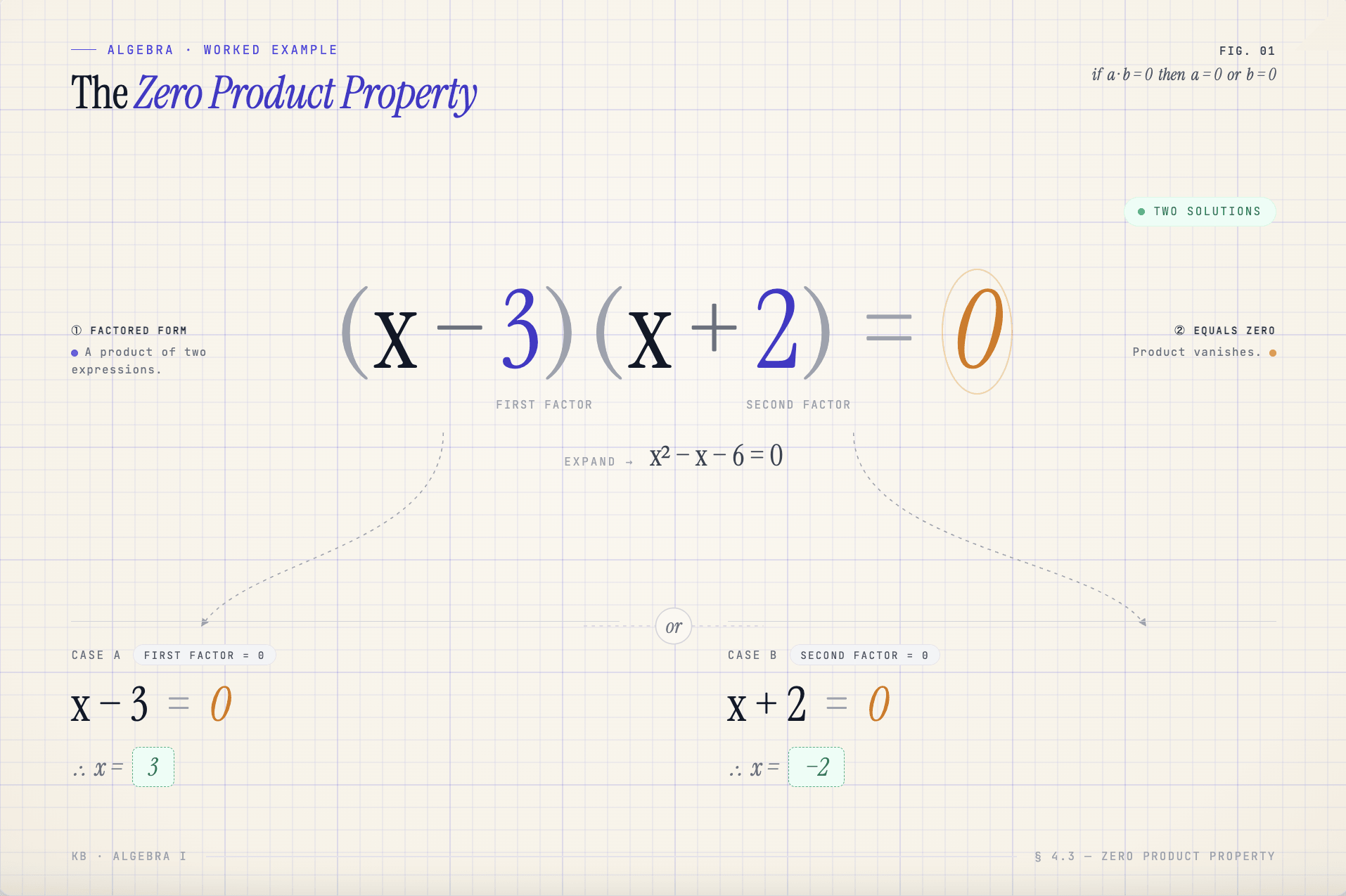
The formula for the zero product property is expressed symbolically to show the relationship between factors and their product. For any real numbers a and b, the property states that if a multiplied by b equals zero (ab = 0), then either a = 0 or b = 0, or both values are zero. This can be extended to any number of factors, such as abc = 0, which implies that a = 0, b = 0, or c = 0. The formula serves as the mathematical foundation for setting individual linear factors to zero during the solving process.
Help your child reach their full potential!
Answer a few quick questions about your child’s learning, and we’ll recommend next steps. 

Solving Equations Using the Zero Product Property
To solve an equation using the zero product property, the equation must first be written in standard form where one side of the equals sign is zero. Once the equation is set to zero, the non-zero side is factored into its simplest components, and then each individual factor is set equal to zero to find the possible values for the variable.
How to Apply the Property to Factored Form
When an equation is already in factored form, such as (x – 5)(x + 2) = 0, applying the zero product property is direct and efficient. You separate the factors into two independent linear equations: x – 5 = 0 and x + 2 = 0. Solving these simple equations yields the roots of the original expression. In this case, adding 5 to both sides of the first equation gives x = 5, and subtracting 2 from both sides of the second equation gives x = -2. These two values are the solutions that make the original product equal to zero.
Solving Quadratic Equations
Solving quadratic equations often requires an extra step of factoring before the zero product property can be applied. If a quadratic is given in the form x squared + 5x + 6 = 0, you must first find two numbers that multiply to 6 and add to 5. These numbers are 2 and 3, allowing you to rewrite the equation as (x + 2)(x + 3) = 0. Once in this factored form, you apply the property by setting x + 2 = 0 and x + 3 = 0, resulting in the solutions x = -2 and x = -3. If the equation is not initially set to zero, you must move all terms to one side before beginning the factoring process.
Importance and Applications
The zero product property is vital because it transforms high-degree polynomial equations into simple linear equations that are much easier to manage. Its primary application is in finding the roots, zeros, or x-intercepts of functions, which is a critical step in sketching graphs and analyzing the behavior of mathematical models. In science and engineering, this property helps solve problems involving projectile motion, where finding the time a’t’ when height ‘h’ is zero is necessary to determine when an object hits the ground. It also plays a role in physics and economics when determining equilibrium points or break-even values where a specific output reaches a null state.
Solved Examples on Zero Product Property
Reviewing solved examples helps clarify the steps involved in identifying factors and solving for variables using the zero product property in different mathematical contexts.
Example 1: Solving a Simple Factored Equation
Problem: Solve the equation (x – 9)(x + 12) = 0 for x. Solution: According to the zero product property, if the product of two factors is zero, at least one factor must be zero. We set each factor to zero: x – 9 = 0 or x + 12 = 0. Solving for x in the first equation, we add 9 to both sides to get x = 9. Solving the second equation, we subtract 12 from both sides to get x = -12.
| Therefore, the solutions are x = 9 and x = -12. |
Example 2: Solving a Quadratic Equation by Factoring
Problem: Find the roots of x squared – 7x + 10 = 0. Solution: First, factor the quadratic expression. We look for two numbers that multiply to 10 and add to -7, which are -2 and -5. The factored form is (x – 2)(x – 5) = 0. Apply the zero product property: x – 2 = 0 or x – 5 = 0.
| This gives us the solutions x = 2 and x = 5. |
You can check these by plugging them back into the original equation: 2 squared – 7(2) + 10 equals 4 – 14 + 10, which is zero.
Example 3: Equation with Three Linear Factors
Problem: Solve x(x – 3)(2x + 8) = 0. Solution: This equation has three factors: x, (x – 3), and (2x + 8). Setting each to zero gives: x = 0, x – 3 = 0, or 2x + 8 = 0. The first solution is x = 0. The second solution is x = 3. For the third, 2x = -8, so x = -4.
| The complete solution set for this cubic equation is {0, 3, -4}. |
Example 4: Finding the Value of a Variable
Problem: Solve 3x(x + 4) = 0. Solution: Here, the factors are 3x and (x + 4). Setting 3x = 0 leads to x = 0 (since 0 divided by 3 is 0). Setting x + 4 = 0 leads to x = -4. Note that the constant 3 does not affect the zero outcome unless the variable x itself is zero.
| The solutions are x = 0 and x = -4. |
FAQ
What is the zero product property in math?
The zero product property is a mathematical rule stating that if the product of several factors is zero, then at least one of the factors must be zero. In algebra, this is used to solve equations by factoring an expression and setting each resulting factor equal to zero. It is a specific characteristic of real numbers, integers, and complex numbers that does not necessarily apply to other mathematical objects like matrices. By breaking down a complex product into its individual parts, mathematicians can easily find the specific values of a variable that satisfy the equation.
Can the zero product property be used for addition?
No, the zero product property is strictly a property of multiplication and does not apply to addition. If the sum of two numbers is zero, such as a + b = 0, it does not mean that a or b must be zero; it only means that a and b are additive inverses (opposites), like 5 and -5. The property specifically relies on the unique behavior of zero in multiplication, where any number multiplied by zero results in zero. Attempting to use this logic for addition or subtraction will lead to incorrect mathematical conclusions and failed solutions.
Does the zero product property apply to negative numbers?
Yes, the zero product property applies to all real numbers, including negative numbers, fractions, and decimals. If a product is zero and one of the factors is a variable expression, the solution for that variable can certainly be a negative number. For example, in the equation (x + 10) = 0, the solution is x = -10. The property focuses on the result of the multiplication being zero, regardless of whether the individual numbers involved are positive or negative. As long as the factors are real numbers, the property remains a reliable tool for solving equations.
Why is the zero product property useful for quadratic equations?
The zero product property is useful for quadratic equations because it provides a clear, step-by-step method for finding the values that make the equation true. Quadratic equations usually have two solutions, and the property allows you to find both by splitting one difficult equation into two simple linear ones. Without this property, finding roots would require more complex methods like the quadratic formula or completing the square for every problem. It simplifies the process of finding x-intercepts, which are essential for understanding the geometry and trajectory of parabolic shapes in algebra.
What is another name for the zero product property?
The zero product property is known by several other names depending on the textbook or mathematical context. It is frequently called the Zero Product Rule, the Null Factor Law, or the Rule of Zero Product. In more advanced mathematics, it might be referred to as the nonexistence of nonzero zero divisors within an integral domain. Despite the different names, the core principle remains the same: the only way to achieve a product of zero is to have at least one factor that is itself equal to zero.
Conclusion
The zero product property is an indispensable tool in the study of algebra that simplifies the process of solving polynomial equations. By recognizing that a product can only be zero if one of its factors is zero, students can efficiently find the roots of equations and understand the fundamental properties of real numbers. This property not only aids in classroom exercises but also serves as a building block for higher-level mathematics, physics, and engineering. Mastery of this concept allows for a deeper understanding of how algebraic expressions behave and provides a reliable method for verifying solutions. Whether you are graphing a simple parabola or calculating complex scientific data, the zero product property remains a consistent and powerful principle for uncovering the values of unknown variables.


Math & reading from 1st to 12th grade
Looking for homework support for your child?

Choose kid's grade

Math & Reading for Grades 1–12
Build real confidence for your child with a Brighterly math or reading tutor.