
Arc Length Worksheets
Updated on August 21, 2026
Arc length is simply a proportional fraction of the circumference of a circle, scaled by the central angle — and the arc formed by a 90° angle always spans exactly one-quarter of the full circle. Arc length worksheets help students master this relationship in both degree and radian form, building the angular-to-linear conversion fluency that underpins trigonometry and physics. Converting between degree and radian measures while simultaneously solving for arc length is a common stumbling block that a geometry tutor can resolve by building a solid mental model of circle fractions.
Download Arc Length Worksheet PDFs
Access our curated collection of printable documents to practice calculating arc measures and lengths using various radius and diameter values in both degree and radian contexts.
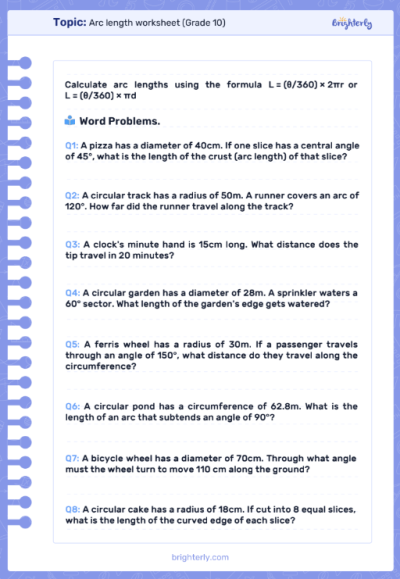
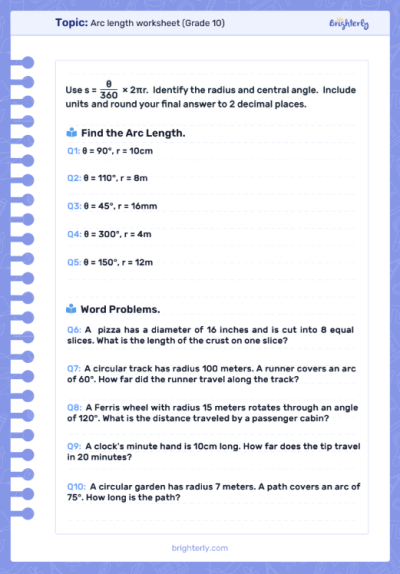
More circle and arc worksheets
Reinforce your arc length skills with these closely related resources — covering full circle area, linear measurement, angle measurement in degrees and radians, and perimeter and circumference calculations that connect directly to the arc length formula.
- area of a circle worksheets
- measuring length worksheets pdf
- measuring angles worksheets
- area and perimeter worksheets
- geometry worksheets


Help your child reach their full potential!
Answer a few quick questions about your child’s learning, and we’ll recommend next steps.
Benefits of Arc Length Worksheets
Utilizing arc length worksheets provides high school students with a structured way to bridge basic circle properties and advanced trigonometry. By working through problems that require converting between degrees and radians, learners develop a deeper technical understanding of how angular measures relate to linear distances along a curve. These activities reinforce algebraic manipulation, as students rearrange the arc length formula to solve for missing parameters like the radius or the central angle. Mastering these calculations is essential for success in higher-level mathematics and physics, where understanding rotational motion and periodic functions is critical. Consistent practice improves precision in rounding and working with irrational numbers like pi. This rigorous approach helps students visualize how circle arc measurements apply in real-world engineering and design contexts, from curved architectural elements to rotational mechanics.


Math & reading from 1st to 12th grade
Looking for homework support for your child?

Choose kid's grade

Math & Reading for Grades 1–12
Build real confidence for your child with a Brighterly math or reading tutor.