
Area of Composite Figures Worksheets
Updated on October 14, 2026
Area of composite figures worksheets help students find the area of complex shapes by breaking them into smaller, familiar figures. Brighterly’s printable worksheets give learners practice decomposing composite shapes into rectangles, squares, triangles, trapezoids, circles, and semicircles, applying the correct area formulas, and combining the results. The topic appears in both middle school and high school geometry, with problems becoming more complex as students progress.
Area of Composite Figures Worksheets PDF: Examples
Composite figures are made from two or more simpler geometric shapes. To find their total area, students first identify the individual parts, calculate each area, and then add or subtract the results depending on how the figure is constructed.
For example, an L-shaped figure can often be divided into two rectangles. A more advanced problem might combine a rectangle with a triangle or semicircle, requiring students to select several different formulas before finding the total area.
Students who need a refresher on the concept can review Brighterly’s guide to composite shapes and the step-by-step explanation of the area of composite shapes.
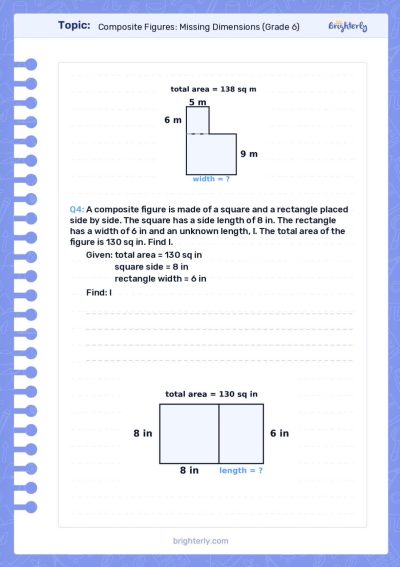
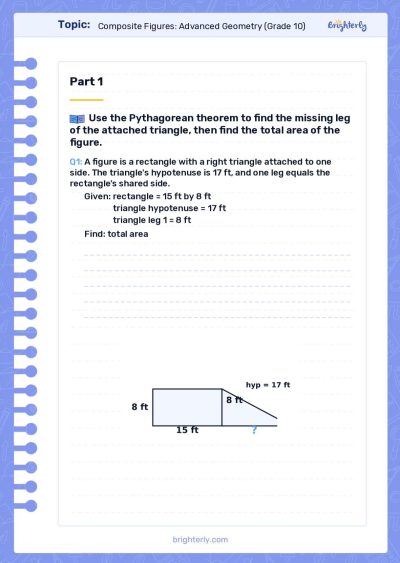
Area of Composite Figures Worksheets [Download for Free]
Download and print Brighterly’s free area of composite figures worksheets for geometry practice at home or in class. The collection includes problems at different levels, from decomposing figures made from familiar polygons to solving more complex area problems involving several shapes and missing regions.
Encourage students to draw lines that divide a composite figure into simple parts before calculating. Labeling each section and writing the corresponding formula can make multi-step problems easier to organize and check.
Area of Composite Figures in Middle and High School Geometry
Students can encounter composite-area problems at different stages of their geometry learning. Earlier problems usually involve familiar polygons that can be split into rectangles and triangles, while later problems may combine more shapes, include curved regions, require missing dimensions, or ask students to subtract an interior area from a larger figure.
Area of Composite Figures in Grade 6
At the middle school level, students typically build on their knowledge of basic area formulas by decomposing irregular or composite figures into familiar shapes. For example, they may divide an L-shaped floor plan into two rectangles, calculate each area separately, and add the results.
These activities develop the spatial reasoning needed to recognize useful subdivisions instead of searching for one formula for the entire figure. Students looking for broader grade-level practice can also use Brighterly’s 6th grade math worksheets.
Area of Composite Figures in High School Geometry
In high school Geometry, the same core strategy becomes more demanding. Composite figures may contain triangles, trapezoids, circles, semicircles, sectors, or missing regions, and students may need several steps to determine unknown dimensions before calculating the total area.
This is why the topic remains relevant for students taking Geometry in 9th or 10th grade. Brighterly’s guide to what grade Geometry is taught in US schools explains how geometry topics progress from middle school foundations to a formal high school course. Students can also find broader high school practice in 10th grade math worksheets.
If your child understands individual area formulas but struggles to see how complex figures can be decomposed, a geometry tutor can help them develop a more systematic approach to visual geometry problems.


Improve your child’s math skill today with Brighterly
Let them be at the top of their class.
Other Worksheets
- Area of a rectangle worksheets
- Area of a triangle worksheets
- Area of a circle worksheets
- Area of a trapezoid worksheets
- Area and perimeter worksheets
- Geometry worksheets
Because composite figures are built from simpler shapes, students should be comfortable with the basic area formulas first. They can review area of a rectangle worksheets, area of a triangle worksheets, and area of a circle worksheets before combining several formulas in one problem.
For a broader review of measuring two-dimensional figures, Brighterly’s area in math guide explains common formulas and square units, while the area and perimeter guide helps students distinguish between measuring the space inside a figure and the distance around it.
Benefits of Area of Composite Figures Worksheets
- Break complex figures into simpler shapes
The central skill in composite-area problems is decomposition. Instead of looking for a new formula for an irregular outline, students learn to identify rectangles, triangles, circles, or other familiar shapes inside it.
This turns one difficult-looking problem into several smaller calculations that use formulas the student already knows.
- Choose the correct area formula
Each component shape requires its own formula. A rectangle uses length × width, while a triangle uses ½ × base × height and a circle uses πr².
Composite figure worksheets require students to decide which formula belongs to each section rather than applying the same calculation repeatedly.
- Practice adding and subtracting areas
Some composite figures are formed by joining shapes, so students add their areas. Others contain a cutout or missing region, which means the smaller area must be subtracted from the larger one.
For example, to find the area of a rectangular garden with a circular pond inside it, students can calculate the area of the rectangle and subtract the area of the circle.
- Work with missing dimensions
More advanced problems may not provide every side length directly. Students need to use the dimensions they do know to determine a missing length before calculating the area.
This adds another layer of reasoning and helps students connect geometry with addition, subtraction, equations, and measurement relationships.
- Strengthen spatial reasoning
There may be more than one correct way to divide a composite figure. One student might split an L-shaped figure horizontally, while another divides it vertically and still reaches the same total area.
Comparing these approaches helps students see geometric structure more flexibly. Brighterly’s article on how to teach geometry also explains why visualization and systematic problem-solving are important for building geometry understanding.
- Apply area to real-world problems
Composite figures appear naturally in floor plans, gardens, walls, playgrounds, and other spaces that do not form one simple rectangle or circle. Students can use the same decomposition strategy to estimate flooring, paint, grass, or other materials needed to cover an irregular region.
This connects the abstract area formulas with practical measurement and geometry problems.
How to Find the Area of a Composite Figure
First, examine the figure and identify the basic shapes inside it. Draw additional lines if necessary to separate the composite figure into rectangles, triangles, circles, trapezoids, or other familiar parts.
Next, label the dimensions of each component. If a required side length is missing, use the dimensions of the full figure and neighboring sections to determine it.
Then, apply the correct area formula to each shape. For example:
- Rectangle: A = l × w
- Triangle: A = ½bh
- Circle: A = πr²
- Trapezoid: A = ½(b₁ + b₂)h
Finally, add the areas of adjacent non-overlapping sections. If the figure contains a hole, cutout, or excluded region, subtract that area instead.
Check that all measurements use compatible units and write the final answer in square units, such as square centimeters, square meters, or square inches.
Frequently Asked Questions
What Is a Composite Figure?
A composite figure is a two-dimensional shape made from two or more simpler shapes, such as rectangles, triangles, circles, or trapezoids. Students can find its area by dividing the figure into recognizable parts and calculating their areas separately.
How Do You Find the Area of a Composite Figure?
Divide the composite figure into simpler shapes, find the area of each part using the appropriate formula, and then add the areas together. If the figure contains a missing or cut-out section, calculate that region separately and subtract its area.
What Grade Do Students Learn the Area of Composite Figures?
Students can begin working with composite areas in middle school, including Grade 6, using rectangles, triangles, and other familiar polygons. The skill is revisited in high school Geometry with more complex figures, curved regions, missing dimensions, and multi-step problems.
What Shapes Can Appear in Composite Figure Problems?
Composite figures can contain rectangles, squares, triangles, parallelograms, trapezoids, circles, semicircles, and other familiar two-dimensional shapes. The exact combination and complexity depend on the student’s level and the geometry problem.
Are Brighterly Area of Composite Figures Worksheets Free to Download?
Yes. Brighterly provides free printable area of composite figures worksheets that students can use to practice decomposing shapes, applying area formulas, and solving multi-step geometry problems at home or in class.


Math & reading from 1st to 12th grade
Looking for homework support for your child?

Choose kid's grade

Math & Reading for Grades 1–12
Build real confidence for your child with a Brighterly math or reading tutor.