
Arithmetic Sequences Worksheets
Updated on September 4, 2026
Arithmetic sequences worksheets develop students’ ability to identify the common difference d, construct both recursive and explicit formulas, and calculate any term using Tₙ = a + (n − 1)d.
Because arithmetic sequences produce constant differences, they model linear growth — making this topic a direct bridge between Fibonacci sequence and the formal algebra of linear equations.
Students who can identify the pattern but lose accuracy writing recursive and explicit formulas benefit most from an algebra tutor who can coach the notation step-by-step.
Download Arithmetic Sequences Worksheet PDFs
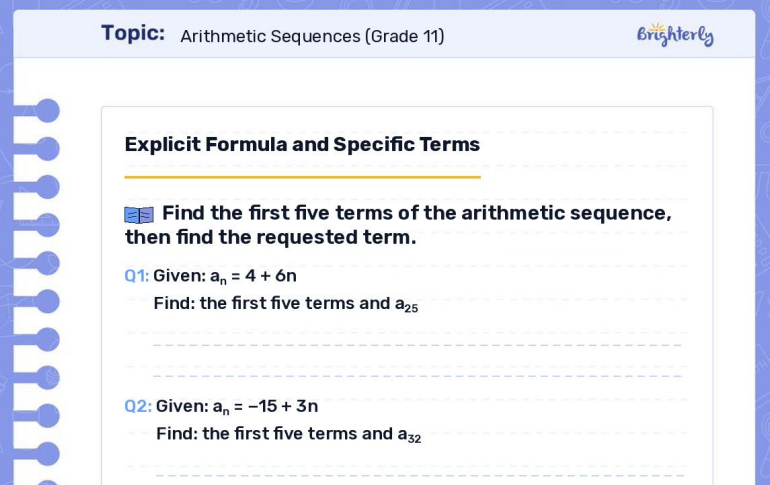
Access our comprehensive collection of printable resources designed to help students practice identifying common differences and calculating general terms.
More sequences and patterns worksheets
Reinforce your understanding of sequences with these related resources covering algebraic equation solving, word problem applications, and the linear function concepts that connect arithmetic progressions to coordinate geometry and function analysis.
- algebra 2 worksheets
- algebra word problems worksheets
- equations and inequalities worksheets
- solving equations worksheets
- two step equations worksheets


Help your child reach their full potential!
Answer a few quick questions about your child’s learning, and we’ll recommend next steps.
Benefits of Arithmetic Sequences Worksheet
Engaging with an arithmetic sequences worksheet provides critical practice for students to develop a deep understanding of linear growth and mathematical modeling.
By working through various problems, learners become proficient at identifying the first term and the common difference, which are the building blocks for constructing both recursive and explicit formulas.
These exercises help students bridge the gap between simple number patterns and the formal algebraic notation of the general term formula, Tn = a + (n – 1)d.
Practicing these sequences improves algebraic manipulation skills and helps students visualize the relationship between arithmetic progressions and linear functions on a coordinate plane. Furthermore, these worksheets introduce practical applications such as calculating simple interest, predicting growth rates, or determining the number of items in a tiered arrangement.
Strengthening these skills is vital for transitioning to more complex topics like what is the difference between geometric and arithmetic, series summation, and calculus, ensuring students have the logical foundation required for higher-level STEM fields and data analysis.


Math & reading from 1st to 12th grade
Looking for homework support for your child?

Choose kid's grade

Math & Reading for Grades 1–12
Build real confidence for your child with a Brighterly math or reading tutor.