Numbers 1-5 Worksheets
Updated on October 20, 2026
Numbers 1-5 worksheets help preschoolers and kindergartners build their first number skills within a small, manageable range. Brighterly’s printable activities give children practice recognizing the numerals 1, 2, 3, 4, and 5, tracing and writing them, counting groups of up to five objects, and matching each written number with the quantity it represents.
Working with a limited range helps young learners connect number symbols with real quantities before moving on to larger numbers. Parents can also explore Brighterly’s guide to learning numbers for kids for additional ideas on introducing numerals at home.
Numbers 1-5 Worksheets PDF: Examples
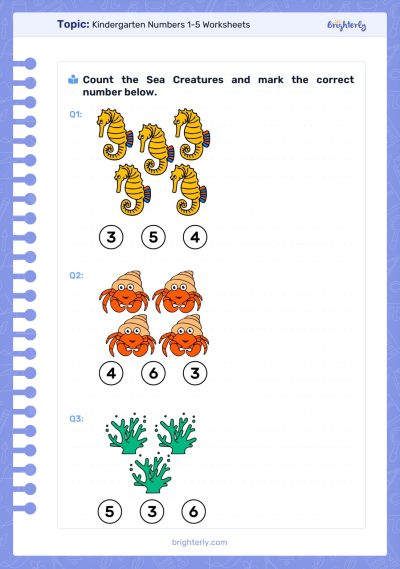
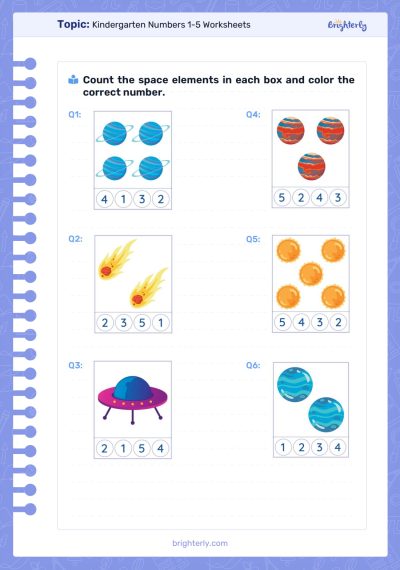
Brighterly’s numbers 1-5 worksheets combine several early numeracy skills. Children may identify a requested numeral, trace its shape, count pictured objects, match a group with the correct number, or complete a simple sequence from 1 to 5.
For example, a child might count four apples and choose the numeral 4, trace the number 4 several times, and then place it correctly between 3 and 5. Practicing the same small set of numbers in different ways helps connect the symbol, number name, quantity, and position in a sequence.


Help your child reach their full potential!
Answer a few quick questions about your child’s learning, and we’ll recommend next steps.
Numbers 1-5 Worksheets [Download for Free]
Download and print Brighterly’s free numbers 1-5 worksheets for early math practice at home, preschool, or kindergarten. The combined collection includes activities for recognizing, writing, ordering, and counting numbers from 1 to 5.
Start with recognition and counting if your child is new to numbers. Once they can identify each numeral and connect it with the correct quantity, add tracing, writing, and missing-number activities.
Counting 1 to 5 Worksheets
Counting from 1 to 5 is an important part of learning the first numbers. Children need to understand that counting is not only saying “one, two, three, four, five” in order — each number also represents a specific quantity.
Counting 1 to 5 activities ask children to count small groups of familiar objects such as animals, toys, dots, or shapes and choose or write the matching numeral. This helps build the connection between spoken number words, written symbols, and actual quantities.
Count Objects From 1 to 5
Encourage your child to point to each object once while saying the numbers aloud. If there are three stars, for example, they can touch each star while counting “1, 2, 3” and then match the group with the numeral 3.
This process develops one-to-one correspondence: understanding that each object should receive exactly one count and that the final number tells how many objects are in the group.
Match Numbers With Quantities
Recognizing the numeral 5 is different from understanding what five means. Matching activities strengthen this connection by asking children to pair a written number with a group containing the same number of objects.
Brighterly’s guide to number sense in math explains why connecting symbols with quantities is an important foundation for later arithmetic.
Understand That the Last Number Tells How Many
When a child counts four objects, the word “four” does more than name the final object — it tells how many objects are in the entire group. Repeating this process with small sets helps children develop an early understanding of quantity.
Recognizing Numbers 1 to 5
Number recognition means seeing a written numeral and knowing which number it represents. Children can practice finding a requested number, circling matching numerals, or distinguishing between numbers such as 2, 3, and 5.
Repeated exposure helps children become familiar with the visual shape of each numeral before they are expected to write it independently.
Writing and Tracing Numbers 1 to 5
Once children recognize numbers 1–5, tracing can help them learn how each numeral is formed. They follow a dotted outline before gradually trying to write the number without a guide.
For more focused handwriting practice across a wider number range, use number tracing worksheets 1-10.
Putting Numbers 1 to 5 in Order
Children also learn that numbers follow a fixed sequence: 1, 2, 3, 4, 5. Missing-number and ordering activities reinforce which number comes before or after another.
For example:
- 1, 2, __, 4, 5 → the missing number is 3.
- What comes after 4? → 5.
- What comes before 3? → 2.
This introduces basic number relationships and prepares children to work with longer number sequences later.
Other worksheets
- Number tracing worksheets 1-10
- Preschool counting worksheets
- Numbers 1-100 worksheets
- Kindergarten math worksheets
- Pre-K math worksheets
If your child can recognize numbers but has difficulty counting the correct number of objects, one to one correspondence worksheets provide useful targeted practice.
Children ready to count beyond five can continue with preschool counting worksheets or explore the broader kindergarten math worksheets collection.
Benefits of Numbers 1-5 Worksheets
Build Early Number Recognition
Working repeatedly with the numerals 1–5 helps children recognize each written symbol more quickly. A small number range keeps the task manageable while children are still learning what written numbers look like.
Connect Numbers With Real Quantities
Counting pictured objects helps children understand that a numeral represents an amount. The symbol 4, for example, corresponds to a group containing four objects rather than simply being a shape they need to memorize.
Develop Early Number Sense
Number sense includes understanding quantities and how numbers relate to one another. Working with 1–5 gives children opportunities to see that 5 is more than 3, that 2 comes before 3, and that a group of four contains one more object than a group of three.
Brighterly’s number sense resources provide explanations of how these early ideas develop into more advanced math skills.
Practice Pencil Control and Number Formation
Tracing and writing exercises let children practice forming numerals while developing the controlled pencil movements they will use in later written math activities.
Prepare for Larger Number Ranges
Once children can confidently recognize, count, write, and order numbers 1–5, they can apply the same skills to 1–10, 1–20, and eventually larger number ranges.
How to Practice Numbers 1 to 5 With a Child
Start with real objects rather than only written exercises. Put three blocks on a table, count them together, and show your child the numeral 3. Repeat the activity with different quantities from one to five.
Next, mix numeral cards and ask your child to identify each number. You can then ask them to build a matching group of toys, buttons, or other small objects.
When recognition and counting become easier, add tracing and simple missing-number sequences. Short activities can also be turned into games — Brighterly’s collection of math activities for preschoolers includes hands-on ideas for practicing counting and number recognition.
For children who need more structured help building early number sense, Brighterly’s math program develops number and quantity skills progressively before moving into later arithmetic concepts.
Frequently Asked Questions
What Skills Do Numbers 1-5 Worksheets Teach?
Numbers 1-5 worksheets help children recognize and write the numerals 1 through 5, count groups of up to five objects, match numerals with quantities, and understand the correct order of the first five numbers.
How Do Counting 1 to 5 Worksheets Help Preschoolers?
Counting 1 to 5 worksheets give preschoolers practice assigning one number to each object and understanding that the final number counted represents the total quantity. They also help children connect spoken number words with written numerals.
What Age Are Numbers 1-5 Worksheets For?
Numbers 1-5 worksheets are especially useful for preschool and kindergarten children who are beginning to recognize numbers and count small groups of objects. Children can move to larger ranges once these first five numbers are comfortable.
Should Kids Learn to Count or Recognize Numbers First?
Counting and number recognition can develop together. Children can count small sets of real objects while also seeing the written numeral that represents the quantity. Connecting the two skills helps build stronger number understanding than practicing either one in isolation.
What Should Children Learn After Numbers 1 to 5?
Once children can recognize, count, write, and order numbers 1–5, they can extend the same skills to numbers 1–10 and beyond. Number tracing, larger counting ranges, and one-to-one correspondence activities are useful next steps.
Are Brighterly Numbers 1-5 Worksheets Free to Download?
Yes. Brighterly provides free printable numbers 1-5 worksheets that parents and teachers can use for early number recognition, counting, tracing, and ordering practice at home or in class.


Need help with Numbers?
- Does your child struggle to master numbers basics?
- Try learning with an online tutor.
Choose kid's grade

Is your child having trouble understanding the concept of numbers? An online tutor could provide the necessary help.
Book FREE lesson