
Parallel Lines Cut by a Transversal Worksheet
Updated on October 14, 2026
Parallel lines cut by a transversal worksheet is a set of exercises that helps students understand angle relationships created when a transversal intersects two parallel lines. This skill is foundational in geometry with parallel lines, so Brighterly worksheets provide practice for 9th and 10th grade students to identify, classify, and calculate corresponding, alternate, and same-side interior angles.
Parallel Lines Cut by a Transversal Worksheets: Examples
Take a look at some sample problems from Brighterly’s parallel lines cut by a transversal worksheets below. Students practice recognizing angle pairs, finding missing angle measures, and applying properties of parallel lines to geometric diagrams.
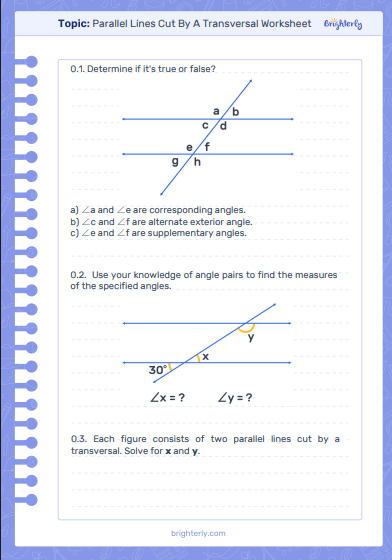
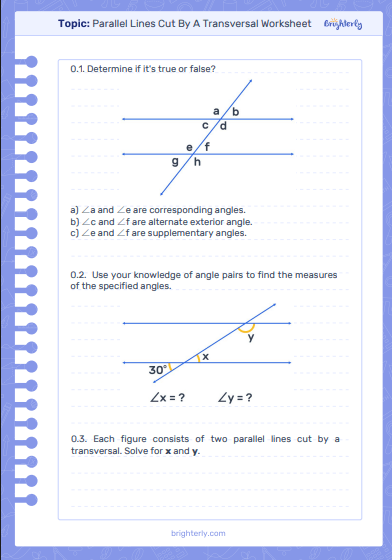
Parallel Lines Cut by a Transversal Worksheet [Download for Free]
Download Brighterly’s free parallel lines cut by a transversal worksheet PDFs for additional geometry practice at home or in class. The combined collection includes exercises on identifying angle relationships, calculating unknown angles, and using parallel-line theorems in more advanced geometry problems.
Parallel Lines and Transversals in 10th Grade Geometry
In 10th grade Geometry, students often move beyond simply naming angle pairs and use parallel-line relationships to solve equations and justify geometric reasoning. They may need to determine an unknown variable from corresponding or alternate angles, show that two lines are parallel using converse theorems, or use angle relationships as part of a proof.
For example, if alternate interior angles are represented by 3x + 5 and 65, students can use the fact that the angles are congruent to write and solve an equation. Brighterly’s guide to alternate interior angles explains this relationship in more detail.
Students can find more high-school-level practice in Brighterly’s high school geometry worksheets and 10th grade math worksheets.
If your child understands angle names but has difficulty deciding which theorem to apply, a geometry tutor can help connect diagrams, algebra, and proof reasoning step by step.


How strong are those geometry skills?
A quick quiz can reveal which high school math skills need review
Other Worksheets
- Parallel lines and transversals worksheets
- Parallel and perpendicular lines worksheets
- Pairs of angles worksheets
- Types of angles worksheets
- Measuring angles worksheets
- Geometric proofs worksheets
Students who need broader practice with how a transversal creates different angle pairs can use parallel lines and transversals worksheets. If the challenge is identifying angle types before applying a theorem, pairs of angles worksheets provide additional practice.
Benefits of Parallel Lines Cut by a Transversal Worksheets
See Geometric Relationships
The worksheets train students to recognize the relationships between parallel lines, transversals, and the angles formed at their intersections. Instead of treating each angle separately, learners begin to see predictable patterns they can use to solve geometry problems.
Brighterly’s transversal lines guide explains how corresponding, alternate interior, alternate exterior, and consecutive interior angles are formed.
Identify Corresponding and Alternate Angles
When a transversal crosses two parallel lines, corresponding angles are congruent, alternate interior angles are congruent, and alternate exterior angles are congruent. Recognizing these pairs lets students determine unknown angle measures without measuring each angle individually.
Work With Supplementary Angles
Same-side interior angles formed by parallel lines and a transversal are supplementary, meaning their measures add to 180°. Students use this relationship to find missing values and determine whether a diagram satisfies the conditions for parallel lines.
The same-side interior angles theorem provides additional examples of this rule.
Improve Logical Reasoning
Transversal problems encourage students to use known angle relationships to reach conclusions about unknown values. Instead of relying only on visual estimates, they need to identify the relevant theorem and apply it logically.
This type of reasoning becomes especially important when students move from calculating angles to writing geometric proofs.
Prepare for Geometry Proofs
Parallel-line theorems are commonly used to justify steps in geometry proofs. Students may need to show that angles are congruent, prove that two lines are parallel, or combine several angle relationships to reach a conclusion.
Students ready for this next step can continue with geometric proofs worksheets.
Connect Geometry and Algebra
Some transversal problems give angle measures as algebraic expressions rather than numbers. If two corresponding angles measure 4x + 10 and 70 degrees, for example, students can set the expressions equal and solve for x.
These problems allow students to apply equation-solving skills inside a geometric diagram and are particularly useful as problems become more advanced in high school Geometry.
How to Solve Parallel Lines Cut by a Transversal Problems
First, confirm that the diagram shows parallel lines and identify the transversal crossing them. Then determine what type of angle relationship is shown.
Use the appropriate rule:
- Corresponding angles are congruent.
- Alternate interior angles are congruent.
- Alternate exterior angles are congruent.
- Same-side interior angles are supplementary.
- Vertical angles at each intersection are congruent.
Next, substitute any known angle measures. If the problem uses algebraic expressions, create an equation based on whether the angles are congruent or supplementary and solve for the unknown variable.
Students can also use these relationships in reverse. If corresponding angles are congruent, alternate interior angles are congruent, or same-side interior angles are supplementary, they may be able to conclude that the two lines are parallel.
Frequently Asked Questions
What Is a Transversal Line?
A transversal is a line that crosses two or more other lines at different points. When it cuts through two parallel lines, it creates eight angles with predictable relationships, including corresponding, alternate interior, alternate exterior, and same-side interior angles.
What Angle Pairs Are Formed When a Transversal Cuts Two Parallel Lines?
A transversal crossing parallel lines forms corresponding, alternate interior, alternate exterior, and same-side interior angle pairs. Corresponding and alternate angles are congruent, while same-side interior angles are supplementary and add up to 180°.
How Do You Know if Two Lines Are Parallel Using a Transversal?
Two lines can be shown to be parallel if corresponding angles are congruent, alternate interior angles are congruent, alternate exterior angles are congruent, or same-side interior angles are supplementary. These converse relationships are commonly used in geometric proofs.
What Grade Level Is This Worksheet Designed For?
These worksheets are especially useful for students studying Geometry in 9th and 10th grade. They can also support advanced middle school students learning angle relationships or older students reviewing parallel-line theorems and proof skills.
How Are Parallel Lines and Transversals Used in 10th Grade Geometry?
In 10th grade Geometry, students often use transversal angle relationships to solve algebraic equations, determine missing angle measures, prove that lines are parallel, and justify steps in formal geometric proofs.
Do Brighterly Parallel Lines Cut by a Transversal Worksheets Include Answers?
Yes. Brighterly’s parallel lines cut by a transversal worksheets include answer keys so students can check angle classifications, calculations, and algebraic solutions after completing the exercises.


Math & reading from 1st to 12th grade
Looking for homework support for your child?

Choose kid's grade

Math & Reading for Grades 1–12
Build real confidence for your child with a Brighterly math or reading tutor.