
Synthetic Division Worksheets
Updated on September 28, 2026
Synthetic division worksheets give students a streamlined method for dividing polynomials by linear binomials of the form (x − c).
By working with numerical coefficients alone — eliminating variables from the process — learners build the speed and accuracy needed to find polynomial zeros and apply the Remainder and Factor Theorems efficiently.
Paired with a strong grasp of high school math fundamentals, synthetic division becomes one of the most efficient tools in a student’s algebraic toolkit.
Download Synthetic Division Worksheet PDFs
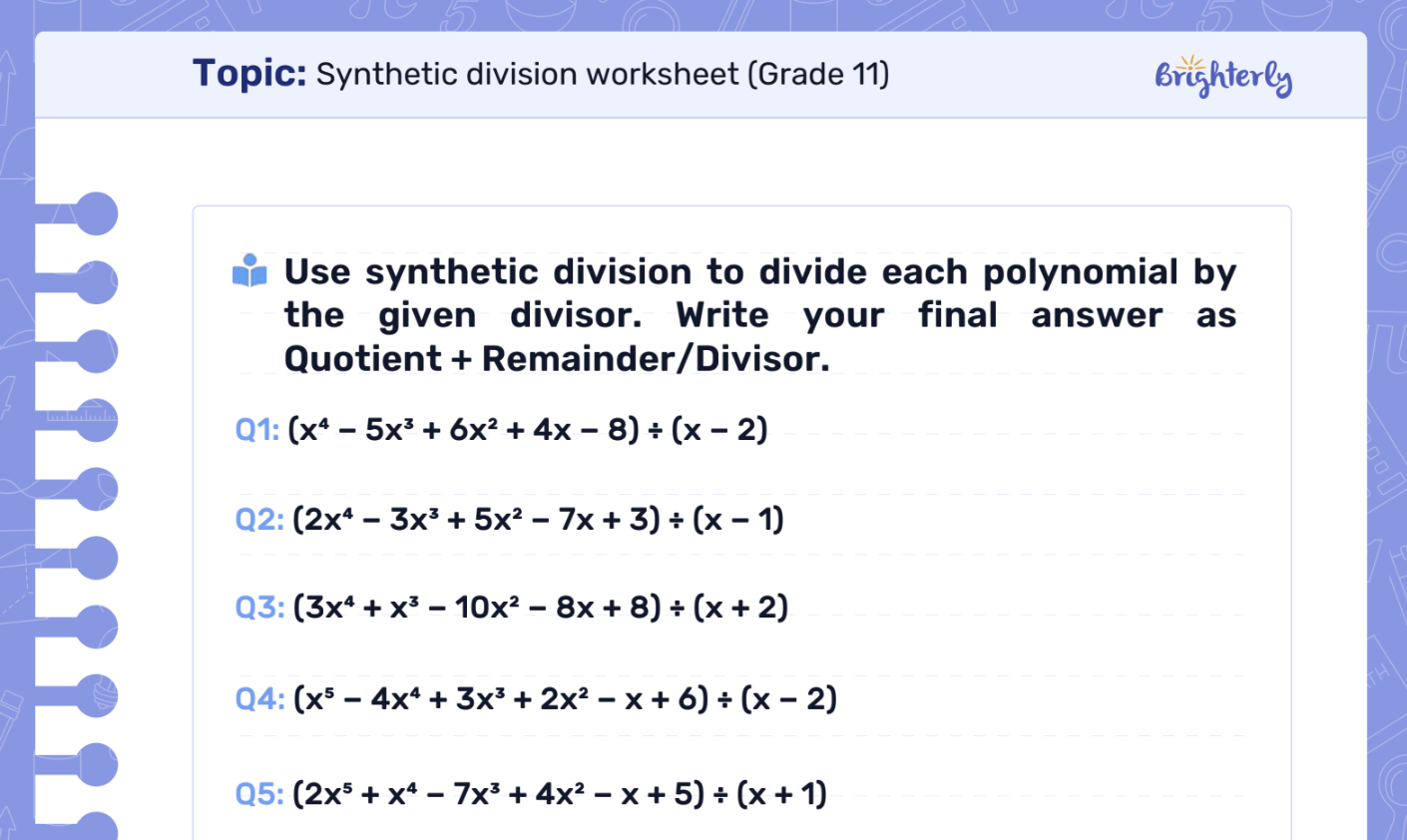
Access our curated selection of high-quality printable files designed to help learners practice the setup and execution of synthetic division.
More polynomial division worksheets
Strengthen your polynomial skills with these related resources covering multiplication, factoring by grouping, and quadratic factoring — the prerequisite techniques that make synthetic division faster and more intuitive.
- multiplying polynomials worksheet
- factoring polynomials worksheets
- multiplying monomials and polynomials worksheets
- factoring by grouping worksheets
- factoring ax²+bx+c worksheet


Help your child reach their full potential!
Answer a few quick questions about your child’s learning, and we’ll recommend next steps.
Benefits of Synthetic Division Worksheet
Mastering the synthetic division provides students with a powerful efficiency tool that streamlines polynomial division, saving valuable time during timed examinations and complex problem-solving sessions.
By using a structured worksheet, learners gain a deep understanding of the relationship between polynomials and their zeros, which is a foundational concept in high school algebra and pre-calculus.
These practice pages reinforce the Remainder Theorem and the Factor Theorem, allowing students to quickly evaluate functions at specific values and determine if a given binomial is a factor of a larger polynomial.
Regular practice helps eliminate common errors, such as forgetting zero placeholders for missing terms or failing to change the sign of the divisor. Furthermore, the repetitive nature of these exercises builds the procedural fluency required to tackle higher-degree equations and more sophisticated mathematical models.
This method also serves as an excellent bridge to understanding the Rational Root Theorem, helping students systematically narrow down potential zeros of a function.
By focusing on the numerical patterns of addition and multiplication, students develop a stronger intuition for the structure of polynomials, which ultimately enhances their overall mathematical proficiency and confidence in algebraic manipulation.


Math & reading from 1st to 12th grade
Looking for homework support for your child?

Choose kid's grade

Math & Reading for Grades 1–12
Build real confidence for your child with a Brighterly math or reading tutor.