What Is Independent Reading? Benefits, Strategies, and How It Works
reviewed by Janice S. Armas
Updated on June 1, 2026
Key points
Independent reading is an impactful practice, under which students pick their own reading books and read independently. This practice helps teachers to build and develop K-12 students’ fluency, vocabulary, and reading stamina.
This article will help to explore the definition, research, strategies for the classroom, and ways to integrate this practice at home.
What Is Independent Reading?
Independent reading is a structured educational practice under which K-12 students choose books themselves and read within a specific classroom or time at home. Teachers and educators also refer to sustained silent reading (SSR) or DEAR (Drop Everything and Read) concepts to use alongside the independent reading definition.
What Does Independent Reading Look Like in Practice?
Independent reading may look different depending on the grade level, yet the core will be the same: specifically dedicated time, the student’s book choice, and minimal teacher participation or intervention.
The common independent reading examples are:
- In Kindergarten, a child may pick a book with pictures from the previously organized bins or libraries and read it for a short period of time.
- In grades 3-5, children can participate in a Drop Everything and Read session after lunch to read a chapter of a novel they picked earlier that day.
- In middle school, independent reading may take place within an ELA class, as a 10-15-minute silent reading session, and may be supported by journaling or note-taking.
- In high school, a teacher may squeeze a sustained silent reading 5-10 minutes session into the dense ELA curriculum, offering room for reading, new strategies, discussions, and reflections.
Note. The freedom to choose different formats, from print books and ebooks to graphic novels to audiobooks, encourages students to be engaged and consistent.
At Brighterly, we follow a similar approach, helping kids develop independent reading via flexible formats, personalized plans, and consistent routines. Students work best when the reading practice connects to what they love.
Want to help your kid develop healthy reading habits?
Brighterly offers personalized plans and interactive 1:1 sessions to build a routine

Explore Brighterly Learning Experience
Learn exactly how Brighterly helps students thrive through expert sessions, online tools, and proven feedback from thousands of satisfied parents
Why Is Independent Reading Important?
The importance of independent reading refers to its effect on fluency, vocabulary, comprehension, and empathy, not to mention academic performance. The reason is that students’ choice of books encourages them to read more, and reading more means more practice.
The National Council of Teachers (NCTE) 2019 report underlines that independent reading is one of the most influential practices affecting learners’ reading success, weighing more than guided reading, drills of skills, and work with assigned texts.
Benefits of Independent Reading for Students
- Reading fluency and vocabulary. Once students read more, they encounter new words naturally. The same NCTE statement says the development of vocabulary has a direct link to the activities students do during self-selected reading.
- Reading comprehension. Similarly, as young students practice more, they better synthesize information and infer meaning in the long run. According to the School Library Research Journal report by Bernice E. Cullinan, the amount a 5-year-old read directly affects reading comprehension when they are 7 years old.
- Empathy. Reading, not only fiction but stories with diverse help develop empathy. The 2025 National Literacy Trust post declares that reading helps readers see views of others (32.8%) and understand more about other people (32.4%).
- Stress reduction. Learners may feel relaxed while reading, even for a short time. The 2025 research results by Project Tomorrow, an education nonprofit, underline that large print books can decrease stress even more.
- Reading habits. Daily reading sets reading preferences and habits for the future. According to a 2026 Purdue University post by Breanya Hogue, Yilin Shen, and Jorge Perez De Jesus, even a few focused minutes a day can help to develop a habit.
What the Research Says About Independent Reading
Research pieces admit that independent reading strategies can be beneficial and provide reasons for using them at home and school.
- The main support comes from the already mentioned NCTE statement from 2019, underlining the effect of independent reading on the students’ development and reading achievement.
- At the same time, the 2000 foundational report by the National Reading Panel is more neutral, admitting the popularity of the independent reading concept and its effect on fluency, but finding no support for it. The report is still used today due to its extensive description of reading components, which is still used today.
- However, a 2024 Scholastic Kids & Family Reading Report hints that though interest in reading and reading habits for fun decline, around 50% still believe reading for enjoyment is crucial. It supports that such a reading practice definitely answers students’ needs.
When Do Students Start Reading Independently?
Most students begin reading simple books independently in Grade 1 (ages 6-7), since they know the foundational phonics and decoding. So, by grade 3, or age 9, they transform into independent readers who can focus on texts that are longer and more complicated.
Nevertheless, everything depends on the reader and their skills. A student who is great at reading in Grade 3 and reads freely, in Grade 5, may need structured support to continue to do so.
Note: Brighterly’s diagnostic reading test can help you identify where the student is, their level, and how they are reading independently, so you can match relevant books.
How to Incorporate Independent Reading into the Classroom
To incorporate independent reading in the classroom, you should ensure that it happens regularly, and at the same time, students can pick what to read, and a teacher leads or models.
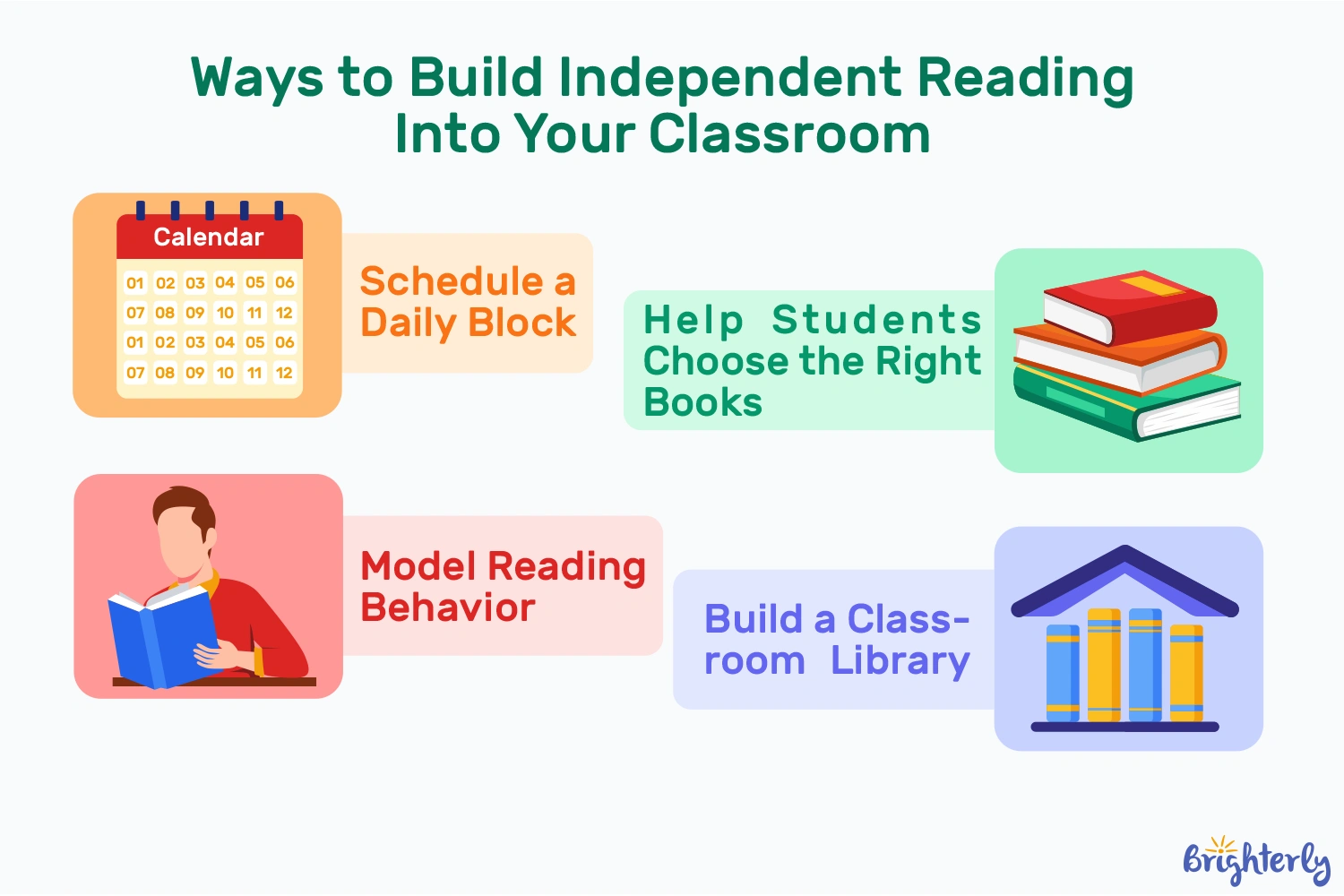
Focusing on these conditions will allow you to build a structure that helps protect free choice reading as a habit, even if the schedule is packed.
Schedule a Daily Independent Reading Block
A dedicated, separate block offers a predictable and consistent time to practice every day. It’s possible when students have a fixed slot for practice. Dedicated independent reading time will allow to develop a habit, have structure, and build reading stamina.
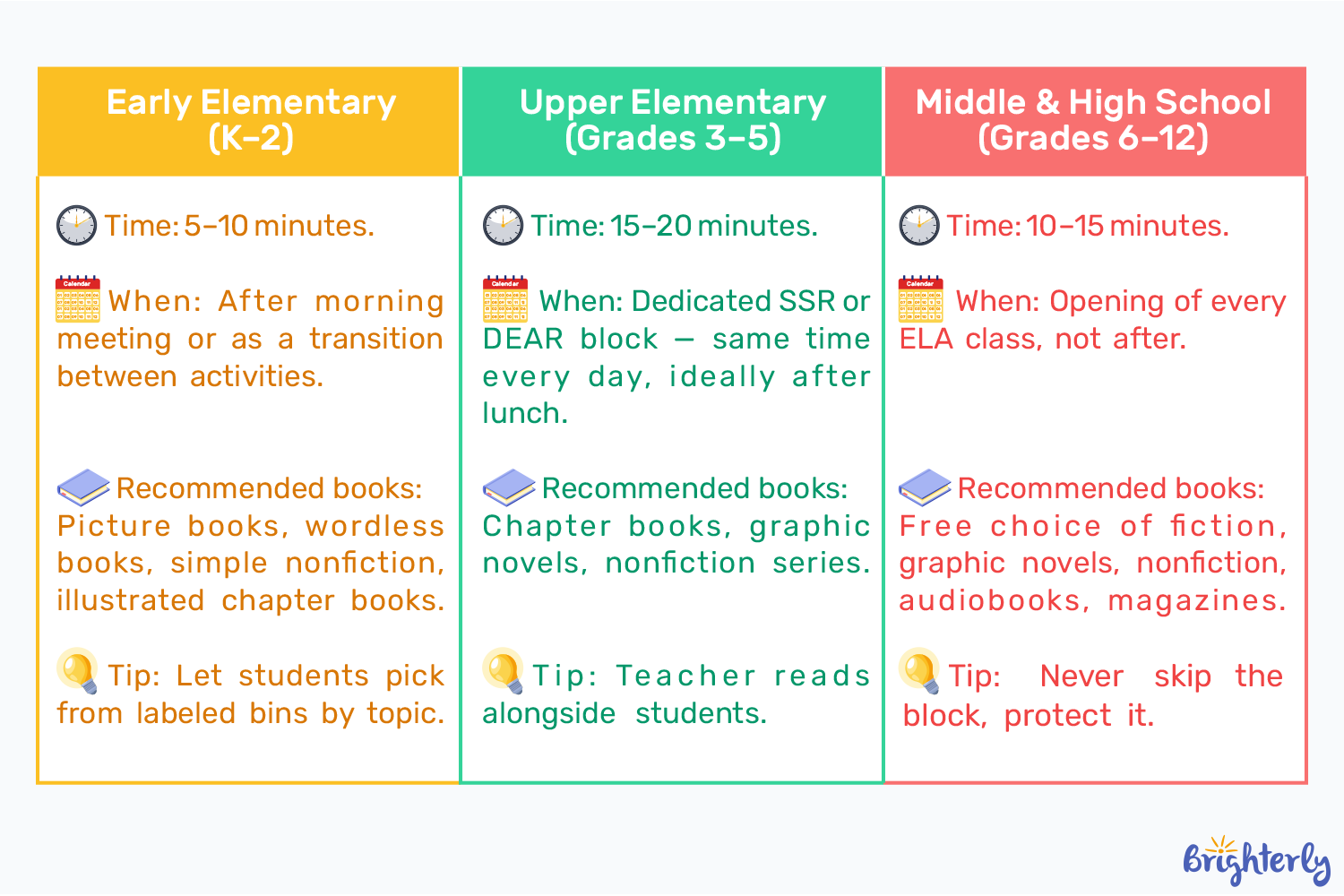
Here are the best ways to incorporate blocks into students’ day:
- For K-2 students, after a meeting or in transition between activities.
- For students in grades 3-5, 15 minutes of sustained silent reading at a specific time (accommodate the environment for it if possible).
- For middle and high school students, make sure you always have 10-15 minutes for independent reading in ELA (or other) class; reduce time, but don’t cut this block out.
Help Students Choose the Right Books
The rationale behind picking certain books is that when books correspond to students’ levels, it’s easier to advance comprehension and learning. Focus on books that a kid will be comfortable with.
“Most times, it’s not that the child is frustrated because they don't want to read at all; it's mostly because the books don’t match a child’s reading ability and interests.”


Yet, don’t limit students to a certain reading level, especially if they are interested in specific books. If an independent reader is passionate about a topic, they may push through a challenging text without losing reading motivation.
Model Reading Behavior
It’s one of the simplest independent reading strategies for a teacher or educator to try. When teachers are reading, and students see them, they receive a signal: “That’s not just an assignment.” Young learners often look at what the figures they see as authority do rather than listen to them.
Build a Classroom Library Students Want to Use
Students should be able to choose a reading that meets their needs and interests. For this, a teacher should focus on creating a decent library with relevant materials. It may be small, but well curated, and it will outperform a large and ignored one. There, you can:
- Collect fiction, nonfiction, graphic novels, and high-interest books that suit different needs.
- Regularly update libraries with popular books, relevant topics, and new editions.
- Encourage students to use library cards and access the school library or digital platforms.
Back independent reading with structured support
Brighterly boosts kids' comprehension and develops a reading routine
How Parents Can Support Independent Reading at Home
To support the self-directed reading programs at home, parents should ensure kids practice reading independently. In this case, they may try to mirror the independent learning strategies, develop routines, and arrange space for it.
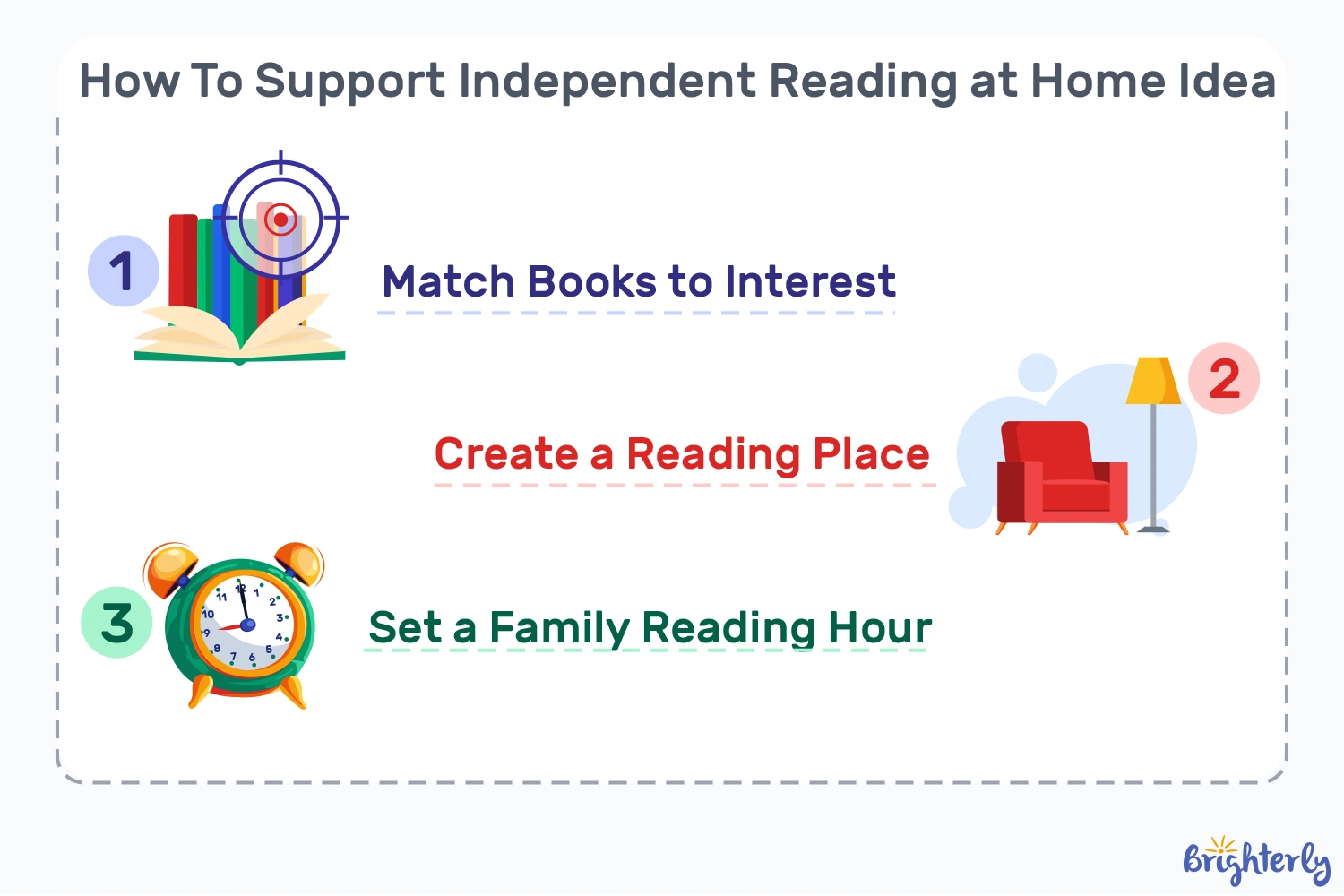
Choose Books That Match Interest and Level
Just like with an independent reading strategy in the classroom, at home, a parent should take into account both interest and level. Nevertheless, at home, a child should have more freedom.
Thus, the best recommendation for a parent is to let your kid lead, pick a topic first, then a level. To support their interest, take notes, and find relevant similar options.
“A great way to encourage independent reading is to let your child choose a book on any topic they’re interested in. ”

Create a Reading Space at Home
Just like in school, an independent reading at home needs a dedicated reading space. A parent should provide an environment where children have no distractions and can maintain reading focus. On the other hand, it should be cozy and add to the reading as an enjoyable experience. When a child finds space with comfort and books, the habit of voluntary reading can stick longer.
“Set up a reading nook in your child’s room. ”
Set a Regular Reading Time Together
Joint reading is one of the popular activities to improve kids’ reading skills at home. And in the case of independent reading, it may work as well. Just think of making a place and time for reading together. You can make it solely about reading, or leave room for discussion as well.
“Create a family reading hour where everyone in your family reads.”
At the end of the hour, discuss the books you each read. Have your child tell you a summary and ask them questions about the book, like: What is the story about? Would you recommend this book to others?
Setting up this family time encourages independent reading, shows that adults enjoy reading too, and creates special shared family time.
Nonetheless, it can happen that independent learning may not be enough. And that’s when families may want to resort to structured support.
For such families, the Brighterly reading program can offer personalized plans, rich and interactive classes, and targeted intervention from tutors. There, a priority is to develop useful habits.
Independent Reading Activities for Students
Reading journals, book talks, and library visits are the independent reading activities that can develop the reading habit and avoid adding pressure.
Reading Logs and Journals
As an educator, encourage learners to have an active reading log or make notes in a journal. Ask kids to regularly include in their things the title, date, and two sentences of reaction.
Records, either in a notebook or a digital app, would help students build accountability and remember the value. Later, you can use these logs to start a conversation.
Book Talks and Group Discussions
Next, try to ignite a conversation in a class. How? Invite one or two students to give a small pitch about their reading. There, the 5WH1 framework may do the trick. Yet, make sure you ensure that participation is voluntary.
A good pitch and a good book may easily ignite a conversation and add to the reading group discussion in a class.
Library Visits and Digital Access
Also, schedule a visit to the library, whether physical or digital, at the start of a semester and instruct kids on how to look for and request books. For digital platforms, share with them how to create free accounts and which platform to use: Sora, Libby, or Hoppia. Once it’s done, focus on teaching to find relevant books.
Conclusion
In a classroom, an independent reading is all about consistency and freedom. It provides consistent practice to help to build fluency, vocabulary, and reading stamina. And that’s why independent reading is so important.
Importantly, if a student needs a structured approach to support independent practice at home, the Brighterly reading comprehension program can help via 1:1 sessions and customized lessons.
Frequently Asked Questions
Can Audiobooks Count as Independent Reading?
Yes, audiobooks count as independent reading, especially for students who develop fluency or experience reading challenges like dyslexia. Exposure to audiobooks that are well narrated adds to vocabulary and comprehension.
What Is the Difference Between Independent Reading and Guided Reading?
The difference lies in the involvement levels of a teacher, student autonomy, role of instructions. Independent reading is when students read silently and autonomously the text they choose to develop a reading habit. Guided reading is teacher-led, where students get text with direct instruction and prompts to target specific skills.
How Do I Know If a Book Is Too Hard or Too Easy for a Student?
Apply the 5-finger rule and ask a student to read one page. If there are zero or one unfamiliar words, it may be too easy; 4 or 5 may be too hard. You can also use a “just right” principle.
Is Independent Reading Effective for Struggling Readers?
Yes, independent reading can be effective for struggling readers if teachers use it with appropriate strategies like scaffolding. Students are to benefit the most from the self-selected reading texts that are paired with structured support and guidance from a teacher or tutor.
How Do I Track Independent Reading Without Quizzes or Tests?
To track independent reading without quizzes and tests, you can resort to reading logs, brief reading conferences, and voluntary book discussions or group talks. In independent reading, the goal of tracking is a conversation.
What Is Sustained Silent Reading (SSR) and How Does It Differ from Independent Reading?
Sustained silent reading (SSR) is not different from independent reading; it’s a classroom format for independent reading. It contemplates a scheduled educational practice when everyone in the classroom reads silently without interruption.


Comparing Mathnasium vs Best Brains means choosing between a specialized math-only center and a multi-subject screen-free classroom. Adding online alternatives like Brighterly into the mix adds another layer of complexity regarding 1:1 attention and scheduling flexibility. This article compares subject focus, teaching format, group size, pricing, and who each program suits best. Best Brains vs […]

May 03, 2026
If you’re wondering “What is a metaphor for kids?”, it’s a figure of speech saying one thing is another, and a powerful tool that helps make language alive, create comparisons, and understand the world better. Once children know how to use metaphors, they can explain concepts more easily, express emotions, and be more creative. This […]

May 05, 2026
Math & reading from 1st to 12th grade
Looking for homework support for your child?
Choose kid's grade

Math & Reading for Grades 1–12
Build real confidence for your child with a Brighterly math or reading tutor.