What Do 3rd Graders Learn? Key Subjects & Skills
reviewed by Franz Jerby Delos Santos
Updated on April 25, 2026

What do 3rd graders learn? In the 3rd grade, the curriculum is built around five main subjects: math, reading, writing, science, and social studies. As such, by the end of the year, kis are expected to read and understand simple texts, solve trivial math problems, and be able to express their ideas in a clear writing way. I prepared this guide to walk you through typical skills required for a 3rd grader.
Key Points
- According to the Common Core State Standards, 3rd graders are expected to know how to multiply and divide simple numbers and solve math problems involving all four basic operations.
- In reading, the child must be able to read, and, more importantly, understand the text, to retell it and answer related questions.
- Writing in 3rd grade goes beyond copying sentences. The pupil should be capable to present his own thoughts on paper.
- Science subjects are high-level, diving deeper into nature and the basic relationships between living organisms and weather. The children got introduced to social studies also, created to help kids get to know the human world.
- As you can see, grade 3 is a big academic leap, and often children need individual support not to get lost early on, which Brighterly can effectively provide.
What Should a 3rd Grader Know: Skills Checklist?
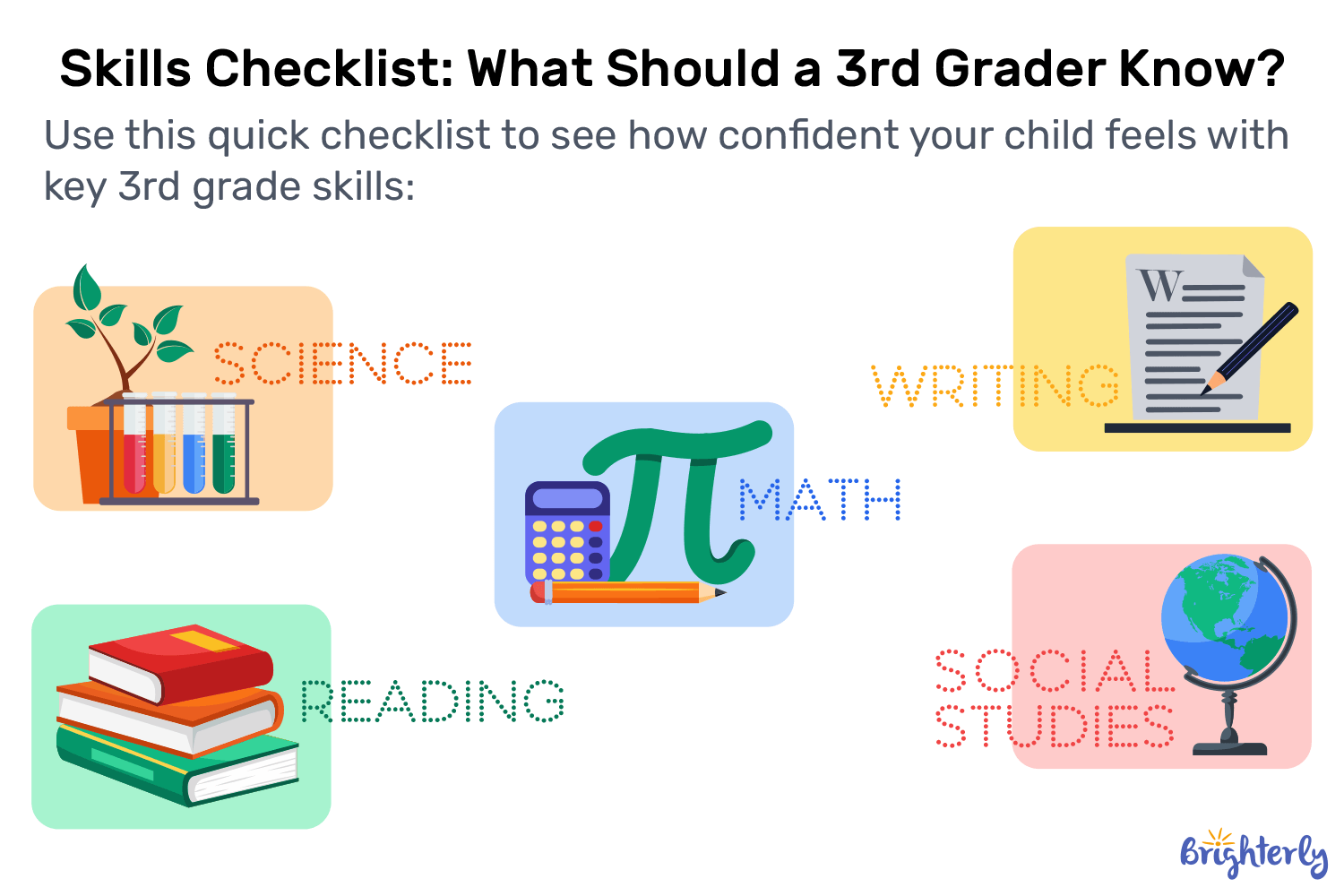
By 3rd grade, kids are starting to tackle bigger numbers, dive into longer stories, and write short paragraphs with a clear beginning and ending. They also should know how to work with simple fractions, retell stories in their own words, and explore how communities and maps work.
Here’s a quick look at the key skills they’re expected to build at this stage.
Math
- To add and subtract double or three-digit numbers
- Know basic multiplication and division
- Solve simple math tasks formulated as word problems
- Understand the simplest fractions such as a half or a third
- Be able to tell time
- Get familiar with common measurements such as length or weight
- Understand the definitions of figure’s perimeter and area
Reading
- Read elementary grade-level texts smoothly
- Understand and retell what they read using their own words
- Answer simple questions about a text
- Identify the main idea of a text
- Figure out the meaning of new words from context
Writing
- Write short chunks of text
- Express ideas clearly in a few sentences
- Build a simple paragraph with a clear beginning and ending
- Use basic punctuation
- Be able to review and improve their own writing
Science
- Know basic ideas about weather and climate
- Recognize simple concepts like force and motion
- With little oversight make basic observations and draw conclusions
Social Studies
- Read simple local maps and familiarize yourself with continents and oceans
- Have a basic sense of history and culture
- Grasp fundamental economic concepts such as money and goods
Explore Brighterly Learning Experience
Learn exactly how Brighterly helps students thrive through expert sessions, online tools, and proven feedback from thousands of satisfied parents
What Do 3rd Graders Learn In Math?
In grade 3 the math starts to become applicable. As pupils already know and write the digits and numbers already, they can start to apply them in real life working through text math problems. But for iterative additions common in everyday life, they miss one more skill – multiplication and division. These are introduced within single and double-digit numbers first. Moreover, one more applicable math item is to get to know basic fractions and basic geometry. All of these are of utmost importance and students need to comprehend them freely to be ready for any standardized testing later on.
Topics Covered In The 3rd Grade Math
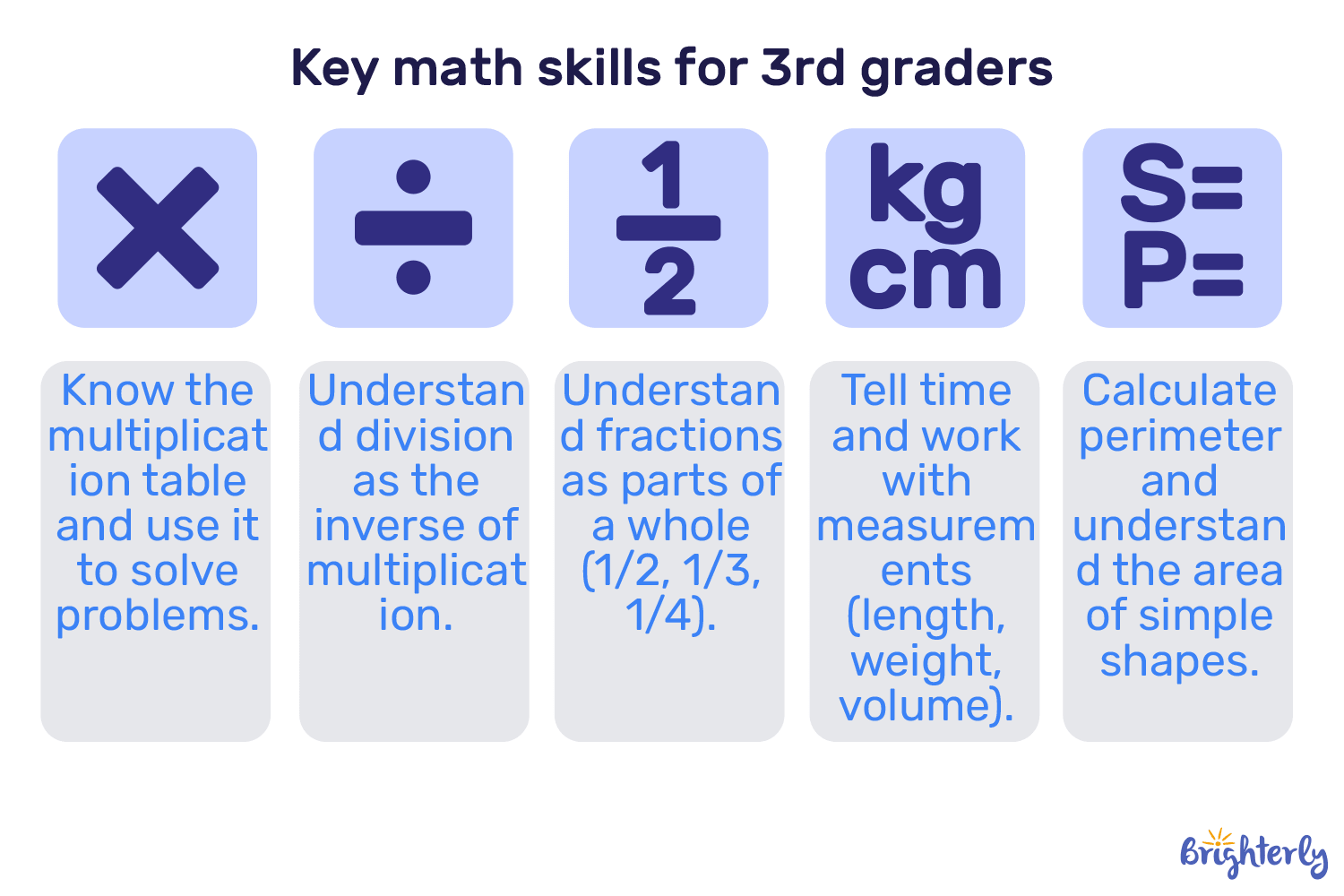
- Multiplication
Multiplication is among the indispensable things 3rd graders should know and apply smoothly. This skill would be taught using everyday situations that need to be tackled. For example, if there are 5 rows of 4 desks in a classroom, how many desks are there in a classroom in total? Or if a box has 6 sets of pencils with 3 pencils in each, how many pencils are there together in a box? In the essence, the child should grasp that multiplication is a quick way for repeated additions. - Division
In a logical step, students also study division as a reverse to multiplying. For instance, there are 24 cookies that are shared among 6 children. How many cookies will each child get? Or alternatively, if you need to place 24 cookies with 4 cookies per plate, how many plates will you need? Again, here the child would need to realize that both tasks require the same type of calculation logic. - Fractions
Smoothly, children start exploring fractions of the whole number using simple examples: pizza, chocolate, apples, etc. For instance: which is bigger, ½ (half) of a chocolate bar or ¼ (quarter)? Or if a pizza is cut into 3 slices and one slice is eaten, what fraction of total was eaten? Everyday examples help understand fractions which are non-obvious for kids that studied before only positive integer numbers. - Area and shapes
The other very practical topic is calculating areas through simple squares. For example: a rectangle has 3 rows of 5 squares. How many squares are there in rectangular in total? Children can also start comparing shapes, for instance, which shape has more sides or perimeter of which shape is larger.
How Brighterly Helps With 3rd Grade Math?
Mastering these topics is essential, as children in 3rd grade can already start lagging behind others. No wonder, the kid won’t enjoy math going forward and it would be also reflected in poor performance in other quantitative subjects. If you spot that your child faces difficulties and you don’t have enough time or patience to help them, professional tutor’s support can solve the issue. Alternatively, even for a math geek kid, a good tutor can develop his inclinations further in an individualized path. Brighterly’s math program for kids offers 1:1 online sessions with such certified tutors. To maintain high standards, lesson plans are aligned with US state standards, and allow for weekly progress tracking. Brighterly’s students don’t just catch up, they get ahead.
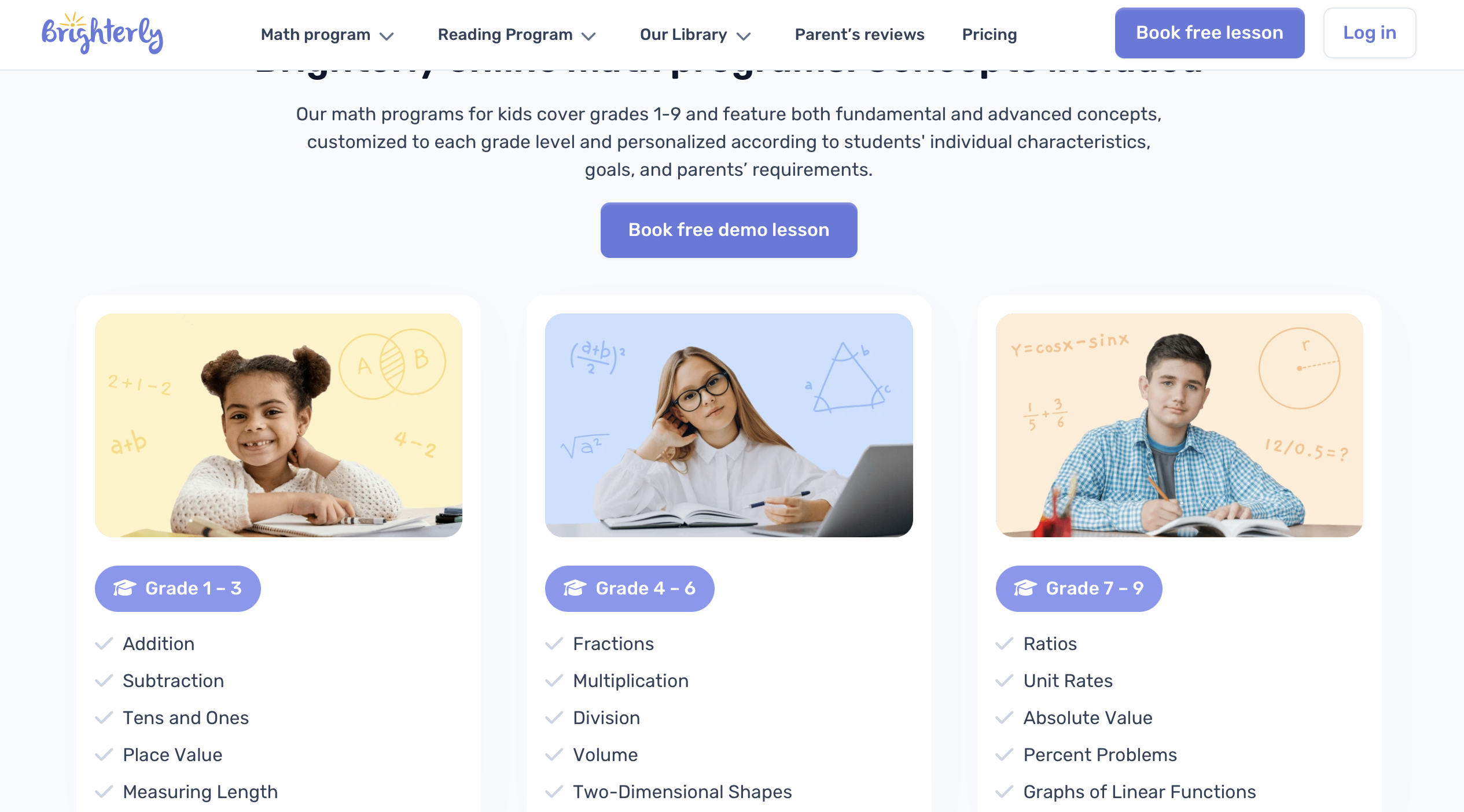
Brighterly’s program as such will adapt to each student’s peculiarities, based on a 3rd grade math test that every child takes before starting learning. What’s impossible to do in a large classroom, can be implemented through individual online sessions, well-thought 3rd grade math worksheets, and customized assignments. Parents will just need to track the progress and in case of any questions refer to personalized support.
Want A Math Mentor For Your Child?
Brighterly teachers make sure students learn with joy and without any stress. 
What Do Kids Learn In 3rd Grade In Reading?
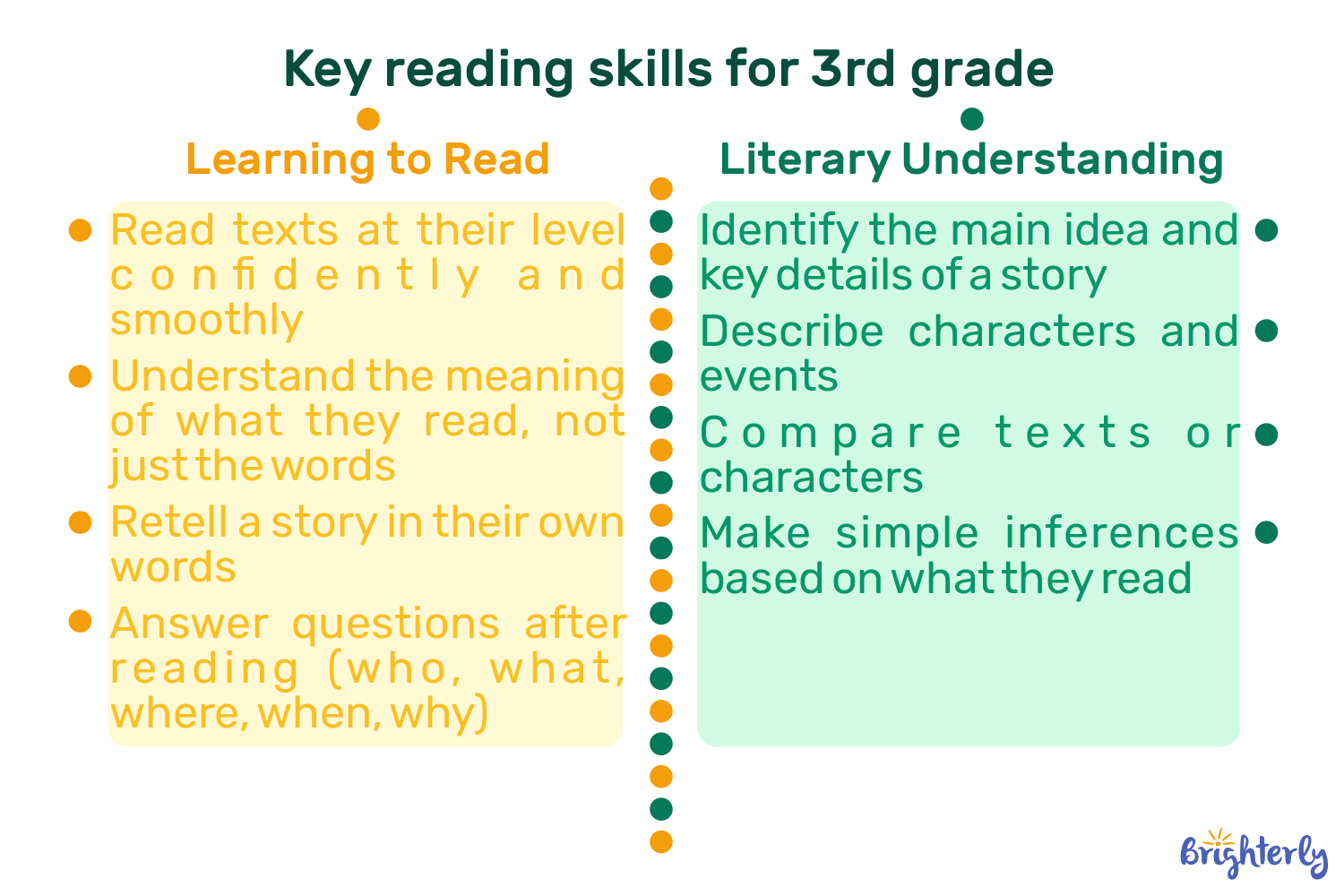
In 3rd grade, children continue to improve reading fluency and reading comprehension. They practice thinking deeply about what they read, a skill that they will use across subjects. The reading list in 3rd grade already includes many informational memos and texts about nature, so that students develop well-rounded erudition.
How Reading Changes In 3rd Grade?
- From “reading” to “understanding” and “explaining”.
In grades 1-2, reading focused on saying words correctly. Finally, at the 3rd, students have to start to understand and analyze the meaning of a text by themselves. Pupils are able to find answers in the text, explain rationale of actions, for example, why a character acted in a certain way. They can also think about the main idea of the story and answer the teacher’s follow-up questions. - Longer texts. More independence.
Generally, one of the things you learn in 3rd grade is the ability to process more complex materials. It can be stories with multiple chapters, informational texts about nature, well-known personalities or even bright historical events. These texts naturally filled with new vocabulary and more advanced grammar. Children should be able to read them smoothly and later be capable of retelling what they understand. Sounds as a big step forward but a child’s brain learns fast. - Variety of topics.
In reading lessons, students will explore a variety of genres ranging from fairy tales to explanatory articles. Reading becomes essential across subjects. For example, elementary science or social studies tasks require reading and understanding information.
How Brighterly Helps With 3rd Grade Reading?
As reading is the main tool for learning all subjects, it’s hard to overestimate the importance to support your child during this stage. If you can provide that support at home, that’s great. Otherwise, nowadays you can rely on a 3rd grade reading tutor who knows the subject inside out and is trained to work with different characters of children.
Brighterly tutors run a dedicated reading program that is again individual-based and frankly contains very engaging content. To exemplify, mentors mix each session with games, have animated presentations, worksheets, and well-though texts matched with the child’s interests. During the lesson, there is constant interaction with the child and the tutor’s goal is to help a student grow both in reading and critical thinking.
Help Your Child Read With Confidence?
Brighterly teaches kids not just to read, but to dive in and understand the meaning.
What Do 3rd Graders Learn In Writing?
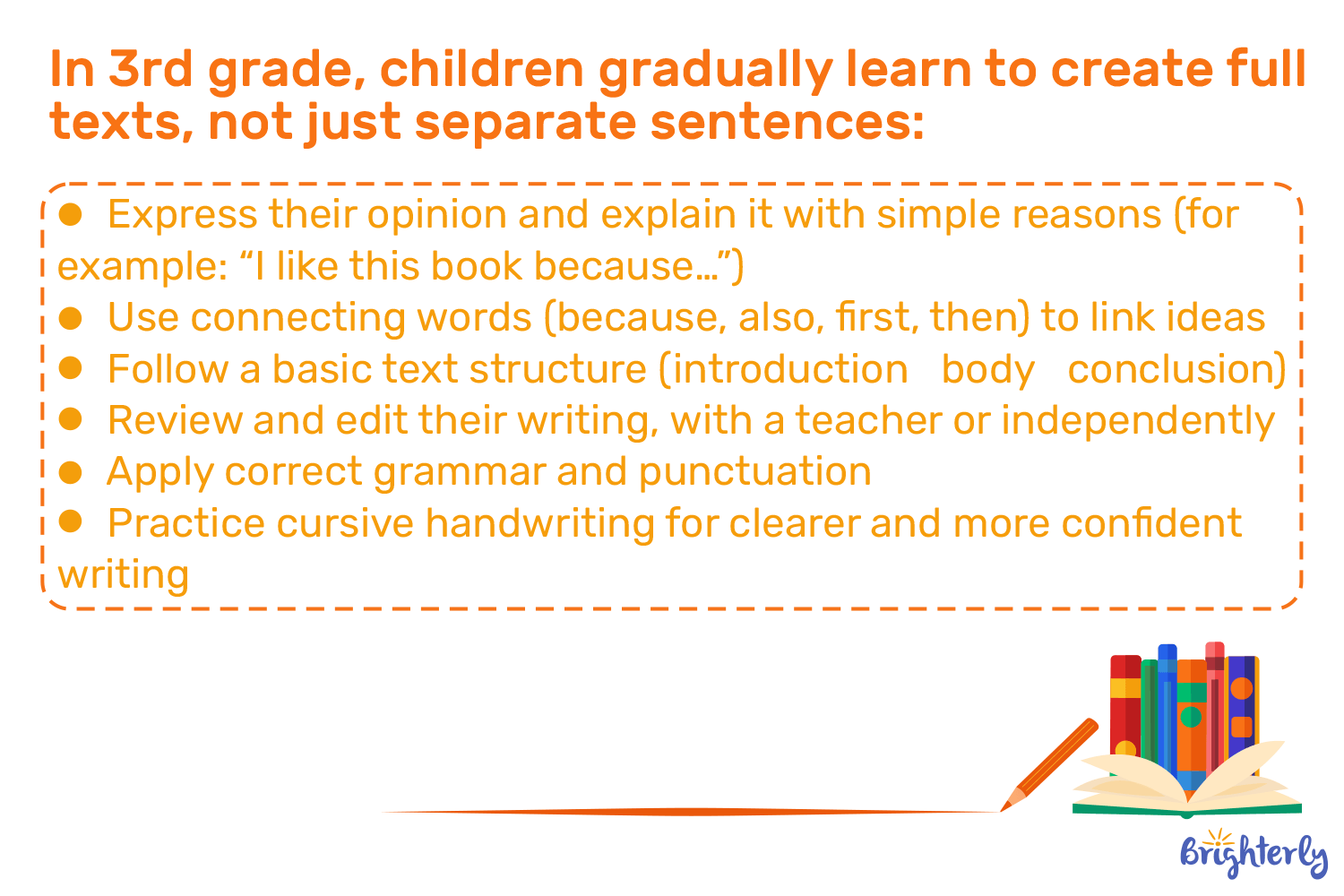
Writing is a logical continuation of advances in reading as throughout this grade, students are learning to organize their thoughts into coherent texts. In classrooms, there is a practice of writing pupils’ own sentences and even text. These can be sharing facts or experiences during the holidays, telling a story of advice, but expressed in a logical way. Children are getting acquainted with proper grammar rules and punctuation. Thus, after ‘technical’ copying of letters and words in the first two grades, kids in the Grade 3 learn to become independent writers, which is a big psychological jump.
Types Of Writing In 3rd Grade
Structurally, as part of learning for 3rd graders, children work with these types of writing:
- Opinion Writing
Students learn to express their own point of view and briefly explain. Example: “My favorite subject is art because I can be creative.” - Informational Writing
Kids share facts and can elaborate to a minimal extent. Example: “Write a short text about an animal: where it lives, what it eats, and what it looks like.” - Narrative Writing
Students tell a real or imagined story. Example: “Describe your birthday” or “create a story about your favourite hero”.
What Do 3rd Graders Learn In Science?
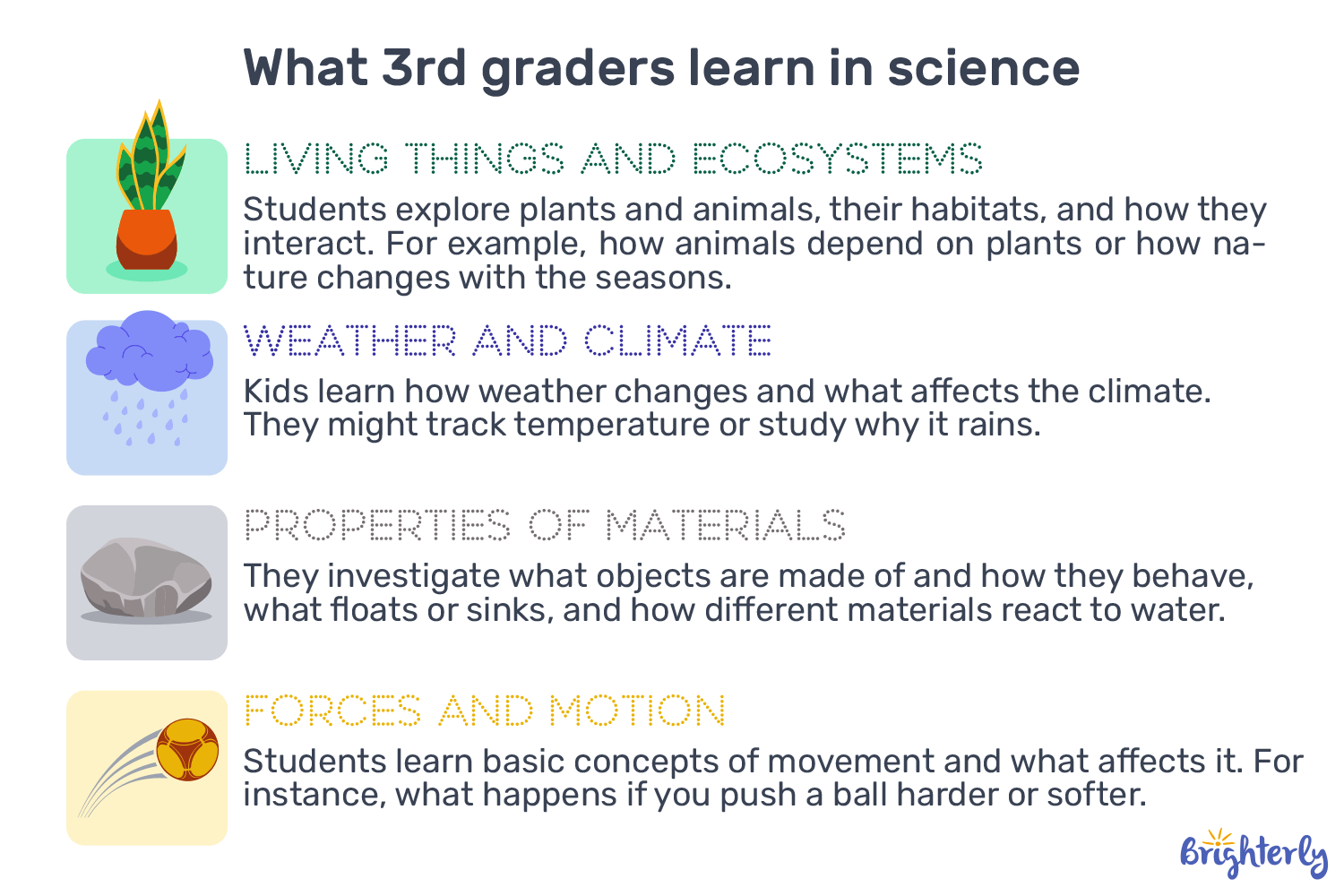
Students start to learn science, which initial focus lies on understanding connections between living organisms, natural phenomena, and the environment. For example, kids can start working as little researchers, do simple experiments with food or water, record observations, and draw conclusions by themselves. As an additional idea, they might explore how a plant grows. All of this given essential understanding of the surrounding world and builds love for self-exploration.
What Does A 3rd Grader Need To Know About Social Studies?
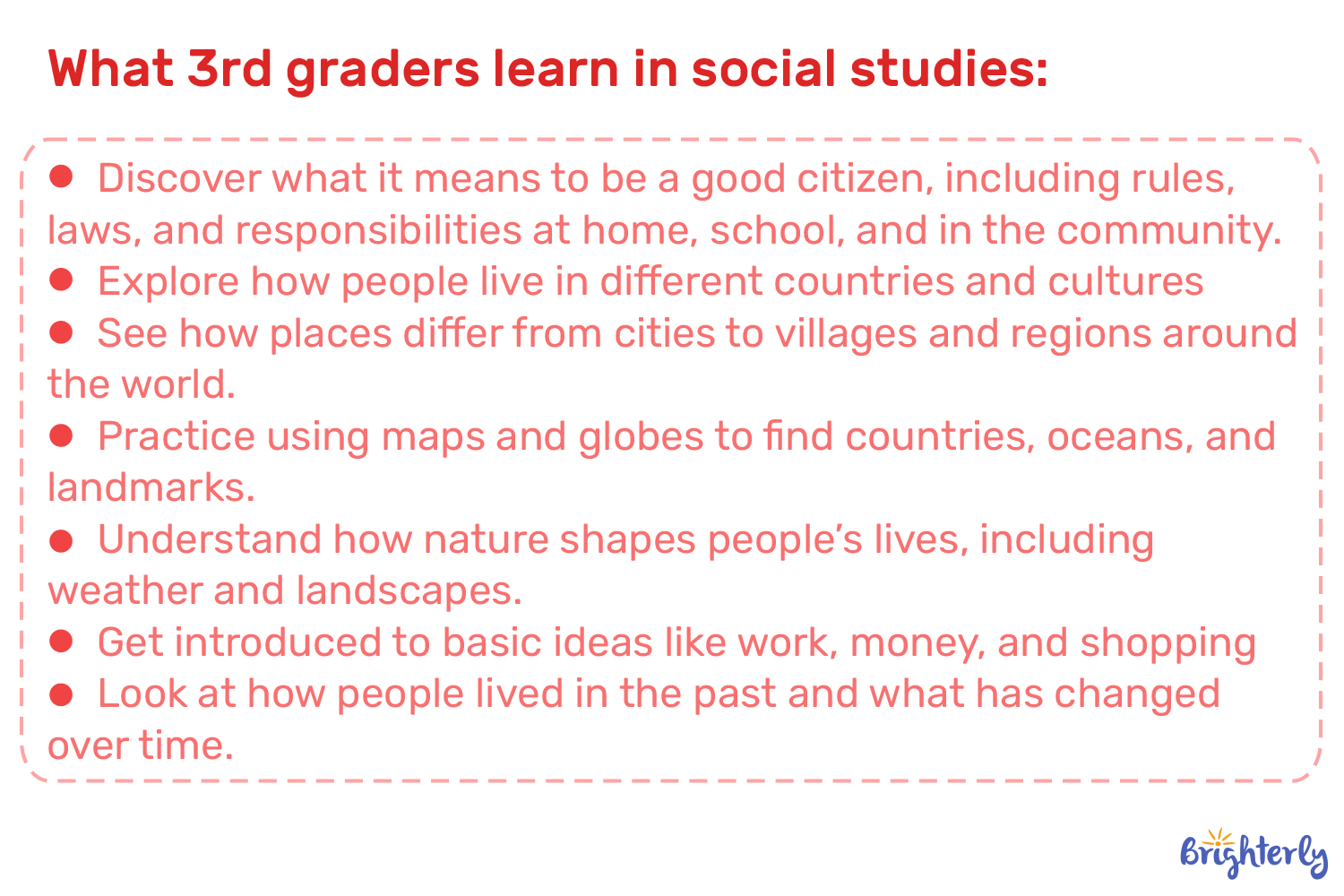
The modern subject of Social studies is the common member of Grade 3 curriculums. Social or human world is what surrounds and shapes us far more than nature, especially in XXI century society. This subject developed to teach students how different communities live, why certain rules exist, and why they do matter at home, at school, and in society. Kids can get introduced to basic geography, learning continents and oceans, and practically explore local area maps and places. Over time, they begin to discover history through texts about how people lived in the past as well as distinguished events and inventions that shaped the modern world.
Conclusion: Should 3rd Graders Get Additional Support?
In elementary school, 3rd graders have an important mission to learn how to apply their basic skills in practice and more independently. That’s the momentum where they start to build confidence in their knowledge and skills. It could be the start of an exciting learning journey if the child would enjoy the process to read, think and apply. Or it could be easily missed and learning would become a ‘torture’. Little of us enjoyed all subjects at school but frankly some children were getting info quicker and moving faster with tasks. That comprehension and self-work is built in Grade 3. So no time to rest for parents – at this stage, it’s particularly important to support your child, with building confidence in reading, writing, math, and other 3rd grade skills.
You are a patient parent who is ready to devote as much time to a child as needed – that’s a rare and great outcome. But if that’s not the case, don’t get greedy and find a professional tutor to work occasionally or regularly with your child. No AI or software can substitute human interaction and teaching. For that, consider professional, personalized support from the Brighterly math and reading platform. Attention to your child’s needs and expert guidance is something you can truly rely on.
FAQ
How Can Parents Help Their 3rd Grader Succeed?
The recipe is simple, pay attention to your child’s learning journey. Read together every day, discuss topics of interest, teach them necessary indoor and outdoor skills as well as norms of social behaviour. Practice math with real-life examples during cooking or shopping. Encourage creative writing and painting. Remember that the key is disciplined routine and definitely celebrating successes to boost your child’s confidence. A child’s brain likes to explore new things, please make sure to not deprive a child of this curiosity. It’s fully understandable that parents may lack time to help their children, – if that’s the case think about professional support, Fortunately, there are plenty of those today. Just spend a few hours comparing these to find the proper one.
What Subjects Do 3rd Graders Learn?
To consolidate, Grade 3 is a really important one. While subjects remain quite the same, the requirements change notably as kids are encouraged to think and work independently expressing their own ideas. Stories and essays on various social and natural topics would be introduced throughout reading and writing. Math will introduce multiplication and division along with more complicated addition and subtraction operations. Meanwhile, there would be new non-intuitive topics including fractions, time, and simple geometry that often cause troubles. Kids will start exploring plants, animals and weather during science classes, all along with conducting basic experiments. Furthermore, social studies are devoted to teaching how to behave in a community, development of interpersonal skills as well as learning about certain notable events that affected our human society.
What Should 3rd Graders Know By The End Of The Year?
By the end of 3rd grade, a child should be able to read and understand texts confidently, summarize them, and answer questions. In math, they should know multiplication tables, solve simple problems, and work with fractions and measurements. In writing, they should be able to create connected texts, express their ideas, and explain them. They should also have a basic understanding of how the world works: nature, society, rules, and how people interact with each other.
What Should A Child Know In Grade 3?
In 3rd grade learning, a child should: Read and understand texts confidently; write simple stories and informational pieces; perform addition, subtraction, multiplication, division, and work with fractions. Additionally, pupils should explore nature, animals, and weather to learn basic science. They should also understand communities and history. Additionally, they participate in art, music, and physical education. This helps them develop creativity, coordination, and teamwork. By the end of the year, students have a solid foundation for fourth grade.

A thesis statement is a key part of academic writing that helps students introduce the main idea of their piece, explain what this piece is about, and what they were trying to prove as an author. Find out how to write a thesis statement step-by-step with examples and templates to make sure you can structure […]

Apr 13, 2026
What if you know your kids need extra support, or if they’ve recently received a disability diagnosis? In such a case, analyzing an IEP vs 504 plan may look scary. This guide is the way to bring you some clarity and show the key differences between plans in a less confusing way. Key points An […]
Apr 13, 2026
Math & reading from 1st to 12th grade
Looking for homework support for your child?
Choose kid's grade

Math & Reading for Grades 1–12
Build real confidence for your child with a Brighterly math or reading tutor.