Social Media in Education: 15 Best Practices 2026
reviewed by Claire Smizer
Updated on September 24, 2026
Key Points
Social media in education shapes how students access information, communicate, and complete assignments. Schools now use platforms like YouTube, Google Classroom, and X (Twitter) as part of classroom technology. This guide covers 15 best practices for teachers and parents using social media in K–12 learning settings.
What Is Social Media in Education?
Social media in education is the intentional use of digital communication platforms to extend learning outside the traditional classroom. With 95% of teens using these sites daily, educators use them to bridge the gap between school and home.
Social media supports collaborative learning, reinforces why reading is important, and strengthens digital literacy skills. In this way, familiar digital tools become practical channels for classroom communication and contribute to K–12 student success.
Explore Brighterly Learning Experience
Learn exactly how Brighterly helps students thrive through expert sessions, online tools, and proven feedback from thousands of satisfied parents
Benefits of Social Media in Education
Benefits of social media in education include bridging the gap between classroom theory and real-world application. Social media transforms passive listeners into active participants. These tools offer dynamic ways to connect, share resources, and practice responsible digital citizenship. Integrating familiar technology increases relevance, accessibility, and retention for diverse students.
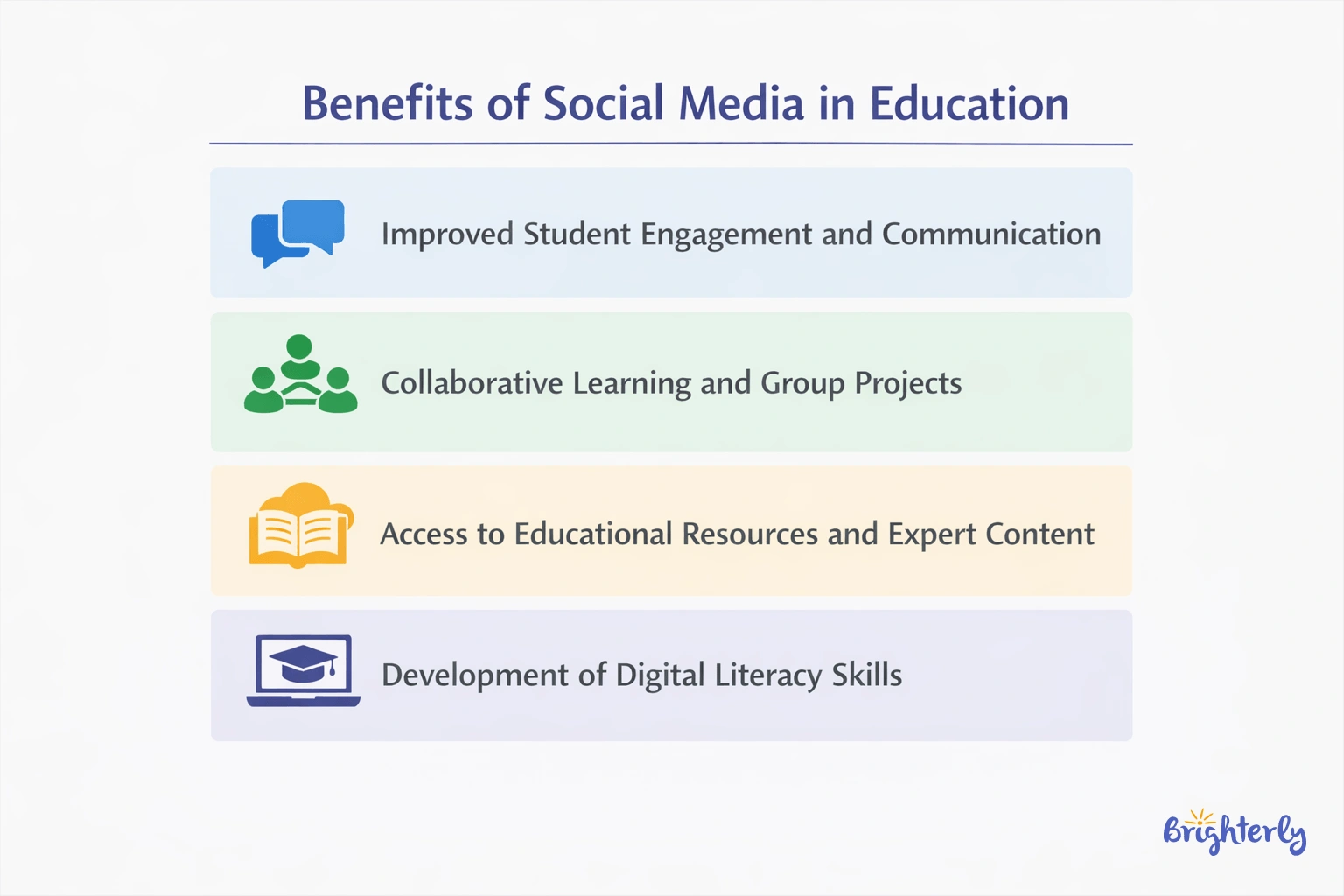
Improved Student Engagement and Communication
Improved student engagement occurs when educators meet learners in their preferred digital environments. By leveraging social media platforms for education, teachers foster higher participation and stronger rapport. These tools allow for instant feedback, regular check-ins, and shared updates that maintain a steady rhythm of learning beyond traditional lecture hours.
Our Brighterly learning platform leverages similar interactive methods to keep students focused on their goals. This constant feedback loop — consisting of daily assignment updates, real-time Q&A, and progress alerts — prevents assignments from falling through the cracks and keeps parents informed. Using social media for education makes the teacher more accessible, ensuring no student feels isolated during the learning process.
Collaborative Learning and Group Projects
Educational social media facilitates seamless collaborative learning by providing shared digital spaces for projects. Students can instantly upload research, debate core ideas, and divide tasks without scheduling physical meetings. This method removes common logistical barriers and teaches students how to coordinate effectively in a professional-style digital environment.
Access to Educational Resources and Expert Content
Social media platforms for education provide instant access to real-time information and global expert content. Unlike static textbooks, these tools allow students to follow scientists, authors, or historians directly. Observing how these professionals apply their knowledge in the real world brings abstract academic concepts to life for every learner.
Integrating current events into the curriculum ensures lessons go beyond the page. Through the use of social media in education, the world is brought into the classroom. Students no longer rely solely on outdated printed materials; they engage with living, evolving data that keeps the subject matter fresh and relevant.
Development of Digital Literacy Skills
Developing digital literacy skills helps students evaluate online information with a critical eye. By using educational social media, the classroom becomes a safe laboratory to build smart habits. Students learn to navigate misinformation and recognize bias, ensuring they become responsible digital citizens rather than passive consumers of unverified content. It also highlights the benefits of social media for students when guided with clear rules and critical thinking habits.
Teachers guide this process by modeling how to verify facts. Instead of accepting a post at face value, students learn to ask: Who wrote this? What is their motive? Is this information consistent with other trusted reports? By analyzing social media statistics and identifying sensational headlines, students learn to filter out rumors and keep their engagement informed.
Furthermore, students must understand that every comment creates a digital footprint. When they view their online activity through the eyes of a future employer, they shift from casual sharing to professional presentation. This awareness turns social media into a space where responsibility grows alongside use.
Finally, by enforcing rules where comments focus on facts and personal attacks are removed, teachers transform potentially toxic spaces into environments for growth. Students learn to practice empathy, set boundaries, and report harassment.
Challenges and Risks of Social Media in Schools
Students lose focus faster when social media is open during lessons. Short task-switching lowers retention and slows reading progress. About 55% of US students ages 13–17 report experiencing cyberbullying, due to a 2025 study from PubMed Central. Many social media platforms collect user data, which raises concerns for children under 13 under the Children’s Online Privacy Protection Act. Misinformation spreads easily through feeds, and age-gating tools often fail to fully restrict access.
Distraction and Reduced Academic Performance
Social media students often switch tasks too quickly. A lesson tab stays open, while notifications pull attention away. This breaks focus and slows reading or problem-solving. Even short checks reduce retention of new material.
In classroom social media use, timing matters. Set fixed moments for interaction, then close apps. Keep online learning tools limited to one task at a time. Parental controls can help at home to block extra apps during study time. Teaching social media use as a skill also improves focus. Students need clear rules on when and how to engage.
Cyberbullying and Online Safety
Online interaction brings social risks. Due to a 2023 nationally representative study by the Cyberbullying Research Center, approximately 55% of US students aged 13–17 have experienced cyberbullying (Cyberbullying Research Center, February 16, 2024). This affects confidence and school participation.
In social media tools for education, comments and chats need moderation. Teachers should set clear behavior rules before using any platform. Educational social media works better in closed groups with known users. Students should know how to report harmful messages. Teaching social media also includes safe communication habits. Regular check-ins help catch issues early, and making sure your child’s personal information isn’t publicly accessible online is an equally important part of keeping them safe. You can use a data removal service to automatically remove your child’s personal details from sites that collect and share them.
Privacy Risks and COPPA Compliance
Younger students need extra protection online. In the US, the Children’s Online Privacy Protection Act sets strict rules for data collection from children under 13. The law requires platforms to obtain verifiable parental consent before collecting personal information and limits how that data can be used.
To avoid these requirements, many social media platforms for education set age limits. For this reason, most major platforms restrict access to users under 13. Schools must ensure that tools meet these requirements. Before using an app, parents should review the permissions. Classroom technology should avoid collecting extra personal data.
You should use platforms that allow teachers to manage their accounts. Home data sharing can also be restricted by parental controls. Privacy settings need to be reviewed often, not once. Even large companies have faced penalties for violating COPPA, underscoring that the risks are real and require active monitoring.
Misinformation and Fake News in the Classroom
Social feeds mix facts with opinions. Students may accept false posts as true. Research shows that young users are more vulnerable to misinformation because their critical evaluation skills are still developing.
Note: According to a Stanford University study, 82% of middle school students could not distinguish between ads and real news content, which shows how easily misleading information is accepted.
A structured reading approach can reduce this gap. Our Brighterly reading program supports students with guided comprehension practice and fact vs. opinion tasks. With 1:1 lessons and a research-based curriculum, it builds stronger reading habits that help students evaluate information more carefully and reduce confusion from online content.
Personalized Learning That Fits Your Child
Our 1:1 tutors help K–12 students build strong math and reading foundations.
This affects reading and writing in the classroom. Check sources and dates when teaching social media. Assess student understanding of the topic by asking them to compare two sources. By doing this, you build a habit of reading carefully. It is possible to support research and reading skills using social media if they are guided well.
15 Best Practices for Using Social Media in Education
These practices are for teachers and parents who work with students using social media for education in real learning settings. The focus is on clear classroom use, safety, and learning outcomes. The goal is to balance social media with structure, safety, and purpose.
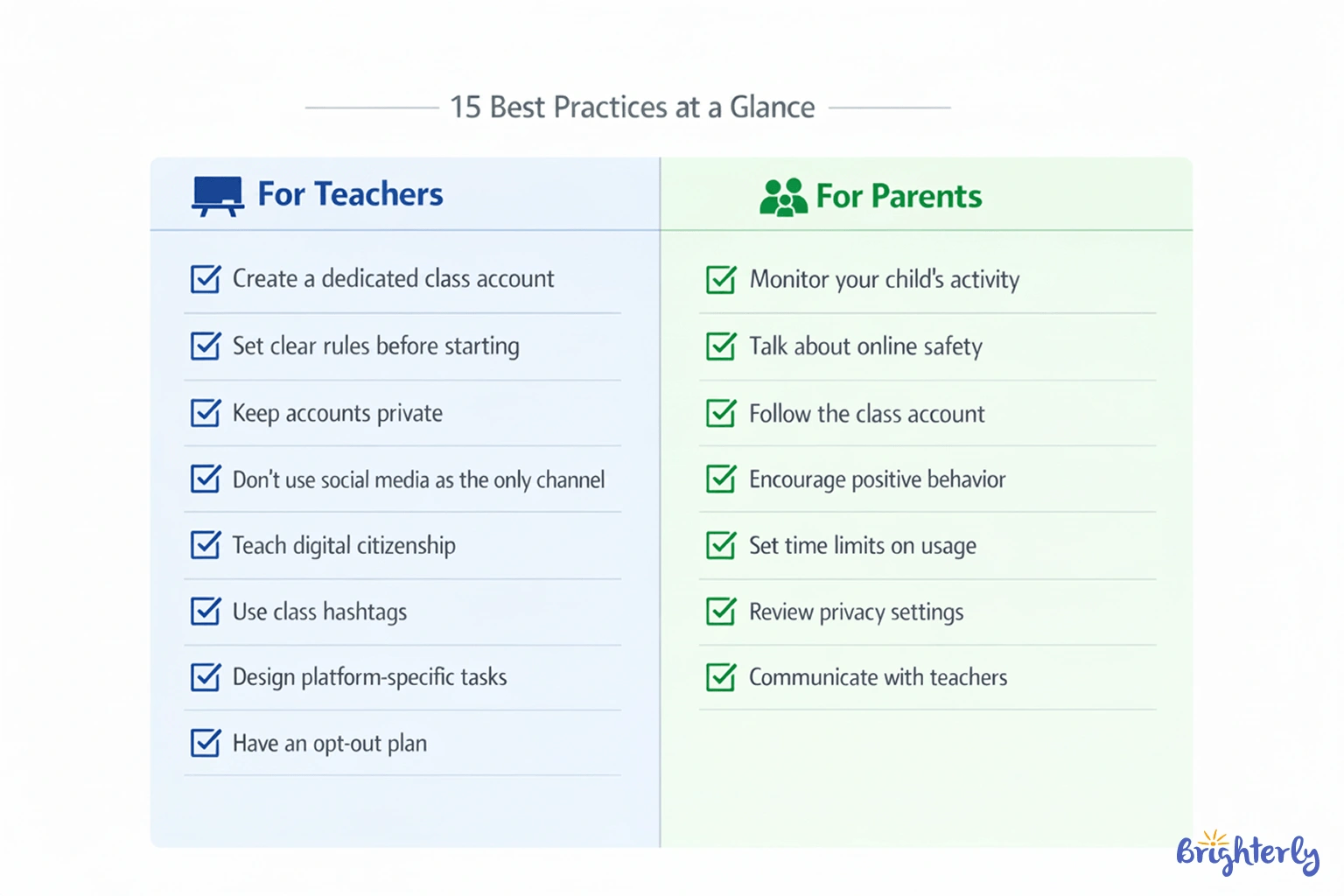
For Teachers in the Classroom
1. Use TikTok or Instagram for a visual example. For sharing information, young students prefer social media platforms with images and videos. While schools still require writing skills, students engage more easily when they use familiar formats. You can ask students to respond to a textbook chapter using a TikTok-style video instead of a written response. To present work to the class, students can create an Instagram carousel or reel.
2. Create a resume with LinkedIn. Most adults benefit from professional self-marketing, but schools rarely teach it directly to students. Using social media in education, students can define career goals, organize academic and project experiences, request recommendations, and connect with potential mentors and employers. And Linkedin the best choice for these purposes.
3. Use Twitter to illustrate the dangers of misinformation. For students at higher grade levels, finding and citing accurate sources is a crucial skill. Sadly, social media makes it easy for anyone to spread misinformation or make false claims without citing a source. Show students an inaccurate tweet or social post and ask them to verify or debunk it. Provide them with a process for documenting their research and citing the sources they used.
4. Use YouTube to explain things step-by-step. Text is often not enough to help students understand complex topics. The teacher can assign a short YouTube video as a “pre-reading” activity. After watching, students write an explanation or draw a diagram of the same idea.
5. Use Google Classroom. It is easy for teachers to post instructions, deadlines, and feedback in Google Classroom. Students can submit a draft, receive feedback, and revise — all in the same platform. Using Google Classroom in this way reduces confusion and keeps all work visible. Also, it provides a consistent way to track progress in social media for education.
6. Use Pinterest to map out ideas. During the project, students collect images, quotes, and examples that relate to their topic. In a history essay, for instance, historical events, maps, and artifacts can be used to begin the writing process. Students can do this before writing to help them organize their thoughts. Rather than forcing full sentences too early, it builds structure. Through visual planning, this method increases student engagement.
7. Use Instagram Stories for quick reflection tasks. Students can post short reflections after a lesson or reading task. For example, one slide can answer “what was the key idea today?” This format works well for short attention cycles in social media students. Teachers can review responses quickly and adjust instruction. It also encourages consistent participation without long writing pressure.
8. Use real news posts to train source checking in class. Teachers can take a short news article from outlets like The Washington Post or BBC News and turn it into a classroom analysis task. Compare the headline with the full article and identify what changes the meaning. They then compare different social media feeds or summaries of the same event. It shows how framing can change interpretation even when the facts remain the same.
For Parents Supporting Learning at Home
9. Learn from short-form content. Parents can use scrolling as a teaching tool. When a child watches a short video on educational social media, pause and ask what problem the video explains. Connect it to a school subject, such as science or history. By doing this, social media students can shift from passive viewing to active thinking. Additionally, it reduces time spent mindlessly on screens without banning them.
10. Limit device use based on study tasks. Use specific work to link devices instead of strict “no phone” rules. For example, phones are only used during homework checks or research. Outside of that, devices should be kept away from the desk. By using this structure, students can focus on educational tasks while using social media. Also, it helps separate study time from leisure time.
11. Discuss the news together. With the child, parents can read a short article from a source like The Washington Post or BBC News. Ask what facts stand out and what feels unclear. Rather than passively reading about media, this promotes shared thinking. It also enhances critical awareness of social media and learning content. With time, children become more comfortable questioning information and increase their reading speed.
12. Check privacy settings on apps and platforms together. Parents need to review account settings on educational social media tools. Make sure you know who can comment, who can message, and what data the app collects. Don’t do this silently, but together with the child. Instead of being hidden, safety will become a habit.
13. Create instead of scrolling. Shift your focus from consumption to output at home. Ask the child to explain, draw, or narrate what they learned online. It is better to use simple formats than to rely on passive scrolling. This encourages collaborative learning outside the classroom. The material is also better retained.
14. Use platform recommendations as a media literacy check. Consider what social media suggests next after a child watches or reads content. Talk about why that content appears and who benefits from it. Compare recommended videos and posts with neutral sources such as textbooks or school materials. In this way, students can see how social media for education and entertainment shapes attention. As well, it raises awareness of how algorithms influence what students think is “important” content on social media.
15. Combine Social Media with Structured Tutoring Support. A guided learning program is beneficial to students who have difficulty focusing or developing their skills. Structured programs like Brighterly offer 1:1 support. This helps connect social media with personalized instruction for kids in 10th, 11th, and 12th grades, or in elementary or middle school. It reduces gaps in understanding and improves consistency.
Best Social Media Platforms for Educational Use
Not every platform fits every age group or task. Younger students need closed systems with strong controls. Older students can work with open platforms when guided. According to Pew Research, 73% of teens visit YouTube daily, while roughly 60% visit TikTok every day (Pew, 2024), making school guidance essential for healthy usage habits.
YouTube — Video Learning for All Ages
YouTube is widely used for instruction. Teachers use it for brief explanations, demos, and background context. Video supports comprehension when paired with active tasks rather than passive viewing.
Pause the video and ask a question. Younger students need curated playlists and restricted mode. By doing so, the user will be exposed to less unrelated content. For focusing, short clips are better than long videos.
Google Classroom and Edmodo — Structured Class Collaboration
Google Classroom gives a controlled space for assignments and feedback in social media education. Teachers post tasks, students submit work, and progress is tracked in one place. This reduces distraction compared to open platforms. Edmodo offers similar features with a social-style interface.
Both tools support a clear structure, which is key for younger grades. Due to Common Sense Education, structured platforms improve focus compared to open social media by providing educators with tools to manage student attention and mitigate digital distractions.
Pinterest — Visual Projects and Lesson Planning
Pinterest is a good tool for collecting ideas and creating visuals. By grouping images by topic, students can explain their choices. Using this approach, we can support project-based learning. The teacher can plan lessons and organize materials with its help. When content is visually sorted, students are more likely to remember it. Furthermore, it simplifies the process of learning how to do research.
LinkedIn — Career Readiness for High School Students
The LinkedIn platform is suitable for high school students. In the context of a social media education platform, it introduces career paths, job skills, and professional profiles. It allows high school students to explore job descriptions and skills required for different jobs. This enables students to connect their school learning to their future goals. Setting up profiles safely requires guidance.
X (Twitter) and Instagram — Current Events and Media Literacy
Students can access real-time content on X and Instagram. It is useful for current events and discussion tasks. These platforms require a high level of media literacy. Students should verify information and check sources. Research from Stanford History Education Group shows that many students struggle to evaluate online information. Guidance from teachers is crucial in this situation.
For students who need more structure, Brighterly offers 1:1 online learning with a clear curriculum. This works well alongside classroom technology. It gives focused support without the distractions of open platforms.
What Schools and Policymakers Are Doing in 2026
Governments are moving toward stricter rules on student device and social media use, with a focus on reducing distraction and online risks. In April 2025, Finland passed a law restricting mobile phone use during lessons, allowing it only with teacher permission to support focus in class (The Guardian). Similar policies are spreading globally, with the share of countries implementing school phone bans rising from 23% to 40% between 2023 and 2024 (Wikipedia).
In the United States, several states have enacted laws restricting phone use during instructional time or requiring districts to adopt formal policies. These laws focus on limiting distractions while still allowing devices for learning when approved by teachers (Encyclopedia Britannica).
Is Your Child Falling Behind? We Can Help
Our K–12 tutors build math and reading foundations, one lesson at a time.
Conclusion
When schools and parents set a clear structure around social media use in education, it works best. When guided by strong rules and media literacy skills, it promotes engagement, collaboration, and access to real-world information. Researchers at Stanford and Pew have found that students need support to evaluate information and stay focused in digital environments. Whether social platforms will be integrated into education in the future will depend on their responsibility in integrating into daily learning routines.
Frequently Asked Questions
What Is the Role of Social Media in Education?
The role of social media in education is to extend learning beyond the classroom through communication, collaboration, and access to real-world content. Teachers use platforms for discussion, assignments, and media literacy tasks. It also helps students connect school topics with current events and expert content.
How is Social Media Affecting Education?
Social media affects education both positively and negatively. In addition to increasing student engagement, it also improves their access to information. If students are not guided properly, it can lead to distraction, spreading misinformation, and cyberbullying.
At What Age Should Kids Start Using Social Media for Learning?
Kids should start using social media for learning only when platforms meet age requirements (usually around 13 years). In the US, COPPA protects children under 13, which limits data collection and platform access. Most structured educational use starts in late elementary or middle school with closed, teacher-controlled tools.
How Can Parents Monitor Their Child’s Social Media Use in School?
Parents can monitor their child’s social media use in school by reviewing app permissions, using parental controls, and checking privacy settings regularly. They should also discuss online activity with the child instead of only restricting access. Shared review builds awareness of digital citizenship and safe screen time habits.
What Are the Safest Platforms for Classroom Use?
The safest platforms for classroom use are controlled systems like Google Classroom and Edmodo. YouTube (with restricted mode) also works when teachers curate content. These tools support structured learning, limit open exposure, and allow teachers to manage classroom technology more safely than open social feeds.


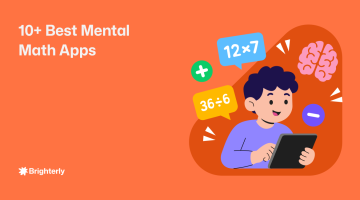
With mental math apps, kids can improve their calculation speed, accuracy, and focus for 5-10 minutes a day. In 2026, the best mental math apps for daily practice combine timed drills, adaptive difficulty, and step-by-step explanations. Compare the 10+ top apps by features, price, and grade level to choose the right one for your child. […]

Apr 20, 2026
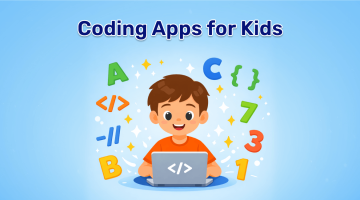
In 2026, the top coding apps for kids focus on block-based coding, introducing concepts via puzzles and games, learning programming languages, and developing apps or games. Drag-and-drop coding apps make learning interactive for younger kids, while block coding and early language programming apps can support their interest. The middle and high schoolers need more complex […]

Apr 28, 2026
Math & reading from 1st to 12th grade
Looking for homework support for your child?
Choose kid's grade

Math & Reading for Grades 1–12
Build real confidence for your child with a Brighterly math or reading tutor.