IEP Vs 504 Plan: Key Differences Every Parent Should Know
reviewed by Laila A. Lico
Updated on April 13, 2026
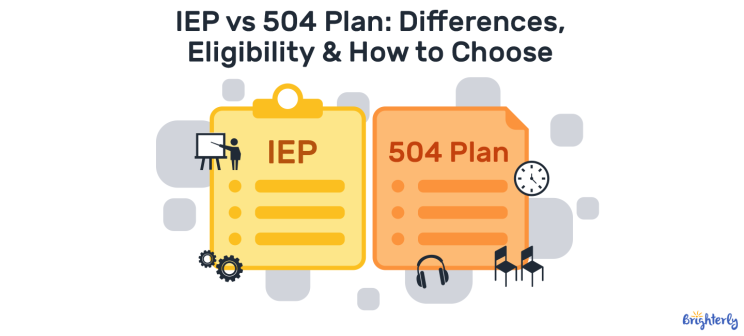
What if you know your kids need extra support, or if they’ve recently received a disability diagnosis? In such a case, analyzing an IEP vs 504 plan may look scary. This guide is the way to bring you some clarity and show the key differences between plans in a less confusing way.
Key points
- An IEP offers specialized instruction to school students whose academic performance has significantly worsened due to their disability.
- A 504 plan focuses on providing accommodations to support kids in a general classroom, without intervening in teaching.
- IEPs are more intensive, formal, and comprehensive, while 504 Plans are more flexible and broad.
What Is An IEP?
An IEP, or Individualized Education Program, is a plan and legally binding document developed for a child with disabilities who needs specialized instruction, ensuring they can succeed in school and have their needs met.
That’s achieved thanks to the special education services and support of the school in meeting the specific needs of such kids. Notably, it’s possible due to the Individual with Disabilities Education Improvement ACT of 2004 (IDEA) that underlines that schools must assist students with learning disabilities.
How Can A Child Qualify For This Plan?
- First of all, under IDEA, they should fall into one of 13 disability categories. They refer to such learning disabilities as dyslexia, autism spectrum disorder, language impairments, emotional disturbance, and others.
- Also, it must be clear that the disability or condition negatively affects the child’s academic performance.
Importantly, an IEP should be developed by a formal team, and it should include the following:
- Measurable annual learning goals,
- Performance levels,
- Specialized instructions or services, like a program, they’ll receive under the plan,
- Methods to track the progress,
- And details on how they will partake in education.
“An individualized education plan provides a special education program and related services.”


Explore Brighterly Learning Experience
Learn exactly how Brighterly helps students thrive through expert sessions, online tools, and proven feedback from thousands of satisfied parents
What Is A 504 Plan For Students?
A 504 Plan is an accommodation plan designed to ensure that a child with a disability receives the support they need to successfully learn in a general education classroom.
It gets its name from Section 504 of the Rehabilitation Act of 1973, a civil rights law protecting individuals with disabilities from discrimination in schools and institutions that receive public funding.
Comparing a 504 plan vs IEP, it’s more of a guarantee of equal access. Thus, a plan would include practical changes, accommodations, and the persons responsible for it. Typically, they have no measurable goals or formal tracking.
There, the examples of accommodations may refer to:
- assistive tools
- arrangement in a class
- extended time for tests
- access to quiet rooms
- movement breaks or pauses.
How Can A Child Qualify?
- The main condition is that a child must have a physical or mental impairment that significantly limits their life activities. It refers to learning, concentrating, or communicating.
- The 504 plan’s bar is far broader than that of an IEP. It means if students won’t qualify for the latter, they still can get a 504 plan.
Note: The 504 plan is not necessarily legally written, yet schools often put it in writing. Considering this, the IEP can be easier to enforce.
IEP Vs 504: Comparison Chart
| IEP | 504 Plan | |
| Main focus | A formal plan offering specialized instruction and services | A formal plan removing barriers in general education via necessary accommodations |
| Legal ground | IDEA, a federal law aimed at addressing disability | Section 504 of the Rehabilitation Act of 1973 is a civil rights law |
| Eligibility | A kid must have one of 13 specific disability categories and need specialized instruction | A kid must have a disability affecting one or more major life activities |
| What’s included? | IEP includes specialized instruction, related services, annual goals, accommodations, modifications, tracking methods, and inclusion details. | A 504 plan includes accommodation, assistive technology, and responsible persons; the inclusion of services is possible but less common. |
| Who creates | A formal team that consists of parents, general teacher, special ed teacher, respective specialist, and school district representative (LEA) for resources approval | Typically, it’s a less formal team of parents, general or special ed teachers, a school principal, coordinators, and sometimes counselors |
| Consent | A parent provides consent twice, before evaluation and before the school provides services to a kid | Consent of a parent is needed to start the evaluation only |
| How are results monitored? | For monitoring and tracking, a school includes annual goals and a schedule. | For monitoring, a school may include communication or reviews. |
| The process of review | The team reviews the plan each year; a kid is to take a re-evaluation every three years. | As each state has its own rules, it differs. In general, the plan can be reviewed yearly. |
| How do schools resolve disputes? | Parents and schools have the following formal options: discussions, mediation, hearings, state or civil rights complaints. | The dispute resolution is less structured; parents and schools resolve disputes similarly. |
From this IEP vs 504 plan chart, you can see that the former plan is more robust and formal with regular updates and annual goals. In addition, it requires the presence of a special teacher but offers more legal protection for a kid and their family.
How To Support Your Child’s Learning
It’s hard to argue that these plans can be crucial strategies. Yet if one is unavailable and the other is not enough, you may want to support the kids’ classroom experience in a different way.
In this regard, professional tutoring is likely to become your supplementary option. For instance, Brighterly, a 1:1 learning platform, is one of the solutions you may want to consider.
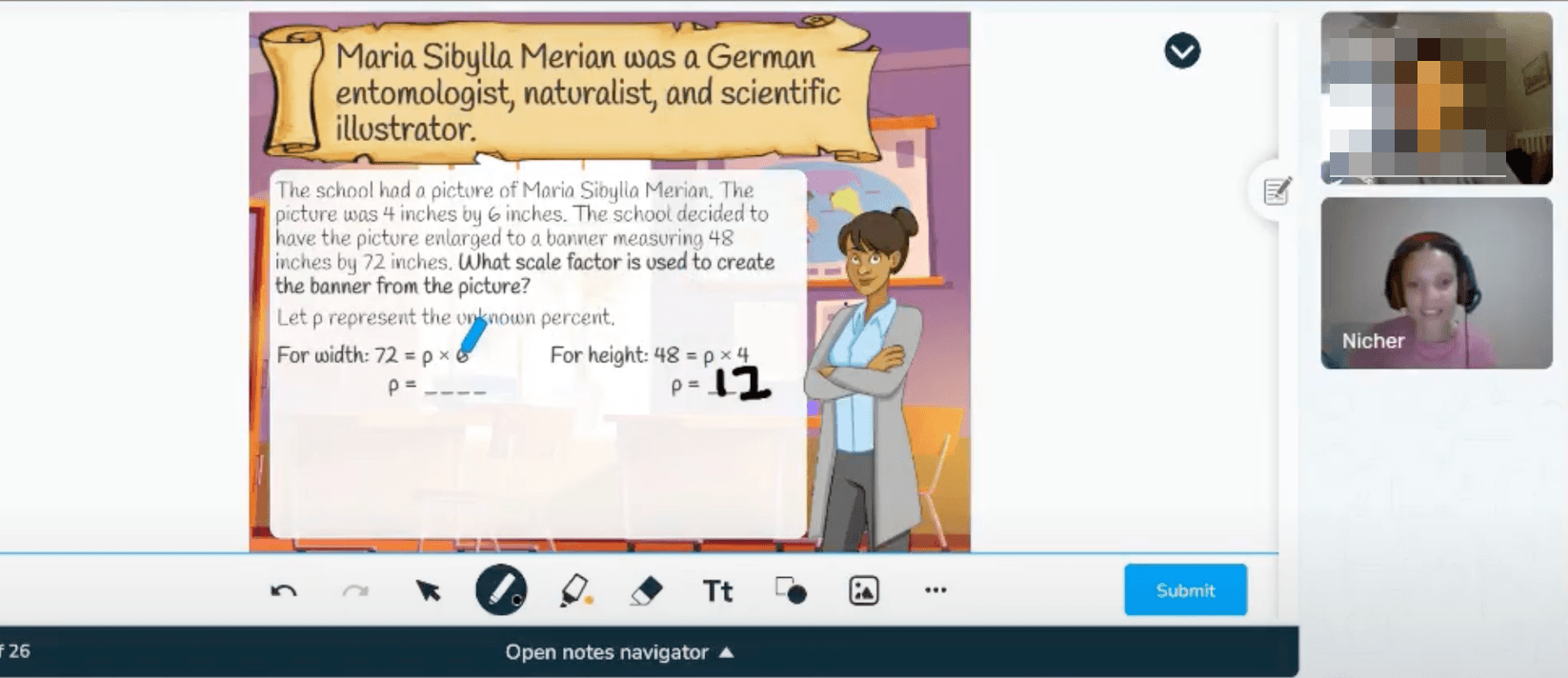
Each course, whether it’s a math program or a reading program, aims to follow national standards. However, it leaves room for interaction and engagement. That way, it’s possible to provide structured learning and support kids’ confidence.
How does it work?
- Our programs start with a diagnostic assessment.
- Upon it, we develop tailored learning plans so that they match specific needs, profiles, and goals.
Other than that, our platform brings in affordable learning plans. So, the support doesn’t become a burden.
Reinforce kids’ schoolwork with tutoring
Our tutors identify gaps and personalize learning to meet kids’ specific needs 

IEP Vs 504 For Specific Conditions
The choice between an IEP or 504 plan often depends on whether your kid needs special education services.
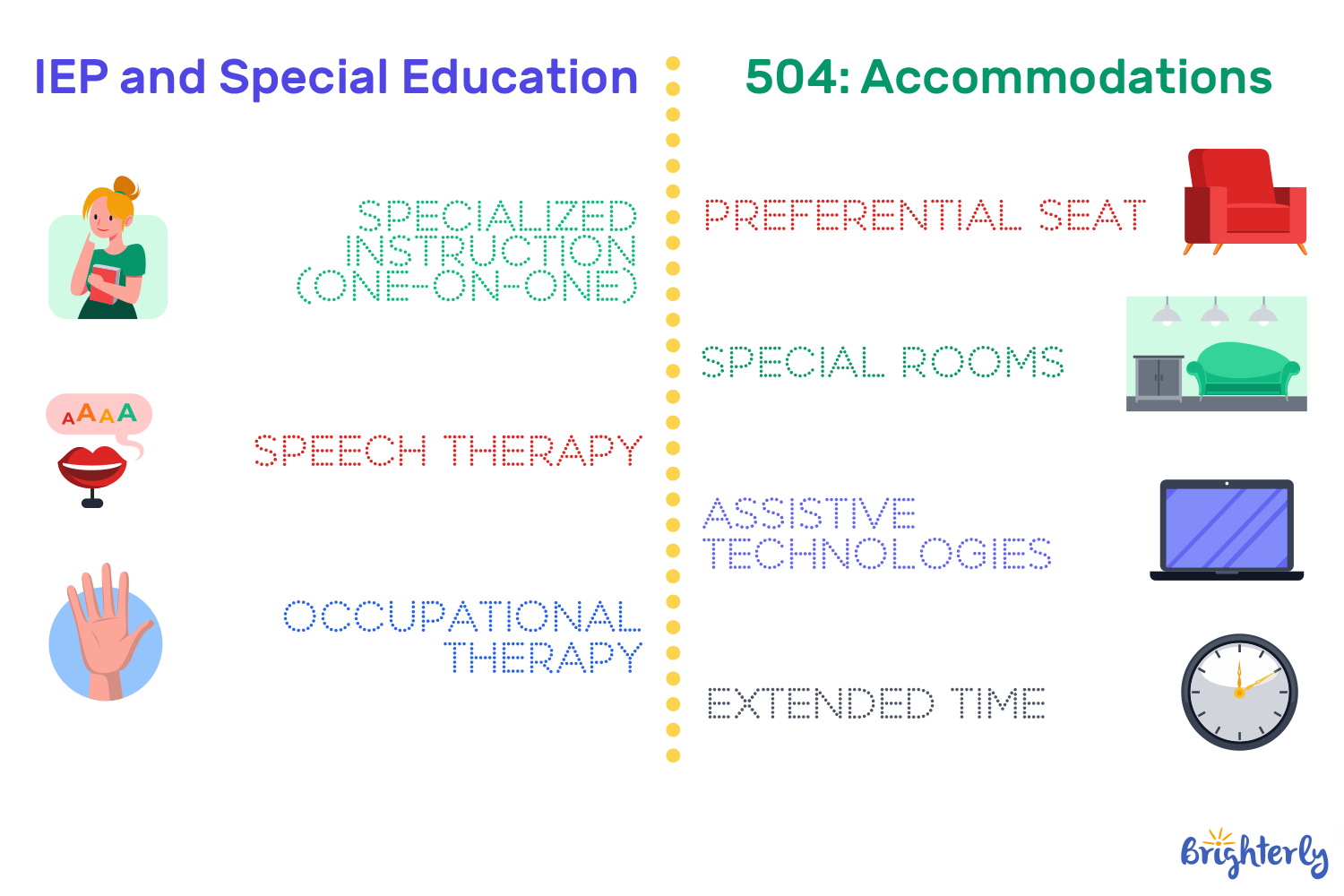
As you are aware, kids are different and so are their diagnoses. And it’s the main rationale behind covering various cases and conditions. Their impact defines kids’ abilities to learn and participate in academic life.
IEP Vs 504 For ADHD
ADHD is simply one of the most common reasons for children to qualify for these plans. If you wonder which one, an IEP or 504 plan, is better for a student with ADHD, the answer lies in the severity of the condition.
Let’s imagine that there’re are two different kids.
- Megan. She is in the 4th grade and has ADHD. She is good at comprehension of materials and actively participates in class discussions, keeping up academically. Yet, her ADHD and reading struggles refer to noisy classrooms and their distraction, as well as stressful tests with strict time limits.
In this case, a 504 plan is a great fit. That’s because such changes in accommodations, like offering extended time, having a separate room for testing, or seating closer to a teacher, can help overcome the challenge.
At the same time, let’s have a look at a second kid.
- Jake. He is also in the 4th grade and has the same condition. Yet, his difficulties have a more severe impact. It leads to a complete lack of attention and impulse control. It results in poor performance and disruption during a class. Therefore, he is behind in reading by one grade level.
The possible strategy for Jake is to qualify for an IEP under one of the categories. The reason for it? Limited strength, unable to react to environmental stimuli. His plan is likely to have specialized reading instructions, behavioral intervention, and regular check-ups.
Look at these examples. Is a 504 plan the same as an IEP for addressing ADHD challenges? No. Megan needs adjustments to the conditions, and Jake needs a change in the way he is taught.
IEP Vs 504 For Autism
Now, try to evaluate the use of an IEP or 504 plan for children with autism. In short, the chances are they will qualify for an IEP.
First of all, autism falls under one of the specific categories mentioned in the IDEA. Yet, how autism is expressed will define the use of one of the plans.
- Meet Sam, an ASD student. He is in the 2nd grade. Despite strong academic skills, he experiences challenges that refer to social communication and sensory sensitivity. As a result, he is extremely overwhelmed when it’s loud or when the whole class goes for a break or lunch.
Will he qualify for an IEP? He may, as he needs and is to benefit from sessions with a speech-language specialist, a sensory diet from a therapist, and visual schedules.
At the same time, if you are asking whether a 504 plan can be applied for autism, the answer is “yes” as well. Yet, conditions do matter.
- In this scenario, there’s Grace. She’s in the 7th grade and has high-functioning autism. She keeps up academically. However, her main challenges refer to the anxiety in group settings and poor interpretation of social cues.
There, to some degree, a 504 may work for Grace. For her, a quiet break room, reduced homework on certain days, and advance notice before a break are the accommodations to reduce anxiety.
Comparing the use of IEP vs 504 for autism, the impact of diagnosis on learning, communication, and school routines will guide the school’s decision.
Note: The 2025 PubMed article by Rae Anne Lindsay about 504 plans for the autistic children suggests kids’ positive experiences refer to the support of school professionals, while negative to the school’s unwillingness to provide accommodations.
IEP Vs 504 For Learning Disabilities
Learning disabilities like dysgraphia or dyslexia often are the basis for the more nuanced cases. What are the reasons? The same diagnosis may have different levels of needs.
- For instance, imagine Emily, a 3rd grader with dyslexia who reads at a 1st grade level. She struggles to decode basic words independently and avoids reading aloud. She is definitely behind her peers.
In this case, she needs structured guidance. Schools may define it as the specialized instruction and ensure kids’ qualification for an IEP under the “Specific Learning Disability” category.
What about a different situation?
- Consider Michael, a 5th grader who also has dyslexia, but thanks to early intervention, has decent progress. His reading is slightly below grade level, and he works with content independently. Yet, he needs extra time to read heavy tests, access materials, and the possibility to type and not handwrite assignments.
No diagnosis and no special instructions are needed; a 504 plan will be the right fit. The reason is that the targeted accommodations, like additional timed digital assignment options, can do the job.
How To Choose: IEP Or 504 Plan?
The right choice depends on your child’s individual needs, the severity of their disability, and the impact on academic performance. The greater the effect of the disability on academic performance, the greater the need for special instruction and an IEP.
However, it’s often a school’s call. For instance, do you need a diagnosis for a 504 plan or an IEP? Not necessarily. That’s because much depends on the school and its evaluation. That’s why you should go into this process informed.
“For both 504's and IEP's, schools are required to provide you with information about your rights.”

Decision Checklist For Parents
Before approaching the school authorities for a specialized plan, ask yourself the following:
- Does my child struggle despite being in a general education classroom with no extra support?
- Has my child been formally evaluated? Has my child been diagnosed with a disability by a professional?
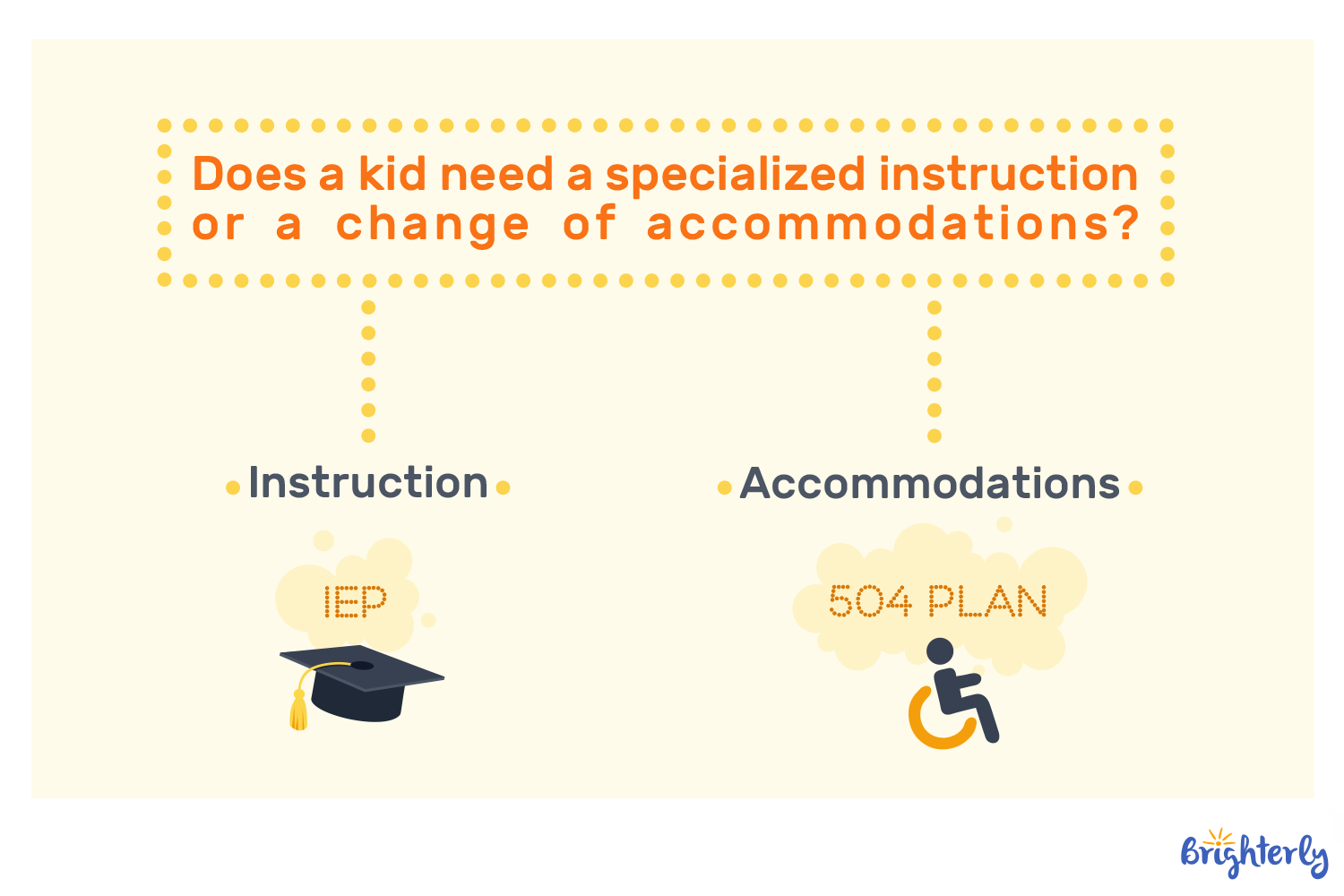
- Does my child need a change in the way they are taught, not a change of accommodations?
- Is or will be my child in need of specific instruction, therapy, or behavioral intervention?
- Have you already used a 504 Plan? Is 504 special education enough, or do you find it ineffective?
- Does my child’s disability fall under IDEA’s umbrella of categories?
Note: If for most questions, you are to answer “yes,” then your kid may need an IEP, and it’s worth pursuing it.
When To Request Each
- Request an IEP evaluation when your kid’s disability impacts their educational performance to a significant extent, while you believe that specialized instruction will be effective.
- Request a 504 Plan when your child has a diagnosis impacting their ability to participate equally in school, yet they can do alright with appropriate accommodations or certain changes in place.
Can A Student Have An IEP And A 504?
Yes, there are cases where both plans may be used together, like during a physical injury. Yet usually, if your child qualifies for an IEP, the accommodations provided by the 504 Plan may be added to the IEP instead.
Conclusion
IEPs and 504 Plans may look scary at first glance. However, once you understand the IEP/504 meaning, it gives you clarity on how to support your kid. The main difference is that:
- An IEP is more formal and aims to support via specialized instruction for kids with poor academic performance
- A 504 Plan is less formal and aims to reduce barriers for kids with disabilities and support their learning needs via accommodations.
There, if you feel that the IEP is unavailable, while a 504 plan is not enough, your solution may be personalized tutoring. Wonder how it can help? Book a free session to try Brighterly.
FAQ
What’s The Difference Between An IEP And A 504?
The main difference relates to the level of support and intervention. An IEP offers specialized instruction, affecting how and what your kids study. A 504 Plan brings in a change in accommodations that make it easier to access or do learning.
Can A Student Have Both An IEP And A 504 Plan?
Yes, it’s possible, for instance, when a kid is already under an IEP and has acquired a separate health condition, like a broken arm. In such a case, the IEP addresses the disability, while the 504 plan provides accommodations or alternative tools for writing. Yet, it’s not very common, as an IEP often includes an accommodations part.
Do You Need A Diagnosis For A 504 Plan?
No, a formal medical diagnosis is not necessary for a 504 plan. The reason is that schools are to evaluate whether a student has an impairment that limits their life or learning activity.
Is A 504 Plan Considered Special Education?
No, the 504 plan is not considered special education, as it derives from the civil rights law aimed at ensuring access to general education.
Which Is Better –An IEP Or A 504 Plan?
Objectively, neither of the plans is better. The right plan is concerned with answering whether a kid needs specialized instruction or accommodations to support their needs or remove barriers.


What do 3rd graders learn? In the 3rd grade, the curriculum is built around five main subjects: math, reading, writing, science, and social studies. As such, by the end of the year, kis are expected to read and understand simple texts, solve trivial math problems, and be able to express their ideas in a clear […]
Apr 13, 2026

When you look for the right college to get into, the best college comparison websites are your closest allies. That’s where you check general information, admission rates, and tuition costs. Alongside comparing schools, it’s worth strengthening your academic profile early — for instance, through structured math courses that build the skills colleges look for. Read […]

Apr 15, 2026
Math & reading from 1st to 12th grade
Looking for homework support for your child?

Choose kid's grade

Math & Reading for Grades 1–12
Build real confidence for your child with a Brighterly math or reading tutor.