Lexile levels: Understanding Your Child’s Reading Skills
reviewed by Franz Jerby Delos Santos
Updated on January 29, 2026

Lexile levels are commonly used to measure the reading skills of a child and the difficulty of a text in order to match students with appropriate books to boost their understanding and engagement. In this guide, I’ll provide you with all the information about Lexile scores that you need as a parent to help your kid choose level-matched reading materials. Most importantly, I’ll show you the best techniques to boost your child’s level for continuous academic progress, based on my decade-long experience as an English language teacher and tutor.
Key points
- Educators use Lexile scores to evaluate children’s reading abilities and offer them level-appropriate books.
- Lexile levels are measured via school assessments and standardized reading tests.
- The best way to increase your child’s Lexile measure is via personalized reading tutoring.
What is a Lexile score and what does it tell parents?
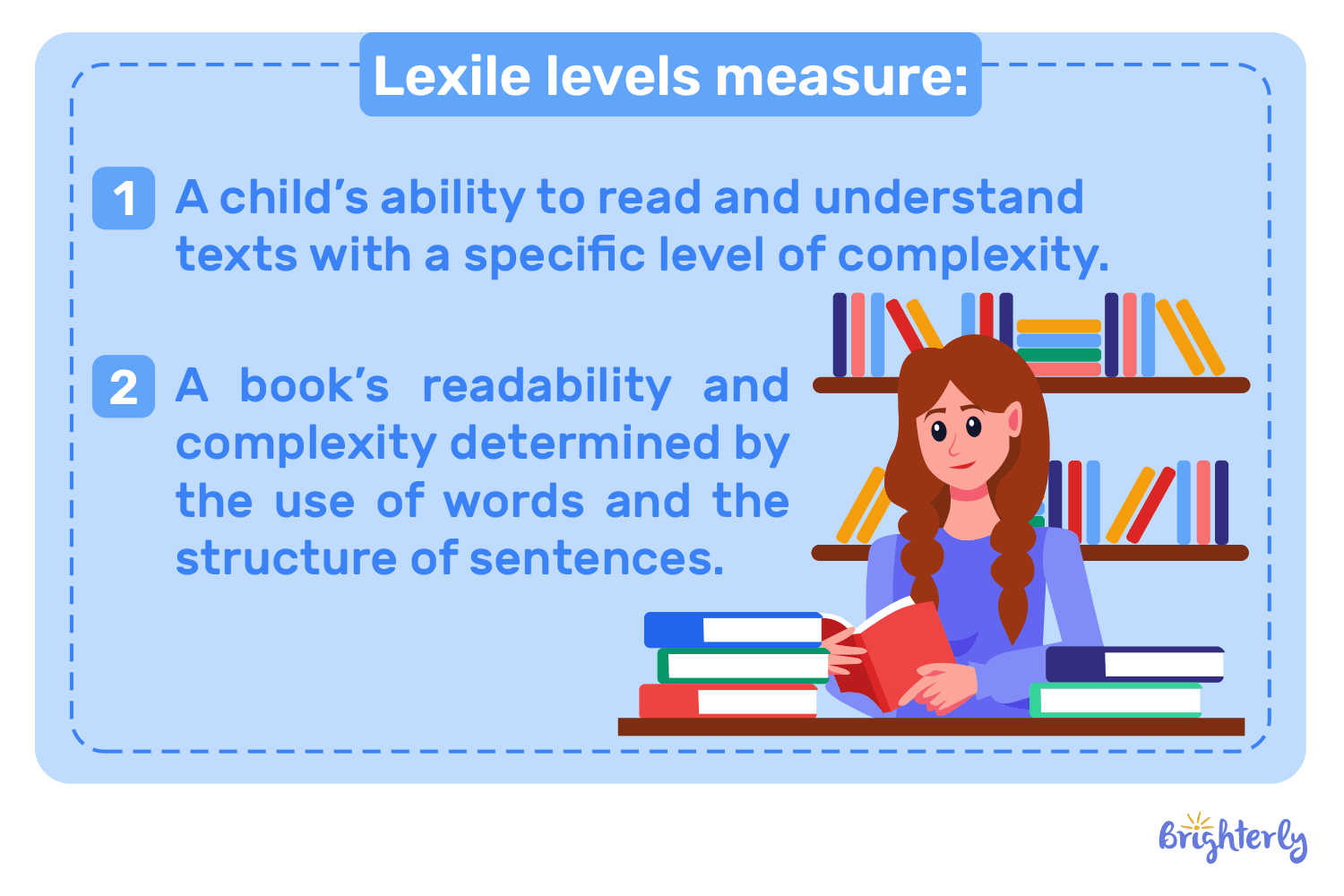
The Lexile level is a common measure of 1) a reader’s comprehension skills and 2) the reading material’s complexity that is presented as a numerical value. It tells parents about the reading capabilities of their child, regardless of their grade at school, and what books are most appropriate for their level.
Specifically, the Lexile level meaning is to show:
- A child’s ability to read books within a certain range of difficulty.
- A text’s readability is based on an in-depth breakdown of word number and frequency, sentence length and complexity, and overall text difficulty.
MetaMetrics developed the Lexile Framework for Reading as an interpretative tool to determine student progress and likelihood for future success. As Allison Wilson, the Senior Director of Curriculum and Innovation at Stratford School, shared, under the research from the University of North Carolina at Chapel Hill (which shaped the Lexile Framework), children tend to understand about 75 percent of a text when the reading level and book difficulty are closely matched. Due to this, educators and parents use Lexile scores to gain insight into a student’s reading level and progress over time.
Still, it’s important to note that Lexile cannot dictate what books the student should or should not read. Since it determines the average expectations for your child’s reading readiness based on a text’s length and vocabulary, these indicators may differ from their actual interests and reading tastes. Due to this, Allison Wilson recommends paying attention to Lexile measures but not limiting your kid’s reading passions based on this framework:
“Research shows that children make stronger reading gains when they are interested in what they read and feel confident doing so.”


Nevertheless, the Lexile measure is widely used by teachers and parents to pair children with the right books and texts based on their reading comprehension level. This is one of the most effective reading comprehension strategies as kids get assigned level-appropriate texts. If children end up reading a book that is too difficult for them, they feel discouraged and develop unpleasant feelings towards reading activities. If, on the opporsite, they read a text that’s too easy, they get bored and don’t develop their reading abilities efficiently.
What is my child’s Lexile level, and how do I find it?
To find out your child’s Lexile reading score, you have to talk to their school administration or English teacher, as typically, a kid’s reading level gets measured at their school. This is done with the help of special reading assessments and standardized reading tests.
While it’s not obligatory within the United States educational system, many schools in all 50 states define Lexile level for their students, usually through the district. This helps them assign relevant books to children to boost reading fluency and also keep track of students’ progress over time.
For parents, Lexile levels are indicators of the books’ complexity. Knowing them can help make more informed decisions while buying.
“Lexile is simply a guideline and not a gatekeeper. Parents can support reading growth by helping children experience books at different levels.”
How to read Lexile levels?
For efficiently reading and understanding Lexile levels, you need to be familiar with the makeup of the score.
The measure includes:
- A number that represents the student’s reading ability or the text’s difficulty. To understand its role in the Lexile measure chart, note that the higher the number, the more skillful the reader or the more complex the book.
- The letter “L” after the number value, which stands for Lexile.
- BR before the number and the letter “L”, which signifies a reading material meant for emerging readers who are still below the standard 0L level. Note that in the case of BR texts, a larger number identifies a simpler text.
Reading Lexile levels examples
- 300L: 300 Lexile grade level is usually associated with the average score of a 1st grade student in the second half of the academic year, or a beginner reader. Books with this score include very basic words, use short, simple sentences, and rely heavily on picture support.
- 570L: 570 Lexile grade level translates into an average of second to third grade Lexile level. Materials with this score are early chapter books with basic vocabulary and simple sentence structures.
- 820L: 820 Lexile grade level is typical for 5th grade to 6th grade students. Reading materials in this range include longer texts with more complex vocabulary and sentence structure. Nonfiction books and chapter books can be introduced.
- 1030L: 1030 Lexile ranges from average Lexile for 6th grade to 8th grade. Texts with this measure include middle school books with more sophisticated vocabulary and ideas.
- 1200L: 1200 Lexile grade level corresponds to the average Lexile for 9th or 10th graders. The corresponding reading materials are high school books that incorporate abstract concepts and dense text.
- 1250L: 1250 Lexile grade level are relevant for 11th or 12th grade. This level includes upper high school books with advanced academic texts appropriate for college preparation.
Common Lexile codes
- AD: Adult Directed. Meant to be read aloud by an adult to the child rather than the child themselves.
- BR: Beginning Reader. Appropriate for young kids who are just learning how to read and are below 0L Lexile reading measure.
- GN: Graphic Novel. Comic books and graphic novels.
- HL: High-Low. Designed for older children who might be behind their grade level and need reading materials that are easy to understand.
- IG: Illustrated Guide. Nonfiction materials such as reference texts.
- NC: Non-Conforming. Used for books that are appropriate for younger children with advanced reading skills.
- NP: Non-Prose. Poems, plays, songs, and other texts that are not written in prose and miss standard punctuation.
What is the lowest Lexile level?
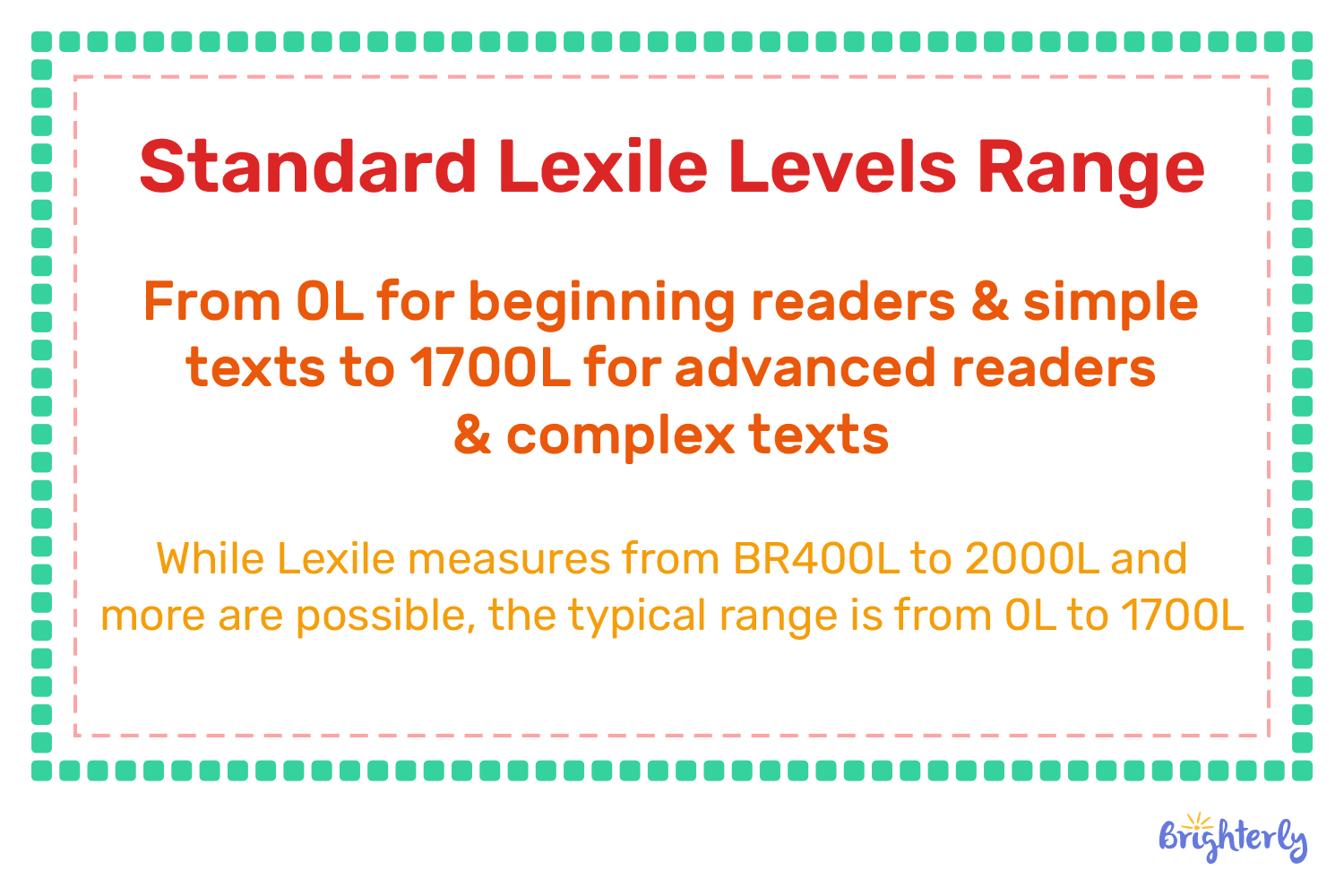
The lowest possible Lexile measure is BR400L, which stands for Beginning Reader 400L. This means that the book is 400 Lexile points before 0L. Texts marked with BR400L are extremely simple with basic sight words, very short sentences, repetitive sentence structures, and a lot of images.
At the same time, it’s important to remember that the lowest Lexile level doesn’t equal the lowest reading skills. It matters more to the text’s level than your kid’s abilities.
“I always tell parents not to panic over the number. Interest matters more than difficulty.”

What is the highest Lexile level?
The highest common Lexile score is 2000L, which is extremely advanced. Texts with a 2000L level use complicated vocabulary, including technical terms, theoretical concepts, and very complex sentence structures. These are usually scientific journals or philosophical works. While a score above 2000L is possible in theory, it is very rarely seen in practice.
Lexile scores by grade level
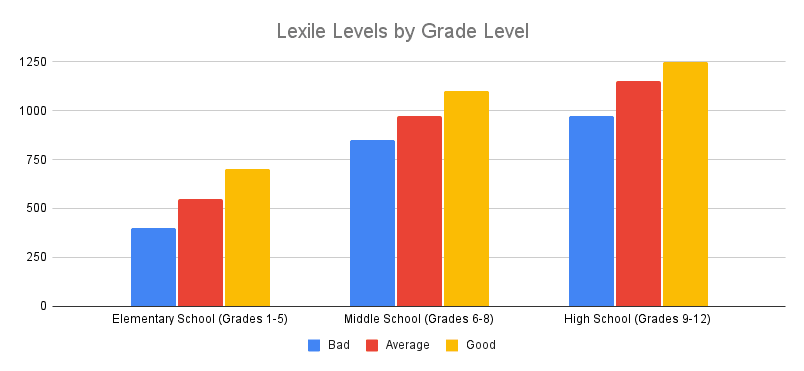
Lexile levels by grade aim to evaluate a child’s reading skills and provide them with appropriate materials regardless of their grade level. Below you can see their typical ranges.
Source: MetaMetrics
Parents can use this reading Lexile chart to compare the reading level of their child with the typical scores expected for their grade. In case it’s below expectations, the graph helps to identify if they need additional support to improve reading fluency.
If you see that your kid needs improvement, Allison Wilson recommends looking for strategies that focus on their confidence, consistency, and comprehension:
“With consistent support and positive reading experiences, children can continue to build skills while gaining confidence as readers.”
Helpful strategies include:
- Shared reading: Read aloud together, take turns, or read side by side to model fluent reading and support understanding.
- Short, regular reading time: Frequent, manageable sessions help build stamina without overwhelming the child.
- Conversation, not quizzing: Talk about the story and make connections to the child’s experiences rather than focusing on right or wrong answers.
Want to boost your child’s Lexile level?
The Brighterly reading program is the best way to improve your child’s Lexile score and their overall reading skills. Brigherly offers individualized, 1:1, online reading tutoring that helps students improve reading comprehension and fluency and move up the Lexile reading scale.
In this way, students not only keep up with grade-level academic requirements but actually exceed expectations for success at school and beyond. Brighterly reading tutoring is available for students grades 1-9.
Why Brighterly reading program works
- Highly qualified and fun reading tutors
- Interactive, personalized, live 1:1 tutoring sessions
- Affordable pricing
Highly qualified and fun reading tutors
To become the best reading program for kids who struggle with increasing their Lexile level, Brighterly applies high hiring standards so that tutors have all the relevant professional qualifications and personal characteristics. Mostly, these professionals have a Bachelor’s or Master’s degree in the field and 5-10 years of experience, in addition to demonstrating exceptional communication skills.
Moreover, Brighterly reading tutors are trained in pedagogy and have the personal skills to turn tutoring sessions into interactive, fun activities that children look forward to. They choose the exact combination of activities individually for each kid, as learning how to increase reading speed and reaching the average Lexile for 9th grade are very different goals.
👇See what just one of the many Brighterly parents shares about their child’s tutor on Trustpilot:
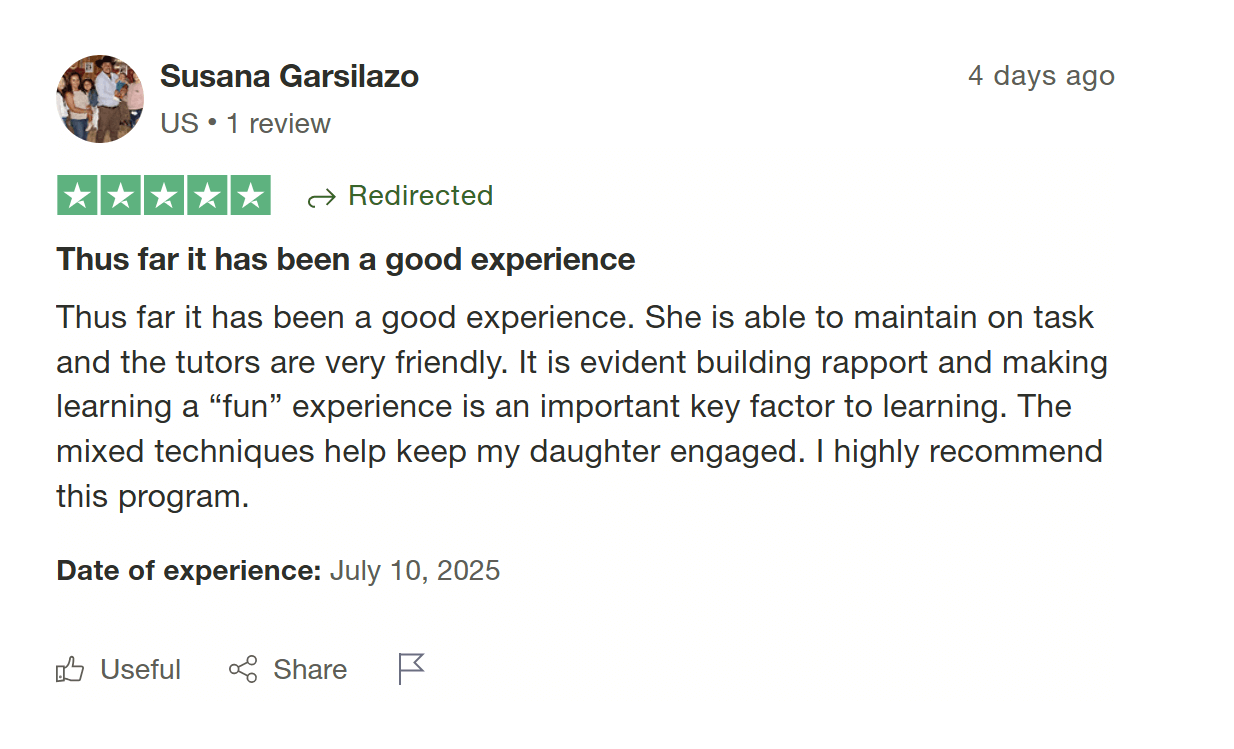
The tutors infect the students with their enthusiasm and excitement, which boosts student engagement and guarantees excellent results. This high level of commitment lasts from the first to the last minute of each tutoring session.
😍Check out below what Brighterly tutors say about the program and their students so that you can feel their passion for teaching:

Interactive, personalized, live 1:1 tutoring sessions
To improve the Lexile levels efficiently, Brighterly tutors develop a personalized learning plan that addresses the goals, needs, and learning style of your kid. The program starts with a free assessment of the current level of the child. Based on it, their tutor prepares an individualized path with customized reading materials that reflect the reading level, grade, skills, and interests of the student as well as their strengths and weaknesses.
Reading lessons are delivered via online, live, 1:1 sessions that feel more like a fun game than a school lesson. The interactive, entertaining sessions follow the philosophy that elements of gamification make reading more engaging, facilitate understanding, and develop imagination.
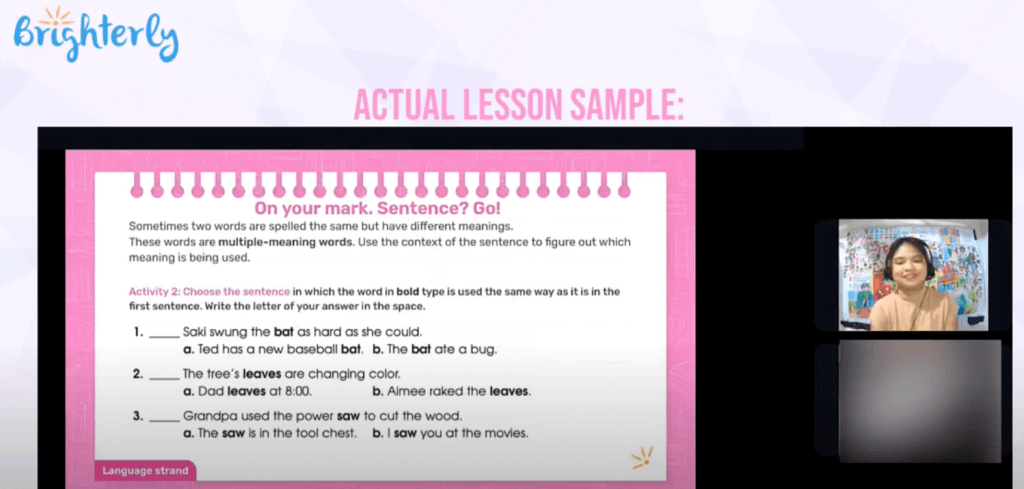
Furthermore, the reading program is aligned with the U.S. state standards in English Language Arts. So, if your kid needs to achieve the average Lexile for 8th grade, you can expect that Brighterly materials will meet the requirements for this grade level across the US.
Affordable pricing
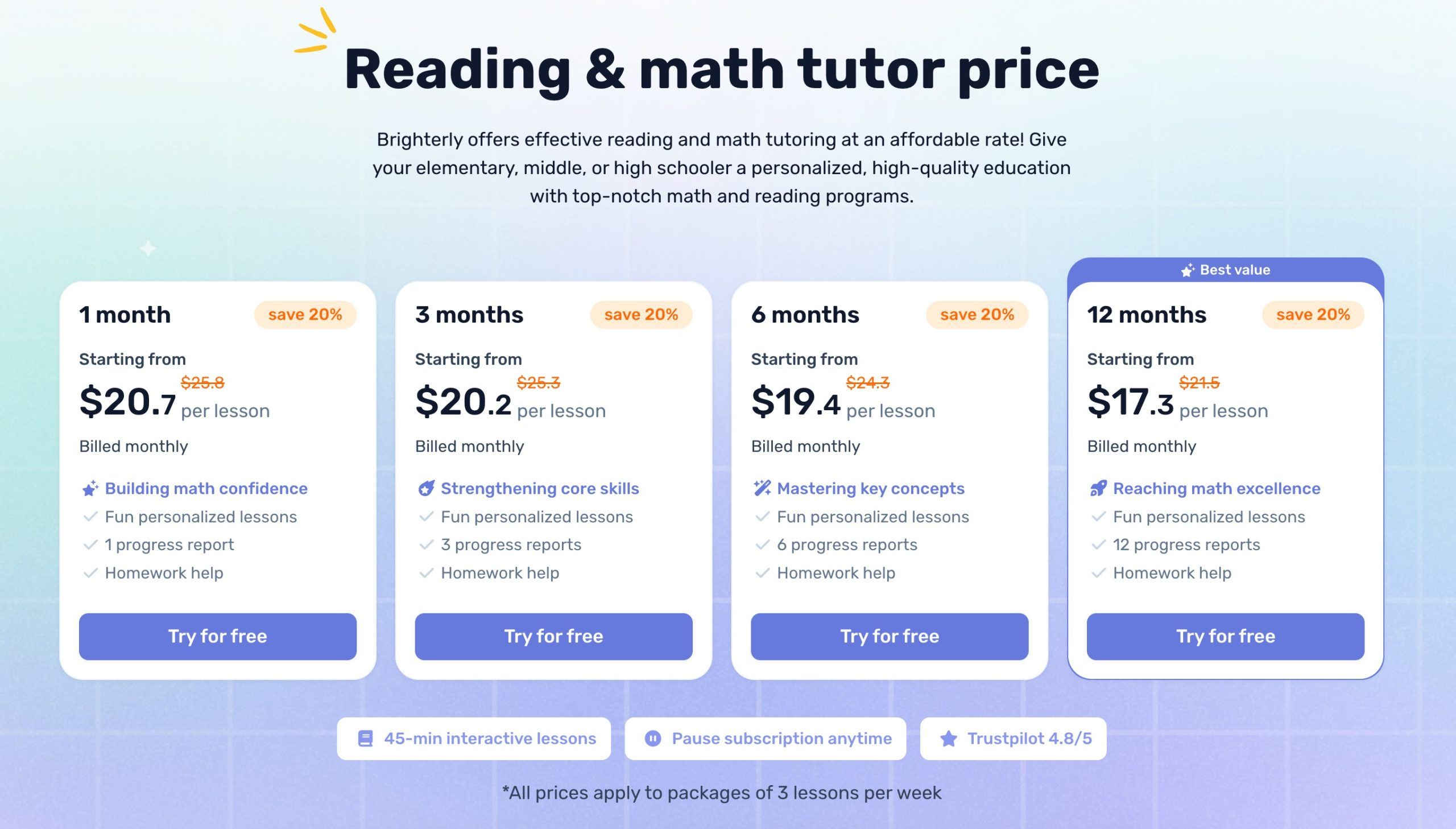
Last but not least, Brighterly provides an affordable price. It starts at only $17.30/lesson with a 12-month subscription (with 20% discount), when the average cost of tutoring in the US can exceed $50. Our price allows families to get their children as many sessions as they need to reach the desired Lexile level without putting a financial burden on the parents.
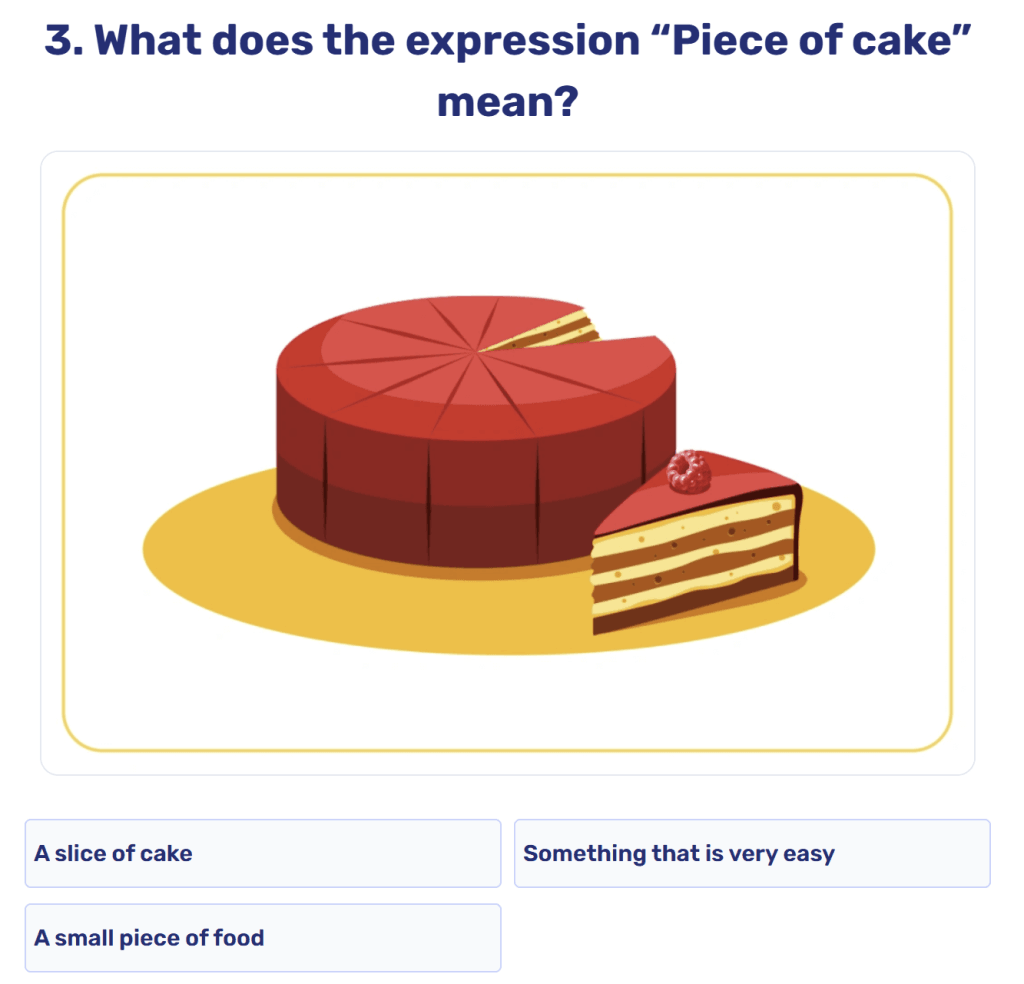
To provide further value to students and their parents, Brighterly supplies free reading tests for students in grades 1-9. You can use these valuable assessment materials to evaluate your child’s reading skills before working on Lexile by grade level. In particular, they help to identify areas of improvement and later track their progress in their tutoring program.
This is an example of a fun question from the 4th grade reading test:
Elementary reading levels
Understanding Lexile levels needs to be done in the context of your child’s grade.
The following is a Lexile score chart that shows the average levels for elementary school students by grade. It also illustrates what constitutes a bad (below average) and a good (above average) measure for each grade level.
Grade |
Bad Lexile Levels |
Average Lexile Levels |
Good Lexile Levels |
1st grade Lexile level: |
99L & below | 100L-400L | 401L & above |
2nd grade lexile level: |
299L & below | 300L-600L | 601L & above |
What Lexile level is 3rd grade: |
499L & below | 500L-800L | 801L & above |
Lexile level for 4th grade: |
599L & below | 600L-900L | 901L & above |
What lexile level is 5th grade: |
699L & below | 700L-1000L | 1001L & above |
By checking the table, you can see what Lexile grade to expect for your child. For example, the average Lexile level for 5th grade students is in the range of 700L to 1000L. Anything below 700L is considered rather low, and a score above 1000L is strong.
Lexile level chart for middle school students
Below you can find a chart with the average Lexile score by grade level for middle school students. How your child’s level compares to the average values is a good indicator of whether they are on track or might need further reading assistance.
Bad Lexile Levels |
Average Lexile Levels |
Good Lexile Levels |
|
What Lexile level is 6th grade: |
799L & below | 800L-1050L | 1051L & above |
7th grade Lexile level: |
849L & below | 850L-1100L | 1101L & above |
What Lexile level is 8th grade: |
899L & below | 900L-1150L | 1151L & above |
The table above depicts not only the average Lexile measures for middle school students but also low (bad) and high (good) achievements. For instance, if a 7th grade student has a Lexile level between 850L and 1100L, they are up to standard. However, if their score is below 850L, they might be falling behind. Alternatively, if they hit a measure of more than 1030 Lexile grade level (like 1100L), they are an advanced reader.


High school Lexile levels
Finally, you can use the reading scores statistics table below as a reference for the average Lexile level for high schoolers, ranged by good, average, and bad for this age group.
Bad Lexile Levels |
Average Lexile Levels |
Good Lexile Levels |
|
What is a bad, average, or good Lexile score for a 9th grader: |
999L & below | 1000L-1200L | 1201L & above |
What Lexile level is bad, average, or good for a 10th grade: |
1024L & below | 1025L-1250L | 1251L & above |
What Lexile level is bad, average, or good for a 11th grade: |
1049L & below | 1050L-1300L | 1301L & above |
What is a bad, average, or good lexile score for a 12th grader: |
1049L & below | 1050L-1300L | 1301L & above |
The values in the table can serve as a good indicator of where your child stands in terms of reading skills and complexity compared to the average student in their grade level. For example, the average 10th grade Lexile level is between 1025L and 1250L. Anything below this range could be a sign of being behind, and any number above this range could mean that your child is an advanced reader.
Note: The average Lexile scores by grade level are a good starting point to evaluate the reading skills of your child. However, they are not a comprehensive measure of reading fluency. I recommend that you perform additional reading tests to decide if your child is on track or needs extra help.
Conclusion
Lexile levels are a useful measure of readers’ skills and a great tool for matching them with appropriate reading materials. Using the charts with average scores by grade level that I’ve provided above, you can evaluate your child’s reading performance by comparing their Lexile measure to the average.
If you want to improve your child’s reading fluency and help them get the highest Lexile score possible for them, Brighterly reading tutoring is the right option for you. The interactive, personalized, 1:1 sessions follow an individualized learning path and use customized reading materials to boost results in a fun and engaging way. You will start noticing improvement after the first couple of lessons.
With Brighterly, your child benefits from:
✅Interactive, live, 1:1 tutoring
✅Flexible sessions that fit your child’s schedule
✅Personalized reading materials and exercises that correspond to their level and interests
✅Highly qualified, fun tutors with proven experience in the English language
✅Alignment with the Common Core standards
✅Affordable pricing with no hidden fees
✅Free resources
Ready to help your children perform better on the Lexile score? Try Brighterly for free – book free reading lesson now to get access to individualized, real-time, 1:1 tutoring.



As a teacher working with reading learners for years, one big concern I’ve noticed among parents is a child’s average reading speed. That’s why I decided to conduct this in-depth research, analyzing the numbers from the latest evaluations. So, here’s a comprehensive guide, designed to dispel all your doubts and provide only concrete information. Key […]

Jul 21, 2025

Reading tutor cost usually varies from $10 to $80, but the exact price you’ll pay depends on the tutoring format, your location, and the expertise of the teacher chosen. As an English tutor myself, I’ll present the factors and exact platforms so you can understand how tutoring pricing models work and get the most value […]
Jul 23, 2025
Math & reading from 1st to 9th grade
Looking for homework support for your child?

Choose kid's grade

Math & Reading for Grades 1–9
Build real confidence for your child with a Brighterly math or reading tutor.