Average Reading Speed by Age: Relevant Data in 2026
reviewed by Marvi M. Andres
Updated on September 7, 2026
Key Points:
- For children, there is roughly 100 WPM spread between reading speeds by age in the 10th percentile and the 90th percentile (Hasbrouck and Tindal, 2017).
- On average, adults read 238 WPM of non-fiction and 260 WPM of fiction silently, while they read 183 WPM aloud (Brysbaert, 2019).
- The widely accepted average reading speeds by age suggested by Taylor (1965) are benchmarks and should not be considered as pass-or-fail levels.
- For children reading below grade band, working with an online reading tutor can help identify the underlying reasons and design a tailored plan to close gaps.
The average silent reading speed by age increases from 80 WPM for 1st grade to 250 WPM for 12th grade. The average silent reading speed for adults is 238-260 WPM and 183 WPM for reading aloud. This guide provides a reading speed chart by age and grade, percentile ranges, and a one-minute home test to check your child’s skills.
What Is the Average Reading Speed (WPM) by Age and Grade Level?
According to Taylor (1965), the average words per minute a student can read silently increases from 80 in grade 1, through 204 in grade 8, to 250 in grade 12 and 280 in college, while the number of words per minute an average adult (18-60 years) can read in silence is around 238 for non-fiction and 260 for fiction (Brysbaert, 2019).
When reading aloud, the average words per minute by grade level can change approximately from 60 for 1st grade to 151 for 8th grade and 138-158 for 12th grade, as reported by Hasbrouck and Tindal (2017). Meanwhile, adults read around 183 WPM aloud, according to Brysbaert.
Reading Speed Chart for Silent Reading and Reading Aloud by Grade Level and Age
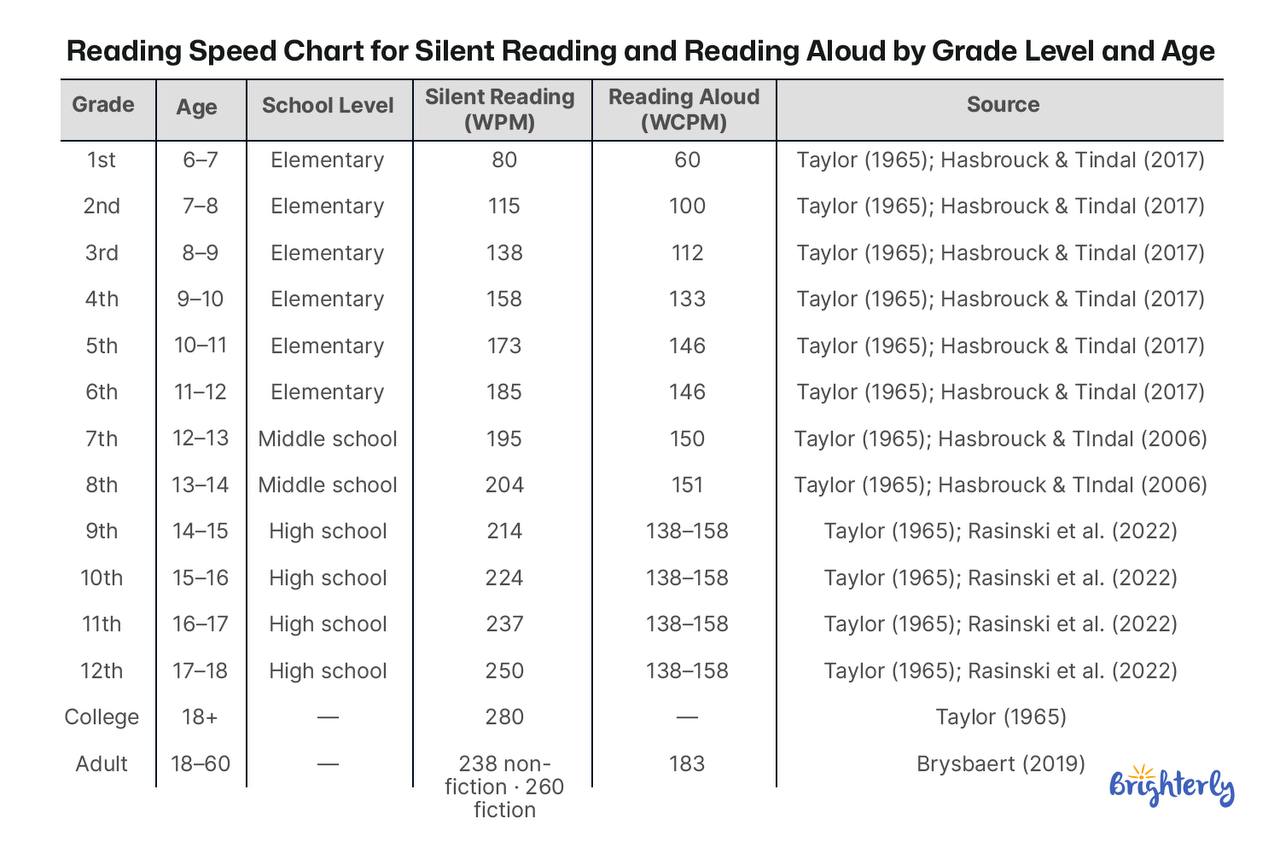
Sources: Silent reading rates: Taylor (1965), grades 1–12 and college. Reading aloud: Hasbrouck & Tindal (2017) for grades 1–6 and (2006) for grades 7–8, 50th percentile, spring. Grades 9–12 range: Rasinski et al. (2022). Adult figures: Brysbaert (2019).
Reading aloud figures are the 50th percentile, spring measurement. The grades 9–12 figure is a range, not a grade-by-grade norm — no oral fluency norms are published beyond grade 8.
Silent Reading vs Reading Aloud: Why the Two Numbers Differ
The average silent reading words per minute exceeds the average reading aloud words per minute across all age groups because speaking speed limits oral reading speed. When you’re reading aloud, your mouth and vocal cords need to match your eyes and brain, which caps the rate at which you can process written words and pronounce them.
Thus, silent reading and reading aloud are two different measurements that describe different skills:
- Silent reading is what a child does when reading for themselves, and you can find the averages by age in the 4th column in the reading speed chart above.
- Meanwhile, schools measure students’ reading aloud speed and refer to it as a reading fluency check – you can find the typical rates in the 5th column in the chart above.
As Brysbaert (2019) observed, the gap between silent and aloud reading speed continues into adulthood: those aged 18-60 read 238-260 WPM silently and only 183 WPM out loud.
Are Today’s Students Reading Slower Than These Benchmarks?
A 2016 replication of Taylor’s 1960 research studying 2,203 students in grades 2-12 and using the same materials and questions found considerably lower rates at all grades except grade 2, with nearly a third of students falling below the 70% comprehension threshold. So, there’s scientific evidence that students today read silently more slowly and less efficiently than the 1960 benchmark established by Taylor.
As a parent, you should consider the reading speed average rates presented in the chart above as a simple benchmark, not as the actual speed at which children read in the classroom or at home in 2026. If your child reads slightly below these levels, this speed is not unusual and is not necessarily a source of concern.
Explore Brighterly Learning Experience
Learn exactly how Brighterly helps students thrive through expert sessions, online tools, and proven feedback from thousands of satisfied parents
How to Test Reading Speed at Home (1-Minute Method)
Use the following steps to conduct a quick and easy words per minute reading test for your child:
- Choose unfamiliar, age-appropriate text.
- Print 2 copies using standard formatting: one for your child and one for you.
- Set up your timer to 60 seconds.
- Ask your child to read the passage aloud in their normal voice.
- Keep track of your child’s reading and discreetly keep track of errors (mispronounced, replaced, or skipped words).
- Stop at the 60-second mark.
- Subtract the errors from the total number of words your child read in this 1 minute.
- Compare against benchmarks.
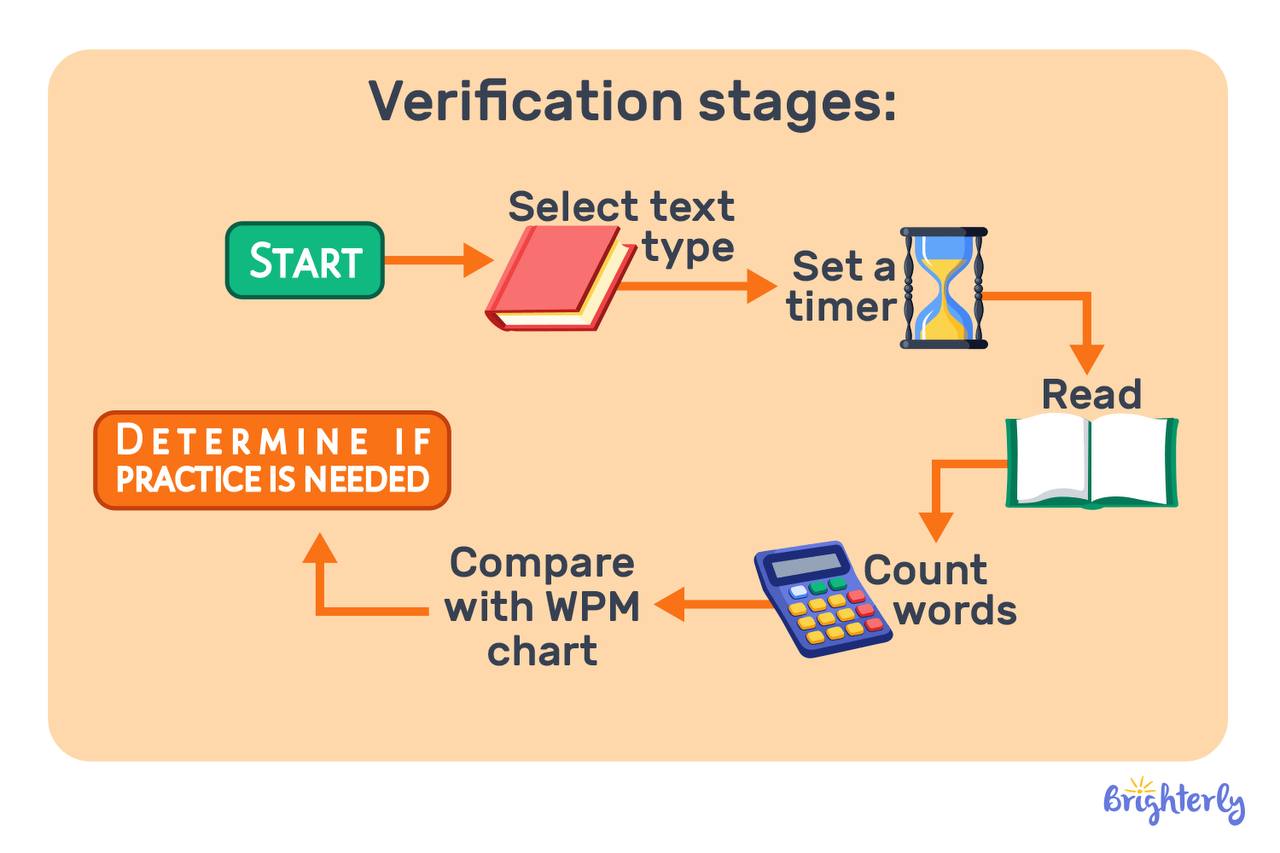
Here’s an example of how to calculate the result of the WPM test reading:
If your 3rd grader read 125 words and made 10 errors:
Aloud Reading Speed = Total Words – Errors = 125 – 10 = 115
115 WPM is in line with Taylor’s benchmarks for grade 3.
Check out some popular speed reading apps for kids that can help boost your child’s performance.
Note: You can answer the question “How fast can I read?” with the same 1-minute test, using adult text. Or take a free reading speed test to see if your child needs support.
If your child’s result sits below grade level, our online reading tutor can determine whether the cause is decoding, vocabulary, or fluency. Then, the teacher can adapt our online reading program to address your kid’s exact weakness to increase their reading speed.
See where your child’s reading stands!
Our tutors will help you get a clear picture of your kid’s level.


Reading Speed Percentiles: Behind, on Track, or Ahead
Reading speed percentiles can help you understand how your child’s reading aloud compares with the speed of other students in the same grade. However, a percentile isn’t a pass-or-fail mark. For instance, a child reading at the 25th percentile isn’t necessarily failing – this mark means that the kid is reading faster than 25% of students in the comparison group.
Reading Speed Percentiles Chart for Reading Aloud by Grade Level
| Grade | 10th %ile | 25th %ile | 50th %ile | 75th %ile | 90th %ile | Spread |
| 1st | 18 | 34 | 60 | 91 | 116 | 98 |
| 2nd | 43 | 72 | 100 | 124 | 148 | 105 |
| 3rd | 63 | 91 | 112 | 139 | 166 | 103 |
| 4th | 83 | 105 | 133 | 160 | 184 | 101 |
| 5th | 102 | 119 | 146 | 169 | 195 | 93 |
| 6th | 91 | 122 | 146 | 173 | 204 | 113 |
Source: Hasbrouck & Tindal (2017), words correct per minute, spring measurement. Published percentiles exist for grades 1–6 only, and for reading aloud only.
The “Spread” column is the gap between the 10th and 90th percentile — roughly 100 WPM at every grade. That is the number that makes the “benchmarks are ranges” point concrete. Keep it or drop it, but do not present the 50th percentile as a pass mark.
The wide range within each grade – ar roughly 100 WCPM – shows why it’s better to consider a child’s percentile band and progress over time than focus on one number, as there’s no single answer to the question “How many words per minute is good?” For instance, 4th graders range from 83 WCPM (10th percentile) to 184 WCPM (90th percentile).
Meanwhile, the 50th percentile represents the middle of the distribution, not the minimum that a child needs to reach to be at grade reading level.
How Long Does It Take to Read 1,000 Words — or a Whole Book?
To read 1,000 words, on average, a 3rd grader needs about 7 minutes, a 6th grader – 5 minutes, a 12th grader and adult – 4 minutes, based on reading speeds estimated by Taylor and Brysbaert. Meanwhile, how long it takes to read a whole book depends on the book’s length (number of words), type (fiction vs non-fiction), and the reader’s age.
Time Needed to Read 1,000 Words and a Book by Grade Level Chart
| 3rd Grade (138 WPM) | 6th Grade (185 WPM) | 9th Grade (214 WPM) | 12th Grade (250 WPM) | Adult (238 WPM) | |
| 500 Words | 4 min | 2 min | 2 min | 2 min | 2 min |
| 1,000 Words | 7 min | 5 min | 5 min | 4 min | 4 min |
| 5,000 Words | 36 min | 27 min | 23 min | 20 min | 21 min |
| Charlotte’s Web – 31,938 Words | 3 hr 51 min | 2 hr 53 min | 2 hr 29 min | 2 hr 8 min | 2 hr 14 min |
| The Giver – 43,617 Words | 5 hr 16 min | 3 hr 56 min | 3 hr 24 min | 2 hr 54 min | 3 hr 3 min |
Sources: For grades 1–12: Taylor (1965). For adults: Brysbaert (2019).
To calculate reading time by grade level, the chart above divides the word count by the reading speed for the level and rounds to the nearest minute, using the formula word count/reading rate.
When estimating how long it’ll take to read a certain book, keep in mind that non-fiction and textbooks require more time as the processing of longer words, dense concepts, and unfamiliar structures slows down readers, as highlighted by Brysbaert (2019).
How Fast Can Adults Read?
According to Brysbaert’s research published in 2019 in the Journal of Memory and Language, adults read 175-300 WPM for non-fiction and 200-320 WPM for fiction. The average reading speed for adults is 238 WPM for non-fiction and 260 WPM for fiction during silent reading. Regarding what is the average reading aloud speed for adults, it’s 183 WPM.
Moreover, a 2017 study published in Nature reports that older adults start to read more slowly. Specifically, readers aged 50-73 read 30% slower than those aged 18-31, partially because of larger crowding, defined as an increased crowding zone and decreased visual span.
Help your child read faster & more accurately!
Brighterly tutors customize the reading plan & practice to your kid’s needs & interests.
What Affects Reading Speed: The Three Reading Styles
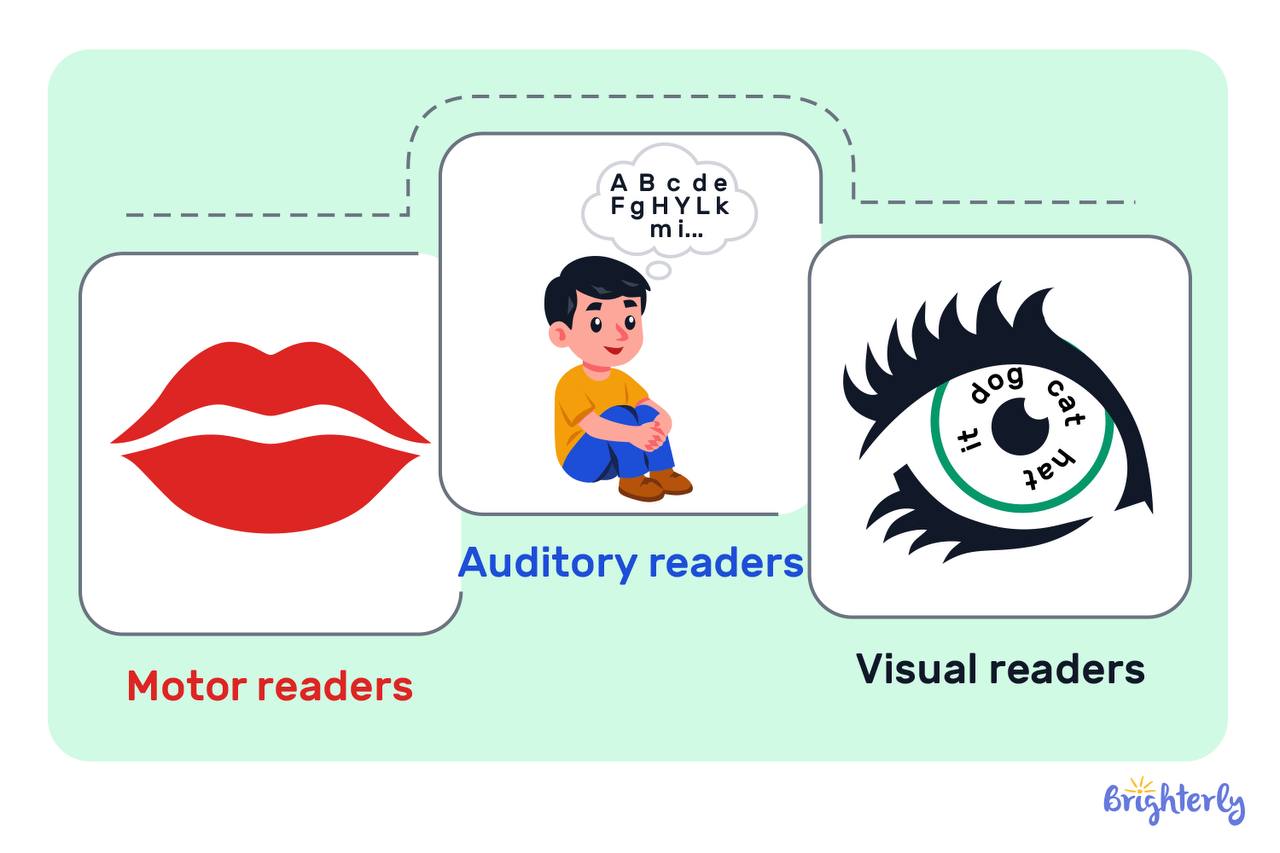
While reading speed depends on age and grade level, each person has a distinct reading style that affects how fast they’re able to go through text. Indeed, there are 3 types of readers who process words at different speeds. Here are the 3 categories of readers, starting from the slowest:
Motor Readers
These readers tend to silently pronounce each word, including sight words, a phenomenon scientifically known as subvocalization. Motor readers tend to read more slowly, but their huge plus is an overall better comprehension. Thus, the average WPM for a 13-year-old is typically about 140-170.
Auditory Readers
Auditory readers are in the middle of our chart. These readers usually process text by “hearing” the words in their mind without physically moving their lips or tongue. Children belonging to this type can score 180-210 in WPM.
Visual Readers
Visual readers recognize words and phrases as visual units rather than sounding them out mentally. These readers skip the “hearing” stage entirely, and so can read much faster than both motor and auditory types. That’s why the average WPM for 14-year-old kids in the 8th grade can reach 220-250 WPM. Although the number itself is impressive, kids typically require extensive practice to achieve it.
Can a Reading Style Change?
You can change your child’s reading style and improve their reading speed, but it takes deliberate practice. For better results, keep reading practice sessions short and interesting.
What Is a Good Reading Speed by Age?
A good reading speed is about 60-120 WPM for ages 6 to 9, 120-180 for ages 9 to 12, and 170-200 WPM for ages 12 to 14. The type of text (fiction vs non-fiction) and difficulty level also impact the expected averages. Children with reading difficulties usually achieve lower rates, while reluctant readers need further motivation to reach grade levels.
Reading Speed: Facts Worth Knowing
- Speed readers can reach 400 WPM or even 600-700 WPM, according to a 2016 article in Psychological Science in the Public Interest. However, text comprehension drops to 74% at a speed of 400 WPM compared to 81% at a speed of 280 WPM.
- Average reading speed is one thing, and skimming is another. People can skim text at up to 700 WPM. However, such surface review isn’t enough for an in-depth understanding.
- Reading rates generally increase with grade level until they reach a plateau around grade 6, as reported by Spichtig et al. (2016).
Average Reading Speed by Age: Conclusion
Now that you know the typical reading speed by age, you can compare your child’s performance to their grade band. If results are below grade level, you can try some techniques offered in the article linked above. Then retest in 4 weeks to see if you need support from a professional.
You can also book free reading lesson and see what our professional reading teachers recommend.
Frequently Asked Questions
How Many Words Per Minute Should an 8-Year-Old Read?
The average reading speed for an 8-year-old is 138 WPM when reading silently and 112 WPM when reading aloud, based on Taylor (1965) estimations. In the reading speed chart above, you can find the typical rates for all ages and grade levels.
How Many Words Per Minute Should a 12th Grader Read?
A 12th grader should be able to read 250 WPM silently and 138-158 WPM outload, on average, according to Taylor’s benchmarks. However, these numbers are just averages, while actual reading speed depends on the type of text and individual skills.
Is Reading Speed Measured Silently or Aloud?
Experts measure both silent reading speed and aloud reading speed, and these are two separate measurements of how fast a person can process text. Children and adults read faster silently than out loud because pronouncing words correctly takes time as it requires coordination between the mouth, the eyes, and the brain.
Why Does Reading Speed Drop on Textbooks and Nonfiction?
Reading speed declines on non-fiction and textbooks because these texts require strong cognitive effort to analyze unfamiliar vocabulary, understand complex concepts, and retain factual data. The difficulty of non-fiction and textbooks forces the brain to move from passive narrative absorption to active learning and critical thinking.
You can use free reading worksheets that use fiction and non-fiction interchangeably to start training your child for more complicated texts in the future.
How Often Should a Child’s Reading Speed Be Retested?
You should retest the reading speed of children reaching benchmarks 3 times a year – in the fall, winter, and spring – to make sure they stay on track. For struggling readers receiving extra support, you should recheck every couple of weeks to adjust activities based on results. Between checks, you can work on automatic word recognition to improve results.
Is a Slower Reading Speed a Problem If Comprehension Is Strong?
Reading speed percentiles help you know how your child compares to peers, but reading speed and reading comprehension are equally important. As long as your kid understands age-appropriate texts and can respond correctly to questions related to them, speed is less of a concern.
You can practice reading comprehension strategies at home to make sure a slower reading speed doesn’t affect understanding.
How Many Pages Can a Child Read in an Hour?
There’s no fixed number of how many pages per minute or hour a child should read as the number of words per page vary from 50 in a picture book to 500 in a textbook. You can estimate an average value by accounting for the number of pages per page.
To estimate the average reading speed pages per hour, count the words on three pages of the book, take the average, and divide by the age-appropriate reading speed from the chart above.


As of September 2026, you can use ABCmouse for free with the Basic Access plan, but purchasing Premium comes with more features in the long run. This guide explains what’s covered in the ABCmouse cost in 2026 so that you see what’s inside the paid plan and choose the right option for your child. How […]

Jul 17, 2025
Lexile levels are numerical scores that evaluate students’ reading levels and the books’ complexity. The goal is to make sure that children are matched with literature that is appropriate for their reading levels. If you are looking to understand Lexile scores better, this guide is for you. What Is Lexile Level? A Lexile level is […]

Jul 21, 2025
Math & reading from 1st to 12th grade
Looking for homework support for your child?

Choose kid's grade

Math & Reading for Grades 1–12
Build real confidence for your child with a Brighterly math or reading tutor.