Lexile Levels: A Parent’s Complete Guide to Reading Scores (2026)
reviewed by Franz Jerby Delos Santos
Updated on September 16, 2026
Key Points:
Lexile levels are numerical scores that evaluate students’ reading levels and the books’ complexity. The goal is to make sure that children are matched with literature that is appropriate for their reading levels. If you are looking to understand Lexile scores better, this guide is for you.
What Is Lexile Level?
A Lexile level is a standardized unit that is used to measure two things:
- The students’ reading levels
- The complexity of the reading materials
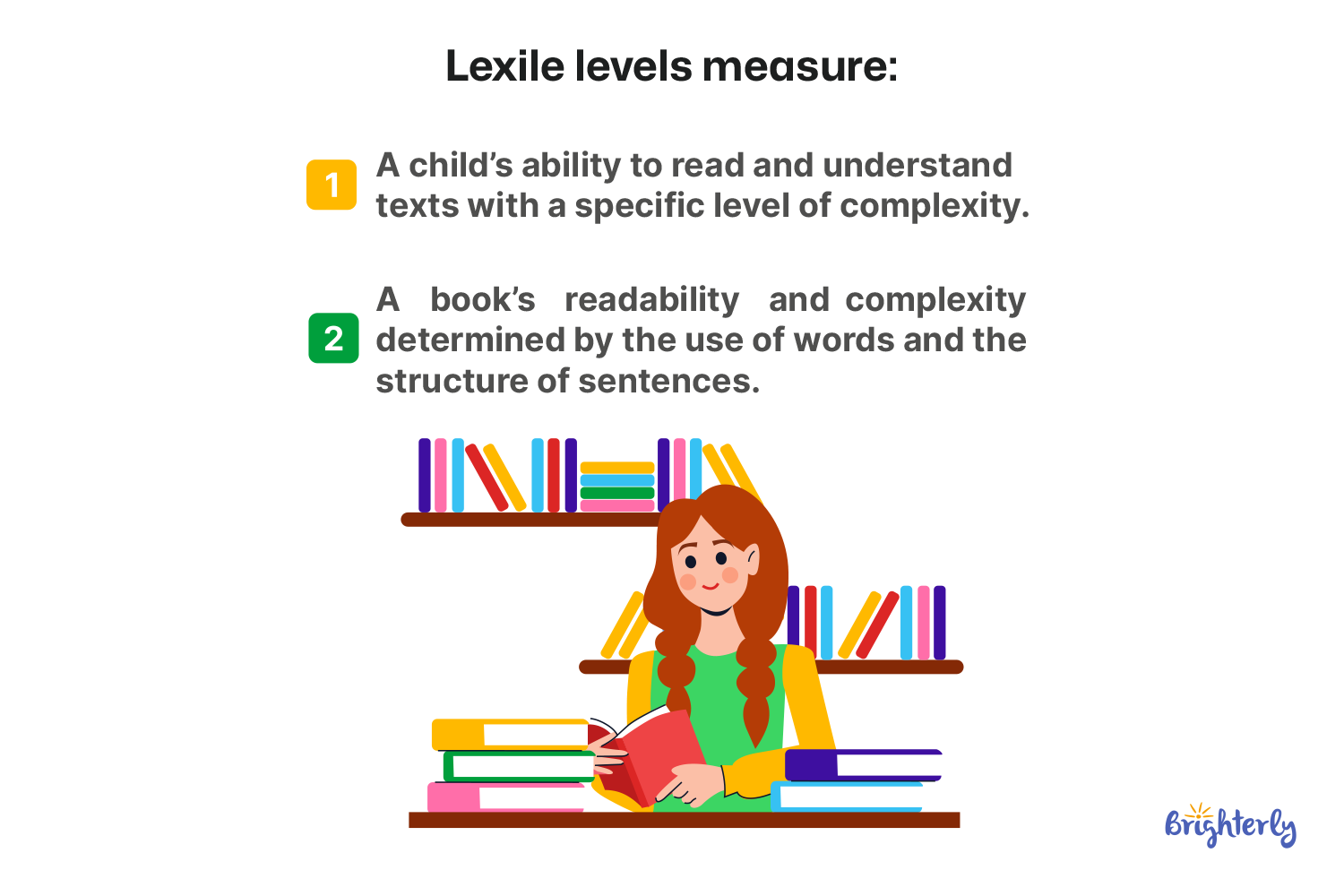
The Lexile framework will tell you your child’s reading level and assign a numerical value to books. This is done so that your child (and other kids and parents) choose books that provide them with the right level of content and challenge, so they are not either bored or overwhelmed.
What Does Lexile Mean? Examples
Lexile Score
Equivalent Grade Level
Common Text Characteristics
300L
1st grade (2nd half)
Very basic words, short and simple sentences, strong reliance on pictures.
570L
2nd – 3rd grade
Early chapter books with basic vocabulary and simple sentence structures.
820L
5th – 6th grade
Longer texts with more complex vocabulary and sentence structure.
1030L
6th – 8th grade
Middle school texts featuring more sophisticated vocabulary and complex ideas.
1200L
9th – 10th grade
High school reading materials comprising abstract concepts and dense text.
1250L
11th – 12th grade
Upper high school materials with advanced academic texts suitable for college preparation.
Note that Brighterly’s elementary reading support and middle school reading help can enable your child to achieve, exceed, or keep up with the required Lexile level.
Learning to read with Brighterly is fun and effective!
Support your child’s learning journey with personalized 1:1 reading tutoring.


Explore Brighterly Learning Experience
Learn exactly how Brighterly helps students thrive through expert sessions, online tools, and proven feedback from thousands of satisfied parents
What Is a Lexile Score and What Does It Tell Parents?
The Lexile levels chart is a measure, a grade, if you will, that helps you remove the guesswork from choosing books for your child.
MetaMetrics was founded in 1984 and spent the next 5 years developing the Lexile Framework for Reading. Even though the original document was last revised in 2014, MetaMetrics continues to maintain and validate the framework. Its January 2022 technical manual provides updated development and validity evidence supporting its use for measuring reading ability and text complexity.
You can think of it as a matching system that can connect your child’s reading abilities (Lexile Reader Measure) and text difficulty (Lexile Text Measure). It uses the same math scale for both, which typically ranges from below 0L to above 2000L. The score is followed by the letter L.
For example, if a book is labeled 600L and your child has a score of 600L, it’s a perfect match. It gives parents a clear reading range, which typically spans from 100L below to 50L above your child’s actual measure. When a text falls within these ranges, it is considered a sweet spot for growth. At this level, the student will have around 75% comprehension rate.
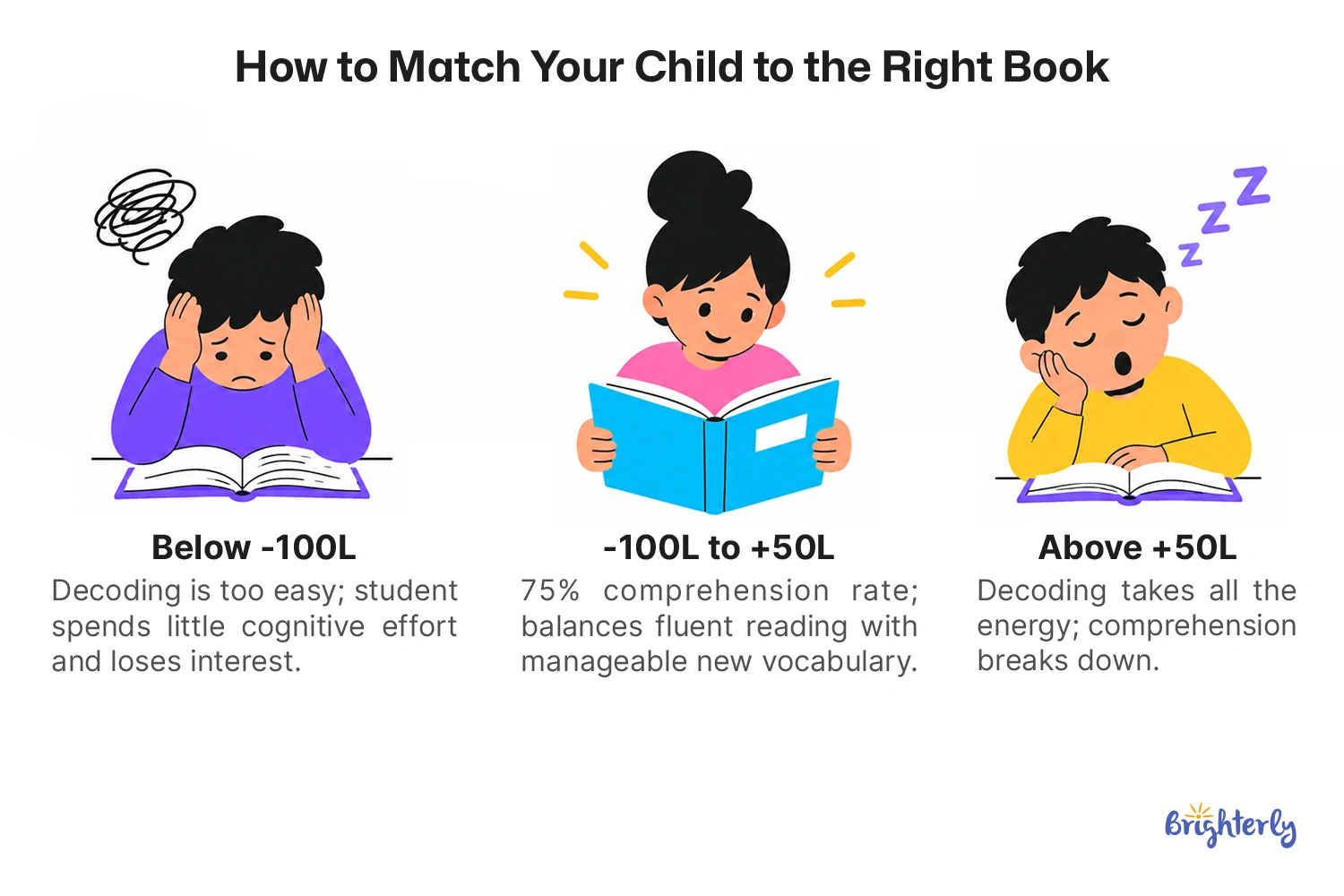
By tracking a Lexile reading level, you will make sure your child enjoys the reading process and learns from it, and also consistently move up and meet the Common Core requirements for their grade. If you notice that they have hit a plateau. In this case, they might need more targeted support.
Lexile scores are useful measures you can calculate and keep in mind, as they determine the average expectations for your child’s reading readiness based on a text’s length and vocabulary. However, these indicators may differ from their actual interests and reading tastes.
Due to this, Allison Wilson recommends paying attention to Lexile measures but not limiting your kid’s reading passions based on this framework.
“Research shows that children make stronger reading gains when they are interested in what they read and feel confident doing so.”


Teachers and parents widely use the Lexile grade level equivalent chart to pair children with the right texts and books based on their literacy and reading comprehension levels. This is one of the most effective reading comprehension strategies for families, as their kids get assigned level-appropriate texts.
Note: If you’re unsure whether or not your kid has any problems with reading comprehension, check out this detailed guide on the most common signs and how to address them early.
How to Find What Is a Lexile Level of Your Child?
To find your child’s Lexile levels, you have to talk to their school administration or the ELA teacher. Most schools in the United States now integrate these assessments into their yearly calendars to make sure children are meeting the state standards.
The most common way to do this is through standardized checks such as the MAP test (Measures of Academic Progress), the Scholastic Reading Inventory (SRI), or state-level end-of-year assessments. After these tests, parents should typically receive a student progress report card that also includes Lexile scores. It’s usually a number followed by an L.
If you can’t find the scores on your kid’s report, your first step should be a quick discussion with their English teacher. Many keep the Lexile score chart and their students’ scores at hand to ensure they assign the correct reading materials. But remember:
“Lexile is simply a guideline and not a gatekeeper. Parents can support reading growth by helping children experience books at different levels.”
If you want to be more actively involved in determining your kid’s Lexile score outside of school, one way to do it is with the help of our reading tutors, who employ similar diagnostic assessments to make sure that the reading skills and instructional materials match your child’s current reading comprehension levels.
Your kid also does a free diagnostic reading test and reading speed test for their grade level. While this test won’t give you their Lexile scores, you can get a good approximate idea of how they are doing.
Below, you can find reading materials organized by grade level to better understand your child’s progress:
Lexile Meaning: How to Read Lexile Levels?
As mentioned earlier, Lexile levels will always be expressed as a number followed by the letter L, e.g., 850L. So, if your child has an 800L, they are ready for the book 800L. There is also some leeway of 100L below and 50L above their levels, so books in the 700L to 850L range will also be reasonable choices.
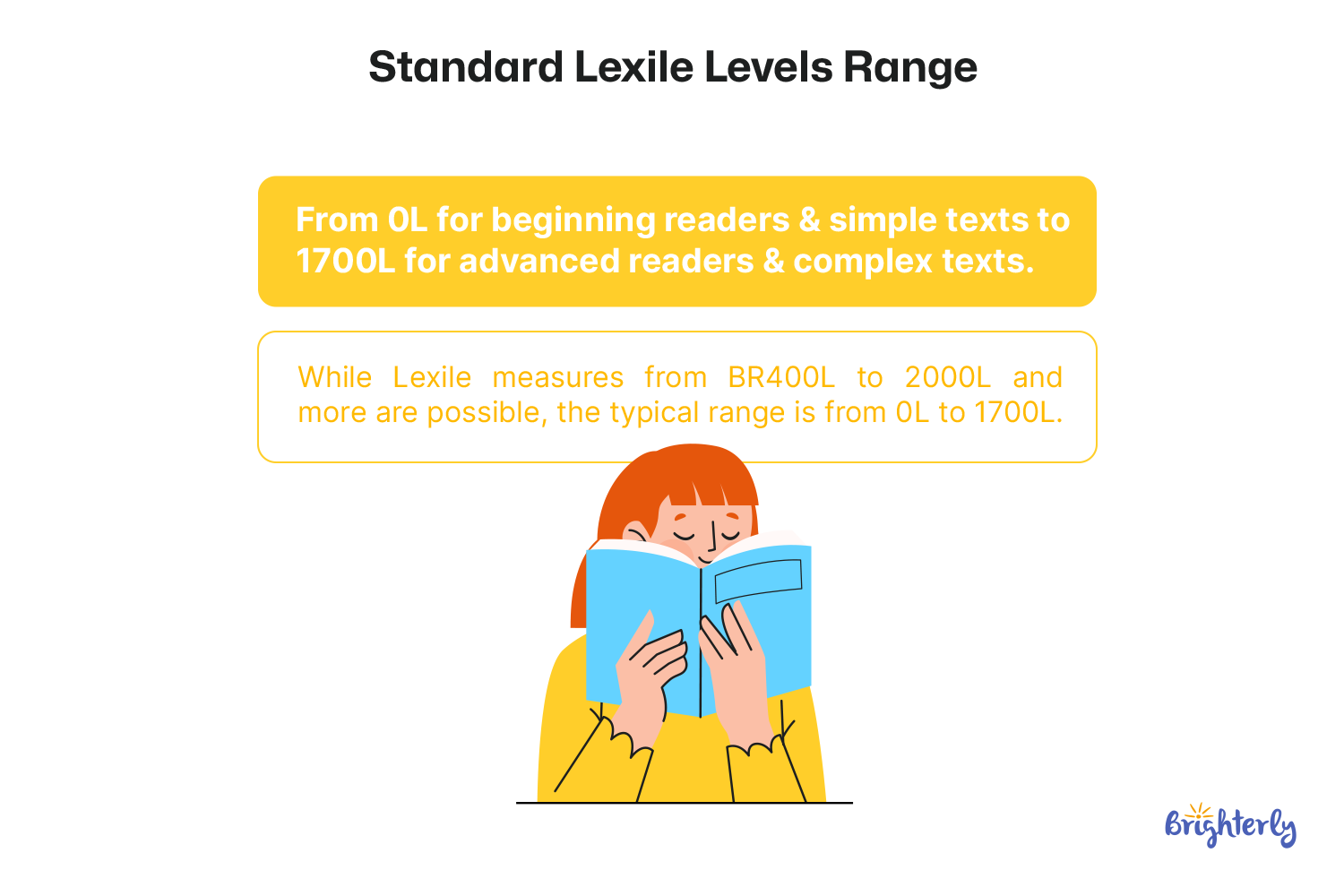
The higher the number, the more advanced the reading level. This can range from BR (Beginning Reader) for early learners to 1600L+ for advanced university-level texts.
What the Measure Includes
The Lexile framework ignores subjective elements like plot, theme, or age-appropriateness. Instead, it calculates:
- Semantic difficulty – How common or obscure the vocabulary is.
- Syntactic complexity – The length and grammatical structure of the sentences. Longer, more winding sentences result in a higher Lexile score.
The measure itself includes:
- A number that represents the student’s reading ability or the text’s difficulty. To understand its role in the Lexile reading level chart, note that a higher number indicates a more skilled reader or a more complex book.
- The letter “L” after the number value, which stands for Lexile.
- BR (or other codes, discussed later in the article) before the number and the letter “L”, which signifies who the reading material is meant for.
Common Lexile Codes
Sometimes the Lexile score includes a two-letter prefix. Through these codes, you can get the essential context of the book’s intended use:
- AD: Adult Directed. Meant to be read aloud by an adult to the child rather than the child themselves.
- BR: Beginning Reader. Appropriate for young kids who are just learning how to read and are below 0L Lexile reading measure.
- GN: Graphic Novel. Comic books and graphic novels.
- HL: High-Low. This is for older children who might be behind their grade level and need reading materials that are easy to understand.
- IG: Illustrated Guide. Nonfiction materials, such as reference texts.
- NC: Non-Conforming. Used for books that are appropriate for younger children with advanced reading skills.
- NP: Non-Prose. Poems, plays, songs, and other texts that are not written in prose and miss standard punctuation.
Note: Learn more about different types of reading skills, whether or not your child’s ones match grade-level requirements, and how reading skills change as your kid grows.
Lexile Score Range: From Lowest to Highest
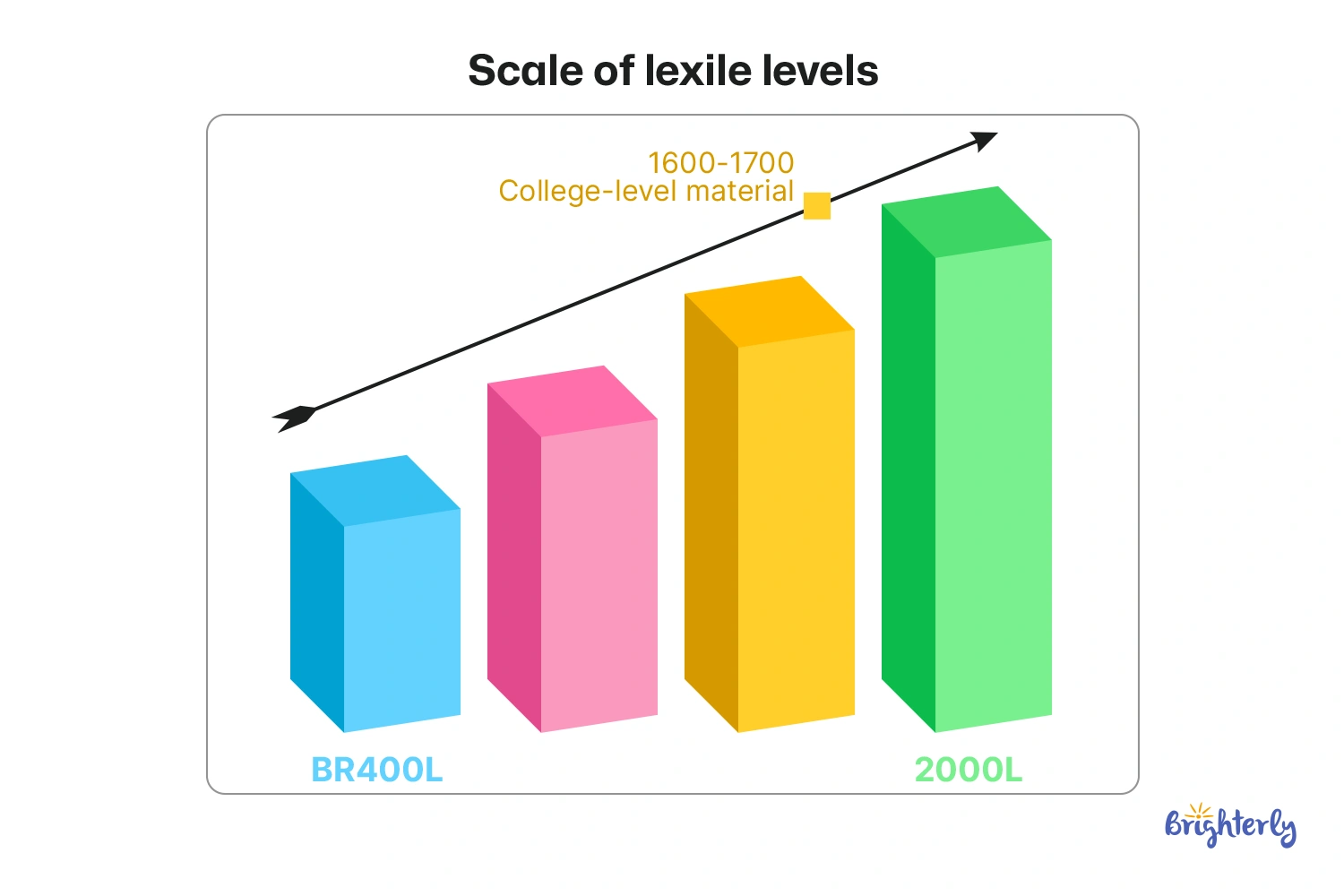
Here’s a somewhat unintuitive thing: the Lexile level chart doesn’t actually start at zero. For the youngest learners who are just beginning to associate sounds with letters, the scale uses BR (Beginning Reading) to indicate the negative territory. The BR score works like a countdown, so BR150 indicates simpler content than BR50. The moment the score hits 0 and starts growing, the code BR won’t appear any longer. The absolute lowest possible score on the scale is BR400, which you can think of as -400 on the numerical scale.
A score like BR150L indicates that your child is at the very start of their journey. Books at these levels are extremely simple, and you’ll find heavy repetition, simple patterns, and plenty of sight words.
As your kid’s child’s skills improve, the BR number gets smaller until they finally cross over into the positive numeric scale. From there, the student’s score becomes a simple positive number (like 10L, 20L, etc.), where higher numbers finally start meaning higher ability.
At the same time, it’s important to remember that the lowest Lexile level doesn’t equal the lowest reading skills. It matters more to the text’s level than your kid’s abilities.
“I always tell parents not to panic over the number. Interest matters more than difficulty.”

On the opposite end, the answer to what is the highest Lexile score would technically be 2000L, which are the extremely advanced texts. For comparison, most college and career-ready texts sit between 1200L and 1400L. At this level, students don’t simply read texts, but can also navigate complex philosophical texts and arguments, scientific and technical material, historical documents, and social studies.
If students are at around the highest Lexile level, it means that they can synthesize information from multiple difficult sources simultaneously, handle a very complex vocabulary, complicated sentence structure, and graduate-level coursework.
In theory, the highest Lexile score can be higher than 2000L, but in practice, it is very rare.
How Lexile Levels Compare to Grade Level and Other Reading Systems
Source: Brooklyn Public Library (conversion data, 2026)
Grade Level
Lexile Score Range
Fountas & Pinnell Level
Kindergarten
BR – 100L
A – D
1st Grade
100L – 300L
C – I
2nd Grade
300L – 500L
J – M
3rd Grade
500L – 700L
N – P
4th Grade
650L – 850L
Q – S
5th Grade
750L – 950L
T – V
6th Grade
900L – 1050L
W – Z
7th Grade
1000L – 1120L
Y – Z
8th Grade
1050L – 1185L
Z
9th – 10th Grade
1100L – 1300L
Z+
11th – 12th Grade
1200L – 1400L
Z+
Lexile Level by Grade
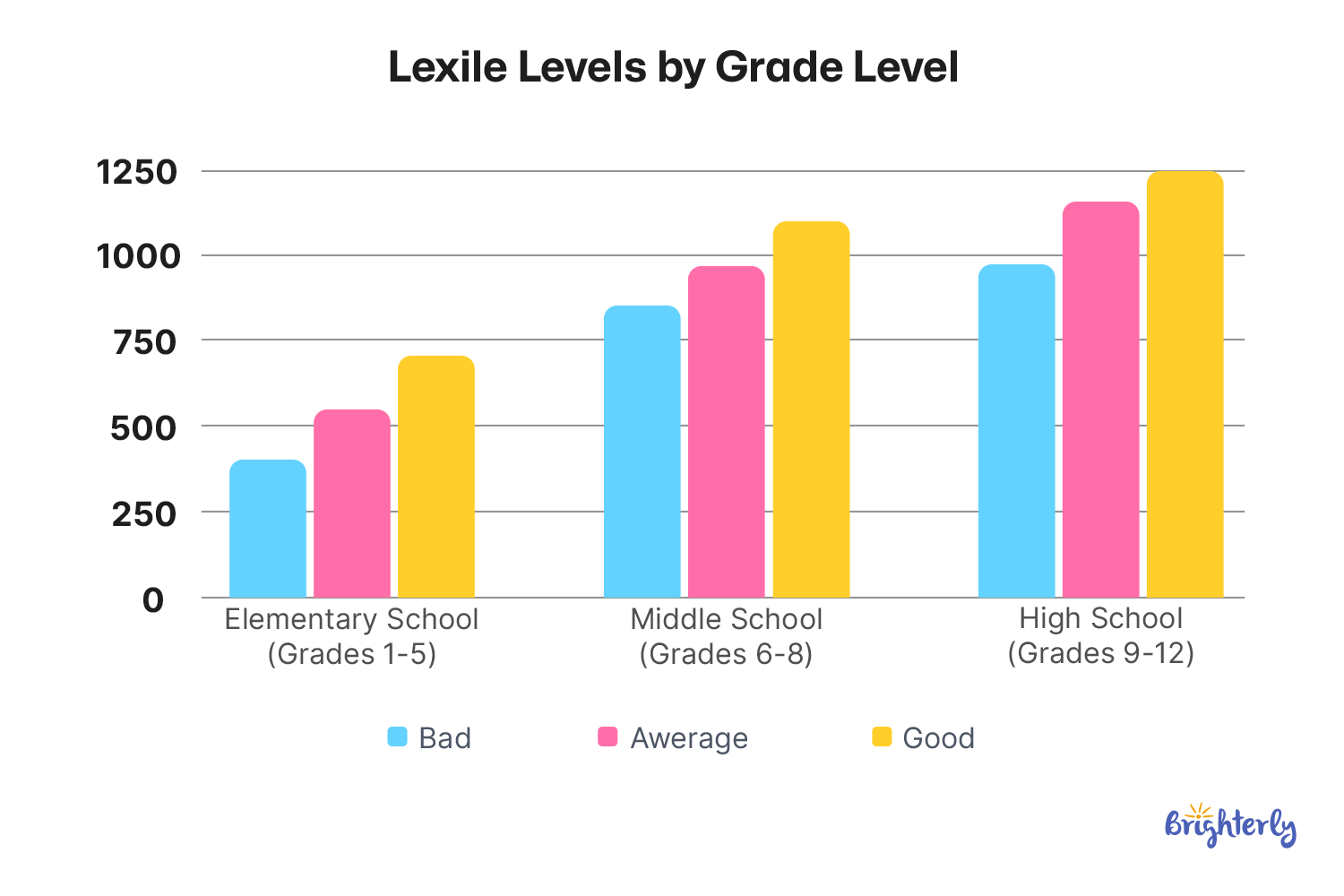
Lexile levels by grade aim to evaluate a child’s reading skills and provide them with appropriate materials regardless of their grade level. Below you can see their typical ranges.
Source: MetaMetrics
Parents can use this reading Lexile chart to compare the reading level of their child with the typical scores expected for their grade. In case it’s below expectations, the graph helps to identify if they need additional support to improve reading skills and fluency.
If you see that your kid needs improvement, Allison Wilson recommends looking for strategies that focus on their confidence, consistency, and comprehension:
“With consistent support and positive reading experiences, children can continue to build skills while gaining confidence as readers.”
Helpful strategies include:
- Shared reading: Read aloud together, take turns, or read side by side to model fluent reading and support understanding.
- Short, regular reading time: Frequent, manageable sessions help build stamina without overwhelming the child.
- Conversation, not quizzing: Talk about the story and make connections to the child’s experiences rather than focusing on right or wrong answers.
If you’re looking to improve your child’s reading skills and the Lexile levels or looking for professional help with reading preparation, our literacy program for kids is a good way to do it. We offer 1:1 individualized reading and ELA tutoring for K-12 students, starting from $17.70/lesson (2 lessons per week, 12-month plan, now 20% off), as of August 2026.
At Brighterly, your child will practice with highly vetted tutors who help students improve reading comprehension and fluency and move up the Lexile reading scale. Our tutors plan the classes specifically for your child’s needs and include an individual combination of activities, as the needs of 1st grade and 7th grade Lexile level are quite different. Through the gradual increase in the complexity of the texts, your child will steadily climb to higher Lexile brackets through careful and friendly guidance.
Elementary Reading Levels
Understanding Lexile level scores requires context in relation to your child’s grade. The following is a Lexile score chart that shows the average levels for elementary school students by grade. You can also find what constitutes a bad (below average) and a good (above average) measure for each grade level.
Grade Bad Lexile Levels Average Lexile Levels Good Lexile Levels 1st grade Lexile level: 2nd grade lexile level: What Lexile level is 3rd grade: Lexile level for 4th grade: What lexile level is 5th grade:
99L & below
100L-400L
401L & above
299L & below
300L-600L
601L & above
499L & below
500L-800L
801L & above
599L & below
600L-900L
901L & above
699L & below
700L-1000L
1001L & above
For example, given that the average score for 5th graders is 700L, if your 5th grade student’s Lexile level is anything lower than that, you should start paying more attention to their reading level and efforts. If they are between 700L and 1000L, they are on track, while anything above 1001L is already at advanced levels.
Middle School Lexile Levels
Bad Lexile Levels Average Lexile Levels Good Lexile Levels What Lexile level is 6th grade: 7th grade Lexile level: What Lexile level is 8th grade:
799L & below
800L-1050L
1051L & above
849L & below
850L-1100L
1101L & above
899L & below
900L-1150L
1151L & above
The table above depicts not only what does Lexile level mean on average for middle school students, but also low (bad) and high (good) achievements. For instance, if a 7th-grade student has a Lexile level between 850L and 1100L, they are up to standard. However, if their score is below 850L, they might be falling behind. Alternatively, if they hit a measure of more than 1030 Lexile grade level (like 1100L), they are an advanced reader.
Turn reading into an interesting adventure
Discover the joy of reading and improve Lexile scores with 1-on-1 tutoring.
High School Lexile Levels
Bad Lexile Levels Average Lexile Levels Good Lexile Levels What is a bad, average, or good Lexile score for a 9th grader: What Lexile level is bad, average, or good for a 10th grade: What Lexile level is bad, average, or good for a 11th grade: What is a bad, average, or good lexile score for a 12th grader:
999L & below
1000L-1200L
1201L & above
1024L & below
1025L-1250L
1251L & above
1049L & below
1050L-1300L
1301L & above
1049L & below
1050L-1300L
1301L & above
For example, the average 10th grade Lexile level is between 1025L and 1250L. Anything below this range could be a sign of being behind, and any number above this range could mean that your child is an advanced reader.
Note: Reading level statistics indicate a growing decline in reading levels and scores among the US students, so paying close attention to whether your child meets the average requirements for their grades or not is increasingly important.
How Is Lexile Level Determined?
The Lexile framework uses a scientific, two-sided approach to measure both the difficulty of the text and the student’s reading ability. And since the system uses the same metric for both, it makes sure there is a perfect match between both of them.
Text Complexity (Sentence Length, Vocabulary)
To determine the Lexile measure of a book, a specialized software algorithm analyzes the text. The two factors it looks at are:
- Sentence length (syntactic complexity) – How many words are there in a sentence, as longer sentences are more grammatically complex
- Word frequency (semantic difficulty) – the more often the book uses complex and rarer words, the more difficult it is, resulting in higher Lexile reading levels
Reading Comprehension Testing
Schools determine students’ Lexile levels through standardized reading assessments. During these assessments, your child will encounter different types of questions, like cloze reading passages, which test whether they can understand the context and logic of what they are reading. The result is a numeric score that represents the highest level of text your kid can read with 75% comprehension.
Limitations of the Lexile System
The Lexile system is an effective one, but it’s not perfect. Because it’s a mathematical system used to determine a non-mathematical skill, it has a few blind spots.
- Content vs. complexity – The book might have simple sentences, but complex content, as well as mature and dark themes. While the themes may not be appropriate for younger readers, a simple sentence structure or usage of common words may classify the book as appropriate for younger audiences.
- Interest levels – The system doesn’t account for the passions of the students. For example, while a 1200L book about geology may be classified as “complex” for a 4th grader, they might be able to crack it if they enjoy the topic
How to Improve Your Child’s Lexile Level
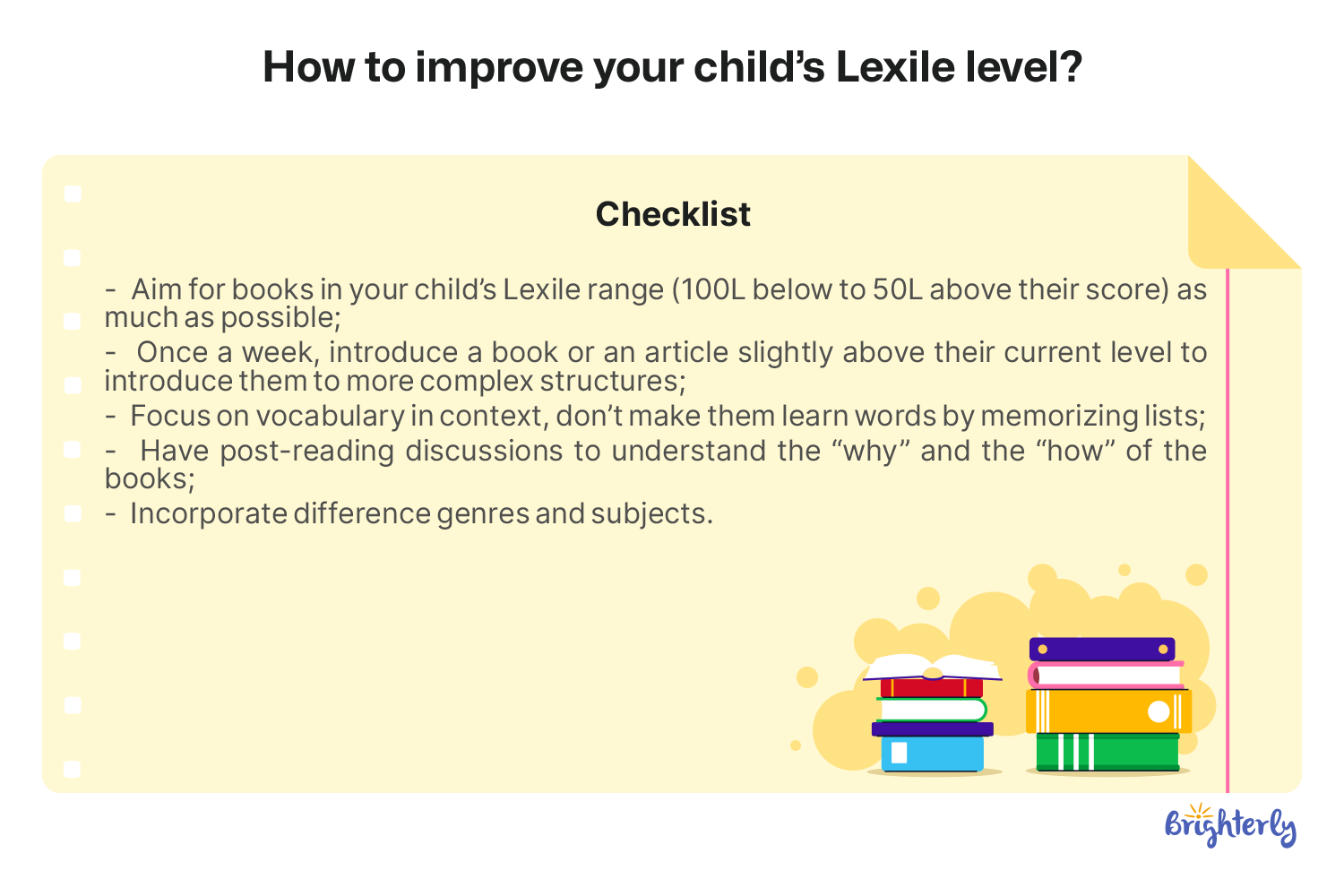
If you want to improve your child’s reading Lexile levels, the first thing to keep in mind that it’s not similar to learning for a test. Instead, you need time to build deep reading skills and develop a love for reading. To move up the Lexile scale, your child needs to bridge the gap between simple decoding skills and deep, analytical comprehension of a text, and it doesn’t happen overnight. You can use this checklist to create an environment that supports this development:
- Aim for books in your child’s Lexile range. You can also include those that are 100L below to 50L above their score
- Once a week, introduce a book or an article slightly above their current level to gradually increase the complexity of what they can understand
- Focus on vocabulary in context, discussing unfamiliar words when they appear in the story
- For stimulating critical thinking, have post-reading discussions with open-ended questions about plot points and characters
- Incorporate different genres and subjects like non-fiction, biographies, poetry, etc., to familiarize them with diverse styles and sentence structures
How to Support Your Child’s Reading at Home
- Choose books within a range of 100L below to 50L above your child’s current Lexile score – it’ll give them opportunities to grow yet without causing frustration.
- Let your kid pick topics they truly like because enthusiasm for a subject can help them proceed with more complex vocabulary.
- To improve reading speed and enhance automatic word recognition, have your child reread familiar books within their comfortable Lexile range.
- Read together books near the upper end of your child’s Lexile range, pausing on unfamiliar words to discuss their definitions and context.
- See how things are going with updated Lexile scores from school assessments to check progress and adjust the difficulty of books chosen accordingly.
- For books near or above their Lexile goal, combine a book with an audiobook because listening during visual reading can help develop stronger reading comprehension for difficult texts.
Common Mistakes Parents Make With Lexile Scores
Even with the best intentions, very often parents misinterpret what the Lexile levels are saying about their kid. Here are some of the common pitfalls you want to avoid on your kid’s learning journey:
- Don’t treat the Lexile score as a grade, because it isn’t. It’s a tool for matching your child with the correct reading material, and it’s not a reflection of their intelligence.
- Don’t forbid books that the score determines as too easy. If your child wants to read a book below their level, let them! Reading for pleasure is what will develop their love for reading.
- Don’t ignore their interests, as mentioned earlier. If your child is interested in a topic and wants to learn something that’s above their Lexile level, let them.
Frequently Asked Questions
What Grade Level Is a 900 Lexile?
The 900L score closely aligns with grades 4 through 8. While for grade 4, 900L is quite a high level, for 8th graders, it’s then the lowest average level.
Are Lexile Levels Accurate?
Lexile levels are accurate for measuring sentence length and vocabulary difficulty, but they don’t measure human factors like interest, maturity, or theme. It’s a score that assesses the technical difficulty of a text and the child’s ability to understand that level of technical difficulty, but nothing more.
What Is the Difference Between a Lexile Level and a Grade Level?
Grade levels and Lexile levels differ in how they evaluate reading abilities:
- Level of detail and coverage. A grade level is a broad bracket showing what a student usually reads in a particular school year, and a Lexile score is a precise number that continuously measures reading skill and book difficulty.
- Assessment method. Grade levels look at overall school standards and age-appropriate topics, and Lexile scores look strictly at word difficulty and sentence length.
- Goal range. Grade levels group students into one big yearly segment, and the Lexile system gives a personalized range so kids can read comfortably yet still be learning.
How Do I Convert a Lexile Score to a Guided Reading Level (Fountas and Pinnell)?
You can’t convert the scores using a precise math formula because each system looks at books differently. Fountas & Pinnell employs letters from A to Z based on teacher reviews and overall themes. Lexile, on the other hand, employs numbers up to 2000L calculated by computer programs that measure sentence length and word difficulty.
Check our conversion chart: For example, a 500L to 700L Lexile score matches Fountas and Pinnell letters from N to P, which fits standard 3rd grade reading. Yet remember that a child may perform slightly differently in each system, depending on the book.
What Is a Lexile Range, and Why Does It Matter?
A Lexile range is a personalized reading band calculated by taking 100L below to 50L above a student’s assessed Lexile reader measure. For instance, if your child has a reader measure of 700L, their optimal reading range is 600L to 750L.
A Lexile range aims at a 75% comprehension rate – ideal for a reader to understand enough of the narrative structure and ideas to read independently, yet still encounter enough new vocabulary to grow. Reading within a Lexile range helps kids avoid books triggering decoding frustration (above range), or handle insufficient intellectual challenge (books below range).
Can Two Books With the Same Lexile Level Differ in Reading Difficulty?
Yes, two books with the same Lexile level can differ significantly in actual reading difficulty because:
- The Lexile algorithm evaluates only sentence length and word frequency; it can’t measure thematic depth or background knowledge requirements.
- A book with short sentences and simple vocabulary receives a low score even if it deals with complex themes. Conversely, a simple children’s dinosaur book filled with technical species names receives a high score despite its simple ideas.
- Visual aspects – like page layout, font size, illustrations, white space, paragraph structure, etc. – strongly affect readability, but none of these are weighed into the score.
What Is the Highest Lexile Score?
The Lexile framework scale formally reaches 2000L. Scores at or near this upper limit represent complex technical manuals, graduate-level research papers, dense legal documents, and classic literature with highly intricate prose.
Within established academic frameworks, like the Common Core State Standards, the criterion for high school seniors preparing for university or technical careers is between 1200L and 1400L.
Scores exceeding 1600L are exceptionally rare within K-12 schooling. Most standard educational assessments cap their reporting scales below 2000L because measuring beyond advanced collegiate reading adds minimal instructional value for school-age readers.


The average silent reading speed by age increases from 80 WPM for 1st grade to 250 WPM for 12th grade. The average silent reading speed for adults is 238-260 WPM and 183 WPM for reading aloud. This guide provides a reading speed chart by age and grade, percentile ranges, and a one-minute home test to […]

Jul 21, 2025

Reading tutor cost usually varies from $10 to $80, but the exact price you’ll pay depends on the tutoring format, your location, and the expertise of the teacher chosen. Here are the key factors and platform comparisons to help make an informed decision. Key points: As of 2026, the average reading tutor charges between $10 […]
Jul 23, 2025
Math & reading from 1st to 12th grade
Looking for homework support for your child?

Choose kid's grade

Math & Reading for Grades 1–12
Build real confidence for your child with a Brighterly math or reading tutor.