12 Sound Devices in Poetry Kids Should Know & Understand
reviewed by Marvi M. Andres
Updated on April 1, 2026
Sound devices in poetry are techniques poets use to create rhythm, mood, and musicality through language. For kids, understanding these patterns makes poems easier to read, interpret, and enjoy. This article breaks down 12 essential sound devices with simple explanations and examples, and aims to help young learners appreciate the “music” behind the verses.
Key Takeaways
- Language is submerged in an immersive aural experience through the use of sound equipment.
- In primary school, rhyme and onomatopoeia are predictive of reading performance.
- Middle and high school students alter mood, create ambiance, and communicate complicated emotions through the use of advanced techniques.
- 12 resources listed below assist kids in deciphering literary meanings.
What Are Sound Devices In Poetry?
Sound devices in poetry definition covers a literary device in which the sound of words affects the meaning and interpretation of the text. This means that words’ vowels, consonants, and sonic qualities, as well as their proximity to one another.
Why Are Sound Devices Important?
There are a lot of reasons why sound devices are used in literature. A style’s formal restraints help create a work’s mood and atmosphere, but they can also be used to enhance the work’s resonance, or even enhance the impact of a particular passage of writing. Even though the sibilance makes it hard to say out loud, “Sally sells seashells by the seashore” is hard to forget. Learning to identify types of sound devices in poetry isn’t just about aesthetics; it’s a practical skill. When students look for internal rhymes or alliteration, they naturally learn how to focus while reading by paying closer attention to word choice.
Common Sound Devices
Did you know that incorporating poetry lessons throughout the school year can actually improve students’ writing in other genres? Writing poetry helps students develop their language, vocabulary, and word choice skills. Poets carefully choose their words so that they have the maximum effect on the listener, so each word in a poem expresses meaning instead of merely telling. Words are chosen so that they will invoke sensory images in the imagination and emotional responses in the heart.
Couplets are a fun way to teach students the basics of rhythm and rhyme using any subject matter of their choice. They are poetry lines with similar meter and rhyme. There can be one or more rhyming stanzas, each containing two lines.
While couplets are a great starting point, exploring 15 types of poetry for kids from Haikus to Sonnets can help students find their unique voice. Teachers can even combine these styles with RAFT writing for kids (Role, Audience, Format, Topic) to give students a creative structure for their poetic assignments.
Brighterly helps kids build stronger reading and literary analysis skills step by step.


Help your child understand poetry with confidence
12 Poetry Sound Devices Kids Learn
- Rhyme
- Alliteration
- Repetition
- Onomatopoeia
- Assonance
- Consonance
- Rhythm
- Sibilance
- Cacophony
- Euphony
- Plosives
- Elision
Note: Regardless of a kid’s current grade or level, learners often mix these stylistic devices. For example, it is very common for students to confuse alliteration with consonance. Addressing a professional tutor at Brighterly can be a good idea to help master the topic through a personalized reading program for kids.
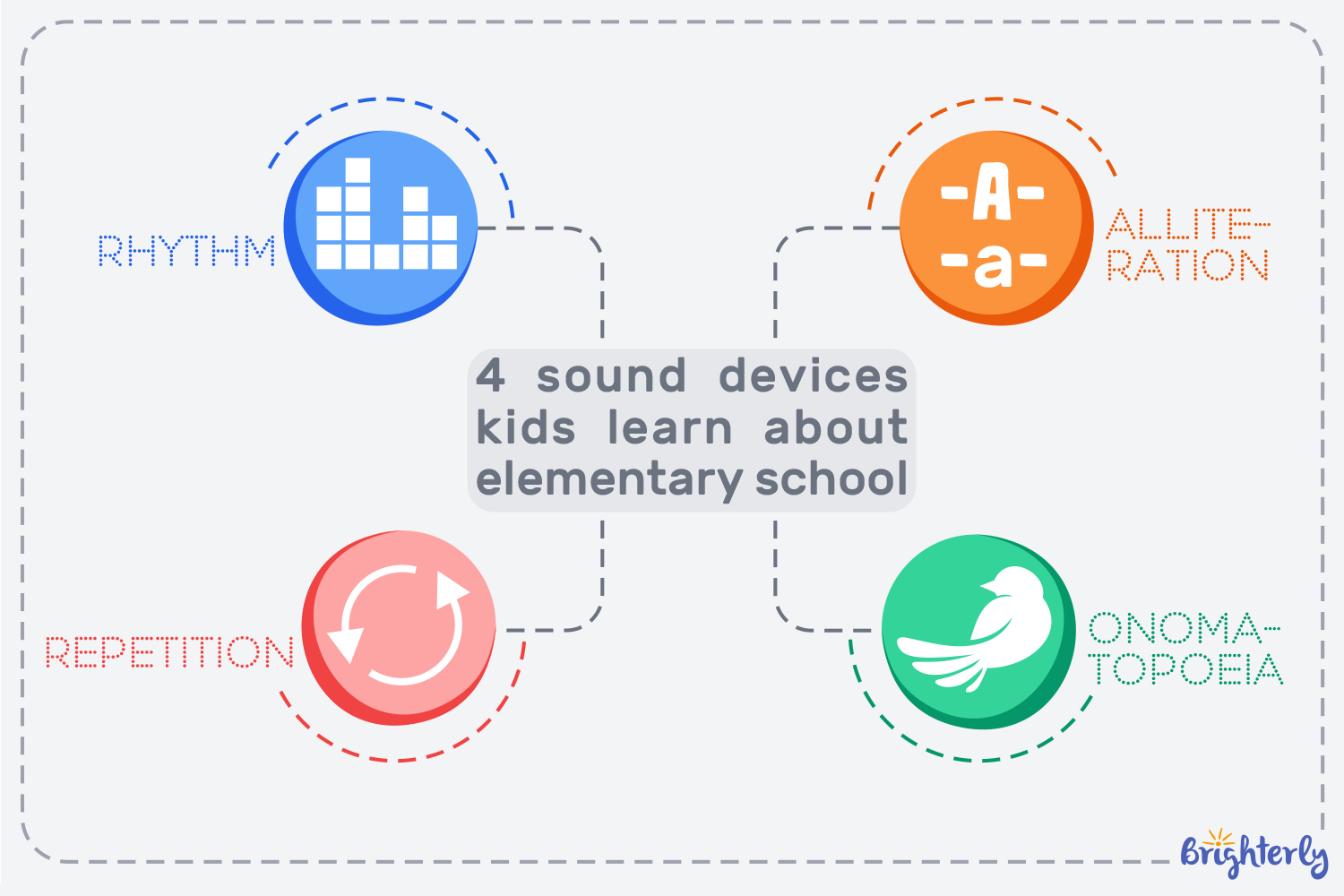
4 Sound Devices Kids Learn During Elementary School
Rhyme
Rhymes are words with matching end sounds. Words that rhyme must have the same vowel sound or be very close to each other (as in near rhyme). Occasionally, however, breaking the chains of a scheme can result in a work of poetry of great quality.
Example:
The people along the sand.
All turn and look one way.
They turn their back on the land.
They look at the sea all day.
(Robert Frost)
Alliteration
Alliteration means “letters next to each other” (from Latin). Consonant sounds or letters are repeated within successive words to achieve it. The use of this stylistic device is common in poetry and prose and gives rhyming lines a rich quality. The Raven, Edgar Allan Poe
Example:
Once upon a midnight dreary,
while I pondered, weak and weary,
Over many a quaint and curious
volume of forgotten lore (The Raven, Edgar Allan Poe)
It is the use of alliteration that makes a passage of writing more memorable and musical.
Repetition
Repeated lines are often used by poets to convey emotion. The repetition of words or ideas can also change their meaning.
Example: “Alone, alone, all, all alone, / Alone on a wide wide sea!” (Samuel Taylor Coleridge).
Onomatopoeia
Onomatopoeia is another form of sound device. It is a word or group of words used to describe an object that mimics it. Buzzing and hissing are obvious for instance Here are some less obvious, but no less effective, examples taken from Edgar Allan Poe’s “The Bells”:
Example: How they tinkle, tinkle, tinkle, > In the icy air of night! > To the tintinnabulation that so musically wells
While these lines contain consonance, they serve as onomatopoeia. The last line almost sounds like the murmur of bees. Because these words mimic real-world sounds, they create strong mental associations. This is a great trick for students learning to retain information, as sensory words are much easier for the brain to remember than abstract ones.
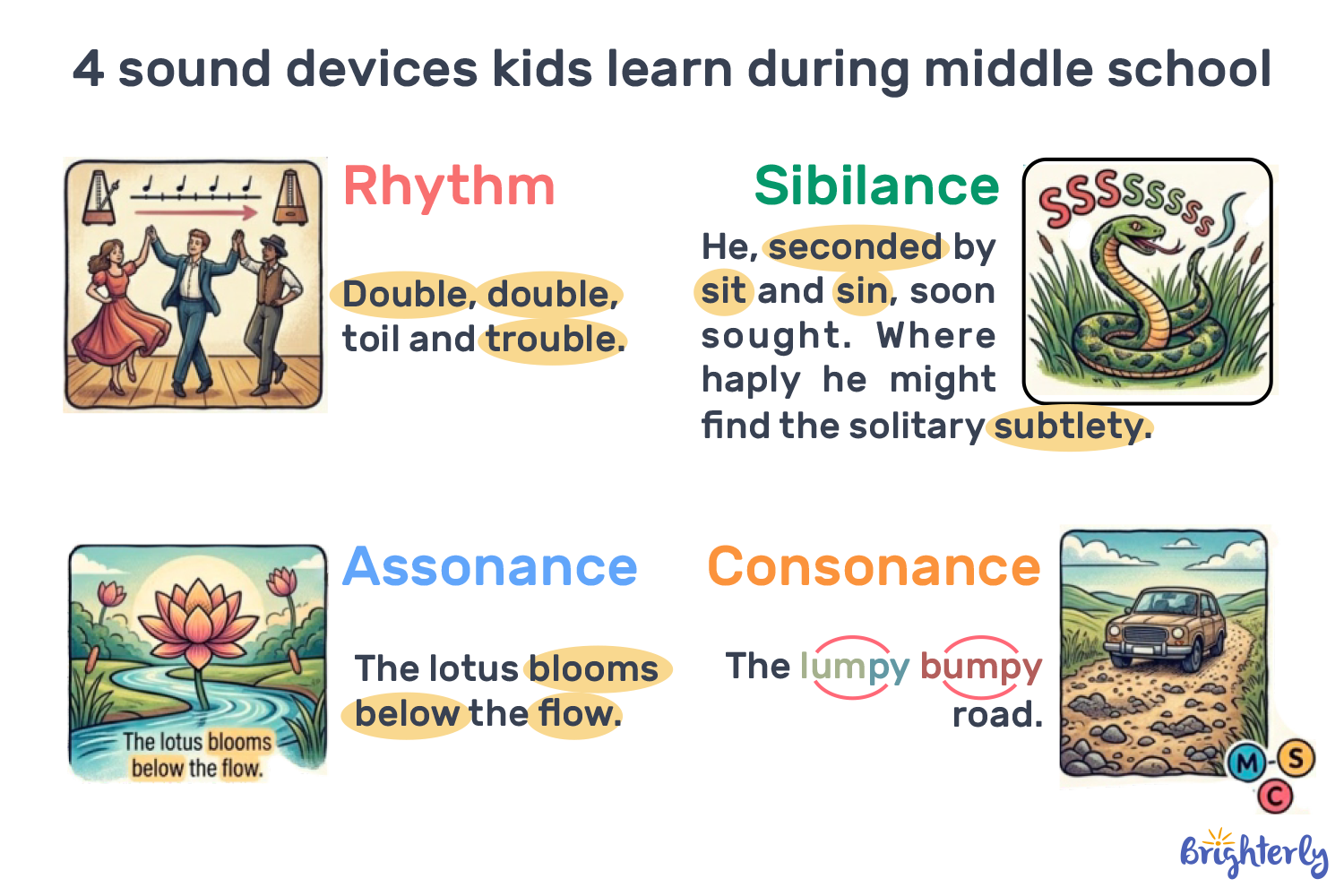
4 Sound Devices Kids Learn During Middle School
Assonance
Assonance is the repetition of similar vowel sounds within nearby words to create a cohesive, internal echo. Unlike a traditional rhyme, the ending consonants do not need to match, which makes it a more subtle and elegant poetic device. It acts like a “vowel rhyme” that ties a line together without being too obvious.
Example: “The lotus blooms below the flow.”
Usage: It is often used to create a soft, flowing, or even sleepy mood in a poem, drawing the reader into a calm state of mind.
Consonance
Using the same or similar vowel sounds in close proximity creates assonance. Words can begin, middle, or end with the vowel, but these sounds must be repeated in a resonant or echoic manner.
It is possible to emulate different feelings and moods using different vowel sounds. In addition, the frequency with which they are repeated can also change. A sense of urgency or energy is created by quick, successive, tall, and low vowels.
Example: “The lumpy bumpy road.”
Difference: Remember, while alliteration is about the initial sound, consonance focuses on the overall “texture” of the consonants throughout the sentence.
Rhythm
All around us, there is rhythm. In the beating of our hearts, in the music we listen to, in the tapping of a pencil as we sit contemplating. The rhythm of music makes emotions palpable. It is for this reason that rhythm is utilized in dance, music, and poetry.
How does rhythm work? It is built through repeating accents and beats. By focusing on stressed and unstressed syllables and lengthening lines, poetry establishes a musical pulse that guides the reader.
One of the most famous examples of rhythm is iambic pentameter, a pattern that mimics a heartbeat with five sets of unstressed and stressed syllables. This sound device in poetry is a staple of Shakespearean sonnets.
Example:
Double, double, toil and trouble;
Fire burn and caldron bubble.
(William Shakespeare, Macbeth)
Sibilance
Sibilance is consonant with the sound “s,” so it’s delightful that the word sibilance is also sibilant. This sound device deserves special attention because it contributes uniquely to the emotional impact of a passage. Especially if the writing is complete with only “s” sounds, sibilance can make writing seem sinister, slippery, tense, or eerie.
Nevertheless, repeated hushing or shushing “sh” sounds are also sibilances. An article with a lot of “sh” may feel calming, soft, quiet, or windswept.
As with the other sound devices in this article, sibilance is also intentional. Despite the fact that plenty of words end with s, and most plural words also do, sibilance requires a certain frequency and intensity in order to affect the mood, tone, and feeling of a piece.
Sound devices are also secret weapons for narrative writers. For example, using sibilance (hissing sounds) for a villain or euphony for a hero is an excellent lesson during developing a character through tone and voice rather than just physical description.
Example:
He, seconded by sit and sin, soon sought
Where haply he might find the solitary subtlety.
(John Milton, Garden of Eden)
Brighterly tutors help your child understand sibilance, rhythm, and other poetry devices in a simple, supportive way.
Make poetry easier and more fun!
4 Sound Devices Kids Learn During High School
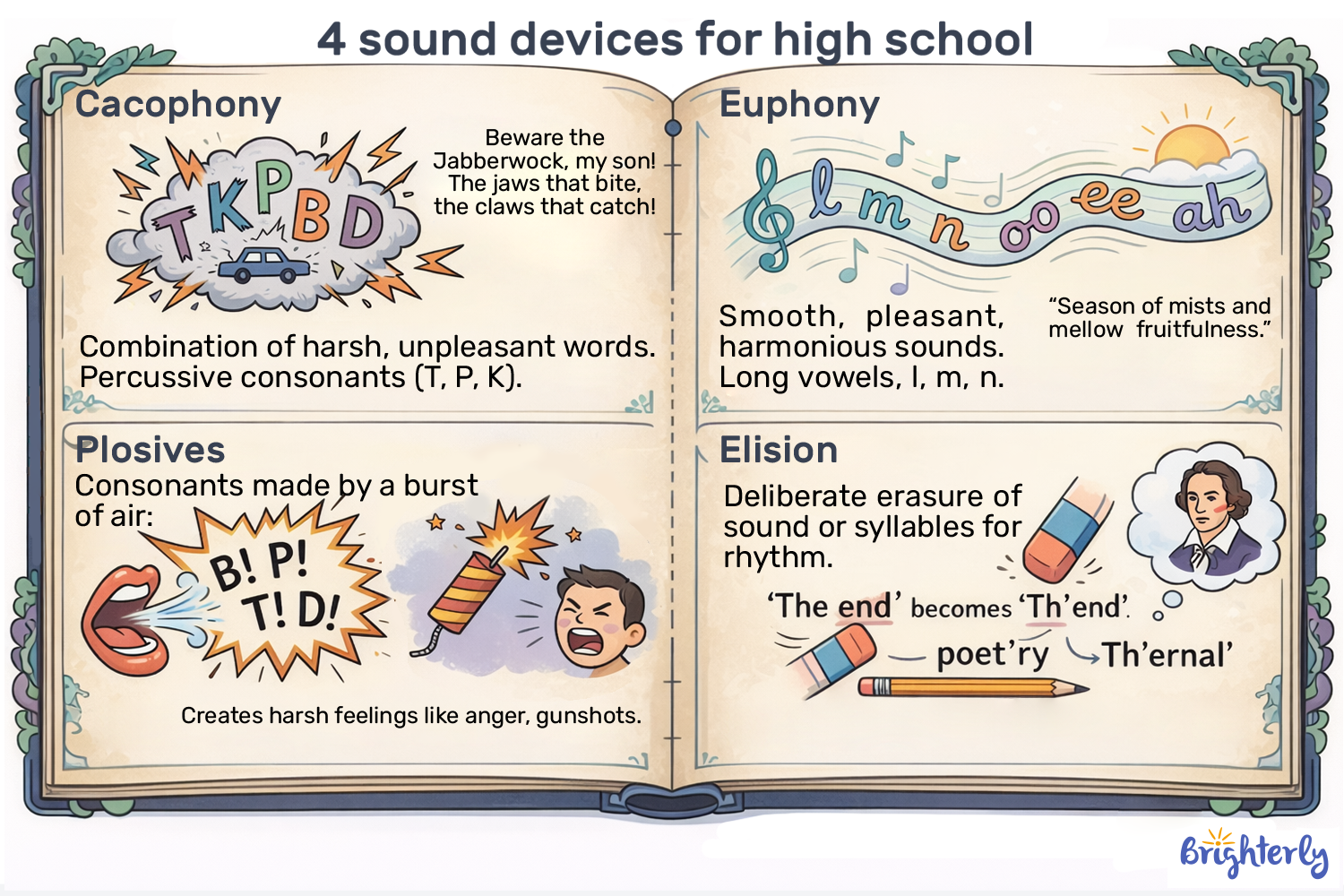
Cacophony
The term cacophony refers to a combination of words that sound harsh or unpleasant together, usually because of their many percussive or explosive consonants (like T, P, or K).
Example: “Beware the Jabberwock, my son! The jaws that bite, the claws that catch! Beware the Jubjub bird, and shun the frumious Bandersnatch!” — Lewis Carroll, “Jabberwocky»
Euphony
The polar opposite of cacophony, euphony uses smooth, pleasant, and “harmonious” sounds (like l, m, n, and long vowels) to create a peaceful effect. If cacophony is a car crash, euphony is a gentle lullaby. It allows the verse to roll off the tongue with ease.
Example: “Season of mists and mellow fruitfulness.” (John Keats).
Context: Poets use this for themes of love, nature, and serenity to make the reader feel relaxed and comforted.
Plosives
Plosive consonants are made by closing the mouth and then releasing a burst of air. In English, the plosive consonants are B, P, T, and D. Their use creates a harsh feeling in the spoken word, particularly when repeatedly used. For instance, anger, a car accident, or a gunshot. When used in poetry, they are more effective due to their focused language, but can also be effective when used in prose.
Elision
Elision is a useful sound device, especially for poets trying to fit their language into a formal poem’s rhythm and meter. As the name implies, elision is the deliberate erasure of sound or syllables. Elision is responsible for a great deal of old-timey poetic words. Check out the elision sound devices in poetry examples:
| Original Word/Phrase | Elided Version | Usage Context |
| Between | ’tween | “’Tween the sun and the moon.” |
| Among | ’mongst | “’Mongst the ruins of time.” |
| Beneath | ’neath | “’Neath the starry sky.” |
| Even | E’en | “E’en as we speak.” |
| It was | ’Twas | “’Twas a dark and stormy night.” |
Conclusion
In high school, students explore how these tools affect the psychological reader’s response. At this stage, it’s not just about the “music” of language, but about using dissonant, harsh, or compressed techniques to mirror complex human emotions. By knowing sound devices, students are better able to analyze classical literature and prepare themselves for college-level reading comprehension challenges.
Sound devices in poetry are essential for transforming written words into an immersive auditory experience. Analyzing poems with sound devices is the best way to see these tools in action. Whether it’s the clanging bells of Edgar Allan Poe or the soft lullabies of Keats, these techniques bring literature to life. By mastering these 12 techniques, students can improve their literary analysis and creative expression. If your child needs extra help navigating these literary waters, Brighterly is here to offer expert guidance and engaging reading lessons tailored to their unique learning style.
Faq On Sound Devices Used In Poetry
What Are The Sound Devices Used In Poetry?
The primary sound devices in poetry include rhyme, alliteration, repetition, and onomatopoeia. More advanced poetic sound devices include assonance, consonance, sibilance, and rhythm.
Why Are Sound Devices Commonly Used In Poetry?
They are used to create musicality, enhance the mood, and make the text more memorable. Sound devices in poems help the author emphasize specific themes by drawing the reader’s ear to certain words.
What Is The Difference Between Alliteration, Assonance, And Consonance?
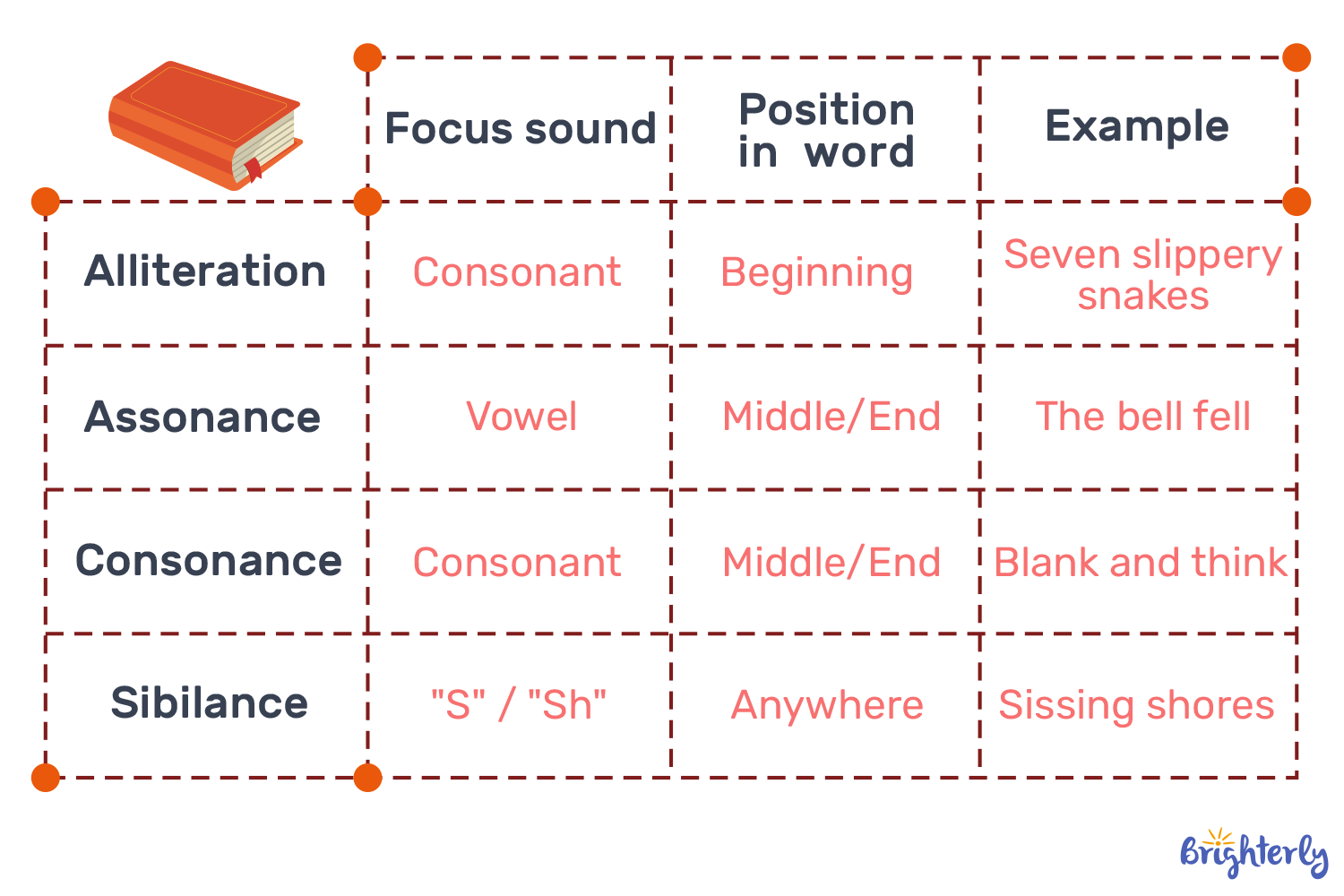
Alliteration repeats initial consonant sounds. Assonance repeats vowel sounds within words. Consonance repeats consonant sounds anywhere within the words.
What Are The Most Common Sound Devices Used In Poetry?
The most common examples of sound devices in poetry found in school curricula are rhyme, alliteration, and onomatopoeia because they are very easy for young ears to identify.
How Do Sound Devices Affect The Mood And Tone Of A Poem?
Smooth sounds (euphony) create a calm, positive tone. Harsh, “choppy” sounds (cacophony or plosives) can create a feeling of tension, anger, or high energy.
Are Sound Devices Used Only In Poetry, Or Also In Prose And Songs?
While they are central to poetic structures, these devices are frequently used in song lyrics, advertising slogans, and persuasive prose to make language more impactful and catchy.



Reading.com is a popular reading app with half a million downloads for phonics-based learning. Designed mainly for children in preschool to early elementary, it can be used as a powerful add-on to early reading, with a parent or teacher. But how much is Reading.com in 2026, and is it worth trying? Let’s find out. Key […]
Mar 25, 2026

Hook sentences examples are used at the beginning of essays and other pieces of writing to catch the reader’s attention and keep them interested in the content. The hook sentence is a well-written opening because it connects the reader’s interests to the piece’s main point. Key Takeaways The hook serves as the “top bun” of […]

Apr 02, 2026
Math & reading from 1st to 9th grade
Looking for homework support for your child?

Choose kid's grade

Math & Reading for Grades 1–9
Build real confidence for your child with a Brighterly math or reading tutor.