15 Types of Poetry for Kids & How to Master Them at Home
reviewed by Laila A. Lico
Updated on March 6, 2026
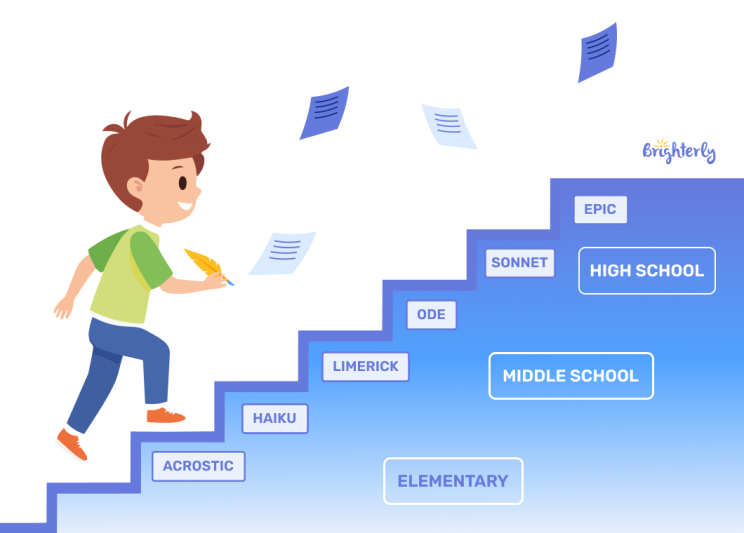
Although there are more than 150 poetic forms, most school programs introduce only a small selection, leaving parents and students confused about which types actually matter. Find out simple definitions of the most common 15 types of poetry for kids used in schools today, some home-practice tips and the most illustrative examples below.
Key points
- US schools predominantly focus on 15 core forms out of over 150 existing poetic types.
- Learning these styles improves reading fluency, vocabulary, and phonological awareness.
- Poetic types range from short and syllable-based forms like Haiku to long and narrative works like Epics. Some poems rely on strict rhyme (Limericks), others focus on visual shape (Concrete) or emotional tone (Odes). Simpler forms are introduced in elementary grades (K-3), and complex structures like Sonnets are reserved for middle and high school.
What are the different types of poetry for kids?
- For younger kids, the most common poetry types include simple forms like Haiku, Acrostic, and Rhyming poems.
- Older students learn structured styles like Sonnets, Limericks, and Narrative poetry.
- Other popular types are Cinquains, Odes, Ballads, and Free Verse.
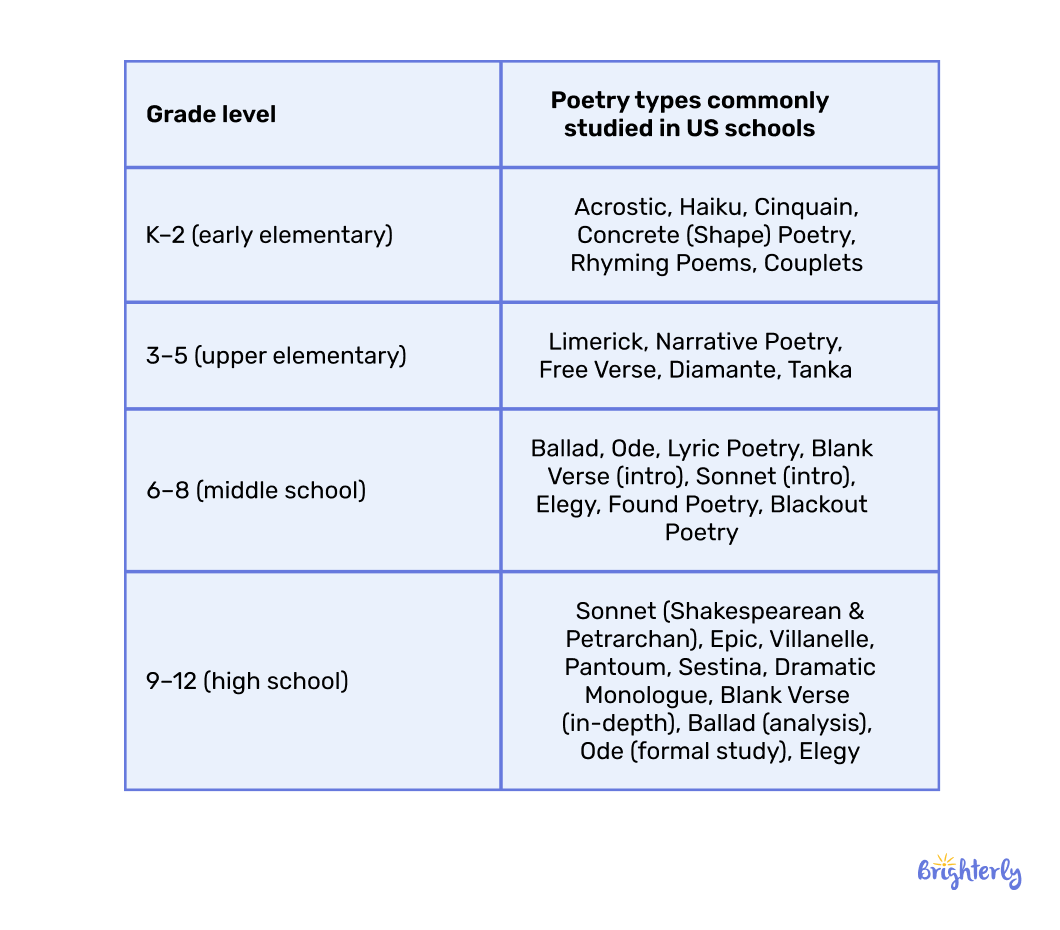
How many types of poetry are there?
To date, there are over 150 types of poetry, yet only 15 of them are most widely covered in the school curriculum. You could’ve heard of Haiku and Ballads, and probably never encountered Limericks or Diamante. Yet mastering the core types allows students of all ages to become much stronger in reading and creative writing.
15 different types of poetry for kids explained
- Rhyming poetry
- Acrostic
- Concrete
- Haiku
- Cinquain
- Limerick
- Diamante
- Narrative
- Free verse
- Ballad
- Ode
- Lyric
- Sonnet
- Elegy
- Epic
#1 Rhyming poetry
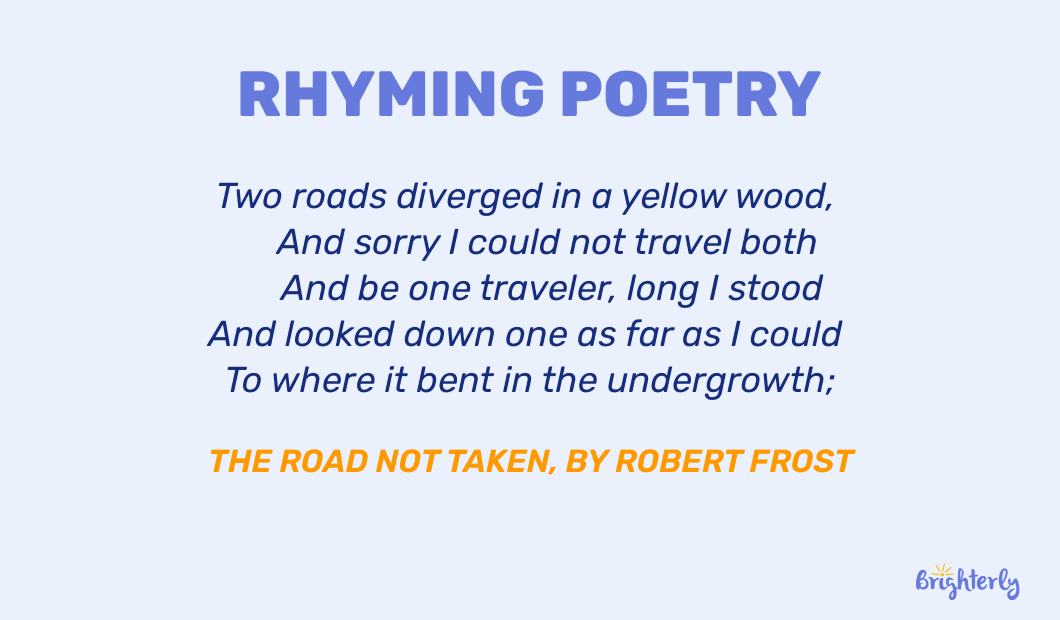
In rhyming poetry, the ending sounds of two or more lines match. Due to repeating sounds, which adds to the poem’s musical quality, such poems are easy to remember and fun to read aloud.
Rule: The final stressed vowel and all following sounds in the last words of specific lines must be identical (e.g., ‘glare’ and ‘stare’). Kids at this stage are usually taught specific patterns called ‘rhyme schemes’. Those can be couplets (AABB) or alternate rhymes (ABAB).
It’s one of the most important types of poetry forms for early childhood development (ages 5-8), because it helps kids develop phonological awareness – the ability to hear and manipulate sounds. When kids search for a rhyming word, they’re actually practicing their vocabulary and understanding of word families.
Note: When kids start figuring out what are the types of poetry, they might feel baffled by the long list of options. That’s why many families regularly turn to Brighterly math and reading learning platform. Their experts specialize in making complex school subjects much easier to understand.
#2 Acrostic type of poetry
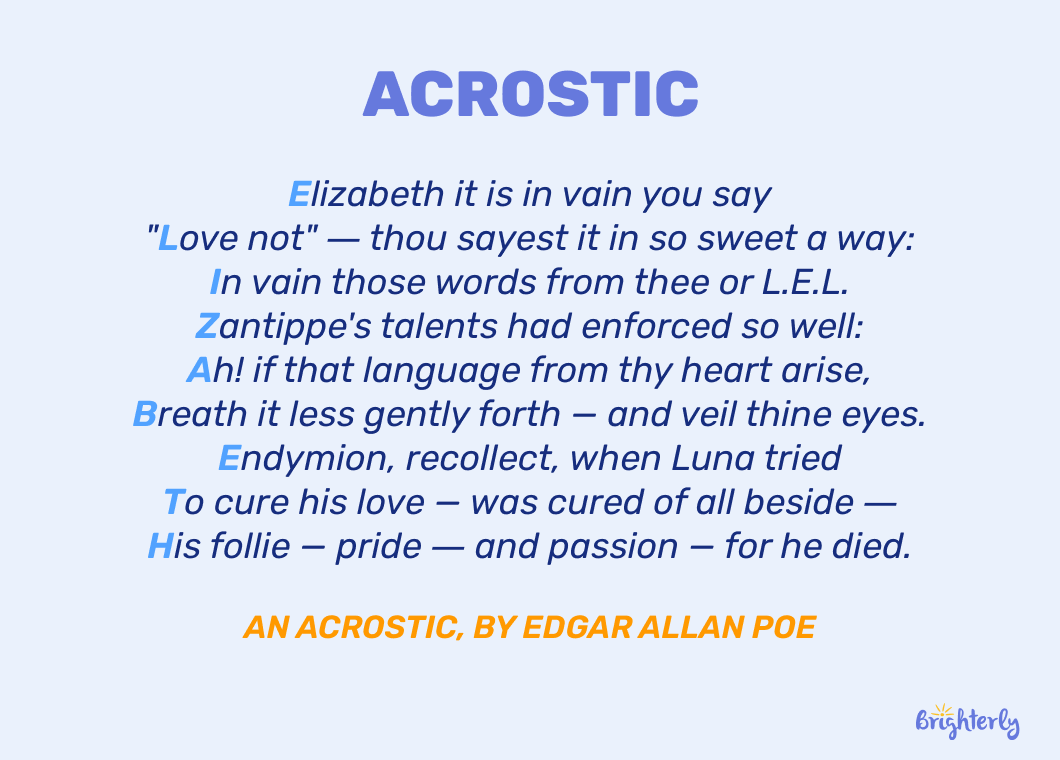
In an acrostic, although the lines read horizontally like a normal poem, the first letter of each line, when read vertically from top to bottom, spells out a specific word (or name, or phrase, etc.).
The vertical word must be the subject of the poem, with no requirements for rhyme or rhythm. It’s especially supportive for teaching adjectives and creative descriptions in grades K-3.
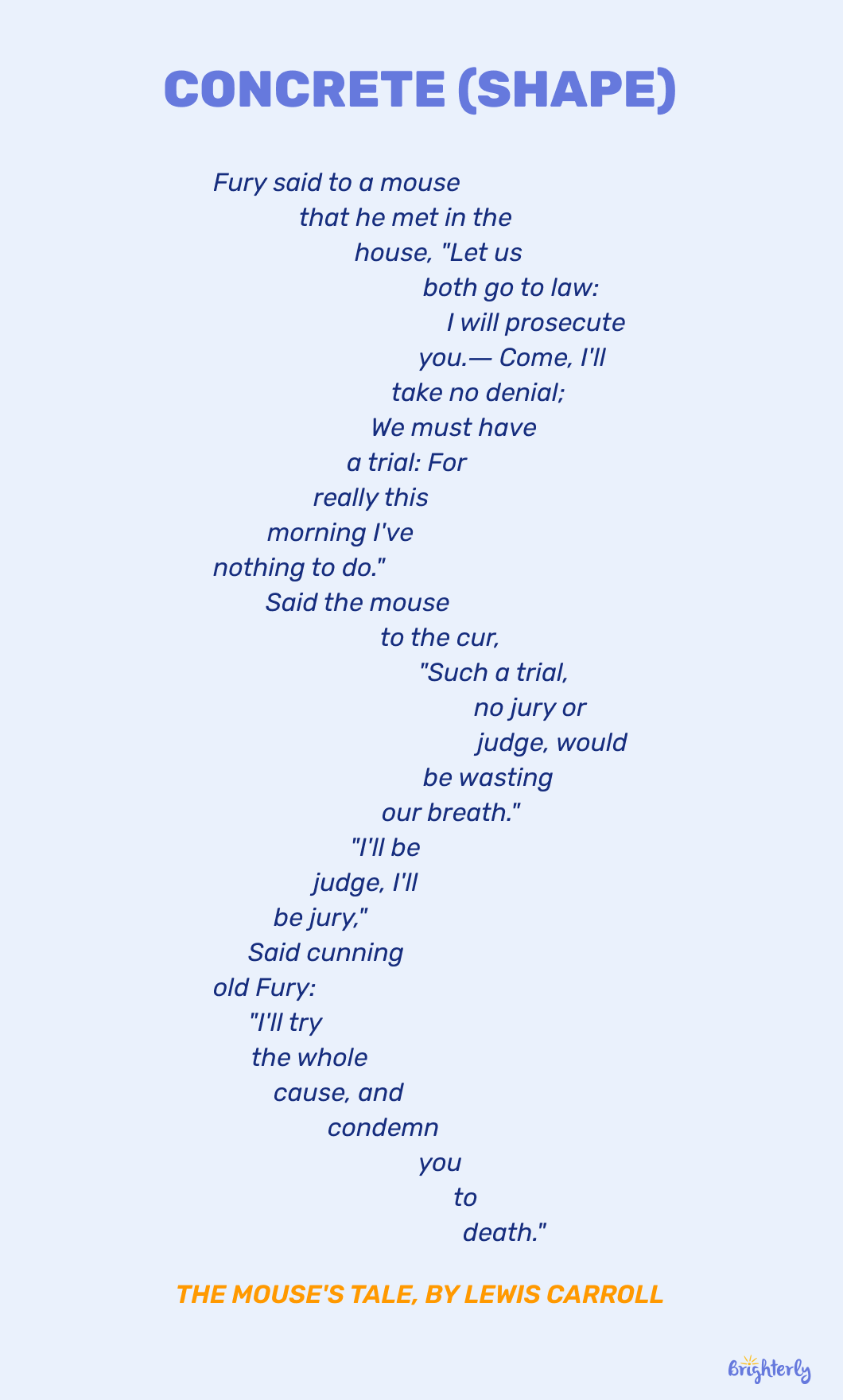
#3 Concrete (aka shape or visual)
It’s one of such styles of poetry, in which the physical arrangement of the words on the page is just as important as their meaning. The text creates a picture that reflects the topic of the poem.
The words must be placed to form a silhouette or an outline of an object. The language used should describe the object being shaped. It can rhyme, but it usually doesn’t, because the focus is on the visual impact and the clever placement of text. Shape poetry is a fav of visual learners, who are more into art and prefer to use the space on a page more creatively.
#4 Haiku
Originating in Japan, the haiku is one of the disciplined and brief types of poetry. It usually captures a single moment in time or a specific feeling.
Rule: It must consist of exactly three lines. The first line has 5 syllables, the second has 7 syllables, and the third one – 5 syllables. It traditionally doesn’t rhyme and often includes a ‘kigo’ (a word that indicates the season).
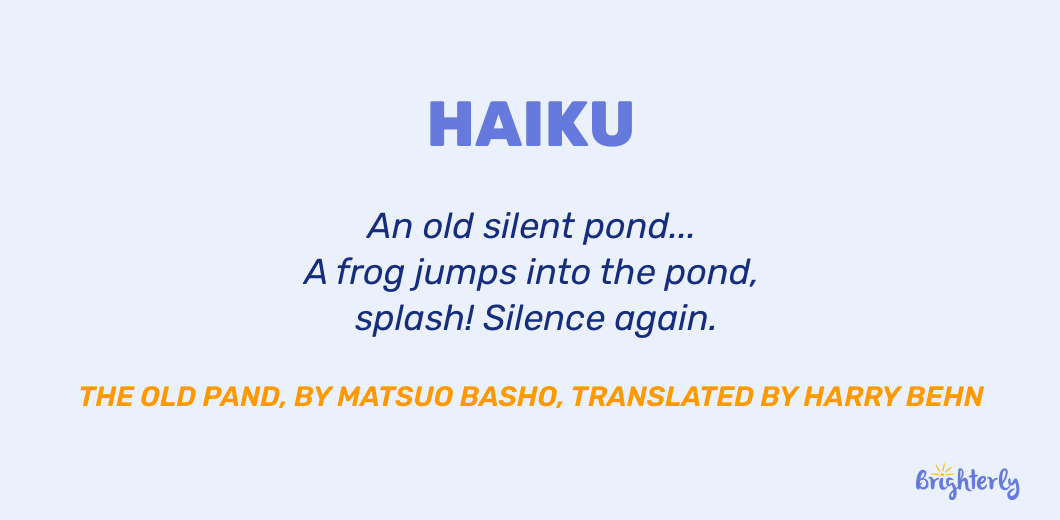
Haikus are taught in almost every elementary grade level to help kids practice ‘syllabication’ (counting beats in words). Because the poem is so short, it teaches kids to be very careful with their word choices, since they only have 17 syllables to work with.

#5 Cinquain poetry type
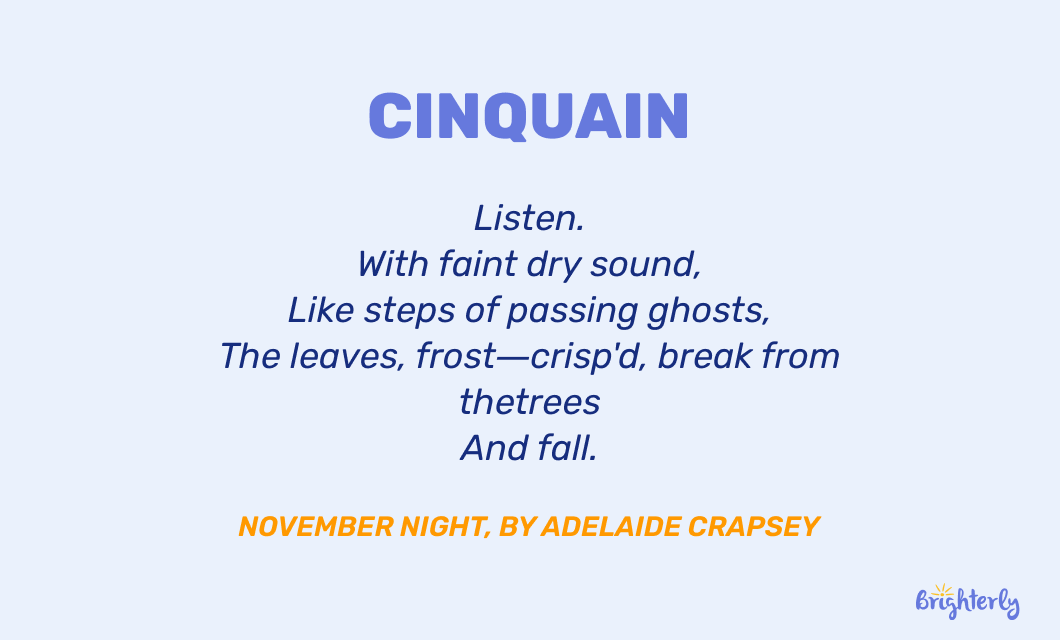
A cinquain is a five-line poetic form that has several variations. The most popular version in schools is the American Cinquain, which focuses on a specific ‘build-up’ of sound and description.
Rule: The American Cinquain follows a syllable pattern for each line:
- Line 1 (2 syllables)
- Line 2 (4 syllables)
- Line 3 (6 syllables)
- Line 4 (8 syllables)
- Line 5 (2 syllables)
There is also a ‘didactic’ version often used for younger kids that uses parts of speech: Noun → 2 adjectives → 3 verbs → 4-word phrase → noun.
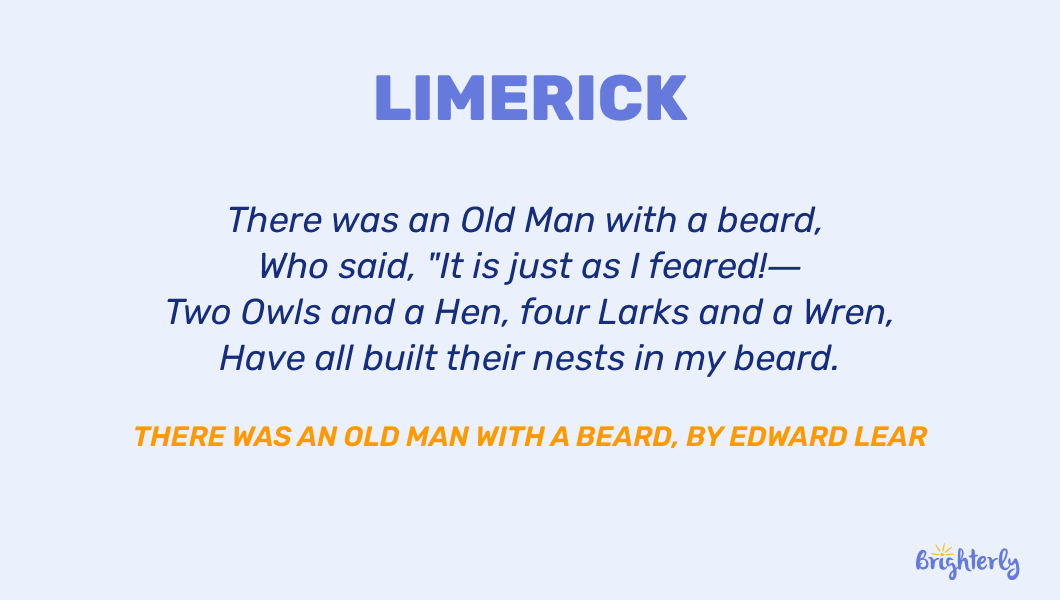
#6 Limerick
A limerick is one of such types of poetry for kids that’s almost always humorous or nonsensical. It has a very bouncy and specific rhythm that makes it sound like a song or a joke. Limericks are taught in grades 3-6 to help kids understand rhythm and meter.
Rule: It follows a strict AABBA rhyme scheme. It means lines 1, 2, and 5 rhyme with each other and are longer, and lines 3 and 4 rhyme with each other and are shorter. Such a rhythm should feel like a gallop.
#7 Diamante
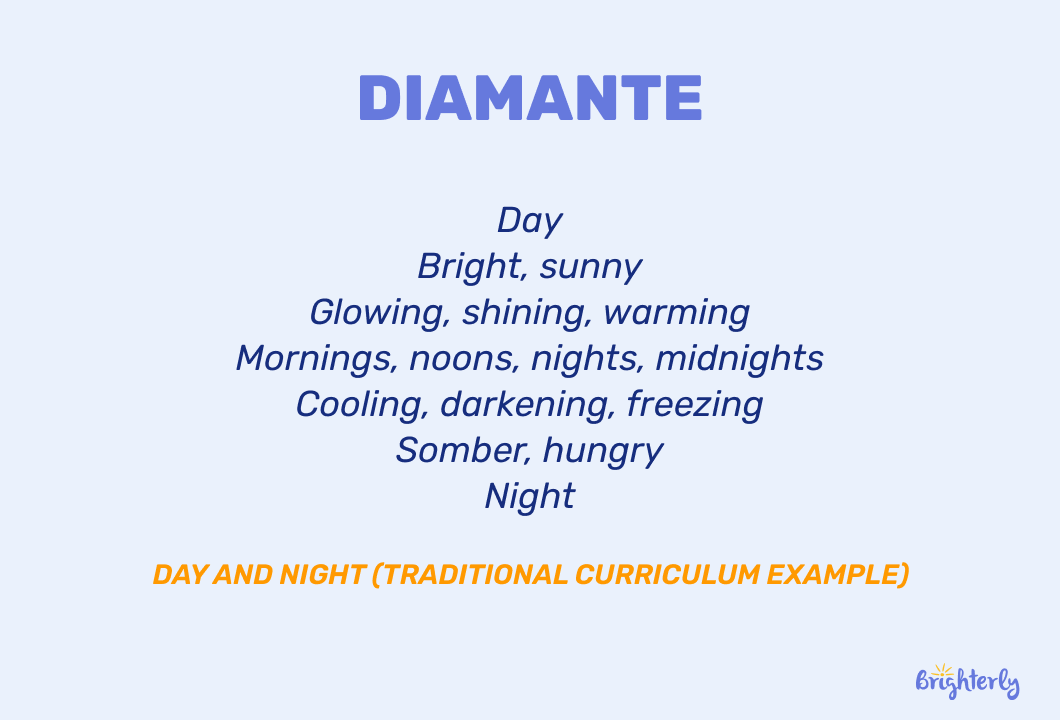
Different types of poetry for kids may be named after their physical shape – for example, diamante, in which, if the words are centered on the page, the poem looks like a diamond.
Rule: It follows a strict ‘part of speech’ formula:
- Line 1. One noun (beginning subject)
- Line 2. Two adjectives describing line 1
- Line 3. Three ‘-ing’ verbs describing line 1
- Line 4. Four nouns (two for the beginning subject and two for the ending subject)
- Line 5. Three ‘-ing’ verbs describing line 7
- Line 6. Two adjectives describing line 7
- Line 7. One noun (ending subject or opposite of line 1)
Diamante is commonly used in grades 3-6 to show the relationship between antonyms (opposites) like day and night or winter and summer.
#8 Narrative as a different type of poetry
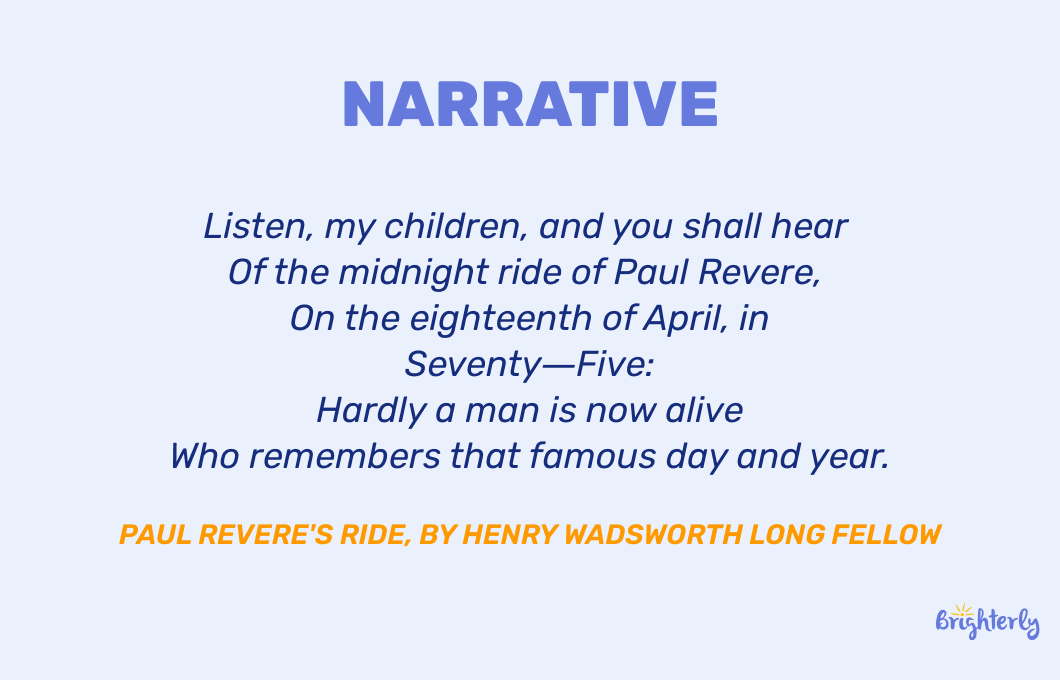
A narrative poem tells a full story, with a beginning, a middle, an end, characters, and a clear plot. It can rhyme, but doesn’t have to. What it should do, though, is follow a sequence of events. It’s usually longer than other types of poems because it needs space to build a story.
#9 Free verse
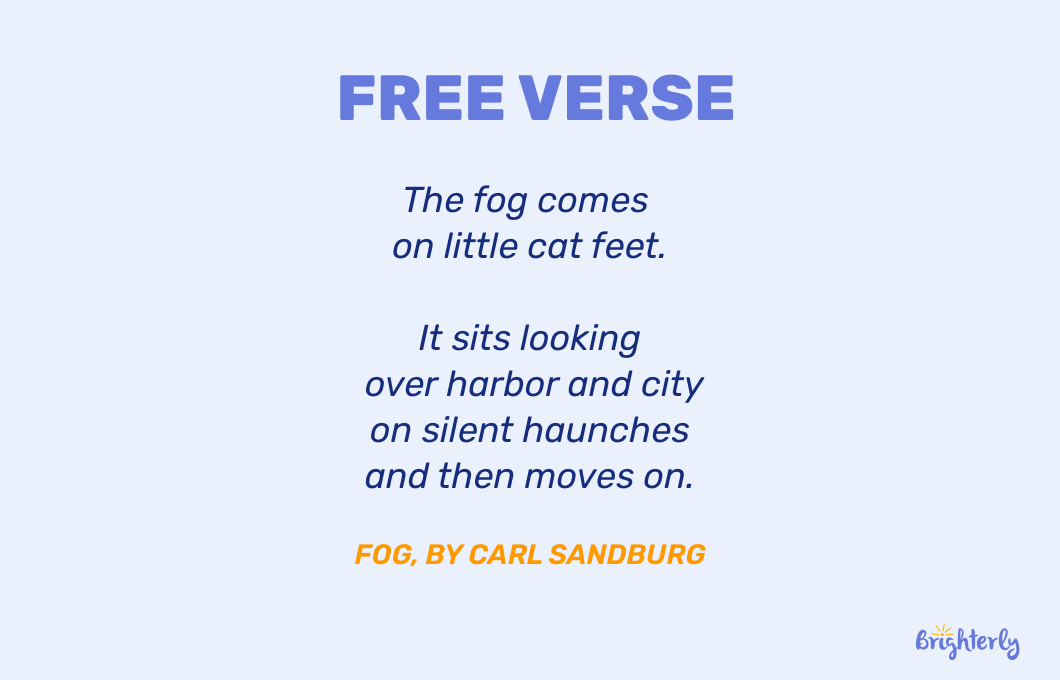
Free verse – the most ‘modern’ form of poetry – doesn’t use a consistent rhythm, rhyme, or musical pattern, and sounds very similar to natural speech.
There are almost no rules! It’s the author who decides where to break the lines and which words to emphasize, so that to focus entirely on the imagery and the feelings the words create.
Free verse is one of those types of poetry for children to realize that, in fact, poetry has no limits. So if your kid feels frustrated by syllable counting or rhyming, let them focus solely on their ‘voice’ and the message they want to share.
#10 Ballad
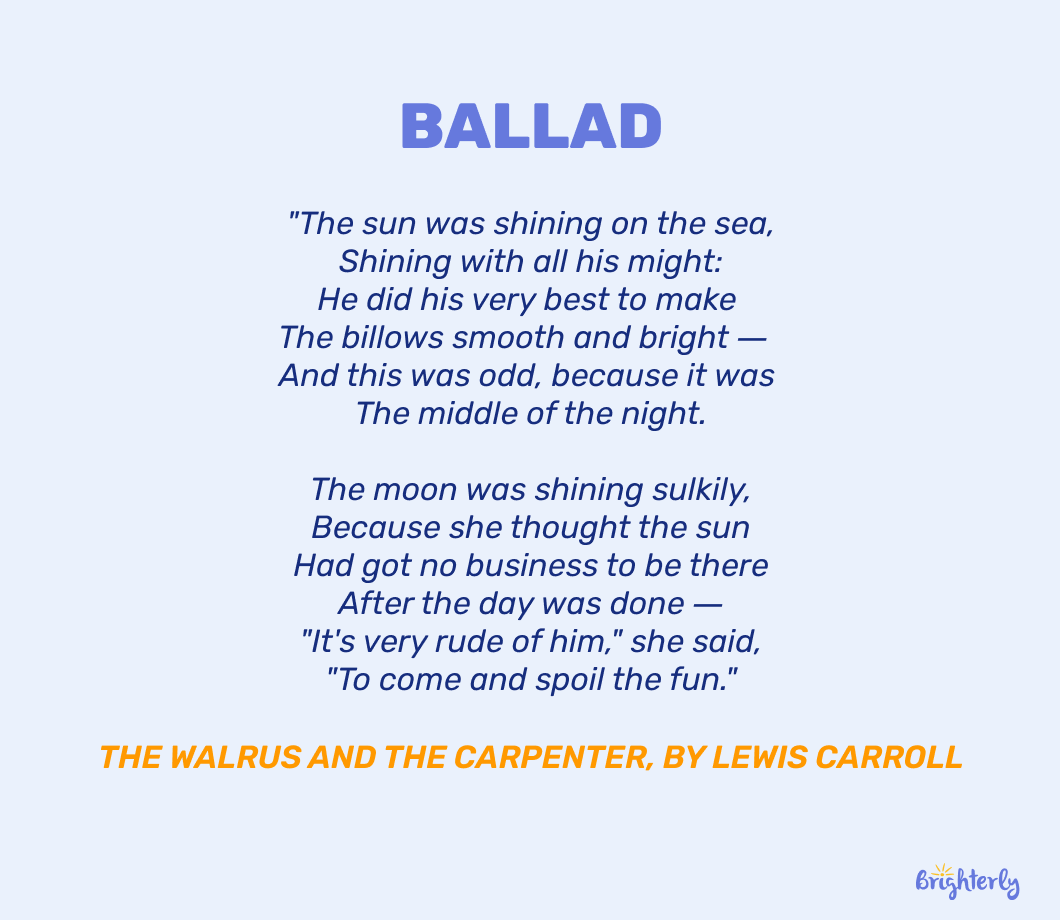
A ballad is a type of narrative poetry that’s very rhythmic and song-like. Historically, ballads were used to pass down legends and folk tales through music.
Rule: They’re usually written in four-line stanzas with a simple rhyme scheme like ABCB. They often include a ‘refrain’ – i.e., a line or stanza that repeats throughout the poem (like a chorus in a song).
Given that ballads often focus on adventure or mystery, they are very engaging for students who enjoy different kinds of poetry with action stories.
#11 Ode
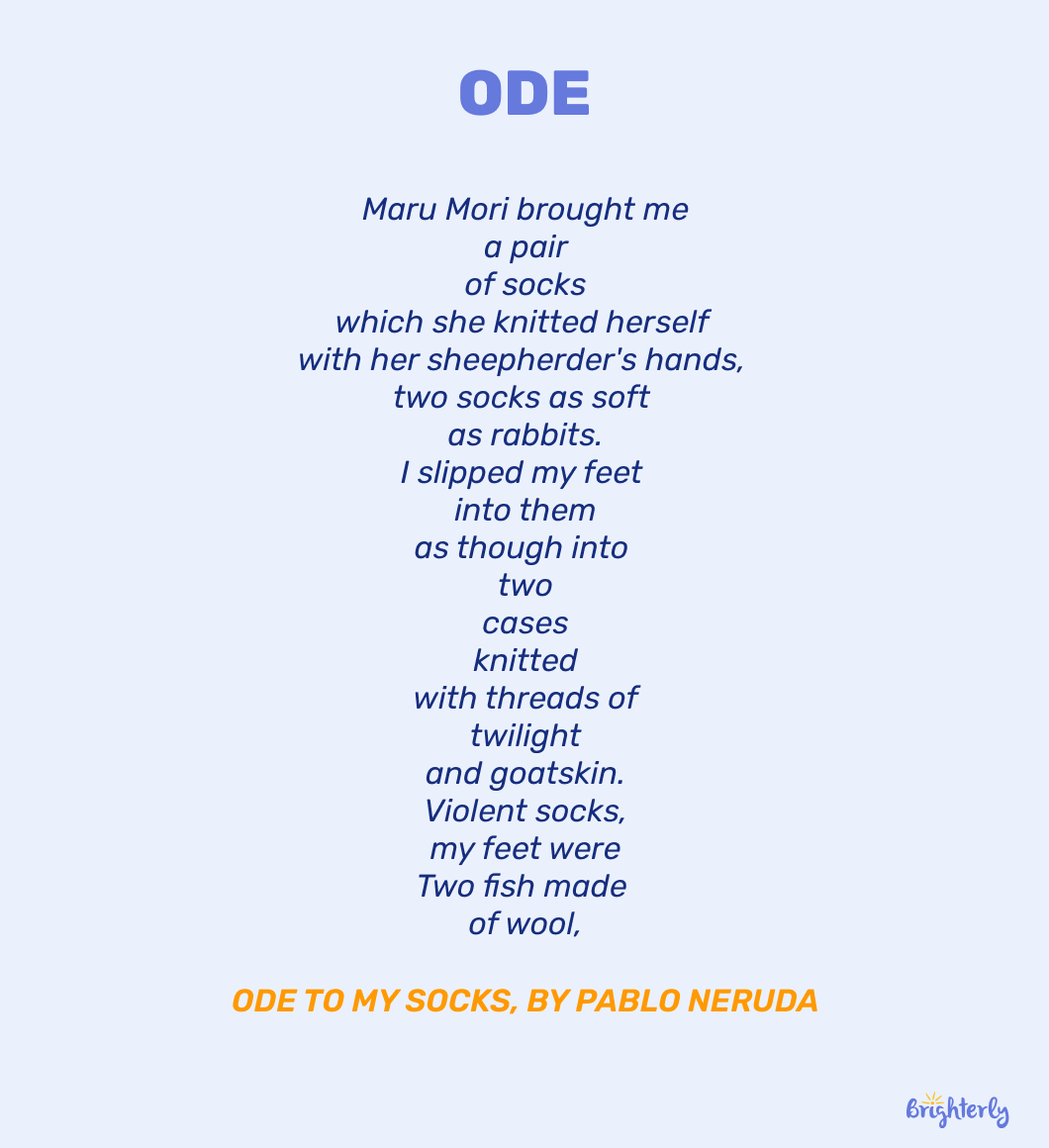
Odes are written to praise a specific person or object. It’s typically deeply emotional and focused on showing high respect or love for the subject. No single set of rules for rhythm or rhyme in modern odes, even though they still must maintain a serious and respectful tone. Hence, to practice using descriptive language in school, kids are often asked to write an ode to something simple (their favorite food or a pet).
#12 Lyric
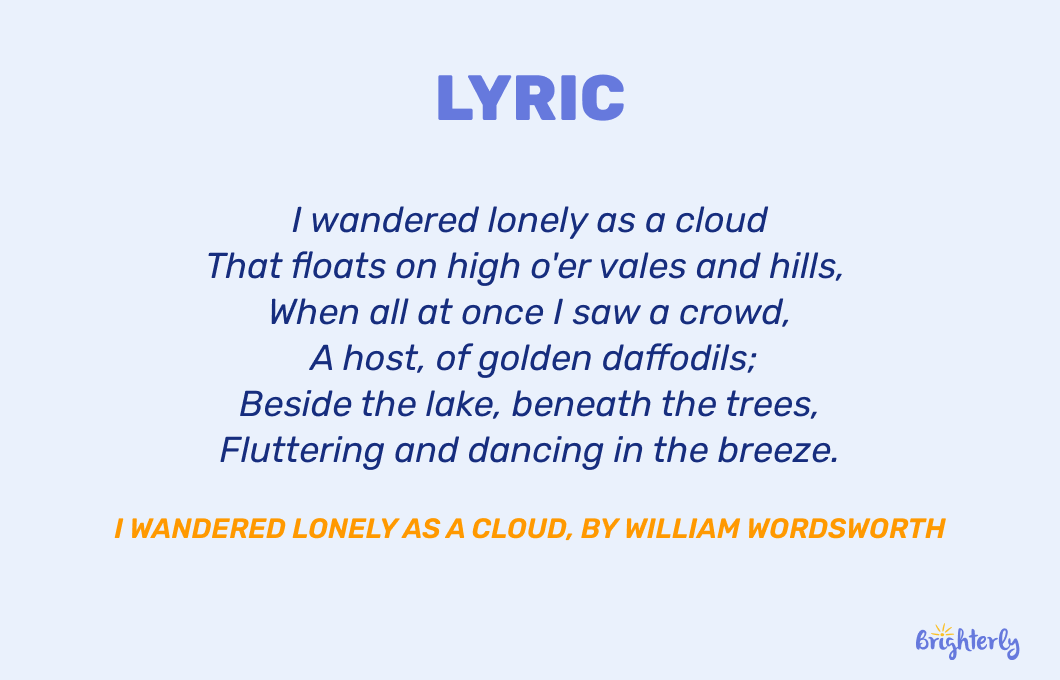
Lyric kinds of poetry are typically short and highly musical poems that express personal emotions or thoughts, yet focus on a single feeling. It usually has a song-like rhythm and a rhyming pattern. Given that most modern song lyrics are actually forms of lyric poetry, it’s your chance to help your kid connect their favorite music to their schoolwork.
#13 Sonnet
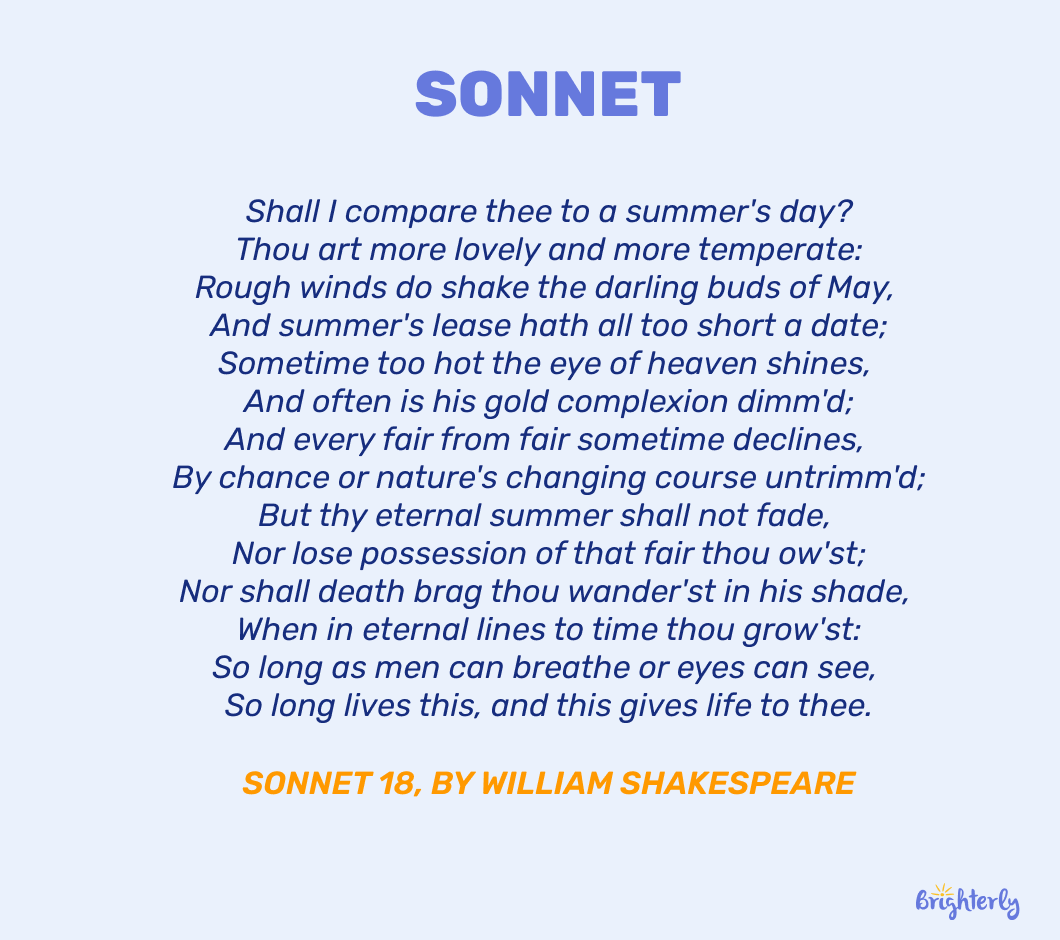
A sonnet – one of the most famous forms in English literature – is a very structured 14-line poem. It’s usually about love or nature, and is introduced in middle or high school.
Rule: It must be exactly 14 lines long. The most common (Shakespearean) version of sonnet types of poetry examples use a rhyme scheme of ABAB CDCD EFEF GG. It also follows a specific ‘heartbeat’ rhythm called iambic pentameter.
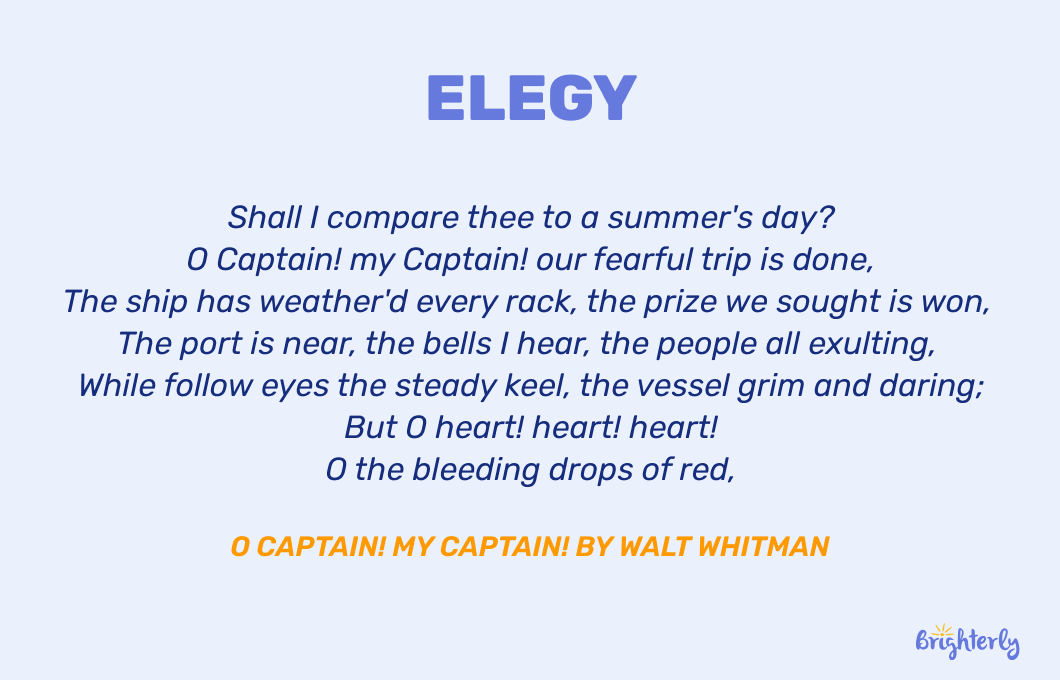
#14 Elegy
An elegy is a poem of reflection and sadness, which is most often written to honor someone who has passed away. It’s a way for the poet to express grief and find a sense of peace afterward.
There are no strict rules for rhyme or meter, if only for the emotional progression: It should start with sorrow, then move to praise for the person, and ultimately end with comfort.
Such a sensitive topic is predominantly taught in later grades to help students understand how practicing different styles of poetry can be a real tool for processing difficult feelings.
#15 Epic
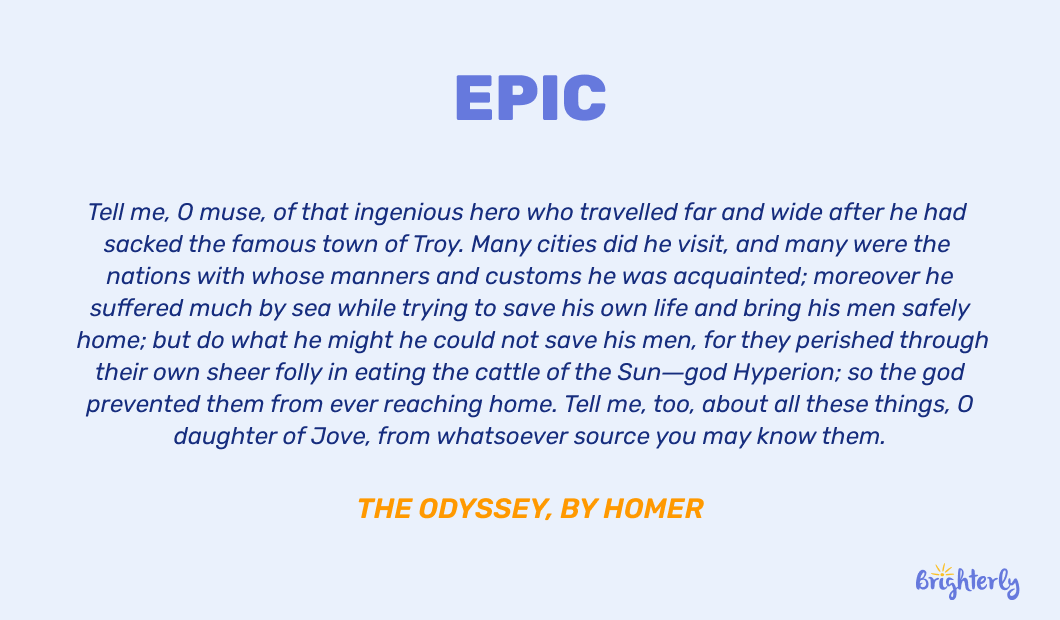
An epic is a very long narrative type of poem that tells the story of heroic deeds and brave adventures. Quite often, its legendary characters have some superhuman strengths or are mythical beings altogether.
Epics don’t have a specific rhyme rule, yet they’re characterized by their vast length and serious language. Sure, kids won’t write a full epic. Nevertheless, learning about it will help them understand world history and mythology.
Different types of poetry: How to help your child understand them better?
- Work with a professional tutor
- Use worksheets
- ‘Clap and tap’ rhythm check
- Mirror the mentor text
- Scaffold the ‘word bank’
Work with a professional tutor on poetic types
Best for: K-12 students striving to improve their reading fluency and become (more) confident in their reading & writing skills.
If your kid prefers 1-on-1 interaction with an instructor yet still needs to meet US state standards for their grade level, then working with an expert tutor is your option. Professional tutors help students resolve common reading challenges for kids related to complex text structures.
Reading tutors at Brighterly, for instance, provide online lessons on identifying story structures, analyzing key details, and understanding the author’s purpose. They may give your kid a direct instruction on how to use textual evidence, which is a necessary skill when practicing different types of poetry examples for kids.

The Brighterly reading program begins with an individual diagnostic test to find a student’s specific knowledge gaps. The curriculum includes vocabulary development and critical thinking exercises in particular. This program provides everything needed for a child to master various types of poetry in literature at home and teaches them how to deconstruct and create complex texts.
Use worksheets
Best for: Children who prefer self-paced learning, and parents who want to track their kids’ academic progress using standardized assessments.
As parents, you can also support your kids’ learning by using structured printed materials. Brighterly offers a collection of free resources for independent practice at home.
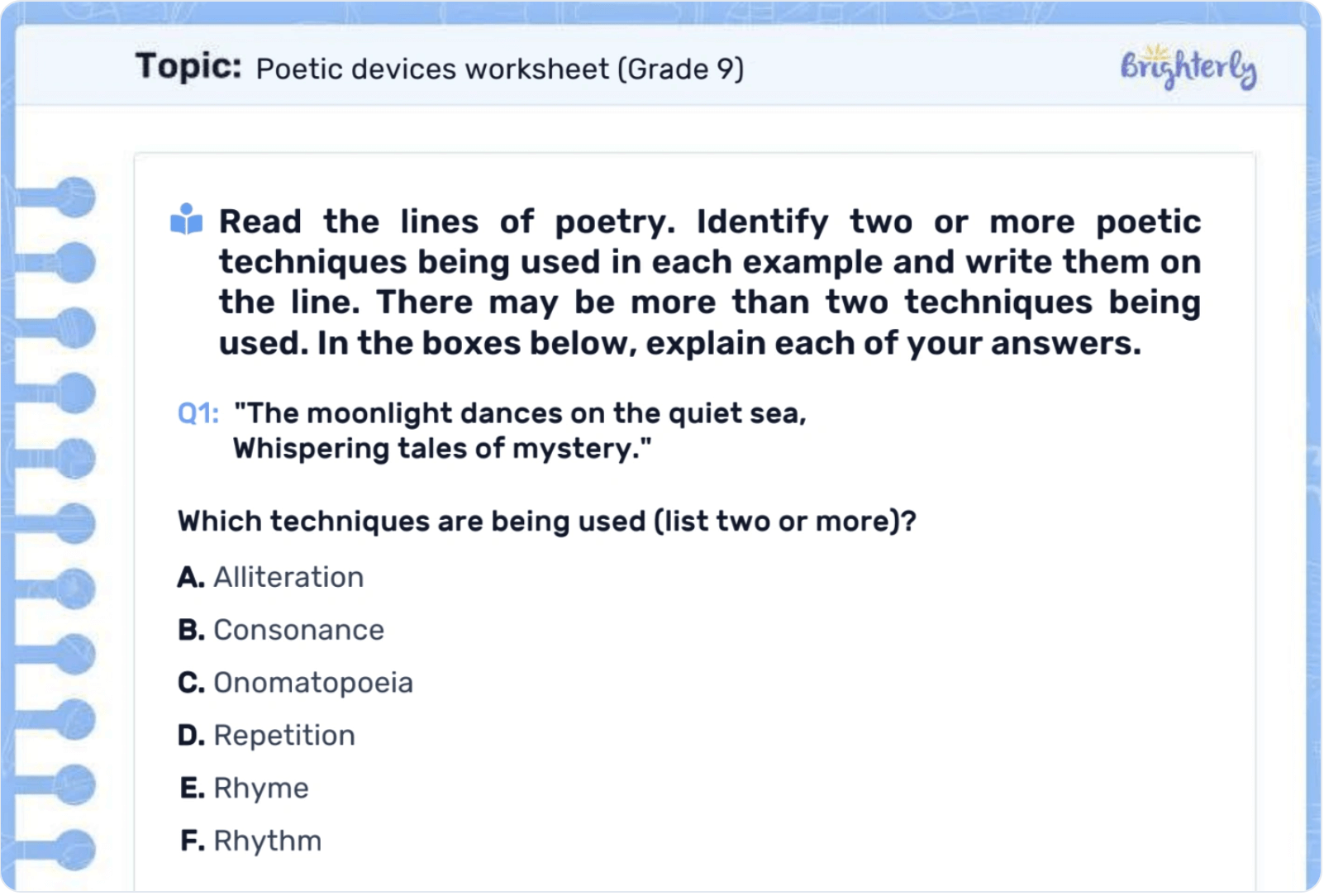
Before starting, you can use the reading tests developed for each grade level and identify exactly where your kid currently stands. These tests, in particular, help define if a student understands what are the different types of poetry and other literacy concepts required by the curriculum.
The reading worksheets themselves are also categorized by grade and topic, and are meant to provide repetitive practice to help students memorize the rules of various literary structures.
To start, feel free to check out these worksheets:
| Shakespeare Worksheets | Poetic Devices Worksheets | Figurative Language in Poetry Worksheets |
‘Clap and tap’ rhythm check of poetry types
Best for: Kinesthetic learners in grades 1-5 who prefer physical activity during study, as well as beginners in learning about syllable division and meter.
With a physical movement, kids can identify the syllable-based requirements of a poem. This technique involves clapping or tapping for every individual syllable to ensure the line matches the specific rules of the form.
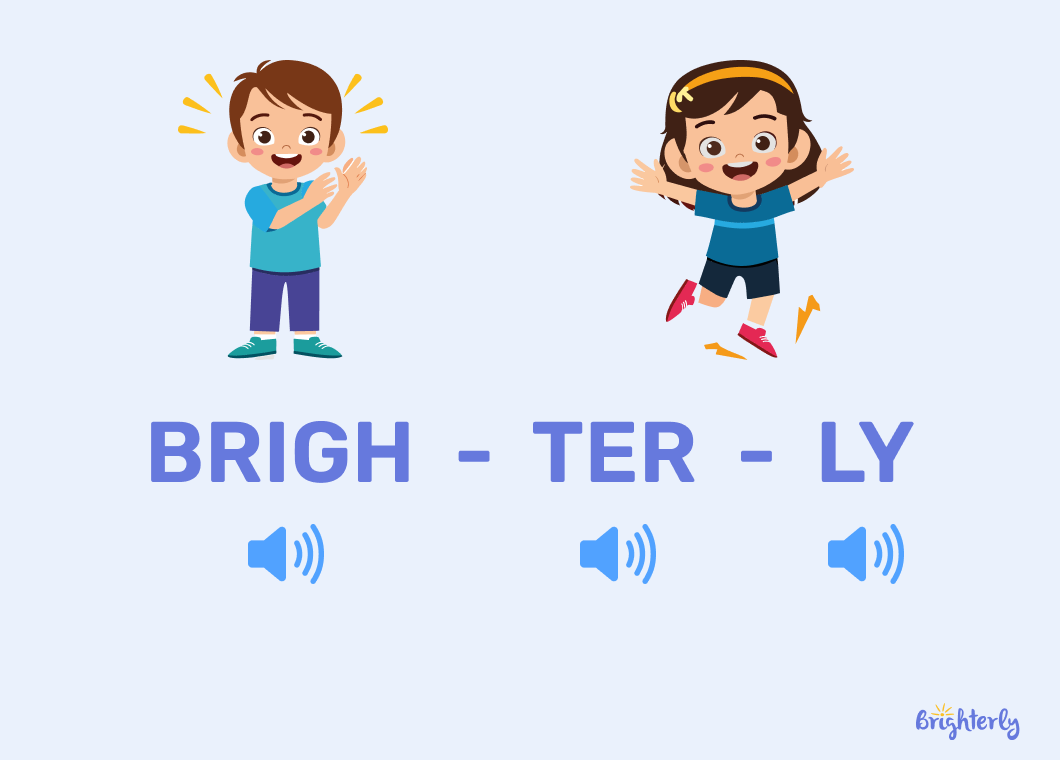
Have your kid read a line of text aloud and clap once for every individual sound or syllable they pronounce. In such a way, for instance, they’ll be able to verify the 5-7-5 syllable requirements of a Haiku or the 2-4-6-8-2 pattern of a Cinquain. Tapping a foot can also be used to mark the stressed sounds in a Ballad. This physical check helps children confirm that they are correctly following various poetry structure types.
Mirror the mentor text
Best for: 3-9 grade students with difficulties starting a poem from a blank page.
This method implies using an existing poem as a template for a new piece of writing. Kids keep the original structure (like, the number of lines and the syllable counts, etc.) but replace the original words with their own.
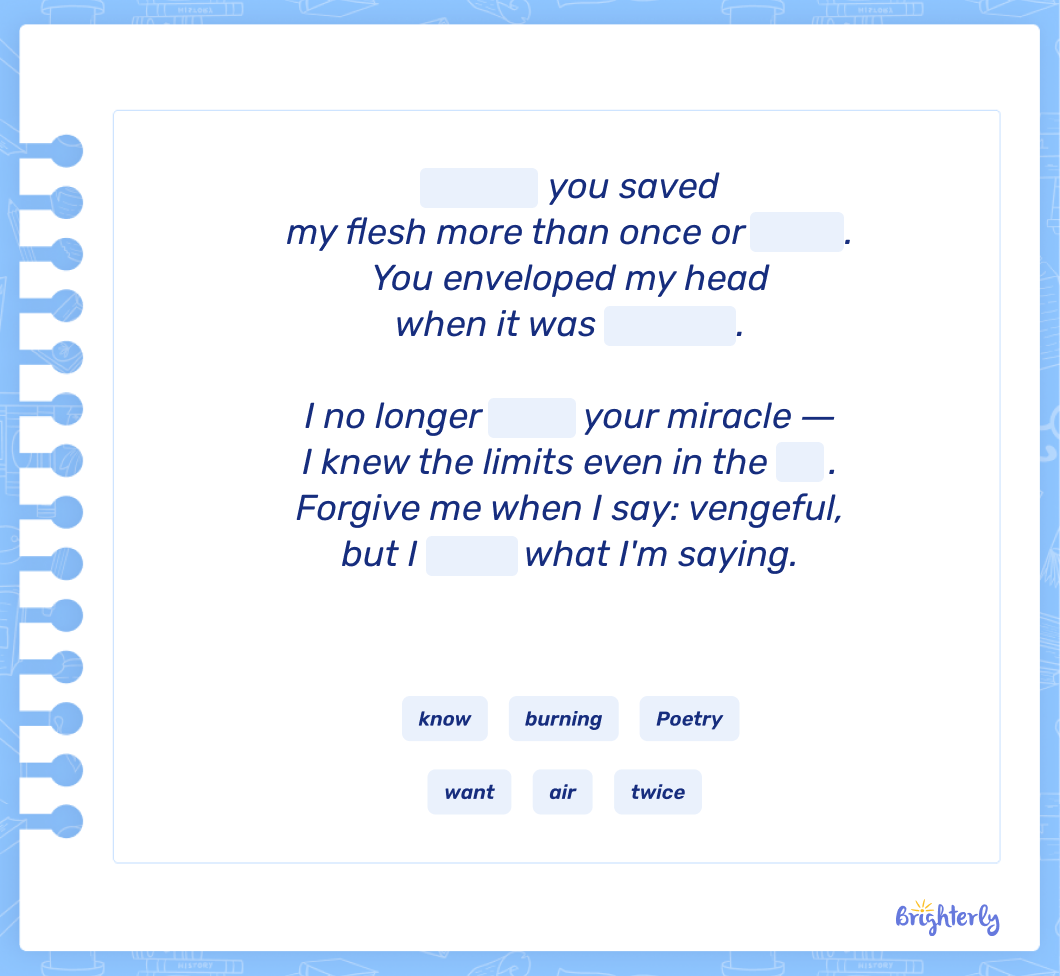
Let your kid browse different types of poetry for kids and choose a specific poem (Haiku, Cinquain, etc.) to serve as a guide. They analyze the specific requirements of the text and then substitute the nouns, verbs, and adjectives, yet maintaining the same arrangement.
With this practice of applying the same rules to their own vocabulary, students will soon recognize the patterns in all poetic forms.
Scaffold the ‘word bank’ for different poetry styles
Best for: Students in grades 1-6 with a limited vocabulary or those who find it difficult to find rhyming words.
This method entails pre-selecting specific words that fit the technical requirements of a chosen poem before the writing process begins. To compile the necessary components to build a poem, kids should first categorize words based on their syllable counts or their ending sounds.
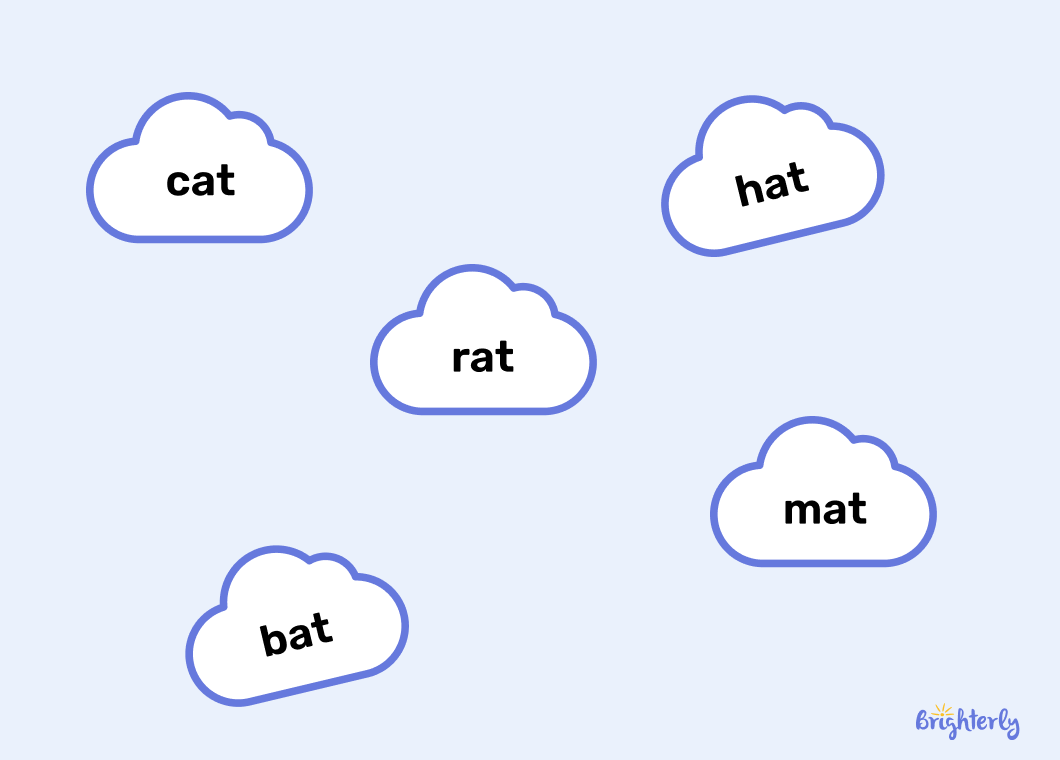
For various poetry types for kids, a student creates a list of words related to their chosen topic. For example, for a Haiku, they might list two-syllable and three-syllable words. For a Limerick or Rhyming poem, they would list groups of words that share the same final vowel and consonant sounds.
Creating such a ‘word bank’ first enables kids to focus on the technical placement of the words in order to meet the structural rules of the poem. BTW, compiling a visual ‘word bank’ for a new poem is one of the fun reading activities to try – check out for more.
Conclusion
Understanding what types of poetry are there is a fundamental part of the school literacy curriculum. By mastering the 15 distinct forms covered in this article, kids develop a stronger grasp of vocabulary, rhythm, and emotional expression. The covered home-practice techniques provide a decent path to it.
However, if your children require additional guidance and professional support, you can book free reading lesson at Brighterly and get a diagnostic assessment and 1-on-1 instruction adjusted to your child’s specific grade level and learning needs.


If you need a Chegg alternative, it means you might now want better support, more features for the price, or a simpler way to study instead of just getting fast answers. Be it AI help or a real professor to talk to that you’re seeking, this list of options should fit your specific needs and […]

Mar 06, 2026
Collecting thoughts and making them sound coherent in writing can already be hard enough for a student. That’s why grammar usually becomes the least of concerns and the text may end up filled with errors. Luckily, now we have digital solutions that help detect and fix different types of mistakes in a few clicks. Check […]

Mar 06, 2026
Math & reading from 1st to 9th grade
Looking for homework support for your child?

Choose kid's grade

Math & Reading for Grades 1–9
Build real confidence for your child with a Brighterly math or reading tutor.