20 Math Careers: Help Your Child See Why Math Matters for Their Future
reviewed by Florence Khitsane
Updated on April 7, 2026

Many parents don’t realize that their child’s strong number skills can actually open the door to dozens of different math careers. If your child enjoys working with numbers, notices patterns, and likes solving challenging problems, they may have a very bright future ahead. To help you understand the full potential of a student who is good at math, we’ve prepared a list of the top 20 high-paying math-related careers in the U.S.
Key Points
- According to the U.S. Bureau of Labor Statistics, demand for math-related careers in the United States is expected to grow over the next decade.
- Some of the highest-paying math careers today include: Actuary, Data Scientist, Mathematician, Statistician, and Operations Research Analyst.
- Children who enjoy math and other exact sciences may choose careers such as: Astrophysicist, Biostatistician, Climatologist.
- When math skills are combined with creativity, great career options include: Architect, Designer, Robotics Engineer, Urban Planner.
- If you are looking for a teacher who can help your child understand and enjoy math from an early age, individual tutoring with Brighterly is a great place to start.
What can you do with a mathematics degree?
A mathematics degree opens the door to careers in finance, IT, engineering, insurance, scientific research, and business intelligence, and in fact, anywhere that requires accurate calculations, logical thinking, and forecasting. Professionals with this background are highly valued because mathematics builds a strong foundation for problem-solving, analytical thinking, and the ability to work with complex information.
To succeed in these mathematician jobs, it helps to develop math skills from an early age. Moreover, your child can even learn math by simply playing in nature.
How Brighterly helps students get better at math?
Brighterly is an online platform that helps students in grades K-12 improve their math skills. Their math program is fully personalized: each lesson is one-on-one, with the teacher adjusting topics, assignments, and pace to fit the child’s level and needs. Lessons are interactive and engaging, with tasks, presentations, worksheets and animations that make math fun and easy to understand.

One of the biggest strengths of the program is the Brighterly tutors. These are highly qualified teachers who know how to work with children of different ages and skill levels. You can see reviews of our tutors to learn more about their experience and teaching style before choosing the right instructor for your child.


Want your child to have a bright future in math?
Brighterly’s tutors help children learn every math topic in an engaging way.
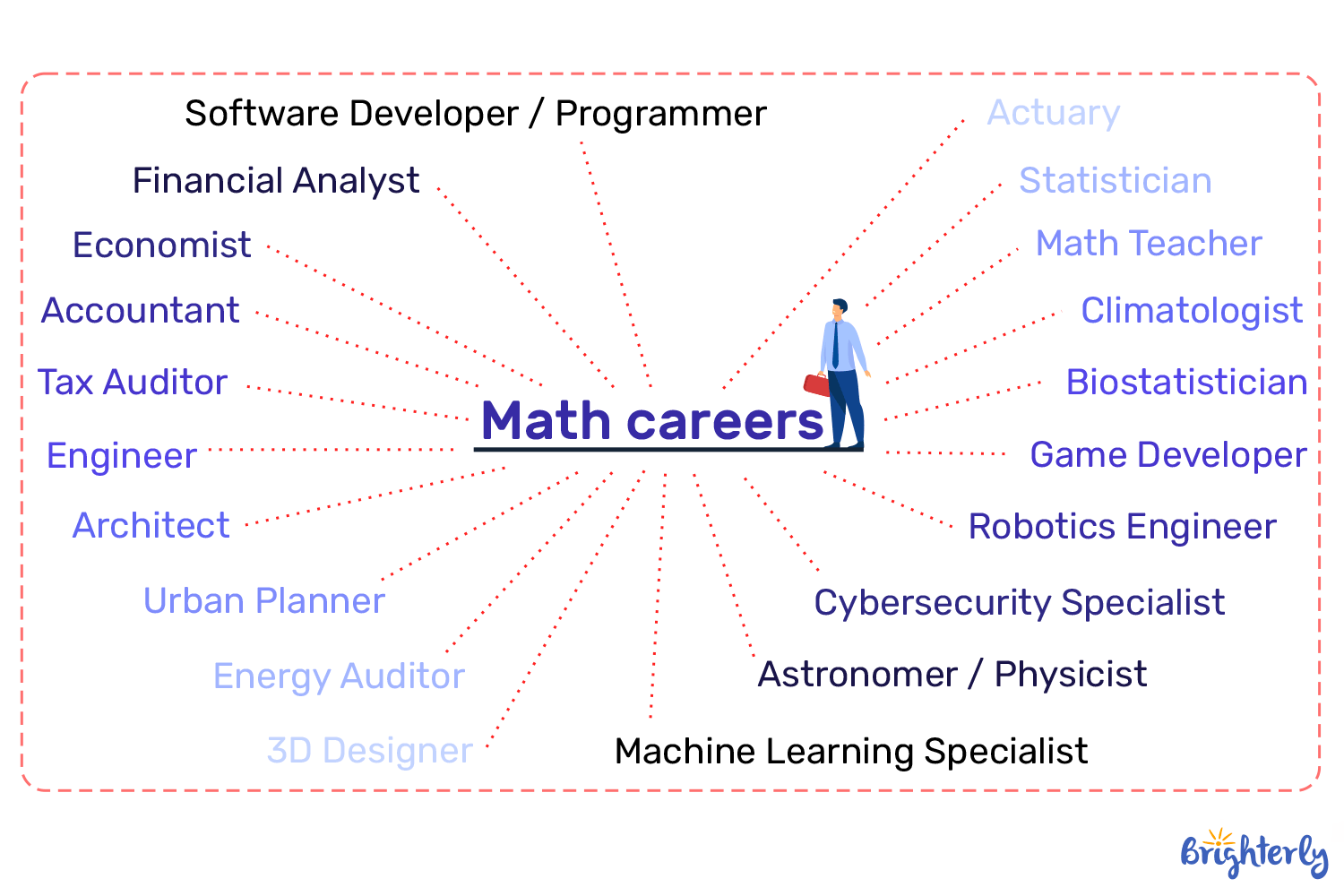
20 Careers in math your child can pursue with strong math skills
- Actuary
- Financial Analyst
- Economist
- Accountant
- Tax Auditor
- Engineer
- Architect
- Urban Planner
- Energy Auditor
- 3D Designer
- Robotics Engineer
- Software Developer / Programmer
- Machine Learning Specialist
- Game Developer
- Cybersecurity Specialist
- Astronomer / Physicist
- Statistician
- Biostatistician
- Climatologist
- Math Teacher
Finance & Economics domain
Actuary
An actuary is a specialist who evaluates financial risks. Simply put, these professionals use math to calculate future costs for companies. They rely on statistics and probability to determine insurance rates, pension plans, and financial reserves.
For example, an insurance company needs to decide how much an insurance policy should cost. An actuary analyzes data from previous years to estimate how many clients may get sick, have accidents, or file insurance claims. Based on these calculations, the company sets the price of the policy and understands how much it may earn or lose.
Financial Analyst
Financial Analyst is another one of the jobs that use math, where strong numerical skills are essential. These specialists can work in large investment funds as well as in companies from almost any industry. Their main job is to manage a company’s finances and analyze where to invest money to increase profits or avoid losses. To make accurate predictions, financial analysts study company reports, financial data, and statistics to understand current performance and plan future decisions.
Economist
An Economist has duties similar to a Financial Analyst, but the difference is in the scale of the work. A financial analyst usually studies the finances of one company, while an economist looks at the economy on a larger level, often a whole country or even the world.
They study markets and economic trends to understand why currencies change, why prices rise, and how inflation can be reduced. In addition, specialists may calculate how new taxes will affect businesses or what will happen to the economy if energy prices increase. In this profession, math is used everywhere.
Note: Economists can work in banks, government institutions, international organizations, or large companies.
Accountant
What to do with a math degree? One option is to become an Accountant. An Accountant is a specialist who manages a company’s financial records. They track income and expenses, calculate salaries, prepare tax reports, and keep financial documents in order. Accountants also need to understand tax laws to make sure the company pays taxes correctly and avoids penalties.
Tax Auditor
Now, let’s look at another side of financial careers. Some professionals help companies make money, while others make sure everything is done legally and taxes are paid correctly. This is the role of a Tax Auditor. They review financial reports prepared by accountants and check that a company calculates taxes correctly and does not hide income.
Brighterly’s tutors teach children attention to numbers and respect for math.
Want your child to succeed in a math career?
Engineering and Design
Engineer
Careers for math majors include becoming an Engineer. These specialists are creators of the material world, from airplanes and ships to bridges and skyscrapers. All of this is possible thanks to precise mathematical calculations. To make constructions safe, engineers use knowledge of physics, math, and technical drawings to calculate loads, dimensions, material costs, and the structure’s capabilities. Math is needed at every step.
Architect
Unlike engineers, architects focus more on buildings. But this is not just a math profession – it’s also creative. Architects think about facades, floor plans, comfort, aesthetics, and natural light. Their work is about creating beauty. If your child is good with numbers and has a big imagination, this is a perfect and rewarding career.
Urban Planner
Another creative math career in jobs that require math is Urban Planning. These professionals design our cities, deciding where to place neighborhoods, hospitals, parks, and schools. Basically, all the planning is on their shoulders. To make a project work, they must calculate everything carefully so that people can live comfortably and enjoyably in their city.
Energy Auditor
Energy Auditors fight energy waste. They analyze how buildings or facilities consume energy, identify sources of loss, and help improve energy usage through optimization with mathematical calculations.
3D Designer
A 3D Designer is a digital sculptor. Using geometry and visualization algorithms, they create photorealistic 3D models and animations for movies, games, and architectural projects. Designers work with textures, lighting, and proportions to bring their creations to life.
Robotics Engineer
One of the most exciting math degree jobs is Robotics Engineer, a specialist who creates smart machines. In real work, they design the mechanics, electronics, and software for all kinds of robots. For example, when building a robot vacuum, they calculate how the motors will move, what sensors are needed to avoid furniture, and how the software will control its movements.
IT and Technology
Software Developer / Programmer
A Software Developer or Programmer creates computer programs, apps, and websites. They turn ideas into code so computers can perform specific tasks and help people. For example, when building a food delivery app, a programmer writes code that lets users quickly choose a meal, pay, and receive an order confirmation.
Machine Learning Specialist
A Machine Learning Specialist is like a coach for Artificial Intelligence. They create algorithms and provide data, helping AI get smarter over time. For everyday users, this means machine learning can already recognize faces in photos, translate languages, or even save lives in medicine.
Game Developer
The name says it all. A Game Developer is one of the exciting math major jobs that creates video games played by millions worldwide. Behind every thrilling story lies a lot of math, logic, and precise calculations. The developer makes characters move realistically, ensures objects follow the laws of physics, and keeps the game running smoothly. They calculate things like character speed, jump force, flight trajectories, and much more.
Cybersecurity Specialist
Their main job is to protect websites, apps, and company data from hackers. To keep criminals from stealing money or personal information, they use math-based codes and encryption to secure systems. They also monitor suspicious activity and test systems for weak points to prevent attacks.
Education and Research
Astronomer / Physicist
In science careers, a strong math background can help you or your child become a true trailblazer – a physicist or astronomer. Someone like a colleague of Stephen Hawking, Albert Einstein, or Isaac Newton. They study the universe and how it works. A physicist’s daily work includes research in labs, universities, and tackling a wide range of calculations.
Statistician
A statistician is a professional in math-related jobs who translates the language of numbers. They work with all kinds of data, spotting patterns in large datasets and drawing conclusions. They collect data from areas ranging from sports to politics and help us understand hidden trends in everyday life through numbers.
Biostatistician
A biostatistician is one of the most responsible types of statisticians. They work in medicine and science, calculating everything that affects human health. They track disease outbreaks, study factors that influence well-being, and collect data during clinical trials for new drugs. Biostatisticians can work in pharmaceutical companies, health organizations, research institutes, and hospitals.
Climatologist
A climatologist is like a detective of weather changes. This is one of the most fascinating mathematics degree jobs, especially for students interested in nature and data. They collect data from satellites and weather stations, study the atmosphere, oceans, and glaciers, and then use mathematical modeling to make predictions for the future, such as what might happen to the Earth in 10, 20, or 50 years.
Math Teacher
Of course, a student with strong math skills can become a math teacher. If a child loves numbers, they can inspire others to explore one of the most important subjects in life. They can teach everyone from elementary school to graduate school students. The key is to explain concepts clearly and show how numbers work in real life. A great math teacher can help shape the next generation of scientists, engineers, financiers, and IT specialists!
What are the highest-paying jobs with a math degree?
According to the latest data from the U.S. Bureau of Labor Statistics, some of the highest-paying math careers in the U.S. include: Actuary, Data Scientist, Mathematician and Statistician, Operations Research Analyst (data for 2024).
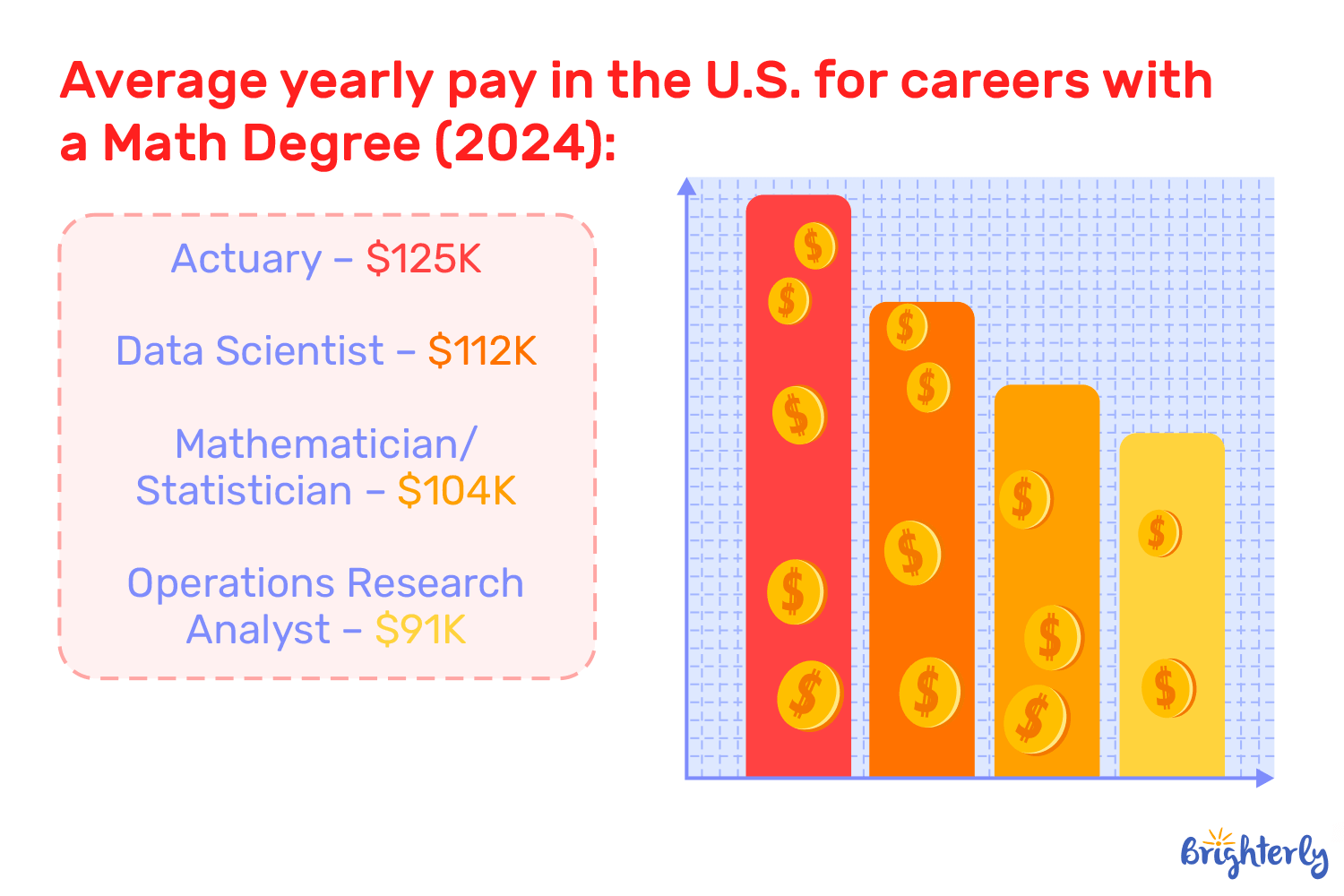
It’s important to remember that these are average salaries, they can be higher or lower depending on skills, experience, and location. Other jobs that involve math can also pay very well, but they often require advanced degrees. For example, an Astrophysicist can earn $165K+ per year, but a doctoral degree is usually required.
Salary and job outlook (2026)
| Profession | Average annual salary in the U.S | Required degree |
| Actuary | $125,770 | Bachelor’s degree |
| Data Scientist / ML Specialist | $112,590 | Bachelor’s degree |
| Software Developer / Programmer | $131,450 | Bachelor’s degree |
| Economist | $115,440 | Master’s degree |
| Statistician | $104,350 | Master’s degree |
| Accountant / Auditor | $81,680 | Bachelor’s degree |
| Math Teacher (High School) | $64,580 | Bachelor’s degree |
| Physicist / Astronomer | $166,290 | Doctoral or professional degree |
| Civil Engineer | $99.500 | Bachelor’s degree |
| Architect | $96 690 | Bachelor’s degree |
| Financial Analyst | $101,910 | Bachelor’s degree |
| Cybersecurity Specialist | $124,910 | Bachelor’s degree |
| Urban Planner | $83,720 | Master’s degree |
| Tax Auditor | $59,740 | Bachelor’s degree |
| Climatologist | $97,450 | Bachelor’s degree |
| Robotics Engineer | $81,507–$130,000 (inf. for 2026) | Bachelor’s degree |
| Game Developer | ~$120,978 (inf. for 2026) | Bachelor’s degree |
| Energy Auditor / Energy Engineer | ~$100,000 (2026) | Bachelor’s degree |
| 3D Designer | ~$97,000 (2026) | Bachelor’s degree |
Conclusion: Is math a good career choice for your child?
Mathematicians are highly sought after in today’s job market. They don’t just work with numbers – they can make a real impact on the world. Mathematicians might create algorithms that power artificial intelligence, helping millions solve complex problems. They could build climate models that warn us about global changes, or take on countless other important roles. Of course, your children might also choose one of the completely different career pathes.
According to the U.S. Bureau of Labor Statistics, the demand for analytical thinkers will continue to grow over the next decade, and STEM careers in math will expand. That’s why it’s so valuable to nurture your child’s interest in math from an early age. If you’re looking for teachers who can help your child understand and love math, check out Brighterly’s math classes.
FAQ
How can math majors stand out to employers?
A strong background in actuarial science can give you a real advantage, but what will truly help you stand out is the ability to use your knowledge in practice. Internships and real projects in data analysis and risk management show employers that you can solve real problems, not just study theory. Programming skills in tools like Python, R, or SQL are another big plus, since modern math careers rely heavily on technology. Good communication, analytical thinking, and professional certifications also make a candidate stronger and better prepared for competitive roles.
What are the top 5 math careers?
In the U.S. job market, some of the top math careers today include Actuary, Data scientist, Statistician, Operations research analyst, and Mathematician/Applied Mathematician. These professions are in high demand because they combine strong quantitative skills with real business and technology needs. According to the U.S. Bureau of Labor Statistics, math occupations offer higher-than-average salaries and are expected to grow faster than most other fields over the next decade.
What math careers make $100,000 a year?
Professionals in fields like Actuarial science, Data science, Financial analysis, Software development, and Statistics can reach six-figure salaries after gaining experience or earning advanced degrees. Math-related jobs are among the best-paid because companies rely on experts who can work with data, predict risks, and make accurate decisions.



Daily movement, even in short bursts, is healthy for every child, but it’s vital for children with ADHD. Your kid can’t sit still, stay focused, and can’t make them complete homework tasks? Is their behavior impulsive and their frustration tolerance low? Let’s explore how ADHD and exercise are connected, and then choose the best exercises […]

Apr 05, 2026

When a child struggles to read, parents start searching for additional apps, programs, and learning platforms to help. They also look through tons of user reviews to understand what the experience is like. This guide is to help you sort through the noise in Reading.com reviews and analyze the platform to provide an unbiased overview […]

Apr 07, 2026
Math & reading from 1st to 9th grade
Looking for homework support for your child?

Choose kid's grade

Math & Reading for Grades 1–9
Build real confidence for your child with a Brighterly math or reading tutor.