What Is ELA and Why Is It Important for All Students?
reviewed by Laila A. Lico
Updated on March 1, 2026

English Language Arts, or ELA, is a crucially important academic subject taught throughout school. In this article, I’ll define what is ELA in simple terms, highlight the common benefits of this class, and show you why it’s worth putting effort into helping your child master ELA.
Key points
- ELA is a school subject that teaches how to use English in an academic setting.
- The core principles of ELA include reading, writing, communication, collaboration, and creativity.
- 1:1, individualized tutoring, like the Brighterly reading program, offers an efficient way to help your child develop necessary ELA skills to perform well at school and in life.
What is ELA?
ELA is a core academic subject in the United States education system. It is taught independently in elementary and middle school and is also studied in high school, usually integrated with other subjects. The ELA school meaning covers the learning and usage of the English language in an academic environment. It is crucially important for students’ success in other subjects as it builds primary language skills.
Kathryn Starke, National Literacy Consultant and Founder of Creative Minds Publications, explains why ELA is not just reading as many parents think.
“ELA is the school-based definition of language arts, which includes everything literacy.”


So, related to this, “What is an ELA teacher?”
The ELA teacher meaning refers to a qualified educator who specializes in the English Language Arts and is an expert on teaching vocabulary, grammar, reading, writing, and communication to students. They usually work within specific grade levels.
What does ELA stand for in education?
ELA stands for English Language Arts in the United States academic system. The abbreviation is official and is widely used within the US school domain.
Typically, the English Language Arts has five strands, or evaluation standards, listed below.
What do you learn in ELA?
Reading
Reading is the first basic skill that the study of ELA subjects at school develops. Students need to be able to read different types of texts in order to comprehend and learn new information and communicate effectively in the classroom and outside of it.

During ELA classes, children learn not only how to increase reading speed (to absorb new facts faster) but also how to boost reading comprehension (to extract more knowledge from texts). This is done through the teaching and practical application of various strategies, such as skimming, scanning, building sight word vocabulary, and reading daily.
Without solidifying reading capabilities, you cannot move forward with the other ELA strands.
Writing
Building writing skills is the second of the nationwide ELA goals in the US. Children need to learn how to structure their ideas and express them clearly, fluently, and eloquently in written form in order to be able to communicate effectively. While writing is learnt at school, it’s a lifelong skill that determines success in higher education and at work too.

In the ELA school subject, students work on both grammar and vocabulary. They learn how to put their ideas into words, develop coherent written messages, and write different genres. They need to practice writing daily for the acquisition of much needed lifelong skills.
Kathryn Starke explains that writing exercises to support ELA skills can go beyond the classroom.
“Modeling writing is a great way to support writing at home.”
Communication
The third strand on which ELA in school works is communication. The ultimate goal of studying this subject is to build effective communication skills that will serve you both at school and beyond – in your personal and professional life. Being able to communicate your ideas coherently is key to success in all academic subjects and all areas of life.
ELA classes teach communication skills to students through active and tentative listening, speaking, presenting, and writing exercises. Communication abilities are developed both during individual work and group projects that require coordination among group members.
Kathryn Starke also offers practical recommendations on how parents can support relevant skills at home.
“When families have conversations about the world, daily life, and books, vocabulary is increased as is background knowledge and comprehension.””
Collaboration
To answer the question “What is an ELA?” comprehensively, we have to consider the fourth aspect of the subject – collaboration. In particular, through learning and using English, children become accustomed to working with others, whether classmates, teachers, tutors, or even parents. That’s how they put the foundations of teamwork, which plays a key role in all future endeavors.

ELA helps develop cooperation skills when kids work in groups, speak in pairs, or review each other’s work. The class provides the grounds for lots of peer interactions.
Creativity
The fifth ELA class meaning is to enhance students’ creativity and imagination. These skills are highly valued in today’s world of continuous innovation and the necessity to think differently.

Reading is important in this regard as exposure to different texts, writing styles, and made-up stories helps children develop their imagination as they try to create pictures of characters and settings in their brains. Another way in which ELA supports creativity is through creative writing where students can train their imagination to come up with new realities.
The combination of these five strands forms the basis of ELA in education.
What is ELA in Brighterly school?
The Brighterly math and reading platform teaches ELA as an integrated subject that helps K-12 students develop crucial English language-related skills. This is done through 1:1, real-time, personalized ELA tutoring that focuses on the individual needs of each child.
Each Brighterly online ELA tutor is a professional ELA teacher who’s also a trained pedagogue. They use customized teaching methods and adaptive reading and writing materials. The Brighterly award-winning curriculum follows the US state standards to ensure compliance with the nationwide and local learning requirements.
The video below explains more about the Brighterly ELA program.
Core areas covered by Brighterly ELA program
- Reading and comprehension
- Writing (language application)
- Speaking and listening
- Language strand
Key features of the Brighterly ELA tutoring
Individualized learning
The Brighterly ELA program develops a tailored approach to how to get better at ELA for each student. This starts with a thorough evaluation of your kid’s strengths, weaknesses, knowledge, and gaps.
Then, the best-matching tutor works out a custom learning plan with your help. All materials are selected to meet your child’s level and preferences. After all, effective learning is not only academically solid but also engaging and exciting.
Qualified, supportive tutors
Every Brighterly teacher meets the requirements of an excellent ELA tutor meaning. But what is ELA tutor in the Brighterly context?
Brighterly ELA tutors are professional teachers with 5+ years of experience in the subject. Their pedagogy training helps them work with different types of learners, even those with learning difficulties.
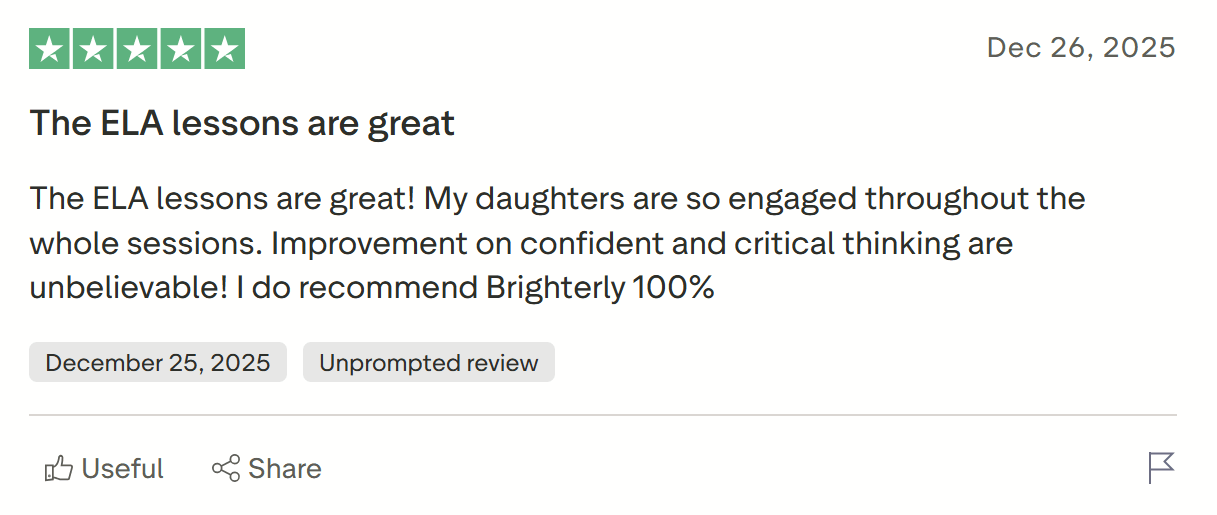
Moreover, during the vetting process, Brighterly ensures that all ELA tutors have outstanding personal skills. Reviews on Trustpilot show that lessons are interesting and effective.
Free resources to complement learning
Brighterly provides access to reading and writing worksheets for free. These ELA resources for students are designed by qualified educators and are organized by grade level and topic. You can use them with 1:1 tutoring or independently to support your child’s ELA learning outside the classroom. To get started, you can assign your kid free reading tests to check their current level.
Brighterly pricing starts at $17.30/lesson, with a 12-month plan and a 20% discount.


ELA facts
- As a core subject, ELA is studied in all school grades in the US education system, from PreK to 12th grade.
- Both national and state standards specify what students learn in ELA classes.
- The development of adequate ELA skills supports academic success across all other subjects, such as social studies, science, and even computers.
- According to data from the National Center for Education Statistics (NCES), in 2025, 35% of 12th graders were at or above a proficiency reading level, while 32% were below basic reading proficiency.
- The average American reads at a 7th-8th grade level, and 54% of adults in the US read below 6th grade. Meanwhile, 21% are functionally illiterate.
What is ELA in elementary school?
ELA class for elementary school emphasizes the early development of simple reading, writing, and communication skills. This helps build the foundation for English language learning and more advanced abilities later at school.

What is Language Arts in elementary school teaching? Topics covered
- Introduction to reading, writing, and communication
- Prolonged silent reading
- Simple text comprehension
- Vocabulary growth
- Basic grammar and syntax
- Oral language development
- Literary skills foundation
What is ELA in middle school?
In middle school, ELA students focus on the development of advanced literacy skills that include all five evaluation standards listed above. One of the most important facts about ELA at this stage of education is that the subject is still taught independently, as a separate class.

What is an ELA class for middle school students? Topics and learning objectives
- Advanced reading comprehension
- Literary analysis of longer, more complicated texts on different topics
- Understanding diverse literature genres
- How to write both analytical and creative pieces
- Finding your own writing style and voice
- Development of research skills
- Integration of research findings in written and verbal communication
- Effective communication in various academic and non-academic settings
What is ELA in high school?
ELA for high school means that the subject is integrated with other classes, such as history or even science. This aims to support the application of language arts-specific skills across different academic subjects and prepare students for real life, where English is rarely used on its own, unless you become a writer.

What is ELA in education program at high school?
- Advanced literary comprehension and interpretation
- Argumentative writing
- Academic writing on various grade-appropriate subjects
- Understanding different literature genres and their meaning
- Learning about and appreciating diverse cultures and perspectives
- Development of college and career-ready skills
Why is ELA important?
- Supports academic success across all subjects
- Builds strong, effective communicators
- Enhances critical thinking and analysis
- Prepares students for life after school
Supports academic success across all subjects
First and foremost, the English Language Arts goal at school is to develop crucial skills that students need to succeed in all academic subjects. You need to use English efficiently to read quickly, understand deeply and comprehensively, write convincingly, and communicate effectively to score excellent grades in math, science, history, social studies, and all other core and elective disciplines.
Builds strong, effective communicators
I cannot emphasize enough how crucial ELA classes are for establishing communication skills, including both verbal and written communication. An ELA tutor can really help students learn how to organize their thoughts and present their ideas in the most efficacious manner. Needless to say, being able to communicate is of indispensable importance both at school and for the rest of your life.

Enhances critical thinking and analysis
Through literary analysis and delving into different genres and texts, students grow and expand their abilities to think critically and analyze various texts and situations. Creativity and critical thinking are some of the most valuable skills in the 21st century, where innovation and thinking outside the box are needed in any college specialization and career.
Prepares students for life after school
Finally, learning ELA helps children not only succeed at school but also beyond. Good reading, effective writing, strong communication, real collaboration, and outstanding creativity are in demand in all college disciplines and jobs.

ELA subject and its significance: Conclusion
Now you know what is ELA in school and why it is so important. As a core academic subject, ELA helps your child learn how to read, write, communicate, collaborate with peers, and be creative not only to cover the school requirements but to gain real-life skills. If your child needs some extra help, you can try the Brighterly ELA tutoring program.
What you get with the Brighterly ELA program:
✅ Tailor-made ELA tutoring aligned with the US state standards
✅ Interactive 1:1 tutoring sessions with professional teachers
✅ Customized reading and writing learning materials matching your kid’s level and interests
Ready to help your child boost their ELA skills? Book 1st free lesson today to test if Brighterly is the right ELA program for your family.


Summer is lots of fun, but things are getting busy as autumn is approaching. Now is the right time to start hunting for the best homeschool reading curriculum, and I’m here to help you make the right decision! While working with kids for the last 10 years, I paid scrupulous attention to what they expect […]

Aug 13, 2025
If you have enrolled your child in ABCmouse but find that it’s not improving their learning, you might be looking for information on how to cancel ABCmouse subscription. As a tutor with years of experience in improving children’s grades and confidence, I want to help you ensure your child gets the best learning experience possible. […]

Aug 14, 2025
Math & reading from 1st to 9th grade
Looking for homework support for your child?

Choose kid's grade

Math & Reading for Grades 1–9
Build real confidence for your child with a Brighterly math or reading tutor.




![IXL Cost: Breaking Down the Membership Fees [2025]](https://brighterly.com/wp-content/uploads/2025/05/How-much-does-IXL-cost-360x200.png)