Writing Statistics 2026: Latest Data on Writing Skills and Education
reviewed by Marvi M. Andres
Updated on January 26, 2026

Learning issues are usually obvious long before they start reflecting in the grades. And from my time helping students as a tutor, I’ve seen writing being one of the toughest things to get good at for the kids. The newest writing statistics for recent years really put that into a clearer view and explain how teaching writing is changing.
Key stats
- 21% of adults in the United States can barely read or write.
- 31% dip in English Language Arts learning happened due to the COVID-19 pandemic.
- $2.2 trillion is how much the inability of people to write and read costs the US economy.
- Learning and practicing writing with Brighterly tutors can significantly improve child’s literacy level.
What are statistics in writing in the US?
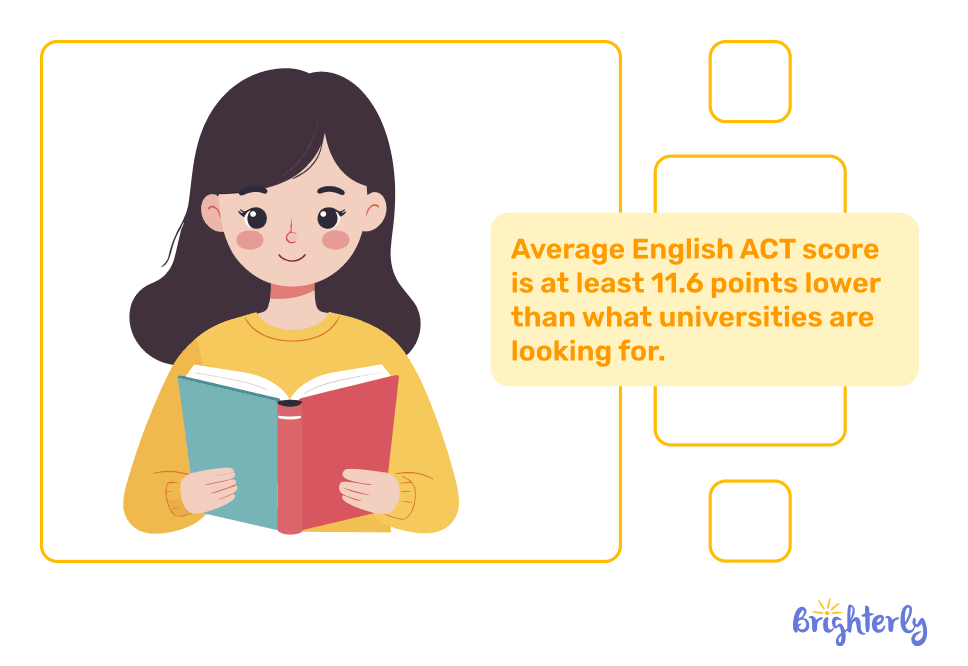
If we look at the current statistics about writing in the US, it’s kind of alarming. The 2025 ACT National Profile says the average English score is down to 18.4. That is when a competitive score is considered to be in the 20s, although universities are looking for scores above 30.
You may wonder what percentage of Americans can’t read and write? Diving into the numbers, it turns out the reading and writing skills of more than half of adults, 54% to be exact, don’t come up to even 6th grade level according to data for 2024. Perhaps most concerning is that nearly 21% of the adult population is considered illiterate, which means these adults have trouble putting their ideas together in writing or even using basic grammar.
Sadly, just like with reading statistics, things seem to look even worse for the future due to the effect of the global COVID-19 pandemic. The lockdown has disrupted the school system, which resulted in English and Language Arts skills dropping around 31%.
How Brighterly helps kids improve reading and writing skills
Brighterly online writing classes and an English Language Arts program use statistical data to find a student’s central tendency in learning. By collecting data on how students solve problems, tutors can use statistics about writing performance to tailor the learning paths to each kid.
Writing isn’t just about getting your grammar right. It’s about how your ideas flow together logically. Writing and reading tutors at Brighterly assist kids to confidently get their thoughts across. They do this by taking big, scary assignments and breaking them down into smaller, easier pieces. By looking at how fast and how well a kid writes, the coaches can figure out the kid’s writing rate and the specific spots where more attention is needed.


What are the writing statistics by state?
Writing skills are all over the map in the US. Some states are doing great with reading and writing, while others aren’t moving forward much. Also, states that have good early help programs and support students with special needs through writing IEP goals also tend to see bigger jumps in writing skills.
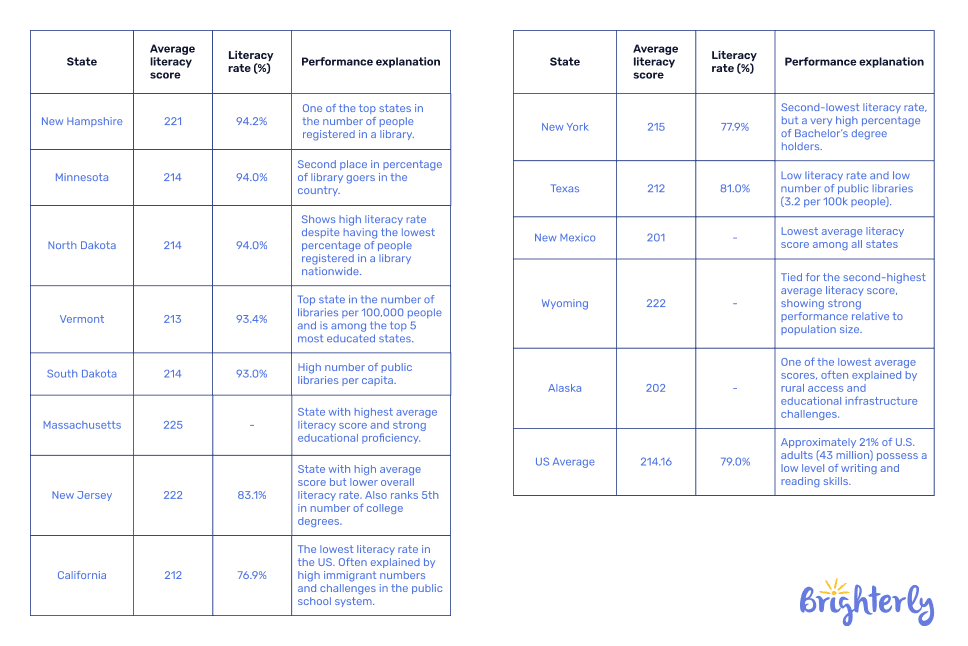
Source: World Population Review
Writing statistics in the US by year
- Writing statistics in the US 2020
- Writing statistics in the US 2021
- Writing statistics in the US 2022
- Writing statistics in the US 2023
- Writing statistics in the US 2024-2026
Writing statistics in the US 2020
The 2024 ACT National Profile shows that the average English score dropped to 19.9 in 2020. This is down from 20.2-20.1 in 2018-2019. The main reason for this drop seems to be the lack of in-person teaching. Talking to teachers is key to learning. And not only when it comes to trying to understand complex grammar rules. It also teaches students to communicate and build arguments. Statistics also support this: students who did well had much more access to their teachers than those who didn’t get as much personal attention.
Writing statistics in the US 2021
In 2021, it felt like things were stuck. Switching to hybrid or online classes didn’t do much to help students figure out how to get better at writing. Without enough help from teachers, it’s no surprise that the national ACT English score dropped to 19.6.
Writing statistics in the US 2022
This year just brought the already existing learning struggles of recent years into the spotlight. ACT English kept falling and ended up at 19.0, showing students weren’t as ready for college writing as they should be. Reports also showed that reading and math scores for 9-year-olds had their worst drop in decades this year, down by 5 and 7 points, respectively.
Writing statistics in the US 2023
This year, the ACT English score kept descending, landing at 18.6. Also, more than 65% of the 2023 graduating students taking the test did not hit the necessary score for English Language Arts.
Writing statistics in the US 2024-2026
In 2024, US literacy scores continued a chain of declines that began before the pandemic. According to reliable data in the NAEP report, the average scores for 4th and 8th graders dropped by 2 points since 2022. To add to that, about 40% of 4th graders and a third of 8th graders were struggling with basic reading skills. It’s the lowest we’ve ever seen for both groups.
Writing statistics in the US by age
According to child literacy statistics United States and recent adult literacy level data, a huge number of people in the US actually struggle with everyday tasks of writing and reading.
Age group |
Key statistic |
Proficiency detail |
| Children (4th Grade) | 34% | Reading/writing level is below basic. |
| Children (8th Grade) | 27% | Reading/writing level is below basic. |
| Young adults (16–21) | 50% | Of those unemployed in this bracket, half are not “functionally literate.” |
| Adults (16–74) | 54% | Approximately 130 million people read below a 6th grade level. |
| All adults (General) | 28% | Scored at or below Level 1 (struggles with everyday reading/writing). |
| All adults (General) | 29% | Scored at Level 2 (basic proficiency; struggle with complex text). |
| All adults (General) | 44% | Scored at Level 3 or above (strong reading/comprehension skills). |
Writing statistics in America by race
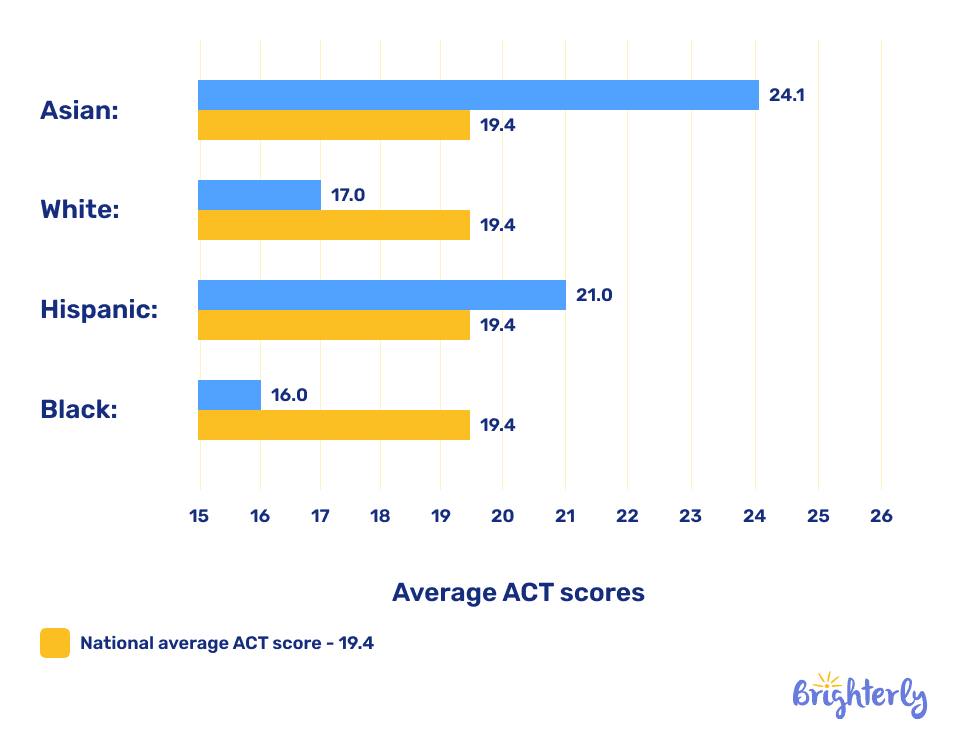
The US writing statistics show some pretty big differences in how educational resources are spread around. The average ACT scores for 2024 illustrate that Asian and White students frequently score higher on parametric tests than Black and Hispanic students. Keeping in mind that the national average composite score was 19.4, here are the average results by race:
8 facts about writing rates in the US
- Only 26% of students can be considered good writers (proficiency level).
- In 2024, women scored 0.2 points higher than men on the ACT.
- Only 30% of teachers believe the current curriculum does a good job of fixing the writing skills gap.
- Only about 25% of middle-schoolers and 31% of high schoolers spent half an hour per day on writing
- Internet use in high-income countries is at 93%, which makes an argument in favor of technology being a huge factor in writing success.
- Low literacy levels lead to a $2.2 trillion loss per year for the US economy.
- Those with literacy skills at or below Level 1 are over 4 times more likely to live in poverty.
- Digital writing has been found to be one of the factors to increase motivation, professional activities, higher-order thinking, creative collaboration, and cognitive load.
Global writing statistics
Let’s have a quick look at how global literacy stands right now. The table shows how reading and writing skills are changing across age groups and regions. UNESCO data from 2025 shows that while literacy has gotten way better in the past half-century, learning to communicate online is a fresh challenge for people everywhere.
Category |
Statistic |
Context |
| Global youth writing rate | 93% | People aged 15–24 who can read and write. |
| Global adult writing rate | 87% | The percentage of the population aged 15+ who are literate. |
| Total population lacking skills | 739 million | One out of ten youth and adults still lacks basic literacy skills. |
| Gender inequality | 63% | Women make up the majority of those who cannot read or write. |
| Primary school proficiency | 58% | Children reaching the end of primary school who meet literacy benchmarks. |
| Digital writing access | 27% | Internet usage rate in low-income countries for digital communication. |
What percentage of people worldwide can’t write?
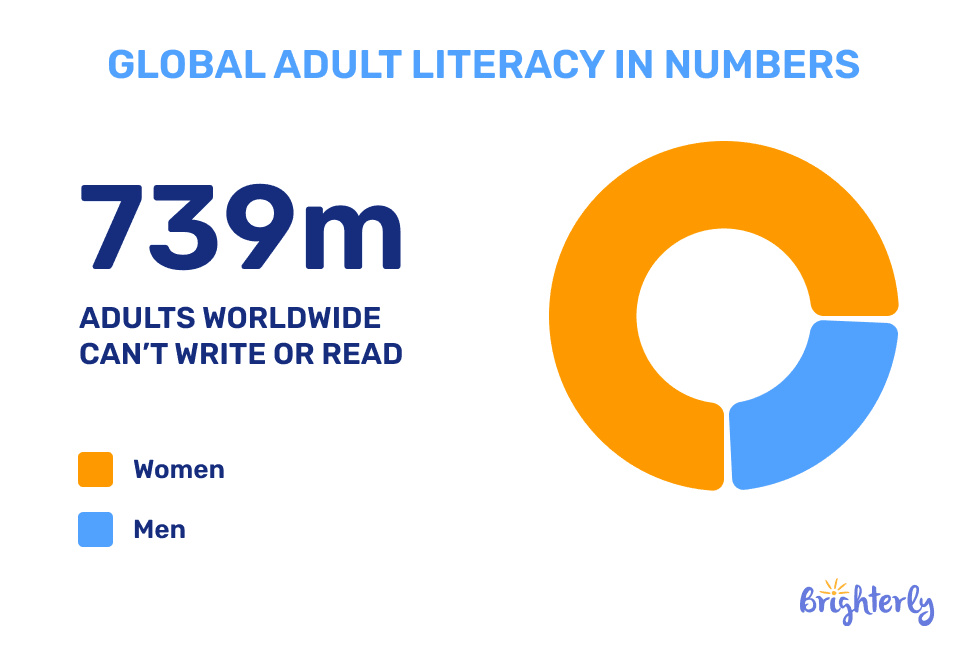
Around 739 million adults worldwide can’t write and read, two-thirds of them being women. This not only causes personal issues but also hinders the economic development of entire countries and regions where people are less literate. Therefore, it can be seen as statistics on why writing is important in general.
Here is more specific data for some of the most and least literate countries based on World Population Review data.
Country |
Total literacy rate |
Male |
Female |
Year |
| Ukraine | 100% | 100% | 100% | 2021 |
| Uzbekistan | 100% | 100% | 100% | 2022 |
| North Korea | 100% | 100% | 100% | 2015 |
| Kazakhstan | 100% | 99.8% | 99.7% | 2020 |
| Azerbaijan | 100% | 99.9% | 99.7% | 2023 |
| India | 77.7% | 84.7% | 70.3% | 2022 |
| Nigeria | 62.0% | 71.3% | 52.7% | 2018 |
| Afghanistan | 37.3% | 52.0% | 22.6% | 2021 |
| Mali | 31.0% | 40.4% | 22.1% | 2020 |
| Chad | 27.0% | 35.4% | 18.2% | 2021 |
Why do students have poor writing skills?
- Not having a solid base in grammar and punctuation makes it tough to put thoughts together in a way that makes sense.
- Not knowing enough words makes it hard to explain complicated ideas, so writing ends up being repetitive and too simple.
- Anxiety, low confidence, and a lack of motivation restrain students’ desire to write in general
- When teachers care only about test scores, students tend to lose interest in writing or being creative and trying more.
- Teachers often have too many students yet not enough time to give detailed, one-on-one feedback so necessary for a student to improve.
- Old or poorly structured textbooks and lessons don’t give students the clear, step-by-step help they need to push through tough writing assignments.
According to the World Journal of English Language, when students can’t write well, it’s usually because of a mix of things like language problems, how they feel about writing, and the way they’re taught. When writing, you have to juggle grammar, creativity, and making sense of the topic you are writing on. When these elements are not properly supported, it becomes clearer what percentage of students struggle with writing.
Writing statistics: Conclusion
Most recent writing statistics show that while there are signs of stabilization, there’s still a lot of variation. From race-based imbalance to the pandemic’s lingering effects, the data point is clear: personalized education is what students need to thrive.
Want to help your child get better at writing, feel more confident, and see their scores go up? Brighterly is here to help. Book free lesson today and see them do great!


What is the right platform to help kids learn? As a tutor, I’m asked this question a lot, especially when parents ask about tutoring solutions. Lately, three of them turn up quite often: Varsity Tutors, Sylvan Learning, and Brighterly. So here’s my Varsity Tutors vs Sylvan vs Brighterly analysis, covering their learning approaches, effectiveness, pros, […]

Jan 23, 2026

It’s a good idea to take a look through Acellus Academy reviews if you’re considering this platform as your child’s homeschooling curriculum. Ensuring children receive a good education is something I’m enthusiastic about, so I’m here to help you decide if Acellus is right for your child by detailing its pros and cons and answering […]

Jan 26, 2026
Math & reading from 1st to 9th grade
Looking for homework support for your child?

Choose kid's grade

Math & Reading for Grades 1–9
Build real confidence for your child with a Brighterly math or reading tutor.