What Does PM Mean? Definition and Simple Examples
Updated on April 29, 2026
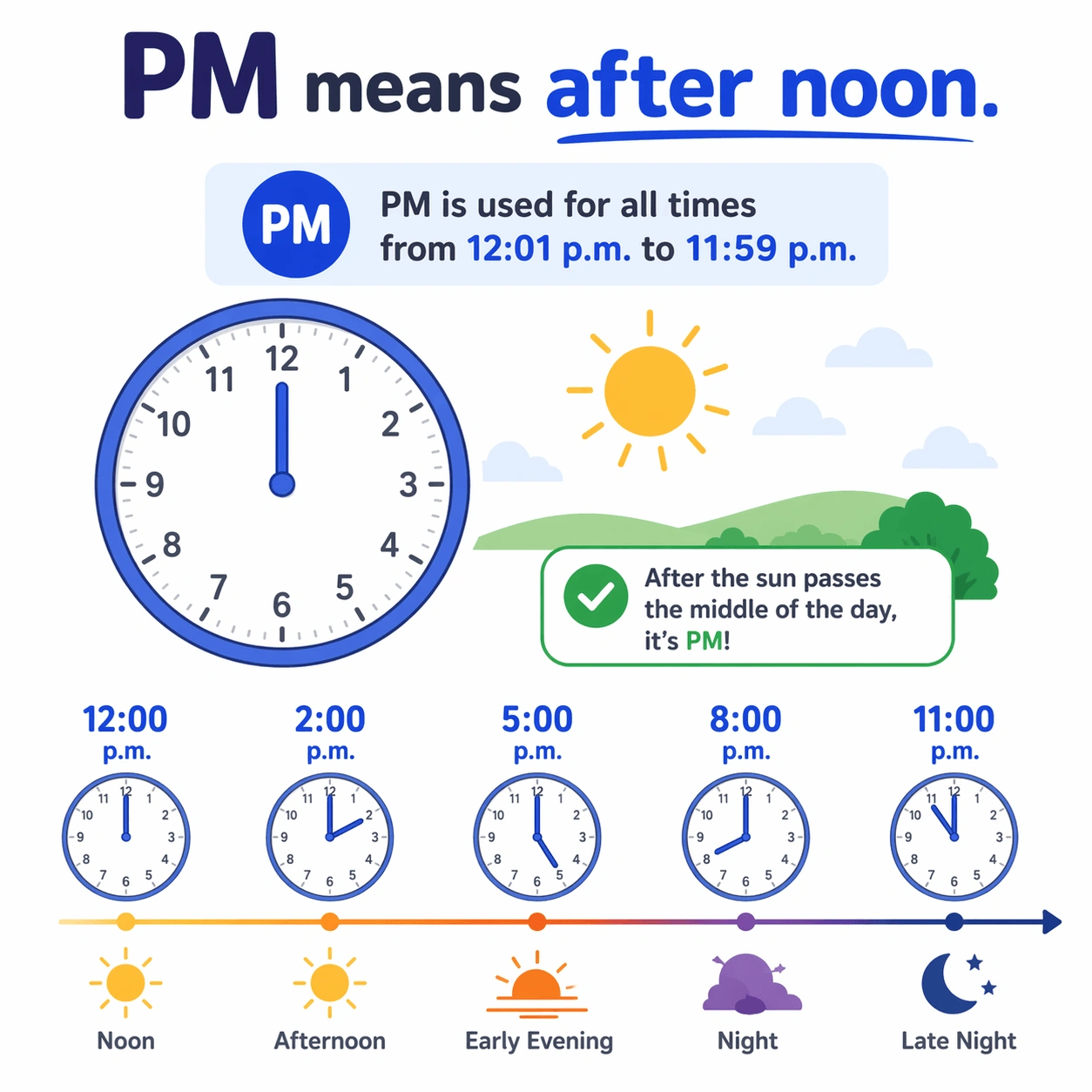
The abbreviation PM primarily refers to the second half of a 24-hour day in the 12-hour clock system. It stands for the Latin phrase post meridiem, which translates to after midday or after noon. This designation is essential for distinguishing between morning hours and those that occur in the afternoon, evening, and night.
For kids, mastering the use of PM in time is a fundamental skill for scheduling daily activities, reading school timetables, and communicating clearly.
What is what does pm mean?
The term PM is a shorthand abbreviation used to denote the period of time from noon until just before midnight, as well as a variety of professional and technical titles. In the context of time, it serves as a marker to separate the afternoon and evening hours from the morning hours. Outside of timekeeping, it is a standard acronym used in industries to simplify complex titles or scientific concepts.
Expert Math Tutors for Every Level
Connect with professional and certified educators who provide specialized support for every grade level, from elementary school basics to advanced algebra
The 12-Hour Clock System: AM vs. PM
The 12-hour clock system divides the 24 hours of a full day into two distinct periods of 12 hours each, known as AM and PM. The first cycle, AM, runs from midnight to just before noon, while the second cycle, PM, runs from noon to just before the next midnight. This system is the standard method for telling time in the United States, Canada, Australia, and many other countries.


Help your child reach their full potential!
Answer a few quick questions about your child’s learning, and we’ll recommend next steps.
Origins of Post Meridiem
The letters PM come from the Latin phrase post meridiem. In this phrase, post means after and meridiem means midday or noon. Therefore, any time labeled PM is literally occurring after the sun has reached its highest point in the sky for that day. This terminology was developed centuries ago to help people organize their schedules around the natural position of the sun, which passes the celestial meridian at noon.
When Does PM Start and End?
The PM period begins exactly at 12:00 PM, which is commonly referred to as noon. It continues through the afternoon and evening until 11:59 PM. Once the clock strikes 12:00 again, it becomes midnight, and the cycle switches back to AM. Understanding this transition is vital for travel and event planning, as 12:00 PM occurs during the daylight hours, while 12:00 AM signifies the very beginning of a new calendar day in the middle of the night.
Other Common Meanings of PM
Beyond its use in telling time, PM serves as an abbreviation for several important roles and technical terms used in daily life and professional settings. In written communication, you might see PM used to describe a person’s job, a type of medicine, or a measurement of air quality. Identifying the right meaning depends on whether the text is discussing a schedule, a workplace, or a scientific report.
PM in Science and Medicine: Particulate Matter and Post-Mortem
In environmental science, PM stands for Particulate Matter, which refers to tiny solid or liquid particles suspended in the air, such as dust, dirt, soot, or smoke. Scientists categorize these as PM10 or PM2.5 based on their size in micrometers.
PM in Government: Prime Minister
In many countries that use a parliamentary system of government, such as the United Kingdom, Canada, and India, PM stands for Prime Minister. The Prime Minister is the head of the government and the leader of the executive branch.
Solved Examples on what does pm mean
Practicing with real-world scenarios helps reinforce the understanding of how PM is used in different contexts. These examples cover time conversion, reading comprehension, and differentiating between multiple meanings of the same abbreviation. Reviewing these solutions can help students avoid common mistakes when interpreting schedules or technical documents.
Example 1: Converting 14:00 to PM Time
Question: If a digital clock shows the time as 14:00 in a 24-hour format, what is the time in the PM format?
Solution: To convert a 24-hour time that is 13:00 or higher to a 12-hour PM time, you must subtract 12 from the hours. In this case, 14 minus 12 equals 2. Therefore, 14:00 is equal to 2:00 PM. This is an afternoon time.
Example 2: Identifying PM in a Sentence
Question: In the sentence, I will send you a PM on social media tonight at 8, what does PM mean?
Solution: In the context of social media and the internet, PM stands for Private Message. It refers to a direct, non-public message sent from one user to another. While the sentence mentions a time (8), the letters PM are used here as a noun representing the message itself.
Example 3: Differentiating PM (Time) from PM (Job Title)
Question: The PM has a meeting at 3:00 PM. Identify the two different meanings of PM in this sentence.
Solution: The first PM is used as a title, likely referring to a Project Manager, Product Manager, or Prime Minister. The second PM refers to the time of day, indicating that the meeting takes place at 3:00 in the afternoon rather than 3:00 in the morning.
Example 4: Calculating Hours Between AM and PM
Question: How many hours are there between 10:00 AM and 4:00 PM on the same day?
Solution: First, count the hours from 10:00 AM to 12:00 PM (noon), which is 2 hours. Next, count the hours from 12:00 PM to 4:00 PM, which is 4 hours. Adding these together (2 + 4) gives a total of 6 hours.
FAQ
Is 12:00 PM noon or midnight?
In the standard 12-hour clock system, 12:00 PM is conventionally used to represent noon, which is the middle of the day. This can be confusing because PM means after midday, and exactly at noon, the sun is at the meridian rather than after it. However, because the minutes immediately following 12:00 (such as 12:01) are clearly in the afternoon, digital clocks and calendars designate 12:00 as PM. To avoid any potential confusion in formal writing or scheduling, it is often safer to write 12:00 noon or 12:00 midday instead of relying solely on the PM abbreviation.
What is the full form of PM in time?
The full form of PM when used for time is post meridiem. This is a Latin phrase where post means after and meridiem means midday. This system was created to distinguish the two halves of the 24-hour day. In countries like the United States, this distinction is necessary because analog and digital clocks typically only display numbers from 1 to 12. Without the post meridiem and ante meridiem (AM) markers, it would be difficult to communicate whether an event is happening in the early hours of the morning or during the afternoon and evening hours.
What does PM stand for in business?
In a business setting, PM most frequently stands for either Project Manager or Product Manager. A Project Manager is the person who organizes the team, tracks the schedule, and ensures that a specific task or project is finished on time. A Product Manager focuses on the product itself, deciding which features to add and how to make the product successful for users. Additionally, PM can occasionally stand for Performance Management, which is a process used by companies to track and improve how well employees are doing their jobs. The specific industry usually makes the meaning clear.
How do you write PM correctly?
There are several acceptable ways to write the abbreviation for post meridiem, depending on the style guide you are following. In formal or academic writing, it is common to see lowercase letters with periods, written as p.m. Many newspapers and magazines use small capital letters without periods, or standard capital letters like PM. The most important rule is to remain consistent throughout your document. If you start by writing 5:00 p.m., you should not switch to 7:00 PM later in the same text. It is also standard to include a space between the numbers and the abbreviation.
What is PM10 and PM2.5 in air quality?
In the context of air quality and environmental science, PM stands for Particulate Matter. The numbers 10 and 2.5 refer to the size of the particles in micrometers. PM10 includes inhalable particles that are 10 micrometers in diameter or smaller, such as dust and pollen. PM2.5 refers to fine particles that are 2.5 micrometers or smaller, which are often produced by car exhausts, power plants, and forest fires. These small particles are a major concern for health because they are small enough to be breathed deep into the lungs and can even enter the bloodstream.


Math & reading from 1st to 12th grade
Looking for homework support for your child?

Choose kid's grade

Math & Reading for Grades 1–12
Build real confidence for your child with a Brighterly math or reading tutor.