
Factoring Polynomials Worksheets
Updated on October 16, 2026
Factoring a polynomial means rewriting it as a product of simpler expressions, for example x² + 5x + 6 = (x + 2)(x + 3). Our free factoring polynomials worksheets take students from factoring monomials and linear expressions in 7th grade to trinomials, special products, and sums and differences of cubes in algebra classes up to grade 11.
Factoring Polynomials Worksheet with Answers Free PDF

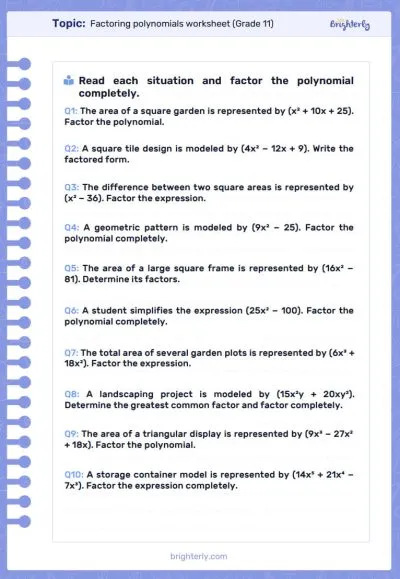

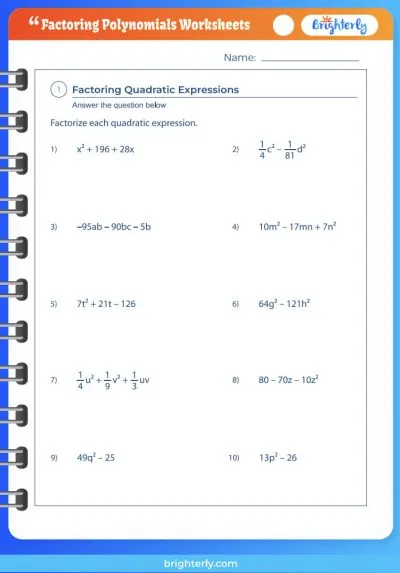
The PDFs are arranged from easiest to hardest. The first worksheets cover factors of monomials, linear expressions like 12c + 32 = 4(3c + 8), and the greatest common factor. Next come quadratic expressions and factoring by grouping. The last worksheets include word problems with trinomials, perfect squares, differences of squares, and cubes. Every PDF includes an answer key.
How to Factor Polynomials
Students usually try these methods in order:
- Greatest common factor (GCF). Pull out what every term shares: 6x³ + 18x² = 6x²(x + 3).
- Grouping. Split four terms into pairs and factor each pair: x³ + 3x² − 4x − 12 = x²(x + 3) − 4(x + 3) = (x + 3)(x − 2)(x + 2).
- Trinomials. Find two numbers that multiply to the last term and add to the middle term: x² − x − 20 = (x − 5)(x + 4).
- Special products. Recognize patterns such as a perfect square, x² + 10x + 25 = (x + 5)², or a difference of squares, 9x² − 25 = (3x + 5)(3x − 5).
- Sum and difference of cubes. Use the cube formulas: x³ − 27 = (x − 3)(x² + 3x + 9) and 8x³ + 27 = (2x + 3)(4x² − 6x + 9).
Always check whether the result can be factored further. For example, x⁴ − 16 = (x² + 4)(x² − 4) = (x² + 4)(x + 2)(x − 2).
Other algebra worksheets
- Factoring trinomials worksheets
- Factoring by grouping worksheets
- Factoring quadratics worksheets
- Algebraic expressions worksheets
- Distributive property worksheets


Help your child reach their full potential!
Answer a few quick questions about your child’s learning, and we’ll recommend next steps.
Factoring Polynomials Worksheets: Benefits
Come with answers
Every factoring polynomials worksheet PDF contains an answer key, so students can check their work, spot mistakes, and fix them on their own. This kind of self-checking builds independent study habits and confidence.
Use different question formats
The worksheets mix multiple-choice questions on the factors of monomials, standard “factor completely” problems, and short word problems where a polynomial describes an area or a volume. This variety keeps practice engaging and shows how factoring is used.
Offer a graduated learning curve
The set begins with simple monomials and linear expressions and moves on to trinomials, special products, and cubes, so students build each skill before the next one.
Train different strategies
Students practice the GCF, grouping, trinomial factoring, and special product patterns. Knowing several methods means that if one doesn’t work, they can try the next one.
Polynomial Factoring Worksheet & Test
Once your child has checked their answers, they can test their knowledge with Brighterly’s factoring polynomials practice test questions. These quizzes mimic the questions students see in school exams.
For more practice, explore our Algebra 1 worksheets and Algebra 2 worksheets.
Frequently Asked Questions
What is factoring polynomials?
Factoring polynomials means breaking a polynomial into simpler pieces, called factors, that multiply back to the original expression. For example, x² − 9 = (x + 3)(x − 3). It is a key algebra skill used to solve quadratic equations and simplify rational expressions.
What grade level are these factoring polynomials worksheets for?
They cover grades 7–11. In 7th grade, students factor simple linear expressions like 6x + 9 = 3(2x + 3). In Algebra 1 (around grade 9), they factor trinomials and special products. In Algebra 2 (grades 10–11), they factor cubes and higher-degree polynomials.
Do the worksheets come with an answer key?
Yes. Every factoring polynomials worksheet PDF includes a complete answer key, so your child can check their own work and catch mistakes without help.
How do you factor a difference of cubes?
Use the formula a³ − b³ = (a − b)(a² + ab + b²). For example, x³ − 8 = (x − 2)(x² + 2x + 4). For a sum of cubes, use a³ + b³ = (a + b)(a² − ab + b²).
What if my child is still struggling with factoring polynomials?
That’s completely normal, because factoring is one of the trickier algebra skills. If worksheets alone aren’t enough, a Brighterly math tutor can work through the concept one-on-one with your child. You can book a free lesson to see how that support could help.


Need help with Equations?
- Is your child finding it challenging to grasp of equations?
- An online tutor could be the answer.
Choose kid's grade

Does your child struggle with understanding of equations? Try lessons with an online tutor.
Book FREE lesson