
Geometric Sequences Worksheets
Updated on September 28, 2026
Geometric sequences worksheets give students practice identifying the common ratio r and applying the explicit formula aₙ = a₁ · r^(n−1) to find any term in the sequence.
Because each term is the previous one multiplied by a constant factor, geometric sequences model exponential growth and decay — from compound interest to population dynamics and radioactive decay rates.
Mastering geometric sequences — and the exponential models they represent — is one of the most transferable skills students develop in high school math, showing up in finance, biology, and physics coursework.
Download Geometric Sequences Worksheet PDFs
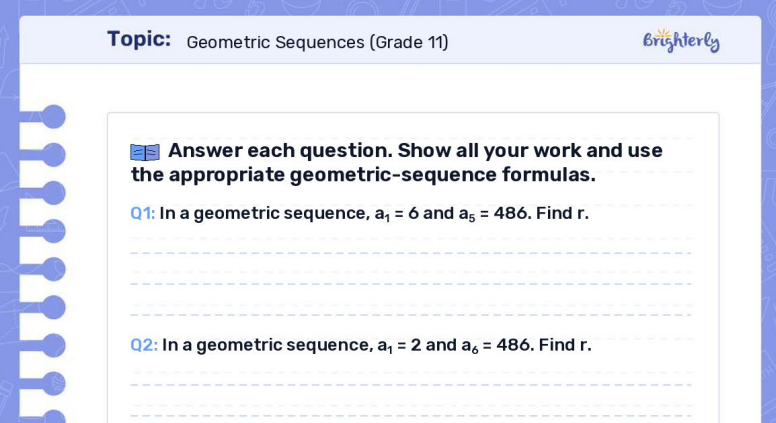
Access our comprehensive collection of printable resources designed to help students practice identifying common ratios and calculating specific terms within a sequence.
More sequences and series worksheets
Extend your understanding of sequences with these related resources covering exponential equations, exponent practice, and algebra word problems — the mathematical tools that connect geometric sequence patterns to real-world exponential models and standardized test problem types.
- algebra 2 worksheets
- solving exponential equations worksheets
- exponents worksheets
- algebra word problems worksheets
- scientific notation worksheets


Help your child reach their full potential!
Answer a few quick questions about your child’s learning, and we’ll recommend next steps.
Benefits of Geometric Sequences Worksheet
Working through geometric sequences worksheets provides students with a rigorous framework for developing Fibonacci sequence skills necessary for high-level mathematics. By identifying the common ratio and applying both explicit and recursive formulas, learners build a bridge between discrete numerical sets and continuous exponential functions.
These exercises are particularly beneficial for understanding real-world applications such as calculating exponential growth and decay, predicting population dynamics in biology, or analyzing radioactive decay in physics.
Consistent practice helps students what is the difference between geometric and arithmetic relationships, ensuring they can accurately model scenarios where quantities increase or decrease by a constant factor. Furthermore, mastering these sequences prepares students for the challenges of calculus and trigonometry by reinforcing the laws of exponents and the properties of logarithms.
These worksheets provide the structured repetition required to gain fluency in finding the nth term or summing a finite geometric series, which are critical skills for standardized testing and university-level STEM coursework.
By engaging with various problem types—ranging from simple integer ratios to complex fractions and negative ratios—students develop the analytical precision and persistence needed to solve sophisticated mathematical problems with confidence.


Math & reading from 1st to 12th grade
Looking for homework support for your child?

Choose kid's grade

Math & Reading for Grades 1–12
Build real confidence for your child with a Brighterly math or reading tutor.