Telling Time Worksheets
Updated on December 25, 2025
If the minute hand traveling past the 30-minute mark confuses your kid, our telling time worksheets may be the answer. They offer goal-driven drills to master the ‘to the hour’ concept. That includes practicing differentiating the hour and minute hands. In such a way, your kid will learn to completely understand both analog and digital time formats.
Telling time worksheet: Examples
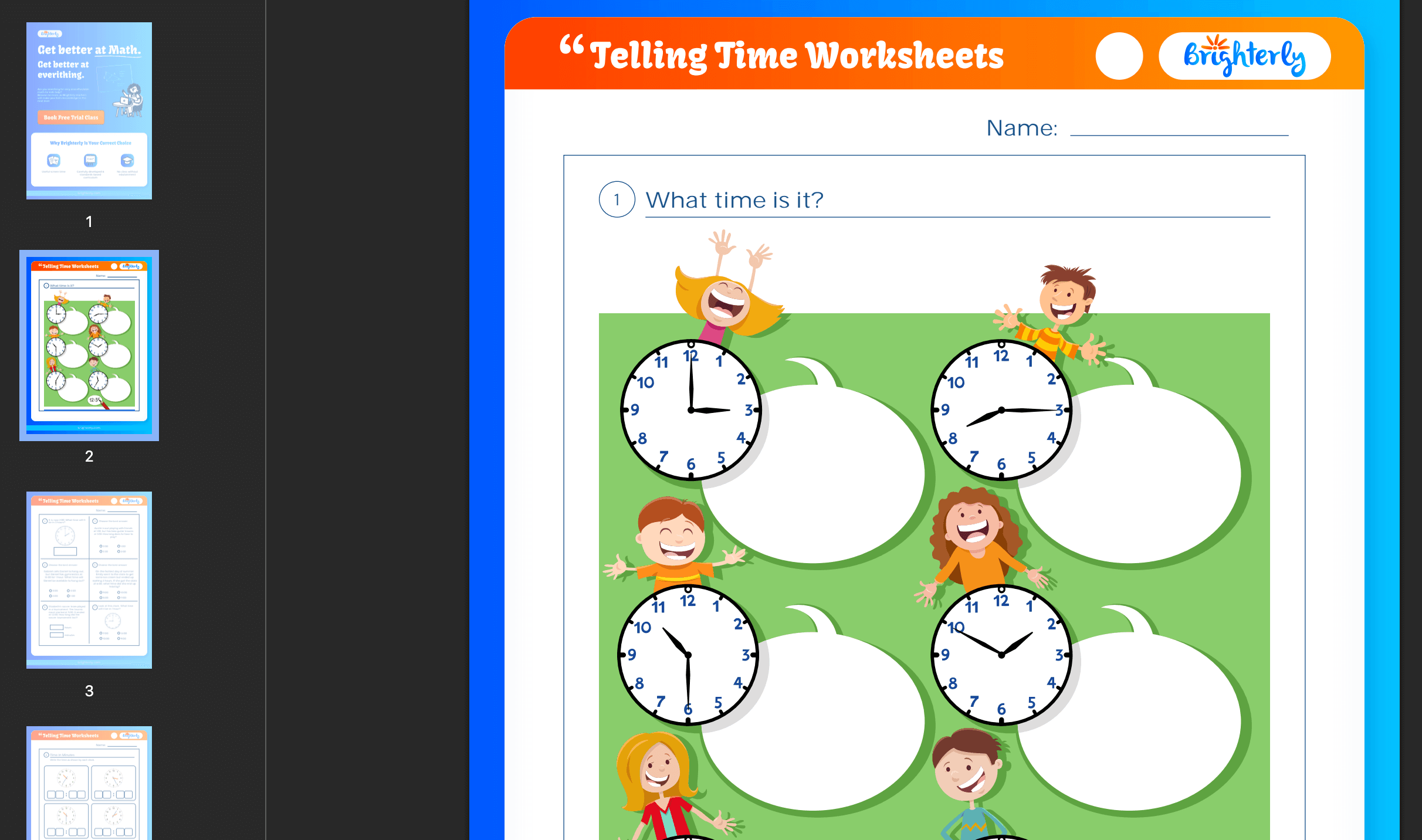
These worksheets offer you varied practice for your kid to fully master analog time. They start by reading the two hands to determine the hour and minute. This exercise also includes tricky minutes to the hour (like 1:50 or 11:35). Next, they are to deal with elapsed time word problems. They calculate how much time passes between two events. Plus, there are some specialized exercises that involve drawing and estimating time using only the hour hand. All that is available for you in our comprehensive free telling time worksheets.


Time telling worksheets: Free download
If elapsed time word problems confuse your kid, download these sheets. They’ll help your kid gain specific practice calculating time differences, like finding out how long a soccer tournament lasted. Together with your kid, you’ll be surprised how good these structured exercises simplify multi-step time calculations.
More time worksheets
- Clock Worksheets
- Elapsed Time Worksheets
- Telling Time Kindergarten Worksheets
- Telling Time to the Minute Worksheets
- Time to the Hour and Half Hour Worksheets
The time topic is vast. Don’t stop here! Check out our comprehensive collection of other practice resources. It includes fully engaged and fun worksheets for interpreting the clock face itself. Your kid can also deal with more challenging word problems about time duration that require calculation.
Benefits of tell time worksheets
- Clarifying full vs partial hours
- Teaching elapsed time with real-life examples
- Building estimation with hour-only clocks
- Strengthening hour-minute conversion
- Improving logic through time questions
Telling time worksheets help strengthen understanding of full hours vs partial hours
Understanding when a partial hour is ‘close to’ the next full hour is a key skill, agree? These clock time worksheets provide practice in approximating the time based on the minute hand’s journey around the clock face.
Kids train differentiating a time like 7:05 (just after) from 7:55 (almost the next hour). That way, the intuition is built. Plus, common reading errors are significantly eliminated.
Note: Research shows the hour hand is significantly more challenging for elementary students to position accurately than the minute hand. It’s especially so when indicating times between hours.
Helps kids understand elapsed time using everyday examples
Our how to tell time worksheets turn abstract elapsed time into something kids can actually relate to. They work with scenarios like getting ready for school, waiting for a bus, or timing a favorite cartoon — all familiar moments that make time differences easy to grasp. By connecting clock reading to real-life routines, kids quickly learn not just how long something lasts, but why elapsed time matters in daily life.
Telling time worksheets free chance to develop estimation by using clocks without a minute hand
Our worksheets for telling time, in particular, feature clocks with the minute hand deliberately removed. This forces kids to use the hour hand’s position alone to estimate the time accurately. Through focusing on where the hour hand falls between two numbers (for instance, halfway between the 4 and 5 for 4:30), kids can quickly tell the approximate time in daily life.
Note: Using analogue clocks (including versions where only the hour hand is present) helps children build a deeper understanding of time as a cyclic and proportional concept rather than just reading digits.
Telling time worksheets PDF reinforces conversion between hours and minutes
These free printable telling time worksheets provide the necessary repetition to master the key conversion. That’s knowing that every number on the clock face represents exactly five minutes. Kids repeatedly practice converting the hour hand’s position and multiplying the minute hand’s position by five. That, in turn, also ensures faster error-free mental math.
Improves logical thinking with multiple-choice time problems
Logical thinking improves dramatically with the right format. Our printable telling time worksheets feature multiple-choice problems. All of them require analyzing elapsed time scenarios.
Kids are expected to use logic to calculate time differences. Or, they are to find a future appointment time, instead of just reading a clock face. This training of selecting the correct answer after two or more steps significantly sharpens critical thinking and decision-making skills.
Note: Research based on Piaget’s theory shows that calculating elapsed time requires children to coordinate hierarchical units. Plus, they’re encouraged to use logical-mathematical thinking. It makes multi-step time problems essential for cognitive development.
Telling time practice worksheets and tests
Consistent practice with worksheets prepares your kid for much more than just clock reading. Mastering elapsed time and conversions now builds the logical foundation needed to ace future math tests for grades 1-9.
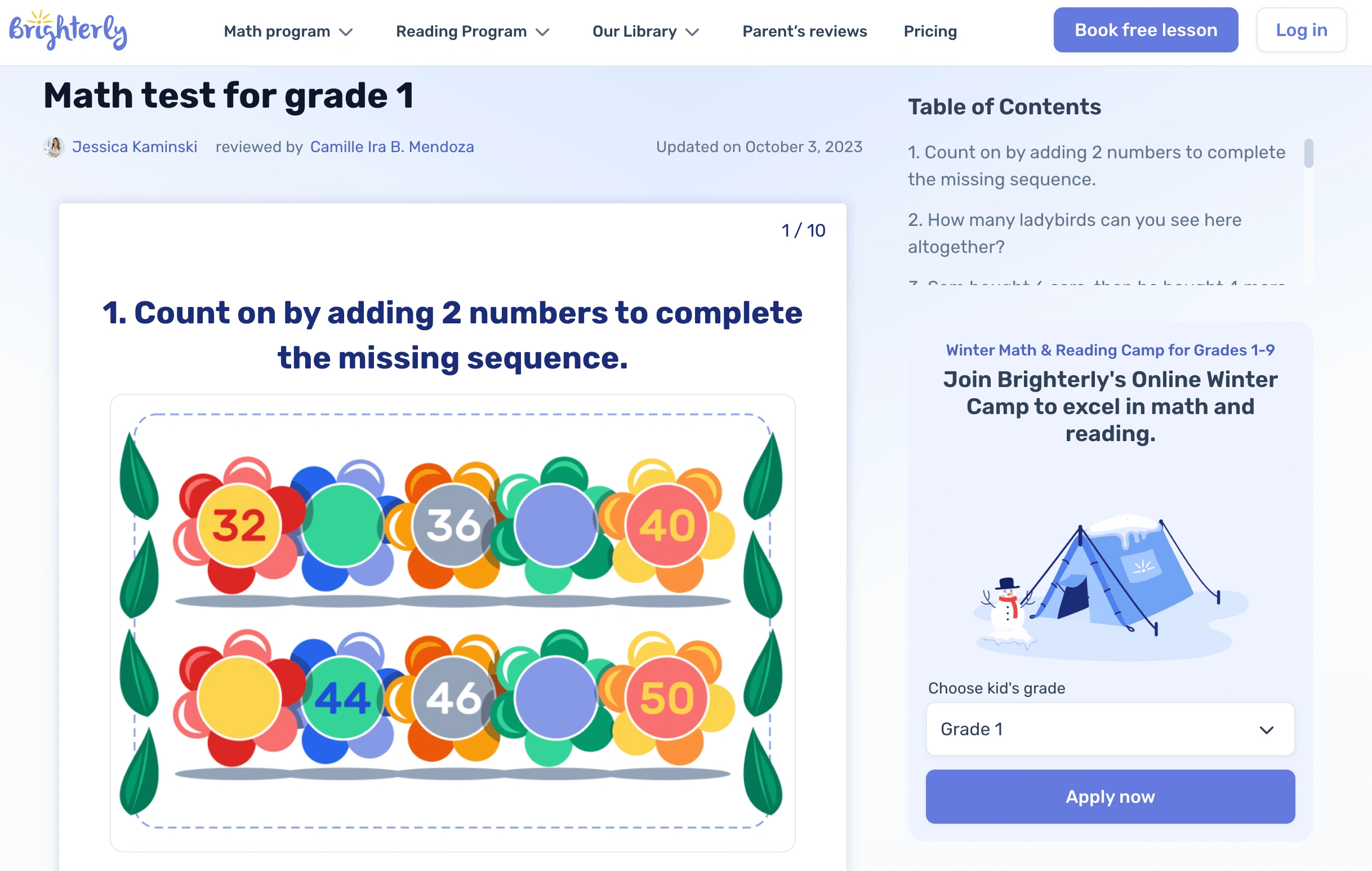
Starting early helps eliminate time anxiety. It also ensures confidence in scheduling and complex math. For beginners, discover foundational activities by visiting Brighterly’s Pre-K (Preschool) Math Worksheets and 1st Grade Math Worksheets.



Need help with Time?
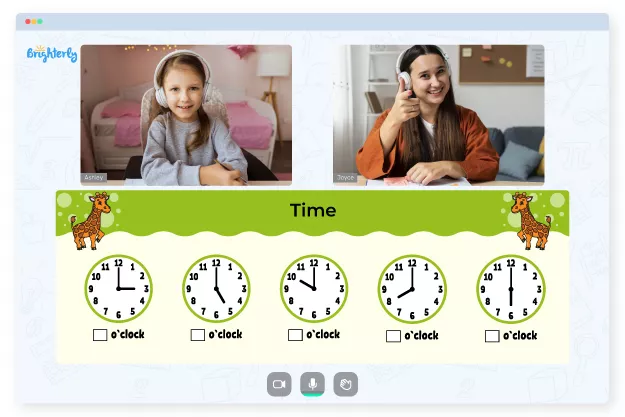
- Is your child struggling to grasp the concept of time in math?
- Start lessons with an online tutor.
Choose kid's grade