
Trigonometric Ratios Worksheets
Updated on September 7, 2026
Trigonometric ratios worksheets help students master the relationships between angles and side lengths in right-angled triangles. Every right triangle follows the same ratio rules regardless of its actual dimensions, meaning that proficiency with SOHCAHTOA unlocks the ability to find any unknown side or angle given minimal information. Students who mix up which ratio applies to which side benefit most from a geometry tutor who uses visual SOHCAHTOA diagrams to anchor the sine, cosine, and tangent relationship in memory.
Download Trigonometric Ratios Worksheet PDFs
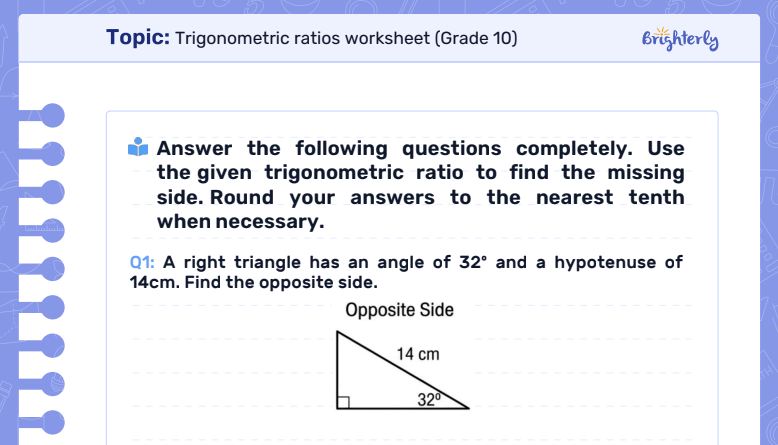
Access our high-quality, printable PDF resources to strengthen understanding of SOHCAHTOA and right-triangle trigonometry through targeted, scaffolded practice.
More trigonometry worksheets
Deepen your trigonometric skills with these closely related resources — covering special right triangle angle ratios, 30-60-90 and 45-45-90 configurations, general ratio and proportion foundations, and right triangle area calculations that reinforce the side-length relationships at the heart of SOHCAHTOA.
- trigonometry worksheets
- special right triangles worksheets
- 45-45-90 and 30-60-90 triangles worksheets
- ratios and proportions worksheets
- area of a right triangle worksheet


Help your child reach their full potential!
Answer a few quick questions about your child’s learning, and we’ll recommend next steps.
Benefits of Trigonometric Ratios Worksheets
Working through trigonometric ratios worksheets reinforces the fundamental principles of geometry and builds the algebraic fluency needed for advanced calculus. By engaging with diverse problem sets, learners develop a deep conceptual understanding of how sine, cosine, and tangent ratios remain constant for specific angles regardless of triangle size. This consistent practice hones equation-rearranging skills, as students solve for unknown hypotenuse, opposite, or adjacent side lengths in multi-step problems. Building fluency with trigonometric functions opens direct pathways to calculus and physics, where these ratios model waves, rotational motion, and force components. These worksheets also bridge abstract theory and real-world application — from architecture’s height calculations to engineering’s structural analyses. Regular use boosts confidence in inverse trig operations and provides a solid foundation for spatial reasoning tasks at the highest levels of secondary mathematics.


Math & reading from 1st to 12th grade
Looking for homework support for your child?

Choose kid's grade

Math & Reading for Grades 1–12
Build real confidence for your child with a Brighterly math or reading tutor.