
Volume of Prisms and Cylinders Worksheets
Updated on September 4, 2026
Volume of prisms and cylinders worksheets help students understand the spatial capacity of three-dimensional geometric solids. A cylinder differs from a prism only in the shape of its base, making it a natural follow-on once rectangular prism volume is mastered — both use the same V = Base Area × Height structure. Students who understand which formula to use but consistently make unit errors or confuse radius with diameter improve most quickly with a geometry tutor providing step-by-step feedback.
Download Volume of Prisms and Cylinders Worksheet PDFs
Access our comprehensive collection of high-quality printable documents designed to reinforce mastery of volume calculations for right prisms and cylinders across a range of base shapes and complexity levels.
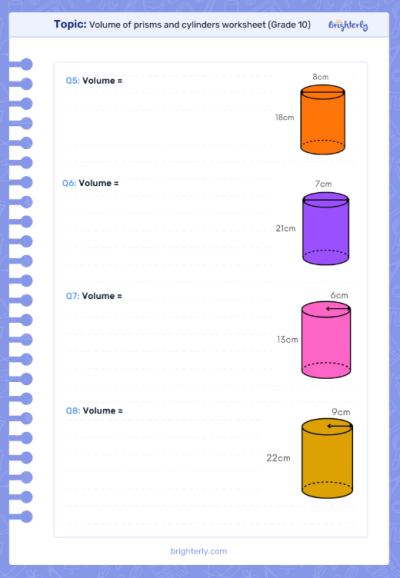
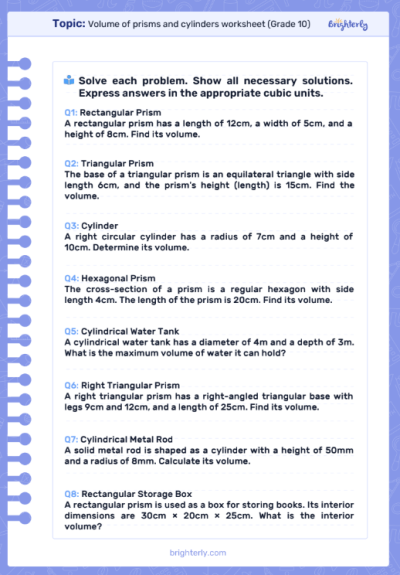
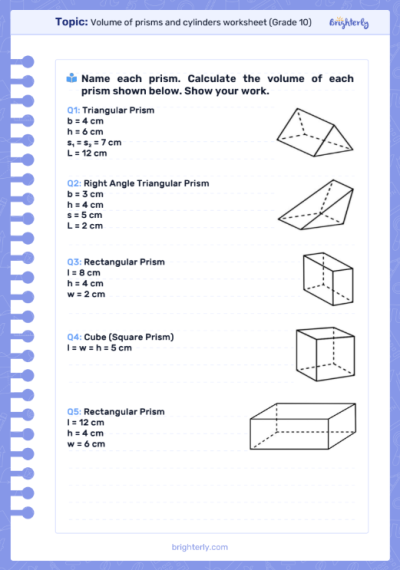
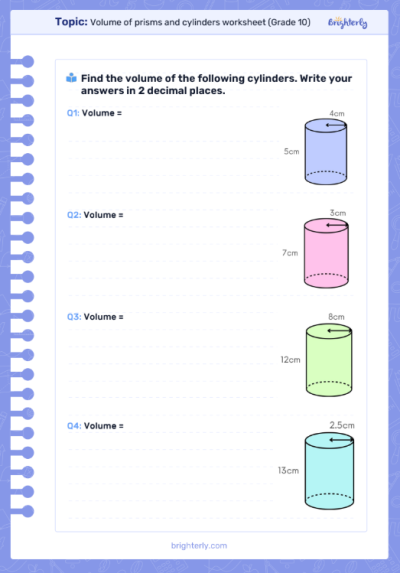
More volume and 3D shapes worksheets
Expand your three-dimensional geometry practice with these closely related resources — covering combined surface area and volume, cylinder and prism cross-sectional base calculations, rectangular face areas, and general measurement skills that underpin all solid geometry work.
- surface area and volume worksheets
- 7th grade volume and surface area worksheets
- area of a circle worksheets
- area of a rectangle worksheets
- area and perimeter worksheets


Help your child reach their full potential!
Answer a few quick questions about your child’s learning, and we’ll recommend next steps.
Benefits of Volume of Prisms and Cylinders Worksheets
Engaging with these worksheets bridges abstract algebraic formulas and concrete spatial visualization. For high school students, mastering the volume of prisms and cylinders establishes the groundwork for understanding Cavalieri’s Principle and the integration of cross-sectional areas in calculus. By working through diverse problem sets with varying heights, radii, and base shapes, learners develop the ability to manipulate units of measurement and solve for missing dimensions efficiently. This practice enhances critical thinking for real-world applications in engineering, manufacturing, and architectural design, where calculating material capacity is routine. These activities also strengthen numerical literacy through complex multiplications involving pi and squared terms, ensuring students are well-prepared for standardized testing and higher-level academic challenges. Using these resources provides a structured environment to troubleshoot common errors — such as confusing radius with diameter or mixing up area and volume formulas — leading to more robust and lasting understanding of three-dimensional mathematics.


Math & reading from 1st to 12th grade
Looking for homework support for your child?

Choose kid's grade

Math & Reading for Grades 1–12
Build real confidence for your child with a Brighterly math or reading tutor.