Calculus for Beginners: A Complete Guide (2026)
reviewed by Florence Khitsane
Updated on September 24, 2026
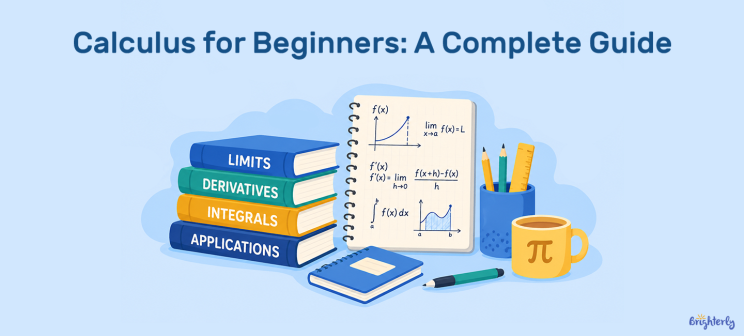
Key Points:
- Calculus focuses on two main ideas: how things change (derivatives) and how small pieces accumulate to large totals (integrals).
- Calculus connects directly to everyday life, from predicting motion and growth to building bridges and calculating medicinal dosages.
- Educators commonly observe that most students find calculus difficult due to weak algebra foundations and poor function skills, not the concepts themselves.
- Beginners learn limits first, then derivatives, and finally integrals, focusing on one area at a time.
- To learn calculus, you have to strengthen your algebra knowledge, go through each part of calculus, and practice with real-world problems.
Calculus sounds intimidating, and many students struggle with it because no one explained what it is. Calculus shows how things change and how small pieces add up to something big. This calculus for beginners guide provides a simple definition, key concepts, and a clear, step-by-step path to start learning.
What Is Calculus?
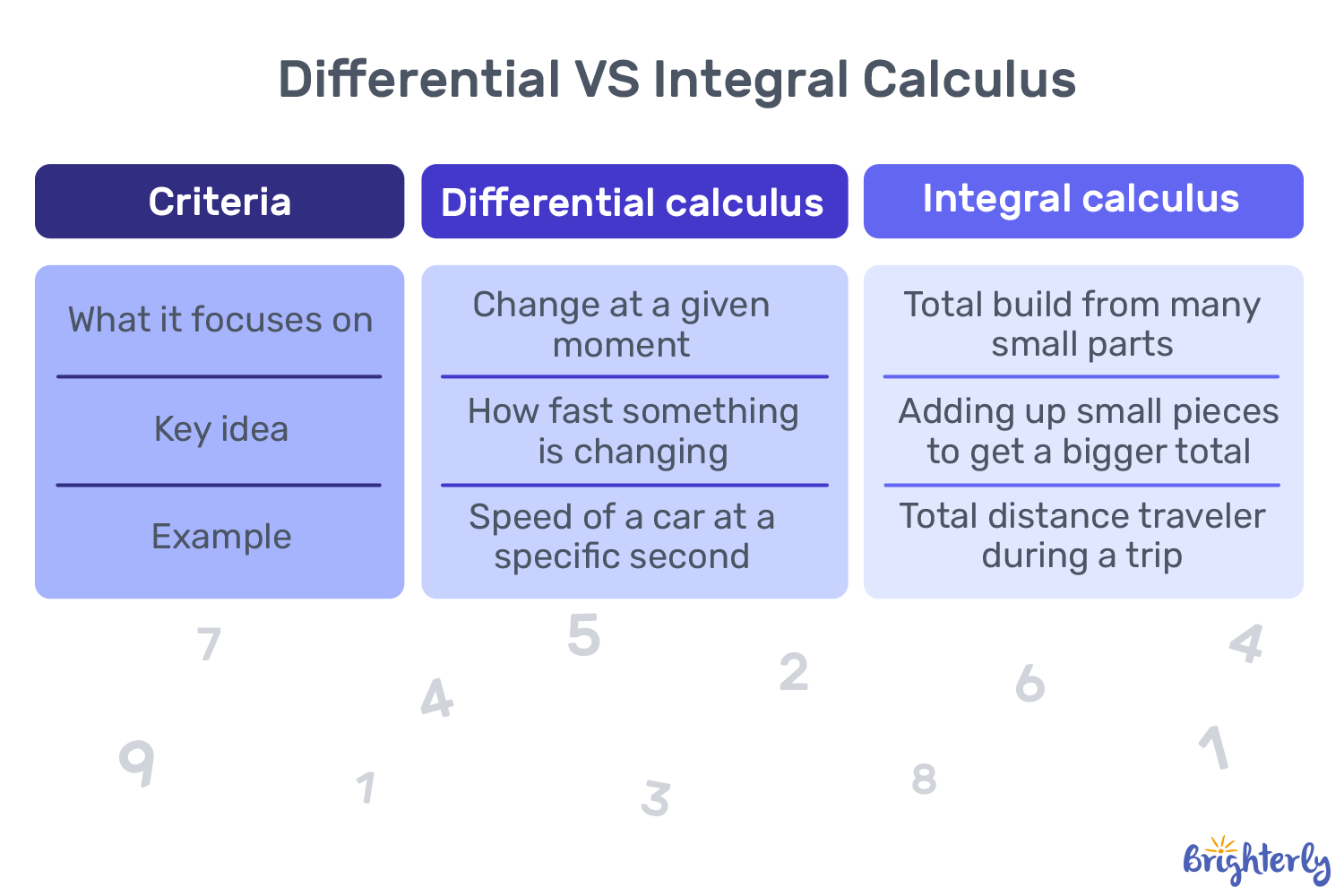
Calculus is a branch of mathematics that focuses on how quantities change and how small parts combine to create a whole. The field studies rates of change and accumulation. The two branches of calculus include differential calculus (change) and integral calculus (totals built from many small parts).
Claire Smizer, Brighterly Educational Advisor, explains what is calculus in simple words:
“Calculus isn't really a new kind of math.”


Unlike arithmetic and algebra, which deal with fixed numbers and relationships, calculus focuses on motion, growth, and continuous change. For example, the math branch helps you understand how speed changes over time, how to measure the area under a curve, and how populations or money grow step by step.
| Math Branch |
Topics Covered |
Example |
| Arithmetic | Basic operations with numbers | 6 + 8 = 14 |
| Algebra | Relationships with variables | Finding x in 3x + 4 = 10 |
| Calculus | Change & accumulation over time | How speed changes over a car journey |
Differential Calculus: Definition and Use
Differential calculus uses derivatives to measure how fast something changes at a specific moment. A derivative shows the rate of change of one quantity compared to another. For instance, speed is the derivative of distance, demonstrating how fast a car moves at any given second.
Integral Calculus: Definition and Use
Integral calculus uses integration to show how quantities accumulate over time. Integration adds up small pieces to find the total. For example, integral calculus can combine small changes in speed to calculate the total distance covered over a certain time as the area under the curve of a speed/time graph.
Explore Brighterly Learning Experience
Learn exactly how Brighterly helps students thrive through expert sessions, online tools, and proven feedback from thousands of satisfied parents
What Do You Learn in Calculus?
According to the College Board AP Calculus AB 2026 curriculum, beginner calculus students learn core concepts like limits, derivatives, and integrals to explain change and accumulation, with a focus on real-world examples. The calculus concepts help learners model motion, growth, and totals in practical situations.
- Limits: How values behave as they get closer and closer to a point, building the foundation for understanding change.
- Derivatives: How to measure how fast something changes at a specific time, such as speed or growth rate.
- Rules of differentiation: How to find rates of change efficiently in different types of problems, step by step.
- Integrals: How to add up small pieces to find totals, like distance traveled or accumulated money.
- Fundamental theorem of calculus: How to connect derivatives and integrals to show how change and accumulation relate to each other.
To understand how calculus works, students apply calculus to real-life problems, such as finding the fastest route, modeling motion, or calculating area.
How Does Calculus Work in Real Life?
Calculus helps us understand change and make accurate predictions – from tracking speed to modeling population growth. The math branch helps turn real-world data into useful insights to track motion or estimate totals. Students learn how to do calculus to solve practical problems in STEM fields and in daily decision-making.
- Calculating speed from position data: Calculus shows how speed changes at any moment, not just the average over a trip, helping analyze motion precisely.
- Finding areas of irregular shapes: With calculus, you can measure spaces that don’t have simple formulas, like land plots and curved surfaces.
- Modeling population growth: Calculus helps you predict how country populations increase or decrease over time, helping with the planning of cities, infrastructure, and schools.
- Building bridges and circuits in engineering: Engineers use calculus to design safe structures and systems by understanding forces, loads, and changes in electrical signals.
- Determining drug dosage rates in medicine: Doctors need calculus to track how medications move through the body to find safe, yet effective dosage over time.
These five real-world applications of math in the real world show why what you learn in calculus matters well beyond school.
What Math Do You Need Before Calculus?
To know how to learn calculus effectively, you need a solid foundation in algebra 1 and pre-calculus. The two subjects build the skills necessary to understand change, relationships between variables, and the behavior of functions, which are essential for grasping calculus. You need to cover the following specific prerequisites:
- Functions and graphs: How function inputs and outputs relate and how to interpret graphs.
- Trigonometry basics: Angles and common relationships, especially related to waves and cycles.
- Algebraic manipulation: Rearrange equations, simplify expressions, and solve for unknown values.
- Limits (basic concept): The ideas of values getting closer to a point.
Claire Smizer highlights the three math concepts you need to master to understand what is calculus about and how to work with it.
“The top 3 prerequisite skills before starting calculus are algebra fluency, solid understanding of functions, and comfort with the coordinate plane.”
If your child needs to fill some gaps before starting calculus, the Brighterly online math program, led by experienced calculus and pre-calculus tutors, can focus on vague areas in a 1:1 mode. In our math for high school students program, your kid gets an individualized learning plan to build the foundation needed for calculus.
Help your child reach their full potential!
Answer a few quick questions about your child’s learning, and we’ll recommend next steps. 

How to Learn Calculus Step by Step
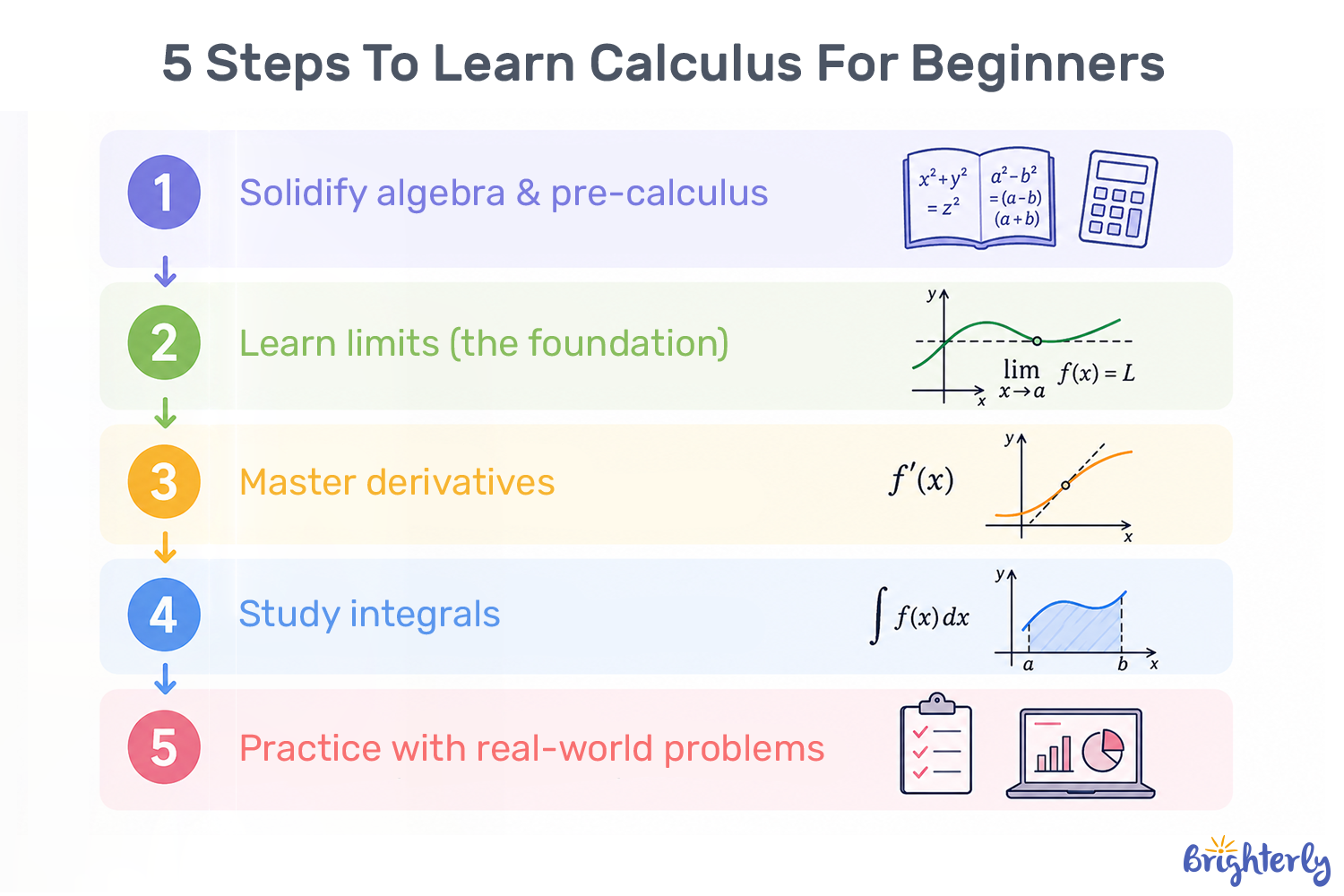
The best way to learn calculus is to build one concept at a time. Start with limits, then derivatives, and finally integrals. Instead of memorizing rules, understand what each idea means, how it connects to the next one, and where it appears in real life.
Solidify Your Algebra and Pre-Calculus
Review key topics like functions, graphs, and equations to get better at math concepts required for calculus. Practice rewriting expressions, reading graphs, and working with basic trigonometry to gain mastery and confidence. Use different free available resources like algebra worksheets to practice problems in your weak areas and build fluency and speed. Or address an algebra tutor for more structured help.
Start with Limits (the Bridge to Calculus)
When getting into basic calculus, begin with limits. Focus on understanding how values approach a point rather than calculating exact answers. Watch visual explanations and try simple examples to see common patterns.
Learn Derivatives (How Things Change)
Next, focus on understanding derivatives as a way to measure how fast something changes, such as how acceleration reflects changes in speed over time. After having derivatives explained, practice real-life examples, and then work on identifying and interpreting the rate of change.
Understand Integrals (How Things Accumulate)
Next, move to integral calculus basics, which explain how adding up small pieces helps you find the total, such as the area of a building or the distance traveled over time. Start with visual examples to see how accumulation works in practice, and then start solving actual problems.
Practice with Real Problems
As a final step to learning calculus, apply each concept to real-life situations like calculating motion, area, and growth to make sure you retain skills for the long haul. Solve beginner calculus problems in each area (before moving to more difficult ones) and check your reasoning, not only your answers.
Is Calculus Hard?
Calculus feels hard for some students and manageable for others, depending mostly on the math foundation they have. Most learners struggle not because of the calculus material itself but because of learning gaps in their algebra knowledge, especially function skills. To answer positively to “Is calculus easy?”, you have to first build a solid algebra foundation and then learn calculus step by step.
“The biggest misconception is that calculus is only for math geniuses. It isn't.”
If your child needs to make up for missed algebra concepts, our 12th grade math tutors can help with targeted instruction and gamified practice. Our calculus tutors can support your kid along the way to supplement and augment the learning offered at school.
1:1 math tutoring to fill gaps!
Brighterly tutors personalize the instruction & practice to your child’s exact needs.
Conclusion
Calculus for beginners helps you understand how things change and how small pieces add up to the whole. You learn core ideas like limits, derivatives, and integrals, and how to apply them to real-world scenarios. Start with strong foundations, follow a clear path, and take it step by step. In math, progress comes with practice.
Frequently Asked Questions
What Grade Do You Learn Calculus?
Most US students learn calculus in grades 11 or 12, often through advanced math tracks or AP courses. Some children encounter calculus earlier if they progress quickly in high school math, while others study it in college. The exact timing depends on when a student completes algebra, geometry, and pre-calculus.
What Are the Basics of Calculus?
The basics of calculus cover limits, derivatives, and integrals. Limits show how values approach a point, derivatives measure how fast something changes, and integrals calculate totals from small parts. The basic calculus concepts for students help explain motion, growth, and accumulation in real-life cases.
Is Calculus 1 Just Algebra?
No, Calculus 1 is not only algebra, but it depends heavily on algebra concepts studied in middle and high school. Calculus 1 builds on previous algebra knowledge while introducing new concepts like limits, derivatives, and integrals. While you still try out to solve equations and work with graphs, the focus shifts from finding unknown values (algebra) to making sense of change and accumulation (calculus).
Can You Learn Calculus on Your Own?
Yes, you can learn calculus on your own if you have already built a solid algebra foundation through school and develop a step-by-step plan that you follow closely. Focus on one concept at a time, use reliable resources, and practice with real-world examples regularly. If you need extra help, 1:1 tutoring can provide personalized support.
What Is Calculus Used for in Everyday Life?
Calculus helps us analyze changes and make predictions in everyday life situations. For example, you can use calculus to track speed and motion, estimate areas and totals, model demographic and economic growth, and optimize number-dependent decisions. Professional fields that frequently apply calculus include engineering, medicine, economics, and technology.
Do You Need Calculus for College?
You don’t always need calculus for college, but it depends on your degree. If you plan to study STEM-related subjects like engineering, physics, or computer science as well as economics, architecture, and some medical fields, you’ll have to cover calculus courses in your first year of college. In case you want to study humanities, calculus is not a prerequisite.


Investing in an early reading program is a big step, and you’ve likely narrowed your search down to Reading.com vs Hooked on Phonics. To help you decide which one justifies the subscription cost, this review covers the age-specific levels, lesson structures, and refund policies for both platforms. Hooked on Phonics vs Reading.com: Quick Comparison Brighterly […]

May 11, 2026

Most kids can tell what a noun is — a person, place, or thing — but completely freeze when asked to spot one in a sentence. This is also true for other parts of speech definitions and examples. This article guides you through the eight parts of speech with kid-friendly definitions, simple examples, and provides […]

May 11, 2026
Math & reading from 1st to 12th grade
Looking for homework support for your child?

Choose kid's grade

Math & Reading for Grades 1–12
Build real confidence for your child with a Brighterly math or reading tutor.