Parts of Speech for Kids: How to Teach Each One With Activities and Examples
Updated on May 11, 2026
Key Points:
- The 8 parts of speech are: Nouns, pronouns, verbs, adjectives, adverbs, prepositions, conjunctions, and interjections, each playing a specific role in a sentence.
- When to teach parts of speech: Kids usually start to learn parts of speech in kindergarten, gradually moving to conjunctions and interjections in grades 3–5.
- How to develop it: Parts of speech for kids are learned best through hands-on activities that parents and children do together, not just memorizing what they mean.
- When kids learn all parts of speech: According to the Common Core ELA Standards K–5 Language strand, kids start to learn parts of speech in grade 1 and complete them by grade 5.
Most kids can tell what a noun is — a person, place, or thing — but completely freeze when asked to spot one in a sentence. This is also true for other parts of speech definitions and examples. This article guides you through the eight parts of speech with kid-friendly definitions, simple examples, and provides 10 home activities any parent can use starting today.
What Are the 8 Parts of Speech?
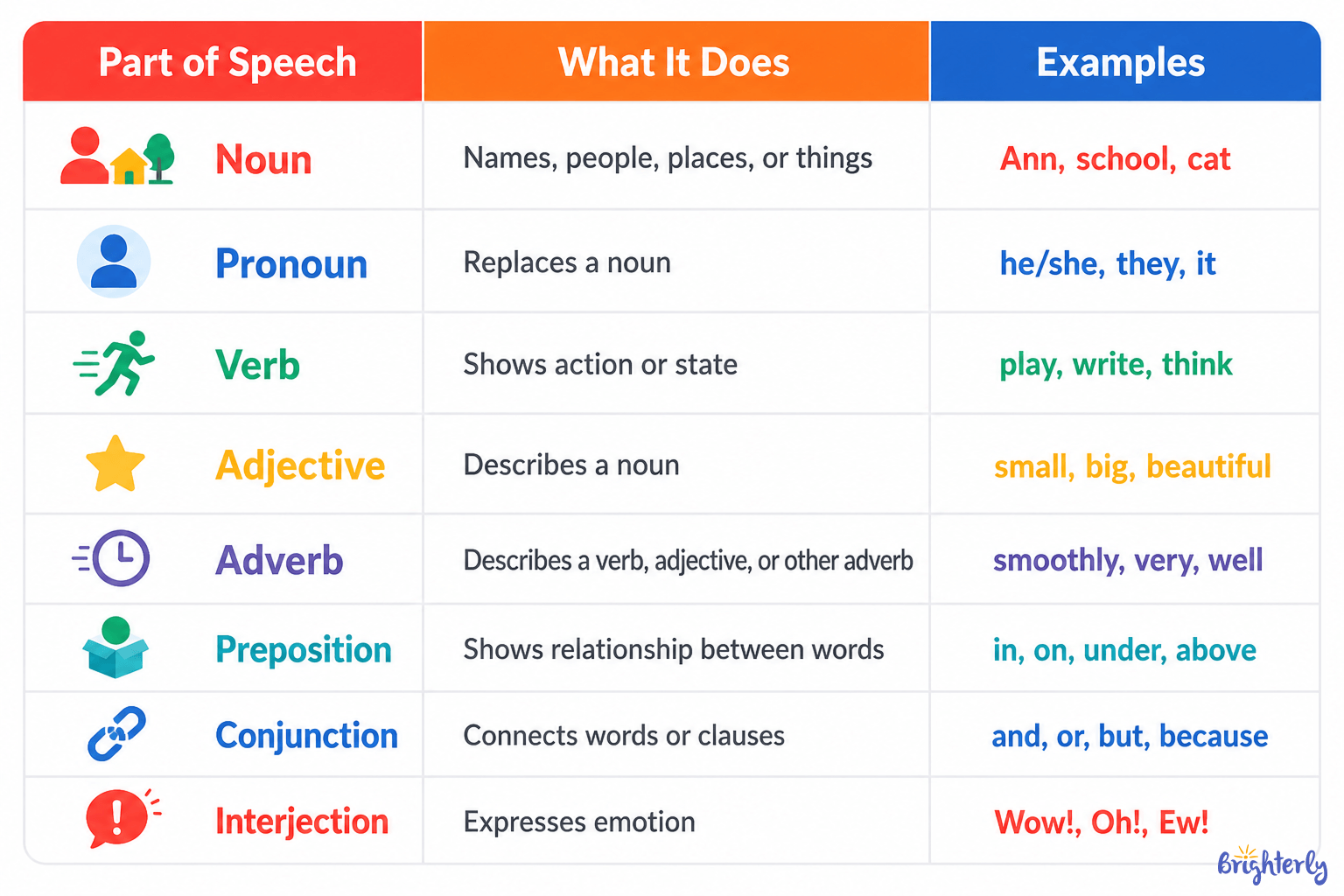
The 8 parts of speech are nouns, pronouns, verbs, adjectives, adverbs, prepositions, conjunctions, and interjections. Each defines the job a word does grammatically in a sentence. Every single word can shift its job depending on how it’s used – this is why it’s important to make sure kids understand function, not just labels when teaching parts of speech.
Nouns
Nouns name a person, place, thing, or idea. They can be common (city, dog), or proper (Chicago, Florida), concrete (apple, table), or abstract (hope, freedom).
Pronouns
A pronoun replaces a noun and changes depending on how you use it in a sentence.
- Subject: she runs
- Object: help her
- Possessive: that is hers
Verbs
A verb describes action, state of being and changes based on tense and subjects.
Examples: run, laugh, build – is, seems, feels – walk/walked/will walk – she runs vs. they run.
Adjectives
An adjective gives more detail about a noun. They answer questions like, Which one? What kind? How many?
Here are a couple of examples: red ball, three happy kids, enormous backpack.
Adverbs
An adverb adds more detail about verb, adjective, or another adverb. Answers questions like: How? When? Where? How often?
Examples: slowly, yesterday, always.
Prepositions
Prepositions connect nouns, pronouns, or phrases. They describe time, location, or movement.
Examples: in, on, under, beside, between, and through.
Conjunctions
Conjunctions are words that link words, clauses and phrases into cohesive sentences.
Examples: for, and, nor, but, or, yet, so, because, although, if, when, either/or, neither/nor, not only/but also.
Interjections
Interactions help you express emotion. They can stand on their own in a sentence.
Examples: Wow!, Oh!, Great!, Yikes!, Yay!, Ew!
Build better skills in ELA with Brighterly!
Our tutors are your child's trusted companions in building ELA foundations. 

Explore Brighterly Learning Experience
Learn exactly how Brighterly helps students thrive through expert sessions, online tools, and proven feedback from thousands of satisfied parents
What Grade Do Kids Learn Parts of Speech?
As per Common Core ELA Standards K–5 Language strand, kids follow a clear developmental sequence. Children start earning parts of speech elementary concepts in Grade 1 and finish the full set in Grade 5.
The table below shows when kids learn all parts of speech. Parents can use it as a reference for planning grammar activities at home and to spot reading comprehension problems in time. Plus, if your child asks, how many parts of speech are there, this table explains that.
| Grades | Parts of Speech Learned |
| Kindergarten – Grade 1 | Nouns (common and proper), verbs, basic adjectives |
| Grade 2 | Adverbs, pronouns (subject and object forms) |
| Grade 3 | Prepositions and prepositional phrases, conjunctions |
| Grade 4 | Conjunctions, relative pronouns, and modal verbs |
| Grade 5 | Conjunctions, perfect verb tenses, interjections in context |
What Is the Best Order to Teach Parts of Speech?
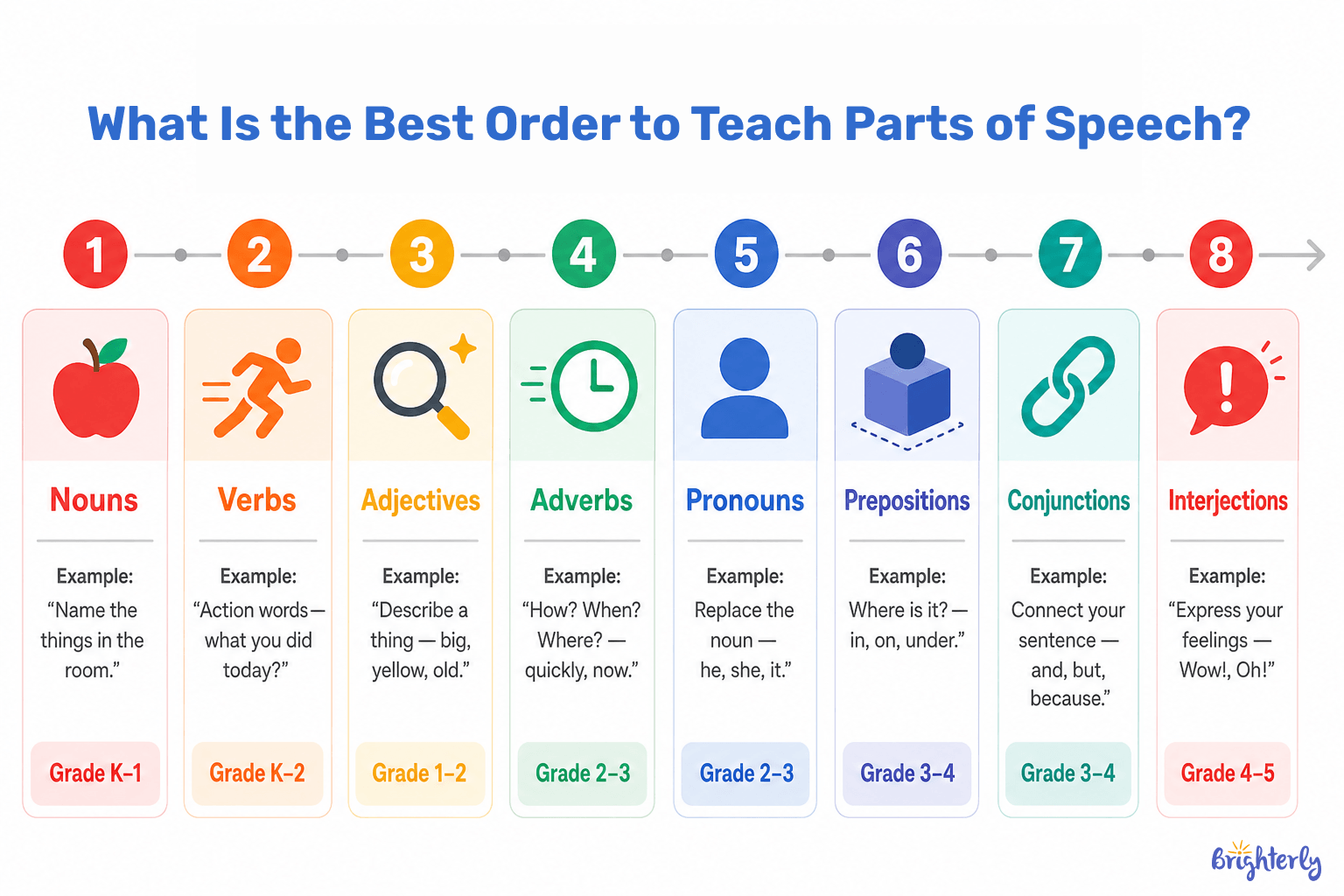
When you teach parts of speech, kids should follow a clear order for better understanding. The most effective sequence is when children move from concrete to an abstract thinking. You can start with things that your child can see and touch (nouns), then actions (verbs), then descriptions (adjectives and adverbs). As last milestone, learn the words that connect and express feeling (conjunctions and interjections).
This is exactly how kids naturally build their understanding of the English language. It also translates directly to the Common Core ELA progressions.
- Nouns – Grade K-1. Example: “Name the things in the room.”
- Verbs – Grade K-2. Example: “Action words – what you did today?”
- Adjectives – Grade 1–2. Example: “Describe a thing – big, yellow, old.”
- Adverbs – Grade 2–3. Example: “How? When? Where? – quickly, now.”
- Pronouns – Grade 2–3. Example: “Replace the noun – he, she, it.”
- Prepositions – Grade 3-4. Example “Where is it? – in, on, under.”
- Conjunctions – Grade 3–4. Example: “Connect your sentence – and, but, because.”
- Interjections – Grade 4–5. Example “Express your feelings – Wow!, Oh!”
How to Teach Parts of Speech: 10 Activities for Kids
The best way to teach parts of speech is to learn through interactive activities like grammar mab libs, color-coding, and verb charades to make abstract concepts concrete. Starting as early as kindergarten can help with long-term parts of speech retention.
This list of activities combines classroom tools, home games, and free printable options. It can help parents teach parts of speech easily at home – it’s so practical, you can start tonight. No special tools needed, and they’re perfect for real life.
Parts of Speech Sorting Game
Write 20-30 words on post-its – nouns, verbs, and adjectives. Ask your kid to sort them into different types of columns with labels. This activity helps them recognize verbs and nouns and works best for K-2. You can do it in under 10 minutes and add a timer for extra fun.
Sentence Builder Cards
Arrange colored cards like this – blue for nouns, red for verbs, yellow for adjectives. Have your child put them into a sentence. This will help strengthen parts of speech recognition and works well for grades 1-3.
Grammar Mad Libs
Before your child sees a story, ask them to call out a noun, verb or an adjective. Together, read what came out of this. This way, abstract grammar becomes easier to remember and helps your kid to see what job each word does in a sentence. Works best for grades 2-5.
Color-Coding Parts of Speech in Real Books
Take your child’s favorite picture chapter book, and have them highlight nouns, verbs, and adjectives in different colors. This activity is great for using actual grammar skills on authentic text and improves reading motivation. Works well for grades 1-2.
Noun Hunt Around the House
Have your child look for objects around the house: one person, one place, and five things. This activity helps to memorize all 3 types of nouns in a familiar home environment and works best for grade 1 students.
Verb Charades
Take folded slips of paper and write verbs like whisper, run, and hop (any verb will work!). Have your child act the verb out while the others guess. This activity helps to memorize what verb is. This is a great activity for kinesthetic learners in grades K-2.
Adjective Describing Challenge
Choose a mystery object and put it in a bag. Ask your kid to reach for the object and touch it then have them describe the object with at least 5 adjectives. This activity helps children boost their descriptive language, especially in grades 1-3.
Conjunction “And/But/Or” Story Game
Start a sentence and have your kid finish it with words like and, but, or or. Pass the story back and forth, like this, “The dog plays with a ball, and…”. This is a low-pressure way to use conjunctions for grades 2-4.
Parts of Speech Flashcard Quiz
Use or make two-sided flashcards: one side with parts of speech and the other with words. Show your child either side and quiz them. This activity builds retention and works well for grades 2-5.
Real-Sentence Labeling Worksheets
Take your kid’s favorite book and ask them to label every word with the part of speech above. For reference, keep a parts of speech chart for kids nearby. This is where children work with real sentences, which is more difficult than drill activities. Works best for grades 3-5.
Common Mistakes When Teaching Parts of Speech
- Teaching isolated parts of speech definition. Teaching isolated parts of speech definition in a single week can be super overwhelming. In that case, kids would rather memorize parts of speech than build real understanding. Skip this approach and follow the developmental sequence – nouns and verbs first, conjunctions and interjections last.
- Skipping pronouns because they seem obvious. Parents think they can just skip pronouns because kids already use them regularly. Pronoun case is what’s important: knowing when to use I vs. me, or who vs. whom is a consistent mistake even in middle school.
- Never connecting grammar to real reading. Whenever you teach, connect activities for the part of speech to books kids are already reading. Ask them things like, “What kind of word is that in this sentence?” It builds a more consistent understanding than decontextualized drills.
Skip the drills and start learning with Brighterly!
Our tutors help close learning gaps and improve reading confidence.
How Parts of Speech Help With Reading Comprehension
Parts of speech help with reading comprehension by allowing kids to break down difficult sentences into parts, spot the main idea and understand relationships between words.
A child that knows what parts of speech mean can read and understand longer, more difficult sentences, especially in nonfiction texts. So, understanding what does part of speech mean is crucial for reading comprehension and independent reading in kids.
The research is clear on that. A 2023 meta-analysis published in Frontiers in Psychology found that better grammar knowledge has a great effect on overall reading comprehension (Zheng et al., 2023, via Frontiers). So, kids who understand parts of speech and what role words play in a sentence have better reading confidence.
For children struggling with parts of speech understanding, reading comprehension can become more difficult. Our online grammar help with personalized 1:1 classes can make a real difference. Brighterly’s reading comprehension program connects expert tutors with students in grades 1-9, addressing learning gaps and improving reading confidence and fluency.
Not sure yet? Start with free, printable PDF worksheets.
Conclusion
Finally, teaching kids parts of speech doesn’t have to be boring, especially now that you have a comprehensive list of 10 fun activities. What’s important is – learn parts of speech gradually in a developmental sequence, work through one activity per week from the list above, and connect words from daily reading to parts of speech.
And if your child is falling behind or losing concentration, book a free reading test and get a complimentary first lesson with Brighterly! Brighterly’s tutors work 1:1 with students in grades 1–12 to build grammar and reading skills through personalized sessions.
Frequently Asked Questions
What parts of speech should a 2nd grader know?
In 2nd grade, most students should be able to identify and use common and proper nouns, action verbs, basic adjectives, and subject/object pronouns.
How can I tell if my child is struggling with parts of speech?
To tell if your child struggles with parts of speech, watch for these signs: repetitive writing, difficulty identifying a word’s role when reading aloud, and confusion about when to use subject vs. object pronouns.
How long does it take for kids to learn all parts of speech?
Under the Common Core ELA scope, kids master all 8 parts of speech by grade 5. But it doesn’t mean it takes 6 years — with consistent practice, your child can master parts of speech much faster.
What are the best worksheets or resources to practice parts of speech at home?
For kids needing targeted practice, Brighterly provides grammar exercises and printable worksheets alongside structured 1:1 support.
What’s the difference between parts of speech and sentence structure?
Parts of speech describe what category a word belongs to (noun, verb, adjective, etc.). Sentence structure — also called syntax — describes how those words are arranged to create meaning (subject, predicate, direct object, clauses).
How do parts of speech support better writing skills in children?
When kids understand what parts of speech are, they gain more control of their writing. They can vary sentence rhythm by placing adverbs in different positions, add depth by layering adjectives, and connect ideas precisely using subordinating conjunctions.



Calculus sounds intimidating, and many students struggle with it because no one explained what it is. Calculus shows how things change and how small pieces add up to something big. This calculus for beginners guide provides a simple definition, key concepts, and a clear, step-by-step path to start learning. What Is Calculus? Calculus is a […]

May 11, 2026
Higher order thinking or Higher order thinking skills (HOTS) is a set of complex cognitive processes that allow us to analyze, evaluate, and create. Learn why these skills are so important for students and how to help your child develop them at home. What Is Higher Order Thinking? Higher order thinking, or as it’s also […]

May 12, 2026
Math & reading from 1st to 12th grade
Looking for homework support for your child?

Choose kid's grade

Math & Reading for Grades 1–12
Build real confidence for your child with a Brighterly math or reading tutor.