
What Is Abstract Thinking & How To Develop It?
reviewed by Claire Smizer
Updated on May 3, 2026

If your child tends to take things very literally and struggles to see the full picture, they may need support developing abstract thinking. Abstract thinking is a crucial mental skill for understanding ideas, patterns, and concepts that go beyond what they can see or touch. In this guide, we’ll go over what abstract thinking is and some practical ways to develop it.
Key Points:
- Abstract thinking is a cognitive ability to understand ideas that you can’t see or memorize, concepts that aren’t concrete, physically present.
- Examples of abstract thinking concepts include humor, love, friendship, success, hope, etc.
- Abstract thinking skills involve understanding the logic behind the rules, understanding jokes and sarcasm, and seeing the implied meaning in conversations.
- If your child loves doing creative things, makes jokes often, and asks hypothetical questions, they are most likely abstract thinkers.
- Online tutoring platforms that focus on foundations can help develop abstract thinking effectively.
5 Easy Ways To Improve Abstract Thinking
Easy ways to improve abstract thinking at home include:
- Ask open-ended questions
- Talk about “what-if” scenarios
- Discuss metaphors and analogies
- Support reflection and reasoning
- Get math and reading tutoring help
Explore Brighterly Learning Experience
Learn exactly how Brighterly helps students thrive through expert sessions, online tools, and proven feedback from thousands of satisfied parents
What Is Abstract Thinking?
Abstract thinking definition refers to a skill that helps understand ideas that you can’t see or memorize, concepts that aren’t concrete, physically present. It helps to understand “why” behind things, see beyond rules, patterns, and connections.
Here are examples of abstract concepts:
- Humor
- Frindship
- Imagination
- Love
- Success
- Hope
- Wisdom
- Freedom
Note: These ideas aren’t physical things but are real concepts that we can experience. You might notice your child asking, “What is hope?” That means they are starting to think abstractly.
For children, abstract thinking skills involve understanding the logic behind the rules, understanding jokes, sarcasm, and metaphors; seeing the implied meaning in conversations, and figuring out different outcomes from a situation.
Let’s see how it works: for example, your child doesn’t just know that 2 + 2 = 4. But they see the logic behind the problem, how the numbers relate to each other, and how they can apply the same logic to other problems.
More importantly, children don’t wake up one day as perfect abstract thinkers. The process of developing abstract thinking is long, and it progresses as kids face new experiences, learn new skills, and ask questions.
Examples Of Abstract Thinking In Everyday Life
Here are some abstract thinking examples in real life:
- Understanding emotions: When we think about concepts like love, friendship, fairness, and hope, we think abstractly. You think about things, even though you can’t see or touch them.
- Using metaphors: Saying phrases like “time is money” activates your abstract thinking, because you don’t mean it literally.
- Planning ahead: When you map out your plans, think about what might happen, and make your decisions based on that, you use abstract thinking.
- Solving problems: Finding the best way to handle a situation instead of following a fixed rule.
- Imagining possibilities: asking questions like, “What could happen if…” and thinking beyond the present moment.
Some people are more naturally abstract thinkers than others. But it doesn’t mean it’s a fixed trait that can’t be improved.
So, abstract thinking is not just something kids use to write an essay or draw a picture. It stretches far beyond academic activities in school, giving kids a deeper understanding of the world around them.
Why Abstract Thinking Matters?
Abstract thinking matters because it allows children to move beyond facts to understand complex concepts, see patterns, and creatively solve problems. It allows for future planning, empathy, understanding ideas like love and hope.
Furthermore, students should develop abstract thinking because it will help them learn. Here’s how.
We often focus on study methods or a student’s learning style to improve their academic results. What we also do is overlook the thinking skills behind them.
One of the most important is abstract thinking – a core skill for thinking critically and solving complex problems more effectively and creatively.
Note: Research supports the importance of abstract thinking in academic development. For example, according to the research by J. A. Vega Vermehren, A. Trikoili & D. Pittich published in the International Journal of STEM Education in 2025, abstract thinking is vital for learning subjects like math and science. It helps kids move from concrete problems to ideas and patterns.
Another 2025 study by Chun Li, Shuo Feng, Yue Zhang, Hui Peng, and Xiaoqing Ma published in J Intell found a higher level of abstract thinking helps kids focus on goals, think more creatively, and come up with new ideas.
Besides, abstract thinking is an essential brain skill for critical decision-making, problem-solving, and reasoning. When kids think abstractly, it helps them visualize the problem and retain information better.
Note: Abstract thinking is all about looking critically at a problem, without relying solely on existing knowledge.
So, why should students develop abstract thinking? Abstract thoughts help children understand and expand concepts and ideas, not just memorize them. Research shows that it’s a key to problem-solving, cause and effect understanding, reasoning, and creativity.
When Abstract Thinking Becomes Overthinking?
Interestingly, there are some bad examples of abstract thinking. Abstract thinking can sometimes work against us – also when it turns into overthinking. And neurodivergent kids can be especially prone to it.
Sometimes an overactive imagination can turn to catastrophizing, where we imagine the worst possible outcomes in any situation.
For example, one small mistake can lead to your child saying, “I’m bad at everything!” or “I will never get that”. A simple and manageable situation can feel much bigger than it actually is.
Due to the 2024 research by Sarah J Egan, Danyelle Greene, Thomas Callaghan, Shravan Raghav, Julia Funk, Theresa Badenbach, Samuel Talam, Georgia Kemp, Peter McEvoy, Thomas Ehring, and Johannes Kopf-Beck 5, those researchers struggle to link this pattern to anxiety and depression in children, where kids react not to what is happening, but to what they think could happen.
To put things into perspective, about 40% of high school students in the United States have experienced prolonged feelings of sadness or hopelessness. Roughly 20% have seriously considered attempting suicide. Some of them might even need behavioral therapy.
So, what does it mean to think abstractly? Occasionally, it can mean being overly focused on “what if something bad happens?” This can manifest in various psychological symptoms and a decline in the mental health of children.
This is why it’s important to guide abstract thinking, help kids stay grounded, and use it to think critically and in a balanced, healthy way.
How Abstract Thinking Develops
Abstract thinking develops gradually with everyday activities like reflecting, asking open-ended questions, and interacting with the world. Before the age of 7, most thinking is concrete. As kids grow, they begin to develop their abstract thinking more actively — they notice patterns, understand cause and effect, ask deeper questions like “why does this happen?” and “what if…” These are important years for the development of abstract thinking.
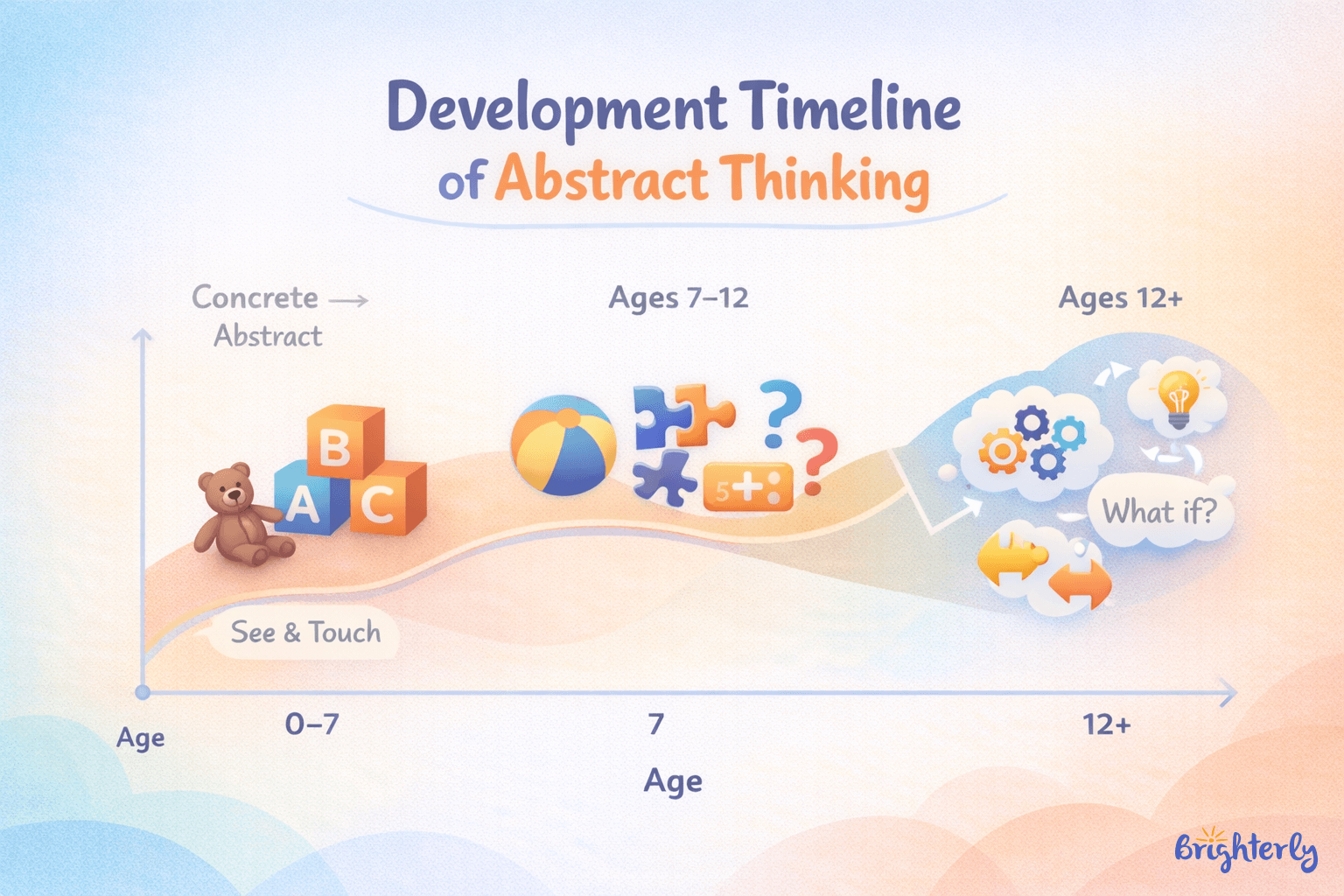
Note: In early childhood, typically before age 7, most thinking is concrete. By around the age of 12, many children begin to use abstract thinking more actively. However, this development doesn’t happen for every child in the same place. Some kids naturally lean toward one or the other way of thinking. .
When abstract thinking is impaired, kids may need more support to move from memorizing rules to actually understanding concepts. This is true for math lessons, where abstract thinking is essential for fractions, algebra, and general problem-solving.
The good news is that parents and tutors can help kids support abstract thinking at home. For parents, simple interactions — like asking open-ended questions, or discussing what-if scenarios — can help strengthen these skills.
Over time, these small experiences can boost the kid’s ability to think abstractly, become more flexible thinkers, and delve into deeper ideas.
How To Improve Abstract Thinking?
You can improve abstract thinking with simple everyday activities. For example, you can ask open-ended questions and discuss “what-if” scenarios. Also, talking about metaphors and their meanings is a good idea. Supporting reflection is another great thing — invite your child to reflect on their experiences.
- Get math and reading tutoring help
- Ask open-ended questions
- Talk about “what-if” scenarios
- Discuss metaphors and analogies
- Support reflection and reasoning
Get Math And Reading Tutoring Help
Reading and math are two of the subjects for developing abstract thinking. Brighterly is an online educational platform with a math and reading program for K-12 learners, built on a foundation-first approach.

At Brighterly, tutors use interactive 1:1 sessions and real-life examples to boost kids’ abstract thinking. The program combines games, stories, and hands-on experiences to help children think critically, solve problems creatively, and apply their knowledge right away.
This after-school math program starts at $17.70/lesson (12-month plan, 2 lessons/week, 20% discount applied). For parents, this is an affordable and effective way to help their children develop abstract thinking and become more confident learners.
Flexible mind and rock-solid skills in key subjects
Brighterly tutors prepare your child for success in school and beyond.


Ask Open-Ended Questions
When you’re trying to improve your kid’s abstract thinking, it’s best to move from closed-ended questions to open-ended questions. This encourages reasoning and thinking beyond “yes” or “no” answers.
For example, you can ask questions like “Why do you think he did that?” or “What do you think will happen next?” Invite your child to explore ideas and possibilities — that will help them see connections and develop a deeper understanding of what’s happening.
Talk About “What-If” Scenarios
Discussing hypothetical situations is key to boosting abstract thinking. Discussing hypothetical situations helps your kid explore possibilities.
For example, you could ask your child, “What could happen if you didn’t go to school today?” or “If the rules didn’t exist, what would you do?” These small moments will improve their problem-solving skills and help them think flexibly.
Discuss Metaphors And Analogies
When you read stories, poems, or watch TV, you can help your child spark abstract thinking. Ask your kid to interpret phrases like “Time is money” or compare characters’ choices in a story to real-life situations. Little by little, you’ll see how your kid moves beyond literal thinking and sees underlying ideas!
Support Reflection And Reasoning
In conversations, ask your child to explain their thought process. Explaining their reasoning out loud strengthens problem-solving.
For example, if you’re having a conversation about something, ask your child, “How did you get to that conclusion?” This helps them think through their steps, reasoning, and understand cause-and-effect relationships.
Abstract Thinking vs Concrete Thinking
Abstract and concrete thinking focus on different things. Concrete thinking focuses on what is real, tangible, and directly experienced, while abstract thinking involves hypothetical ideas and possibilities.
Here’s a simple comparison of abstract vs concrete thinking:
| Abstract thinking | Concrete thinking | |
| Focus | Focuses on ideas, hypotheticals, and indirect experiences | Things they can see, touch, or experience |
| Examples |
Understanding emotions, using metaphors, planning ahead, solving problems, and imagining possibilities |
Following the rules exactly, counting objects |
| Problem-solving | Memorizing, following the steps exactly | Predicting outcomes and looking for patterns |
| Thinking style | Reflective | Fact-based |
| Age | After the age of 6-7 | Usually before 7 |
Conclusion
Finally, what is abstract thinking? Abstract thinking is the ability to understand and think about non-physical things, concepts that aren’t concrete or physically present. It helps to understand “why” behind things, see beyond rules, patterns, and connections.
So, should you help your child develop abstract thinking? Absolutely! It helps children understand and expand concepts and ideas, not just memorize them. Research shows that it’s a key to problem-solving, cause and effect understanding, reasoning, and creativity.
And if you need some support – Brighterly is here to take on the task. Reading and math are two of the subjects for developing abstract thinking. Book free lesson and see how our interactive approach helps your child think more creatively!
FAQ
When Does Abstract Thinking Develop?
Abstract thinking develops gradually and every child develops at their own pace. Basically, kids begin to think abstractly around 6 or 7 years old.
This is when they move from concrete thinking (seeing, touching, and experiencing directly) to abstract thinking – understanding ideas, exploring possibilities, noticing patterns, etc. The key is that abstract thinking evolves as children interact with the world, experience things, and learn.
How To Assess Abstract Thinking?
You don’t need formal tests to evaluate your child’s abstract thinking skills. In general, you can assess it through daily activities.
For example, you can ask questions like, “Why do you think that?” or “What do you think will happen next?”. If they can explain their thinking, reasoning, and connections between ideas, their abstract thinking may be developing well.
Is Abstract Reasoning High IQ?
Abstract reasoning can be linked to high IQ. It involves skills like problem-solving, reasoning, and logical thinking. But a well-developed abstract thinking doesn’t mean high intelligence, per se.
A child doesn’t need a high IQ to develop abstract thinking or vice versa. Some kids develop abstract reasoning earlier than others, while others need more time and guidance.
How Do I Know If I Am an Abstract Thinker?
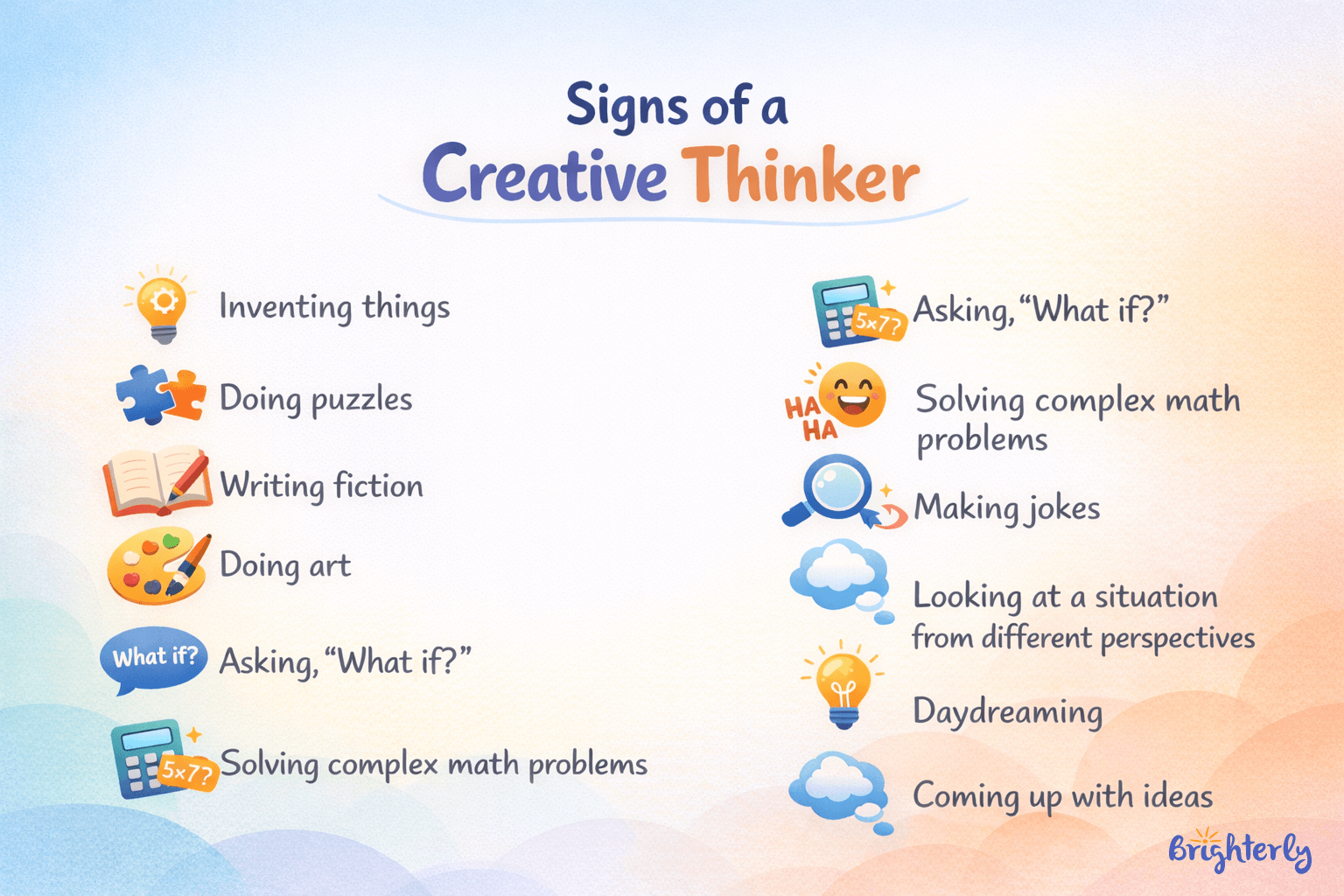
Abstract thinkers are often more drawn to:
- Inventing things
- Doing puzzles
- Writing fiction
- Doing art
- Asking, “What if?”
- Solving complex math problems
- Making jokes
- Looking at a situation from different perspectives
- Daydreaming
- Coming up with ideas
Abstract thinkers often think about the bigger picture rather than concrete ideas. They are more interested in the deeper meaning, patterns, and possibilities.
Do People With ADHD Struggle With Abstract Thinking?
People with ADHD don’t necessarily struggle with abstract thinking, but they may find it harder to use it consistently. It’s linked to challenges with attention, focus, and working memory. However, many are strong in it—especially in creative or idea-generation tasks. The challenge lies more in staying consistent.
What Are Some Examples Of Abstract Thoughts?
Abstract thoughts aren’t tied to physical objects or direct experiences. If you’re thinking about emotions, values, and hypothetical ideas, you’re having abstract thoughts.



When you look for the right college to get into, the best college comparison websites are your closest allies. That’s where you check general information, admission rates, and tuition costs. Alongside comparing schools, it’s worth strengthening your academic profile early — for instance, through structured math courses that build the skills colleges look for. Read […]

Apr 15, 2026

The best high school homeschool curriculum depends on your kids’ needs and family preferences. You can choose between faith-based and secular, self-paced and parent-led, classical and modern curricula. This guide compares 10+ recognized homeschool solutions by price, format, approach, and preparation. If your child needs personalized support, you can find online reading and online math […]

Apr 17, 2026
Math & reading from 1st to 12th grade
Looking for homework support for your child?

Choose kid's grade

Math & Reading for Grades 1–12
Build real confidence for your child with a Brighterly math or reading tutor.