Higher Order Thinking: Definition and Importance
reviewed by Marvi M. Andres
Updated on May 12, 2026
Key Points:
- Higher order thinking is a complex of cognitive processes that move beyond basic memorization, recall, and comprehension.
- January 2013 research by the University of Chicago and the University of North Carolina found that children begin to show signs of higher-level thinking skills as young as age 4 ½.
- It’s important to develop these skills early, not only to help children achieve academic success but also to adapt to different life situations, become independent, and prepare for a future career.
- Parents can support the development of these processes in their kids through applying specific strategies, like playing question-based games, encouraging a child to find a solution to a particular problem, or asking them to create their own project from scratch.
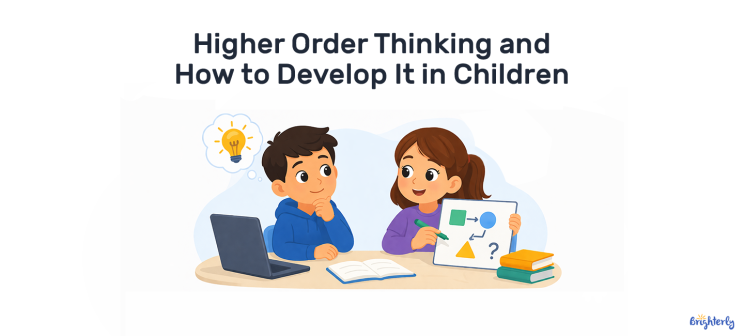
Higher order thinking or Higher order thinking skills (HOTS) is a set of complex cognitive processes that allow us to analyze, evaluate, and create. Learn why these skills are so important for students and how to help your child develop them at home.
What Is Higher Order Thinking?
Higher order thinking, or as it’s also called, higher order thinking skills (HOTS), is a set of cognitive processes that occur in our brains, allowing us to do more than memorize, recall, and comprehend. Thanks to these processes, we gain skills to think critically, evaluate concepts, and be creative.
Note: Back in January of 2013, research by the University of Chicago and the University of North Carolina has recently found: “Children begin to show signs of higher-level thinking skills as young as age 4 ½.”. This 2013 study remains the primary reference in early childhood cognitive development research, as no later study has contradicted its results.
How Higher Order Thinking Differs from Basic Thinking Skills
Higher order thinking skills differ from basic thinking skills based on how all of these skills are categorized in Bloom’s Taxonomy. It’s a pyramid that divides lower order skills into categories called “recall”, “understand”, and “apply”, and places them on the bottom, while the higher level skills fall into categories called “analyze”, “evaluate”, and “create”, and form the top.
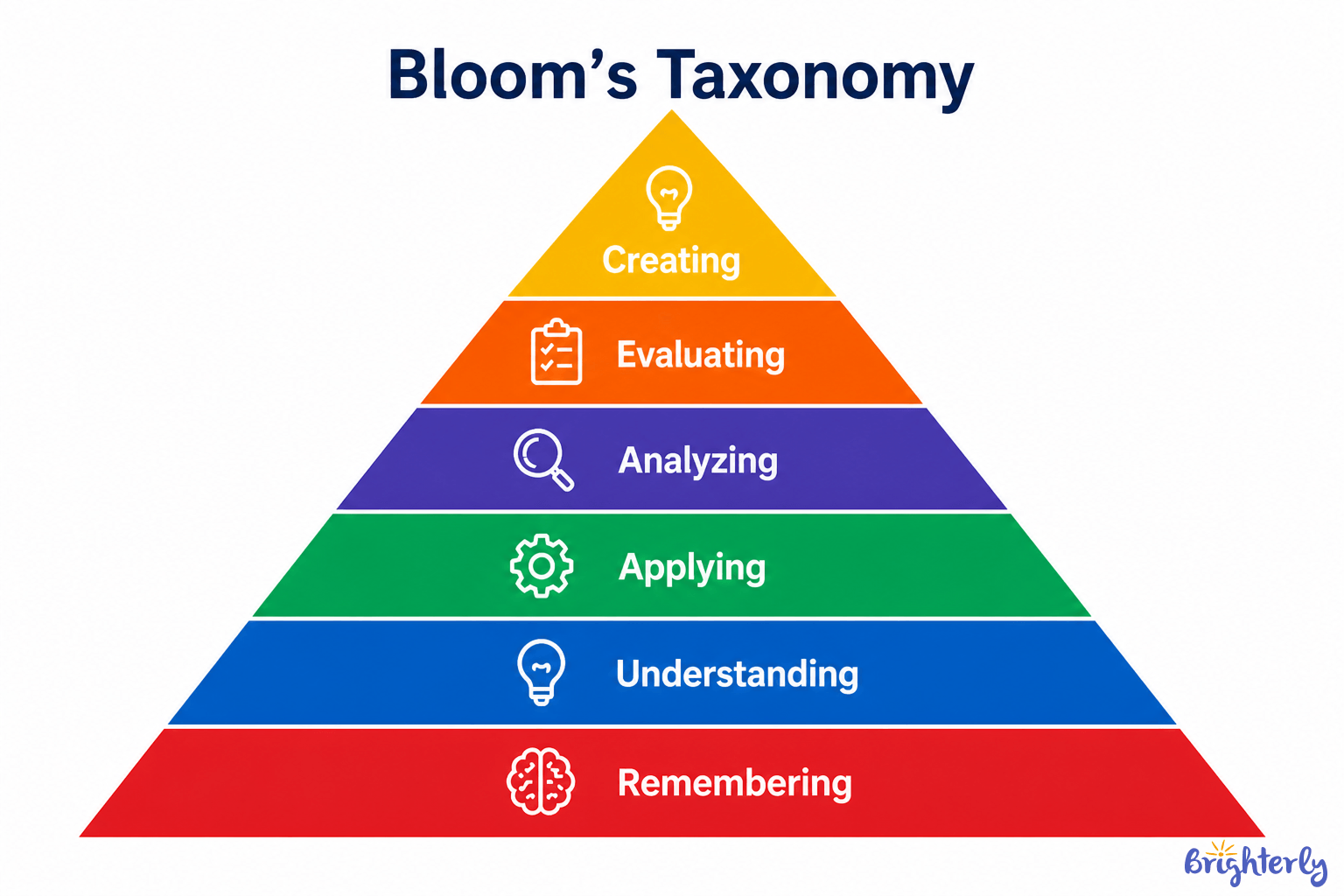
In essence, the higher order thinking meaning lies in the ability of the brain to think in an abstract way and solve complex mental tasks, while lower order thinking involves the processing of simple, more basic tasks.
Help your child develop HOTS easily
Brighterly tutors help your kid analyze, evaluate, and create based on their learning style and knowledge level.


Explore Brighterly Learning Experience
Learn exactly how Brighterly helps students thrive through expert sessions, online tools, and proven feedback from thousands of satisfied parents
Higher Order Thinking Skills Explained With Examples
Based on Bloom’s Taxonomy, higher order thinking skills are divided into three major categories: analysis, evaluation, and creative thinking. However, there are higher order thinking examples for each of these major categories that help us understand what each one means in real-life situations.
Analysis Skills Examples
Analysis is a skill that means the ability to break down information, like a topic, text, or a problem, into smaller parts to understand how they relate to one another. Examples of when this skill is applied include comparison, examination, deconstruction, and contrast.
- Comparison: Comparing two characters in a story to see what their main differences are.
- Examination: Examining several math problems to find the common rule.
- Deconstruction: Deconstructing a math word problem to figure out which data is relevant and which isn’t.
- Contrast: Looking at two historical figures and contrasting their motivations and actions.
Evaluation Skills Examples
Evaluation is a skill that involves judging something by relying on evidence, outcomes, and logic. This skill is the core of critical thinking. The examples of when this skill is applied include accessing (fact-checking), reviewing, and deciding.
- Assessment: Determining if a source of information is reliable.
- Review: Analyzing a classmate’s project based on certain criteria to formulate constructive feedback.
- Decision-making: Choosing the most efficient way to solve a problem and explaining why that way is the best.
Creative Thinking Examples
The skill to create is the highest level of thinking. It means the ability to use already gained knowledge for forming something new and original, whether it’s a text, an art piece, a new theory, etc. The examples of creativity include inventing, composing, and hypothesizing.
- Invention: Designing a new tool to help with a household chore.
- Composition: Writing a unique story that doesn’t copy any famous scenario.
- Hypothesization: Using a scientific theory to explain why a plant grows faster in certain conditions.
Note: Find out why creative storytelling is an important skill to teach kids.
Why Are Higher Order Thinking Skills Important for Students?
The importance of higher order thinking skills for students primarily lies in the improvement of academic performance. Learners who have mastered how to analyze, evaluate, and create are better prepared for their upcoming career, adapt to life situations more easily, and don’t struggle with making their own decisions, which is essential for both education and private life.
- Academic excellence: Students get better grades in classes.
- Adaptability: Students can use their knowledge in unfamiliar situations.
- Career readiness: Students are prepared for complex tasks and challenges a job may involve.
- Independence: Students know how to analyze, evaluate, and create on their own.
Higher Order Thinking vs Lower Order Thinking
While lower order thinking (LOTS) provides the necessary cognitive skills base we need to receive and recall information, the skills that define higher order thinking are essential for manipulating this memorized information to make decisions, solve problems, or create something new.
| Lower Order Thinking | Higher Order Thinking | |
| Bloom’s Taxonomy levels | Remember, Understand, Apply | Analyze, Evaluate, Create |
| Cognitive effort | Low (recalling) | High (processing) |
| Examples | Listing, naming, defining | Comparing, judging, inventing |
| Outcome | Fact acquisition | Deep understanding |
| Materials/activities used for practicing | Flashcards, rote drills | Math worksheets, debates, projects |
Higher Order Thinking Questions Parents Can Use
There are specific questions we can ask to launch higher order thinking processes in a child’s brain. Such questions encourage a child to think critically, solve problems, offer alternatives, etc. They can be open-ended questions, socratic questions, or Bloom’s Taxonomy question stems.
Open-ended questions are the higher order thinking questions that encourage critical thinking:
- “What would happen if the main character made a different choice?”
- “Why do you think this math formula works for this problem?”
- “What do you think would happen if schools did not give grades?”
Note: You can use these math riddles for practicing.
Socratic questioning techniques are used to challenge the child’s reasoning:
- “Can you give me an example of where that would not be true?”
- “If someone disagreed with you, what might they say?”
- “Is there another way to look at this situation?”
Question stems by Bloom’s taxonomy are the questions tied to each category of higher order skills in Bloom’s taxonomy pyramid:
- Analyze: “What is the relationship between X and Y?”
- Evaluate: “Which solution is most effective and why?”
- Create: “Can you design a plan to solve this problem?”.
How Parents Can Develop Higher Order Thinking at Home
The higher order thinking strategies parents can use at home include playing specific question-based games, brainstorming, debating, looking for solutions, encouraging mistake analysis, and asking a child to create something new and unique.
- The “Why” game: Every time your child states a random fact, ask them, “Why?”
- Mistake analysis: When a child gets a math problem wrong, ask them to find where their solution process went wrong instead of solving it for them.
- Creation: Ask a child to build something, write a story, or create something else.
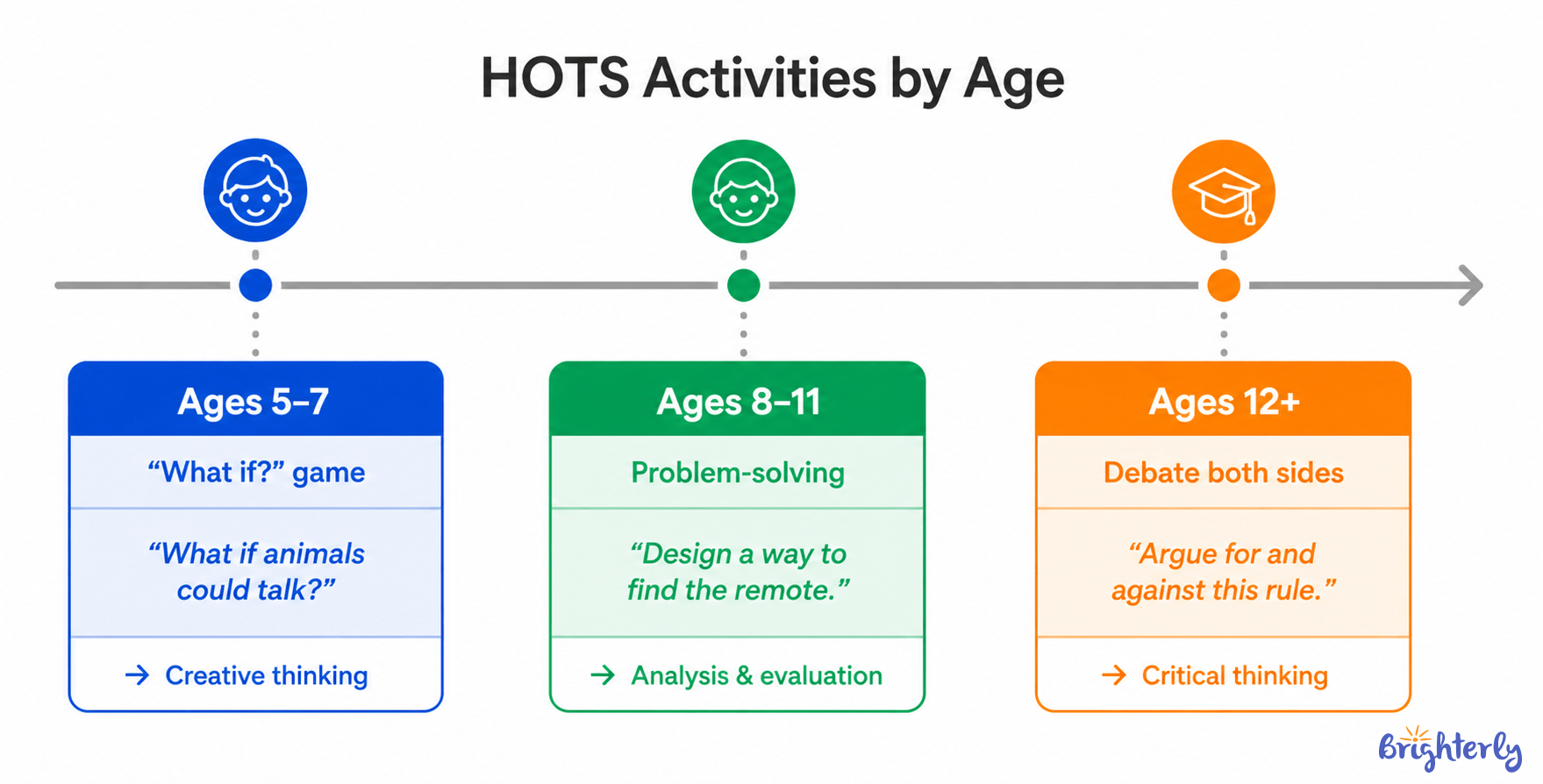
According to Serina Lee, Owner and CEO of Newborn Nursery Furniture, the kids’ age also plays a huge role in which questions and methods parents should use. Here is what she offers:
“For ages 5-7, you can play the 'What if?' game, for example, 'What if animals could talk?' and let your kids run wild.”
For age 12+, you can pick a topic and let your kids debate on both sides, like sports rules. It stretches their ability to analyze and challenge assumptions.


In case you struggle to help your kid develop higher order thinking skills, we have professional reading and math tutors who know how to identify where the problem is and apply game-based and interactive practices to teach your child. For example, a tutor can offer professional homework assistance, teaching a kid to apply higher order thinking while analyzing their mistakes.
Our reading and math classes are developed for kids in grades K-12 and align with the U.S. state standards. However, our professionals personalize the program to your kids’ needs, learning style, and level of knowledge.
How to Assess Higher Order Thinking Skills
To assess the child’s higher order thinking skills, look at how deep their thinking process can go and how their reasoning works. For this, the following methods can be of much help.
Rubrics and Performance Tasks
Rubrics and performance tasks use rubrics that evaluate specific thinking skills, like clarity, logic, and innovation.
- Clarity: How well did the child explain their problem-solving process?
- Logic: Did the conclusion match the evidence?
- Innovation: Did they provide a creative solution?
Open-Ended Assessments
Open-ended assessments are when you ask a child to come up with an answer on their own, without providing them with answer options. For example, ask them how they would solve a particular conflict in history if they were a historical figure.
Project-Based Assessment
A project-based assessment is when you allow a child to demonstrate multiple levels of thinking by offering them the opportunity to propose solutions to a project. For example, choose a local environmental issue and have the kid brainstorm solutions.
Want professional help for your child?
Our professionals choose higher order thinking strategies that match your child’s age and needs.
Common Challenges in Developing Higher Order Thinking
Common challenges in developing higher order thinking skills include pedagogical issues, fast curriculum, and cognitive barriers students have. It means that while kids keep relying on teachers to solve tasks, teachers don’t have enough knowledge, resources, or time to help children master HOTS effectively.
- Pedagogical challenges: Teachers struggle to create, implement, and assess tasks for developing kids’ HOTS, focusing on lower order thinking tasks instead.
- Fast curriculum: School programs are too tight for educators to fit deep higher order thinking activities into lessons and too fast for kids of different learning styles to keep up.
- Student cognitive barriers: Kids often rely on teachers for answers rather than solving problems themselves, which hinders their ability to think critically or act independently.
Frequently Asked Questions
What Is the Highest Order Thinking Skill?
According to Bloom’s Taxonomy pyramid, created by Benjamin Bloom in 1956, the highest order thinking skill is the ability to create. It involves all kinds of creation: designing, planning, writing, constructing, assembling, investigating, generating, and formulating. So, when you use your creativity skill, the result must be something original, whether it’s a physical piece, an approach, a solution, or something else.
What is Another Name for Higher Order Thinking?
Other names for higher order thinking are critical thinking, complex thinking, deep learning, strategic thinking, or advanced cognitive processes. Basically, any term or process that implies analysis, evaluation, and creation can be referred to as higher order thinking.
What Are Examples of HOTS Questions?
The examples of HOTS questions focus on analysis, evaluation, and creation, so they usually open with “What if”, “How”, or “Why”. These types of questions push kids to think critically, justify their opinions, or solve problems, rather than simply recalling something.
Can Higher Order Skills Be Self-Taught?
Yes, higher-order skills can be self-taught, but it requires lots of regular practice, active learning, structured self-examination, and review to master them on your own. While self-teaching positively affects autonomy and self-reflection, mentorship from parents or educators can help to speed up the process.
What Is the Difference Between Higher and Lower Order Thinking?
The main difference between higher and lower order thinking lies in the complexity of cognitive processes. Lower order thinking is about receiving and storing information, while higher order thinking is about manipulating this information, judging it, or creating something new from it.

Most kids can tell what a noun is — a person, place, or thing — but completely freeze when asked to spot one in a sentence. This is also true for other parts of speech definitions and examples. This article guides you through the eight parts of speech with kid-friendly definitions, simple examples, and provides […]

May 11, 2026
Brainly reviews show that the platform works well for quick homework questions, AI explanations, and peer-supported learning, but it is not designed around consistent long-term instruction with the same tutor. For students who need personalized teaching, targeted work on learning gaps, and ongoing 1:1 support, Brighterly provides a more structured math and ELA alternative. Rating […]

May 13, 2026
Math & reading from 1st to 12th grade
Looking for homework support for your child?

Choose kid's grade

Math & Reading for Grades 1–12
Build real confidence for your child with a Brighterly math or reading tutor.