Phonics Activities for Kids: Hands-On Ways to Build Reading Skills
reviewed by Laila A. Lico
Updated on November 13, 2026
Key Points:
Phonics activities for kids teach them how letters and sounds connect, and transform reading time playfully with fun stories and effectively with worksheets. Save these exercises to teach kids phonics (organized by age and format) and particular methods of doing it at home, and find out how to make phonics practice feel like play.
Phonics Activities for Kids
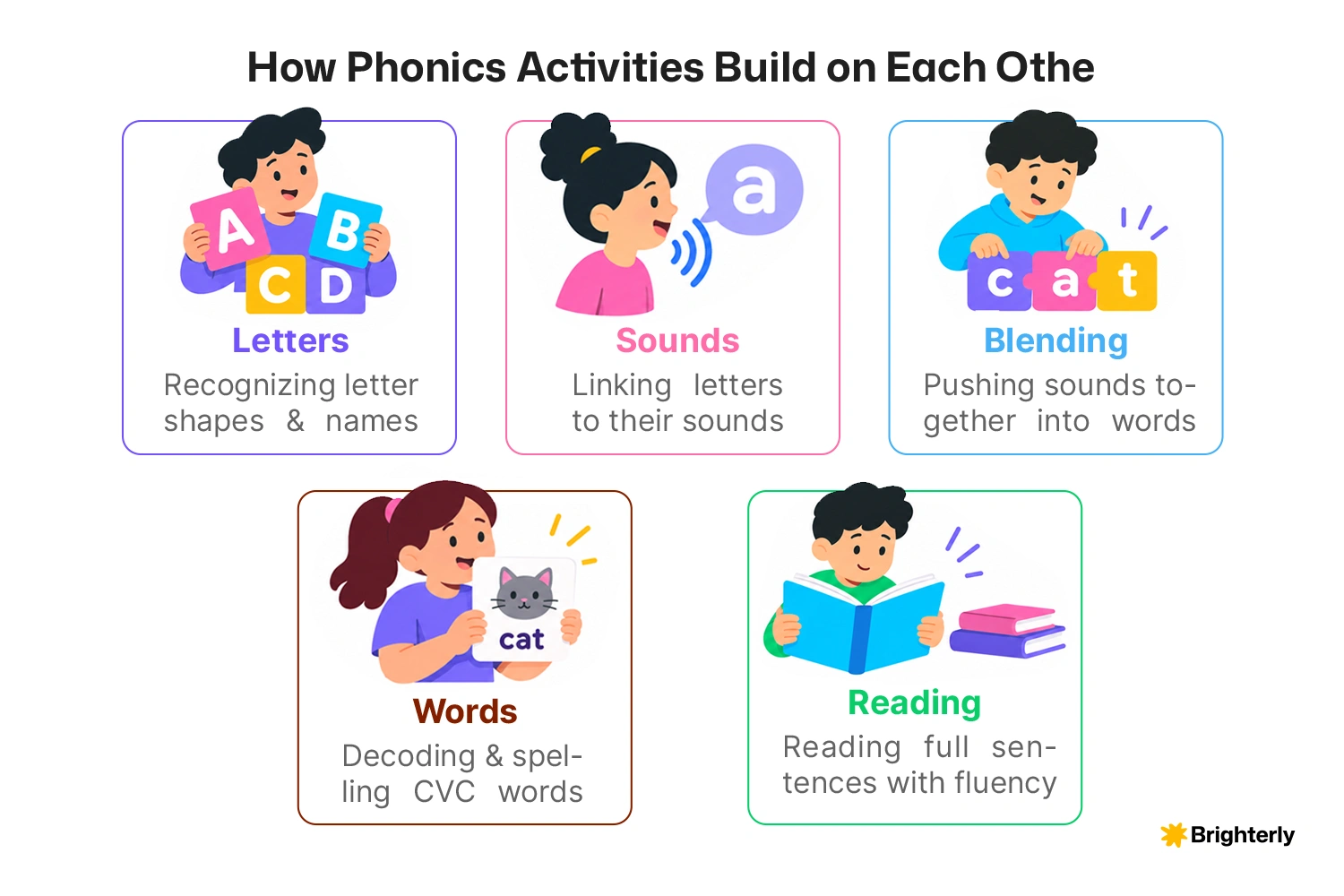
Activity 1 – Phonics Worksheets for Practice
Best for: Kindergarten to 2nd grade
Our professional reading tutors at the Brighterly math and reading platform created targeted printable tasks that reinforce phonics rules. Before you start practice, our 1st grade reading test or a 2nd grade reading test can help identify your child’s current level, so the activities for teaching phonics could better match. You can pair these printable tasks with magnetic letters for hands-on phonics fun. Our exercises build consistency and visual memory, enhancing letter-sound recognition, as well as decoding and spelling.
Our phonics worksheets on Brighterly are free, expertly designed, perfect for at-home practice, and widely used by students across the US. You can use them online, print and laminate the pages, or apply dry-erase boards so your child can reuse them for daily practice.
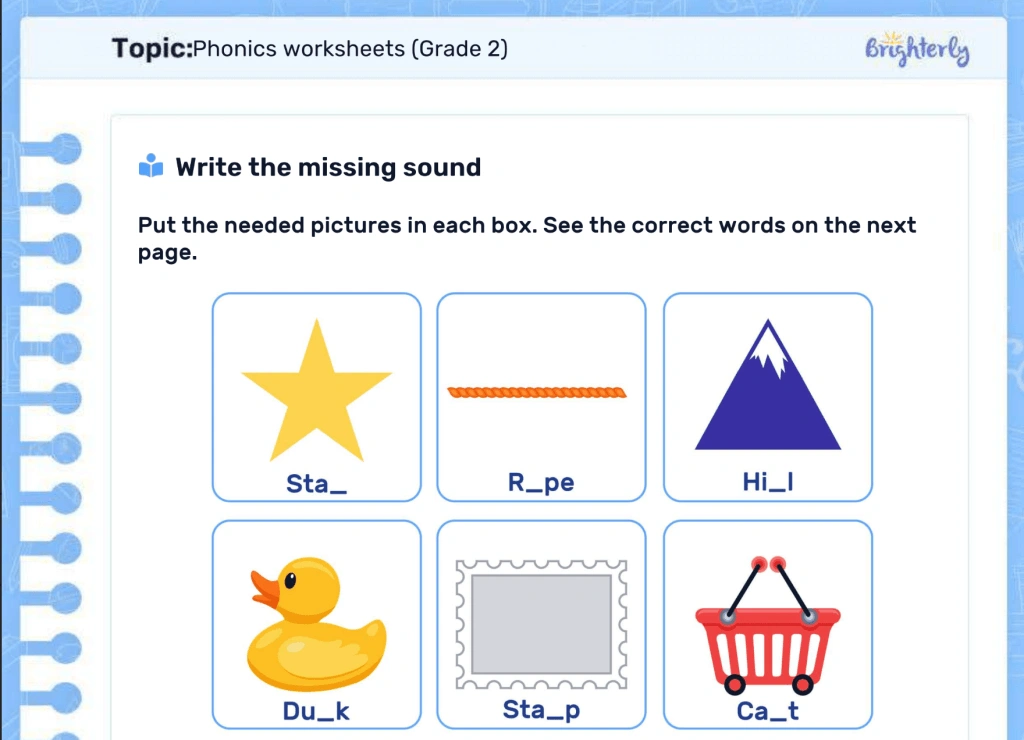
Teaching phonics activities may be a win-win way to spend time together! You’re having fun and, at the same time, improving a wide range of reading and spelling skills, including encoding and other core phonics essentials.
Help your child reach their full potential!
Answer a few questions about your child’s learning, and we’ll recommend next steps. 

Activity 2 – Recognizing Letters Everywhere
Best for: Preschool and kindergarten
It’s spotting letters on signs, labels, or books that strengthens print awareness and alphabet familiarity. This type of phonics activities for kindergarten is used early in phonics learning, during daily routines. It ultimately helps develop visual discrimination and letter identification. It also helps little ones connect what they see in the world with the letters they’re learning.
Examples of phonics activities for recognizing letters:
- Letter search. Print some worksheets (or grab a few old magazines) with a bunch of different letters laid out in a grid, and let your kid look for and circle one letter. You can also have them circle letters in various colors (A in red, D in green, etc.).
- Letter lineup. Take a set of letters (first uppercase, and then lowercase), and challenge your child to sort them by letters with:
- only straight lines (e.g., W or X),
- only curvy lines (like C or S),
- a mix of straight and curvy (D or B, etc.).
- Environmental letter bingo. When you take a walk or do the groceries together, take a simple 3×3 bingo grid with uppercase and lowercase letters and have your child cross off letters when they spot them on street signs, cereal boxes, storefront logos, etc., until they get three in a row.
Note: In fact, here are 10 more ways to teach your child letter recognition: find out if starting with the alphabet is a good idea and at what age kids are expected to name letters altogether.
Activity 3 – Connecting Letters With Sounds
Best for: Kindergarten
Children pair written letters with spoken sounds. That way, phonemic awareness and decoding ability are actually formed. Use letter-sound correspondence before blending sounds or reading simple words to build your child’s sound recognition and phoneme-grapheme connections.
Examples of phonics activities on connecting letters with sounds:
- Alphabet sound sorting. Grab a few containers or baskets marked with letters (e.g., A, B, and C). Collect small pictures or toys beginning with those sounds – like, an apple, a ball, a car. Ask your kid to say the item’s name out loud, listen for the sound it starts with, and put it in the correct container.
- Sound hunt around the house. Choose a sound of the day – let’s say it’d be /s/. Walk around your house and search for items beginning with that sound: it might be sock, spoon, soap. Pronounce the words together, stretching out the starting sound.
- Letter sound sensory tray. With a spread layer of salt or flour on a baking sheet, name a sound (e.g., /m/) and ask your child to say it aloud using their finger to trace the matching letter (M) into the tray.
Note: According to the study published in March 2026 in Frontiers in Psychology, young kids often learn letter sounds faster if they connect them with familiar visual associations: S – with the shape and hiss of a snake, B – with a bouncing ball, etc.
Activity 4 – Short Vowel Sound Practice
Best for: Kindergarten and 1st grade
Practicing short vowel sounds – like /a/ (cat), /e/ (bed), /i/ (sit), /o/ (top), /u/ (cup) – strengthens phonemic awareness and decoding when reading CVC words (consonant-vowel-consonant).
Phonics instruction activities for practicing short vowel sounds:
- Put five paper cups on a table, each marked with a short vowel (a, e, i, o, u), and household items representing those vowels (e.g., hat, pen, pig, mop, bug), and let your child say each word aloud and put the item into the matching cup.
- Build a CVC word with magnetic letters – e.g., cat – ask them to swap the middle vowel to form new words (like changing cat to cot, then to cut), pronouncing each new word aloud to hear how changing just one sound creates a totally different word.
- Draw a grid on the floor (use painter’s tape), writing one short vowel (a, e, i, o, u) in each square and then naming a short vowel word (hop, tin, etc.). Your child hears the middle sound and jumps on the matching vowel square, naming the sound.
Note: Short vowel sounds – especially /e/ (pet) and /i/ (pit) – can be difficult for young learners to distinguish, so focus on how the mouth opens wider for /e/ in contrast to a subtle smile for /i/, helping your child hear and feel the difference.
Activity 5 – Sound Blending Practice
Best for: Kindergarten and 1st grade
These activities combine sounds to form words. They teach how sounds come together to make meaning and, in doing so, develop blending, segmenting, and early reading fluency.
Phonics activity ideas on sound blending games:
- Robot talk. Act like robots speaking in sounds – ‘C-A-T.’ Challenge your kid to guess the word. And then, switch roles! Children adore the silly voice, and it helps them brush up on blending sounds into full words.
- Elkonin boxes. Sketch three or four boxes on a sheet of paper. Pronounce a word like ‘ship’ or ‘dog.’ Let your kid put a counter or token in every box as they say every sound.
- Blending slide. Draw a playground slide, placing letter cards for a short CVC word along the path (e.g., S at the top, U in the middle, and N at the bottom). Have your child slide a toy car down the slope, pronouncing each sound slowly at first and then blending them together faster, reaching the bottom to say the full word.
Note: To help you cover the full spectrum of the 1st grade possible phonics issues, Brighterly reading experts developed 1st grade phonics worksheets.
Activity 6 – Spelling and Reading Practice
Best for: 1st and 2nd grade
It means writing or reading words following phonics instruction aimed at reinforcing sound patterns and sight recognition. Therefore, once kids can blend simple words, they move on to spelling accuracy, phonics decoding activities, and comprehension.
Note: You can find the most comprehensive list of exercises in Brighterly’s 2nd grade phonics worksheets, or feel free to start with the examples below first.
Fun phonic activities on spelling & reading practice:
- Blended maze
- Make a worksheet with a grid of 5×8 blends. In the top left corner, write a word beginning with a consonant blend.
- Then make a ‘snaking path’ of words that start with consonant blends that wind their way down to the bottom right corner.
- Fill in the remaining spaces with words that do not start with a consonant blend.
- Mark the upper left corner ‘Start’ and the lower right corner ‘Finish.’
- Let your child find their way through the maze by coloring in all the cells starting with consonant blends.
- Find the missing letter. This activity features cards with illustrations and a label next to each. However, each label should be missing one (or more!) letters, featuring a blank space where the missing letter should be. Let’s say, a picture of a stop sign might have the label ST _P (or F_ O G (frog), F_AG (flag), etc.). Ask your child to fill in the missing letters.
- Word ladder challenge. Write a starting word at the bottom of a page – e.g., cat – and give your child one clue at a time to change letters, climbing up the ladder. E.g.: change one letter to make a word for something you wear on your head (hat); now change one letter to make a word for a small rodent (rat), etc. – this exercise strengthens phoneme manipulation and active decoding skills.
Is your child learning to spell new words?
Build phonics and spelling skills with personalized 1:1 lessons from Brighterly.
Activity 7 – Playing With Syllables
Best for: 1st grade
These phonics activities for first grade involve clapping, sorting, and splitting words into syllables. Once your child masters short words, doing these activities will help make longer words easier for them to read and say. It’s about word segmentation, rhythm, and pronunciation.
Activities to teach phonics with syllables:
- Syllable split. Create a worksheet with one-, two-, and three-syllable words, write them down in a large font. Have your kid draw a slash through the words, thus separating out the syllables (e.g., winter should be divided like win/ter).
- Syllable boxes. When studying closed syllables, give your child a worksheet containing a list of words with a closed syllable – e.g., lemon, topic, model, and visit. Ask them to draw a box around the closed syllable.
- Syllable jump and tally. Name multi-syllable words (like banana, dinosaur, pancake) and let your child jump forward for every syllable that they hear in the word, and then write the total number of beats counted.
Note: A study published in Learning and Instruction in April 2026 found that rhythm-based training helped developing 1st-grade kids improve phonological awareness.
Activity 8 – Mastering Tricky Sight Words
Best for: 1st and 2nd grade
Fun phonics activities for 2nd grade, in particular, include learning irregular words that don’t follow phonics rules. It’s meant to build fluency and reading confidence. It also helps get better at word recognition, visual memory, and fluency.
Phonics skills examples of sight words’ practice:
- Pronoun pointing. Some pronouns – like I, they, she, you, we, he – will be encountered by children long before their ability to decode them. Put up a text with multiple pronouns and read it aloud. Then have your kid make the corresponding gesture upon seeing/hearing one of the pronouns:
- I – point their thumb at their chest
- You – point their index finger away from their body
- She – point the thumb to the left
- He – point the thumb to the right
- We – point both thumbs at their chest
- They – one thumb pointing left and the other pointing right.
- Sight word flyswatter slap. For building fast word recognition and visual memory, spread sight word cards on a table, read one of them aloud, asking your child to quickly spot the word and slap it with a flyswatter.
Note: If sight words are still your child’s stumbling block, check out this 2026 guide featuring research-backed strategies to help them gain mastery fast and easily.
Activity 9 – Phonics Storytime and Rhyming Fun
Best for: Kindergarten to 2nd grade
Before you move on to phonics activity for grade 3 – 4, it’s highly recommended to read stories, poems, or rhymes with a phonics focus. It’ll help your child apply phonics in real reading situations and boost vocabulary, comprehension, and creative thinking.
Teaching phonics activities with storytime and rhyming:
- Word family silly stories
- Come up with a fill-in-the-blank story where each blank is meant to be filled with a word from a particular word family.
- Let your child suggest words to fill in the blanks and spell them aloud.
For example: Adam wants to (verb with _ake) a (noun with _ame).
This could come out as Adam wants to make a game.
Or, it could also end up, Adam wants to shake a frame or even Adam wants to bake a flame.
This example of a phonics activity can be really fun – their imagination may surprise you!
- Rhyming poetry
- Write down a short poem, with the last word of each line missing, like here:
Today I want to ____
But I found a ____
That made me ____
- Choose a word family, and encourage your child to finish the poem. For example, in the case of the _ake word family:
Today I want to bake
But I found a snake
That made me shake!
- Phonics scavenger story. Take a storybook and choose a particular sound or word family (e.g., words with the -ip sound or the sh blend). Read the story together, having your child raise a hand every time they hear a word matching the addressed phonetic rule.
Explore Brighterly Learning Experience
Learn exactly how Brighterly helps students thrive through expert sessions, online tools, and proven feedback from thousands of satisfied parents
How to Teach Phonics at Home
To teach phonics at home, move from sounds to letters to words: first help your child hear the sounds in spoken words, then connect each sound to a letter, and then blend sounds into short words. Keep sessions short, practice on most days, and move to the next step only when your child feels confident with the current one.
- Start with sounds your child can hear. Play rhyming games and “I spy something that starts with /m/” before you add letters. This builds phonemic awareness.
- Teach letter sounds, not just letter names. Begin with a few common letters, such as s, a, t, p, i, and n, so your child can build real words early. Songs, stories, and visual aids help sounds stick.
- Blend and segment simple words. Move to CVC words like sat, pin, and tap: say each sound, blend the sounds into a word, and then break the word back into sounds.
- Add new patterns step by step. Introduce digraphs (sh, ch, th), then consonant blends (st, fr), and then long vowels with silent e (cap → cape).
- Practice tricky sight words separately. Words like the, said, and was don’t follow regular phonics rules, so practice them a few at a time.
- Read decodable books. Let your child apply each new pattern in short books that use only the sounds they already know.
- Keep it multisensory and regular. Tracing letters in sand, hopscotch games, and worksheets engage several senses, and short practice on most days builds retention and confidence.
Note: Mixing visual + auditory + kinesthetic methods will enable your child to develop early reading confidence, whereas phonics apps and games will make the learning process fun.
Phonics at Home Activities by Age
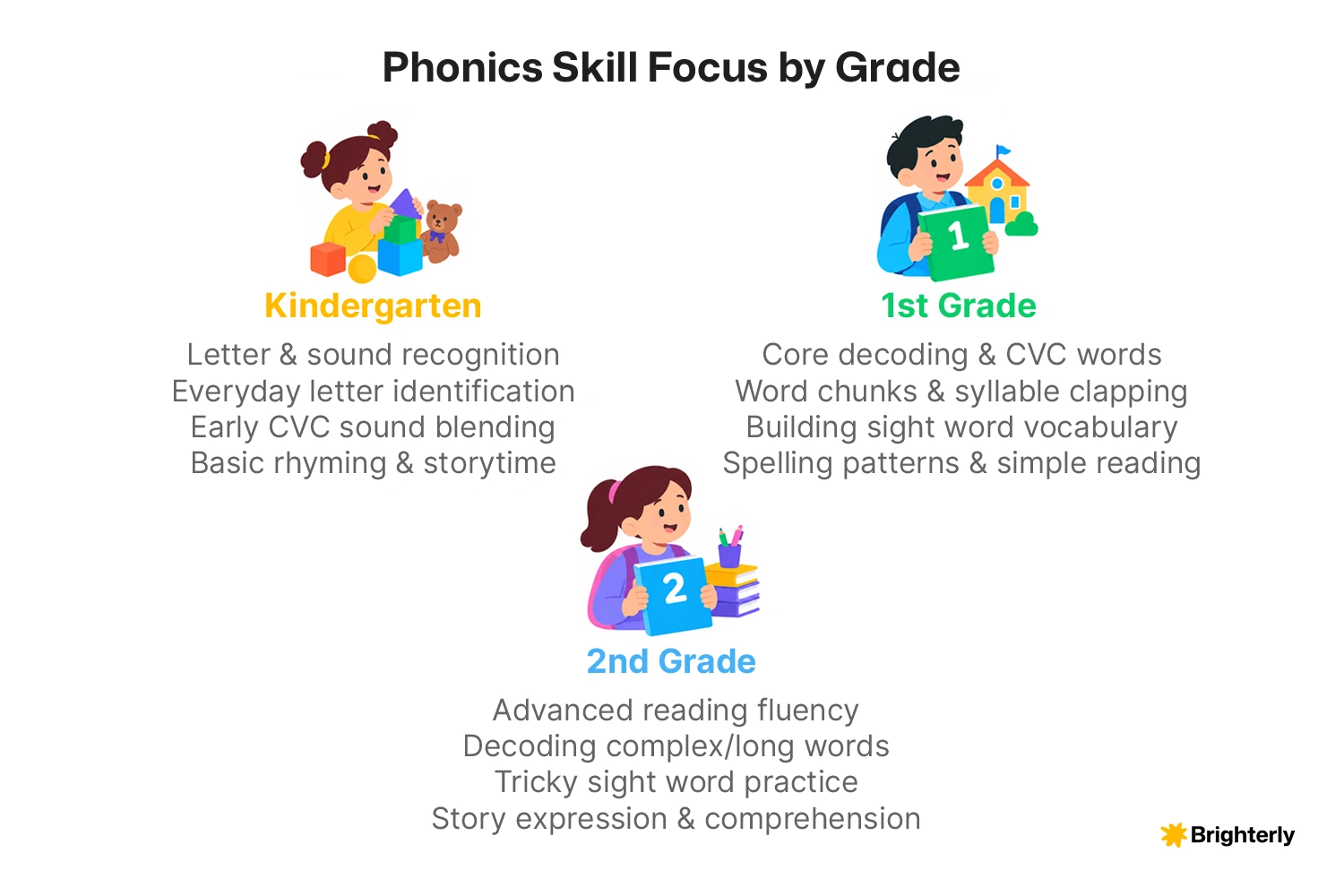
Kindergarten 1st grade 2nd grade Why Worksheets for practice 👍 Build letter & sound recognition 👍 Practice new phonics skills 👍 Boost reading fluency & spelling Practice builds automaticity Recognizing letters everywhere 👍 Learn the alphabet IRL 👎 Quick review 👎 Occasional review Makes learning letters fun & hands-on Connecting letters with sounds 👍 Core early skill 👍 Strengthen decoding 👎 Review only Key step toward reading readiness Short vowel sound practice 👍 Master core vowel sounds 👍 Strengthen CVC decoding 👎 Quick review only Important for reading simple CVC words Sound blending games 👍 Blend simple words 👍 Build reading fluency 👎 Extra practice Teaching how sounds form words Spelling and reading practice 👎 Early exposure 👍 Core skill Connects reading and spelling Playing with syllables 👎 Simple clapping game 👍 Learn word chunks 👍 Decode long words Helps with longer words Mastering tricky sight words 👎 Start with basics 👍 Build a word bank 👍 Fluency practice Builds confidence with everyday words Phonics storytime & rhyming fun 👍 Enjoy rhymes & rhythm 👍 Create stories Makes phonics fun & meaningful
Other Ways to Practice Phonics by Format
If you’re not sure where to start, you may use the following summary table. Choose the format your child prefers or the skill they need to improve, and choose an activity from the examples.
Examples of phonics activities Benefits/skills developed Hands-on/craft-based format Glitter letters, Letter labels, Blend & build with blocks, Phonics flower, Fix the word! – Improves fine motor skills – Strengthens letter-sound recognition through tactile learning – Strengthens letter formation and visual memory Movement & physical games Go fish!, Letter says, Silent match, Phonics hopscotch, Reading hopscotch, Human spelling bee, Human syllable bee – Supports kinesthetic learning – Improves memory – Supports active engagement and focus – Great for active learners Sorting & matching activities Mystery bag of sounds, Sing the sound song, Letter swap, CVC plus silent e, Vowel up, thumb up!, Word unscramble, Contraction matching – Builds pattern recognition and understanding of letter-sound groups – Strengthens understanding of letter-sound relationships and word structure Word-building & writing games Floss your consonants, Draw the sentence, Word family ladder, Eyes on oo! – Builds spelling fluency – Helps children see word families and phonetic patterns – Builds creative sentence-making skills Reading & listening games Spelling challenge, Silent Simon, ‘The’ hunt, Fill in the blank, Mystery sentences, Rhyming poetry – Improves listening comprehension, vocabulary, and pronunciation – Builds sight word recognition and reading comprehension in context
Turn Phonics Practice Into Play
Phonics success starts with consistency and joy if you try out interactive lessons and hands-on activities that your child will love. Book free reading lesson on Brighterly, and see how else joining parent effort and professional academic support can help your child thrive in fundamentals.
Frequently Asked Questions
At What Age Should Children Start Phonics Activities?
No universal rule. The Ohio State University examined 281 preschool kids at risk of later reading difficulties (May 2025) and found that kids’ initial letter-name knowledge and phonological awareness predicted later skills, while initial letter-sound knowledge did not. Evaluating the UFLI Foundations program with kindergarten and 1st-grade students (January 2025) found that adding systematic instruction in phonemic awareness and phonics increased early-literacy scores compared with usual instruction. Together, these studies support developing foundational literacy skills in preschool and teaching systematic kindergarten and 1st grade phonics activities accordingly, although they don’t establish a universal age at which every child should start.
How Long Should a Phonics Practice Session Last?
Aim for 30 min. In 2025, the University of Alberta, York University, and Australian Catholic University tested 30-minute phonics-based reading intervention sessions and found improvements in reading outcomes after students got one of two small-group interventions combining phonics with other reading instruction. Therefore, 30 minutes is a duration that was used successfully in structured interventions for early elementary students, although researchers didn’t claim it as the ideal duration for every child.
What’s the Difference Between Phonics and Phonemic Awareness?
Phonemic awareness is the ability to hear individual sounds in spoken words, and phonics teaches kids how those sounds connect with written letters. In other words, phonemic awareness means hearing that sun has the sounds /s/, /u/, and /n/, and phonics means identifying the letters S, U, and N and applying their sounds to read the word. Phonemic awareness develops first, and both skills complement each other to help kids decode words + read and spell.
Can Phonics Activities Help an Older Child Who’s Behind in Reading?
Yes. Systematic phonics instruction can help older kids who struggle with reading, especially with decoding unfamiliar words. In September 2026, researchers at SRI International evaluated a structured linguistic phonics program (including phonics classroom activities) and concluded that students receiving the program made greater gains than comparison students in word-reading and sentence-reading efficiency.
Phonics, however, may not be enough on its own if an older child also struggles with vocabulary or comprehension. In May 2026, the Educational Research Review reported that reading interventions for students in grades 4-12 had an overall positive effect, with larger effects for interventions addressing comprehension and vocabulary.
How Many Phonics Activities Should a Child Practice Each Week?
Aim for regular phonics practice on most days of the week, adjusting the number of activities to your child’s age. Because a 2026 review published in Reading Research Quarterly found that 77% of surveyed teachers reported teaching phonics daily, and 17% taught it 3-4 times a week. The study doesn’t prove, however, that daily instruction produces better outcomes than 3-4 sessions weekly, but it’s what teachers reported about their successful practice.
Is It Normal for Kids to Mix Up Similar Sounds During Phonics Practice?
Yes. It’s common, especially when kids are still developing phonemic awareness. Yet, even though occasional mistakes are part of learning, persistent difficulties do deserve attention. In January 2025, researchers from UiT The Arctic University of Norway, the University of Bergen, and the University of Oslo found that kids with speech-sound difficulties had much weaker reading skills on average, and that differences in reading and language skills could persist over time. So, if your child repeatedly struggles to distinguish sounds even despite practice, or the difficulty interferes with decoding and spelling, consider discussing it with their teacher.


The simple view of reading (SVR) is a foundational literacy model that implies that reading comprehension equals decoding multiplied by language comprehension. First introduced by Hoover and Gough (1986), it helps identify whether a child’s reading difficulty stems from word recognition, language understanding, or both, and provide teaching instructions accordingly. Key points The simple view […]

Oct 22, 2025

Reading skills matter for every part of a child’s growth. But how can parents help improve kids’ reading? Through regular practice at home, and the easiest way to make practice stick is to turn it into play. Read on for 25 fun reading activities from preschool to high school, reading challenges to try at home, […]

Oct 23, 2025
Math & reading from 1st to 12th grade
Looking for homework support for your child?

Choose kid's grade

Math & Reading for Grades 1–12
Build real confidence for your child with a Brighterly math or reading tutor.