Simple View of Reading: What It Is and How It Works
reviewed by Franz Jerby Delos Santos
Updated on April 23, 2026

The simple view of reading (SVR) is a foundational literacy model that implies that reading comprehension equals decoding multiplied by language comprehension. First introduced by Hoover and Gough (1986), it helps identify whether a child’s reading difficulty stems from word recognition, language understanding, or both, and provide teaching instructions accordingly.
Key points
- The simple view of reading = Decoding × Language Comprehension. Reading breaks down when at least one side is weak.
- Decoding develops slowly through phonemic awareness, phonics, and fluency
- Language comprehension depends on vocabulary, background knowledge, syntax, and inference
- Different combinations of strengths and weaknesses create reading profiles, which help identify the root of reading difficulties and adjust the instruction
- The science of reading supports teaching both components. It’s also helpful to look deeper at subskills (as shown in Scarborough’s Reading Rope) if you see slow progress in reading.
What Is The Simple View of Reading?
The simple view of reading (SVR) is all in this formula: skilled reading equals fast, accurate word reading times strong language comprehension.
This formula matters because it pinpoints where to help first.
Usually, when we first share SVR with families, we sketch two pillars on the board.
- On the left is one pillar: Word Recognition (Decoding).
- On the right is the second pillar: Language Comprehension.
Families start to nod in agreement because they have seen it: children who can read every word of text but cannot then tell you what happened. Or children who can understand every story you tell them when reading aloud, but when it comes time to read the print, they can’t decode anything at all.
So how do you figure out which “pillar” is wobbling? It’s not always obvious when you listen to a child read. Sometimes the issue is decoding, sometimes it’s understanding the meaning, and sometimes it’s both. A good way to get clarity is through a diagnostic reading test, which breaks reading down into core skills and shows where support is most needed.
A child reads without understanding?
Find out what’s missing: decoding or meaning

What Is Word Recognition In Practice?
Word recognition is a system of skills turning print into speech: phonemic awareness (hearing individual sounds), phonics (mapping letters to sounds), and automaticity, which means words are recognized instantly. When kids read with cleaner, faster patterns, without adding irrelevant sounds, cognitive energy can be devoted to making meaning.
Note: If your children struggle with reading, you may find some interesting tips on how to improve reading skills for better academic performance.
Explore Brighterly Learning Experience
Learn exactly how Brighterly helps students thrive through expert sessions, online tools, and proven feedback from thousands of satisfied parents
What Is The Simple View Of Reading Formula?
The simple view of reading formula is:
Reading Comprehension = Decoding × Language Comprehension
The multiplication sign is crucial; if any of the factors is close to zero, the whole comprehension collapses. Efficient teaching first targets the limiting factor, then combines both in authentic texts so that skills transfer to reading in everyday life.
Here’s the implication for teaching that schools and families consider impactful: the simple view of reading proposes that reading is fundamentally constrained by its weakest side. If one lifts the decoding (accuracy, automaticity) or augments the language (vocabulary, knowledge, syntax), the comprehension will increase, particularly when the practice involves a meaningful text.
Both decoding and language comprehension are essential, but their internal components and their relative impact may vary across learners. This principle is supported by a 2025 study in Scientific Studies of Reading conducted by Hongjun Chen, Ying Zhao, Peng Sun, Haolan Wang, Yi Zhao, and Xinchun Wu, which found out that decoding plays a dominant role in early grades, while language comprehension becomes increasingly predictive of reading comprehension as texts grow more complex. This shift explains why some students “read well” in early grades but later, in middle school, have so much trouble with understanding the meaning.
Simple View Of Reading Graphic
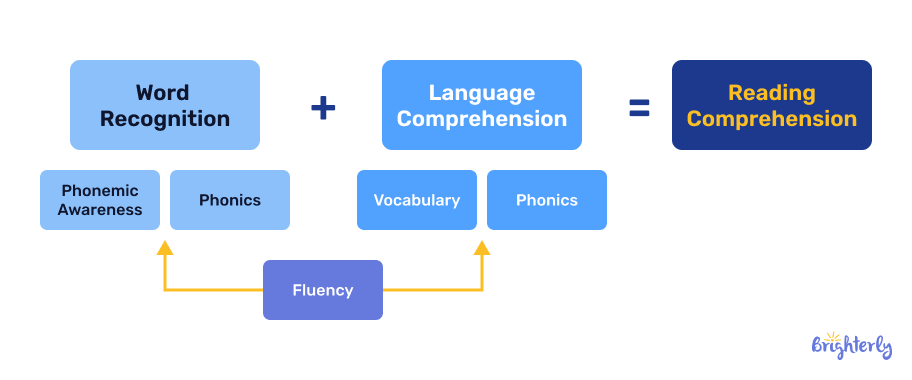
A traditional basic perspective on reading depicts two domains, or better say, support pillars – Decoding (Word Recognition) and Language Comprehension – that combine to form Reading Comprehension.
Components Of The Simple View of Reading
There are two categories of the simple view of reading components that make up the concept. The word recognition family includes phonemic awareness, phonics, and fluent, automatic word reading (decoding and sight-word recognition).
The language comprehension family includes vocabulary, knowledge, syntax, discourse, and inferences. One can hardly grow these reading comprehension components without explicit, cumulative, and connected instruction.
Decoding Skills
Decoding is the process of turning written text into spoken language. It relies on a set of foundational language systems:
- Phonology, or awareness of sounds in spoken language (phonemic awareness)
- Orthography, or understanding how sounds connect to letters and spelling patterns (phonics)
- Morphology, or recognizing meaningful parts of words (prefixes, suffixes, roots).
Together, these systems are the pillars of accurate and efficient word recognition. However, in practice, decoding develops through several ‘must-have’ skills:
- Phonemic awareness, i.e. hearing and manipulating individual sounds (for example, blending /s/ /a/ /t/ into “sat”)
- Phonics, i.e. mapping letter patterns to sounds, including digraphs and vowel teams
- Fluency, i.e. reading words accurately and quickly, without stopping to decode each one
Note: You can learn more about phonics and phonemic awareness in this guide.
As decoding becomes more automatic, it requires less mental effort, and it’s essential because it frees up working memory for reading comprehension (understanding the meaning of the text, not just the words).
Spelling (encoding) plays a supporting role here, but this role should not be diminished. When a child learns to write words, this strengthens decoding by reinforcing sound–symbol relationships and word structure.
How can you monitor the progress a child makes in decoding? It’s typically monitored through oral reading fluency, nonsense word reading, and accuracy in controlled (decodable) texts. You can also check the innovative methods of how student progress is monitored at Brighterly.
Language Comprehension
Decoding helps a child read the words, and language comprehension helps them understand what those words mean. It includes a few key pieces:
- Semantics (vocabulary), or knowing what words mean
- Syntax, or understanding how sentences are built
- Pragmatics, or understanding meaning in context
- Discourse, or connecting ideas across sentences.
How a child understands the meaning of words often shows up in everyday situations, and here are a few of them for illustration:
- A child reads a sentence: “The boy was exhausted after the game,” but doesn’t know what “exhausted” means → vocabulary gap
- A child gets confused by a long sentence with “because” or “although” → syntax issue
- A child reads a full paragraph but can’t explain what happened → discourse or inference gap
Another common example is when a child can read the word “photosynthesis” perfectly but can’t explain it. That’s not a decoding problem, but a language comprehension gap, specifically background knowledge.
Ideally, in the simple view of reading model, decoding and language comprehension must work together.
- Decoding = reading the words
- Language comprehension = understanding the message
If one side is weaker, reading comprehension suffers, even if the other side looks strong.
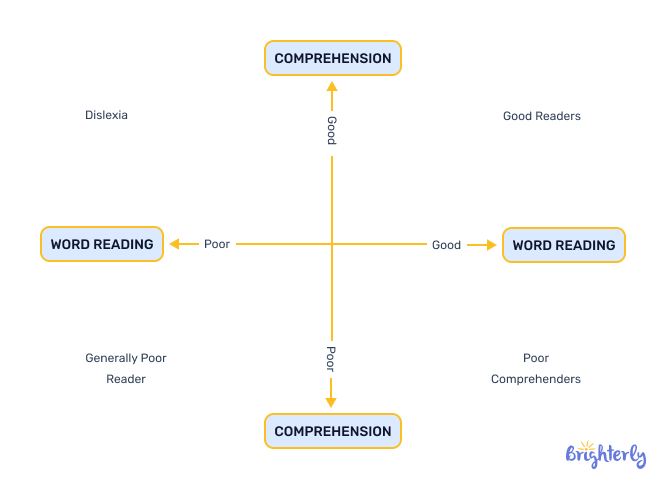
The SVR model reading framework serves as a tool for schools and families to prioritize what to teach first, and it’s particularly relevant for early screening and support. For example, if a child has markers of a learning disability and/or dyslexia, SVR helps clarify instruction on the limiting side: either targeted decoding (phonemic awareness, phonics, fluency) or enhanced language skills (vocabulary, knowledge, syntax).
Systematic phonics instruction — starting from foundational phoneme awareness — reduces cognitive load and produces early measurable gains in word reading accuracy. For example, Brighterly’s reading program for kids, which combines together all phonics, vocabulary development, and comprehension practice, can support both sides of the equation. This is an example program that adapts to a child’s level and focuses on specific gaps, resulting in more consistent progress that both teachers and parents can see within a short period of time.
Reading gaps don’t fix themselves
Join a structured reading program to work on decoding and meaning together
Why The Simple View of Reading Matters?
The simple view of reading model matters since it explains uneven profiles: fluid oral reading but weak summary, or strong storytelling but weak decoding. When families identify the side of reading that is limiting a student’s ability to read successfully, and teach that side of reading explicitly, you can see much quicker and clearer gains: fewer hesitations, richer vocabulary, better retells, and more independent reading choices.
Note: If you want to make your kid a better reader, check out our proven reading comprehension strategies
Sometimes teachers and parents notice their student is changing after only a couple of weeks: Better stamina, fewer “stuck” times, and better predictions or explanations.
How The Simple View Explains Reading Difficulties
The biggest strength of the simple view of reading formula is that it doesn’t label a child as “good” or “bad” at reading, but helps you see where things are going wrong and fix the problem.
A 2025 study in Read Writ that was conducted by Kargiotidis, A., Tafa, E., Mouzaki, A. et al. showed that a broader range of language skills plays a key role in predicting reading difficulties. These include vocabulary depth, morphological awareness (understanding word parts), syntax (how sentences are structured), and the ability to make inference across a text.
In other words, reading challenges rarely come from only one weak skill. Usually, they reflect a mix of gaps across both decoding and language systems. This issue is of prime importance when working with students with dyslexia, who struggle with decoding, but may also experience difficulties with fluency or language processing. The science of reading highlights that effective support needs to address these multiple components together and avoid focusing on a single skill in isolation.
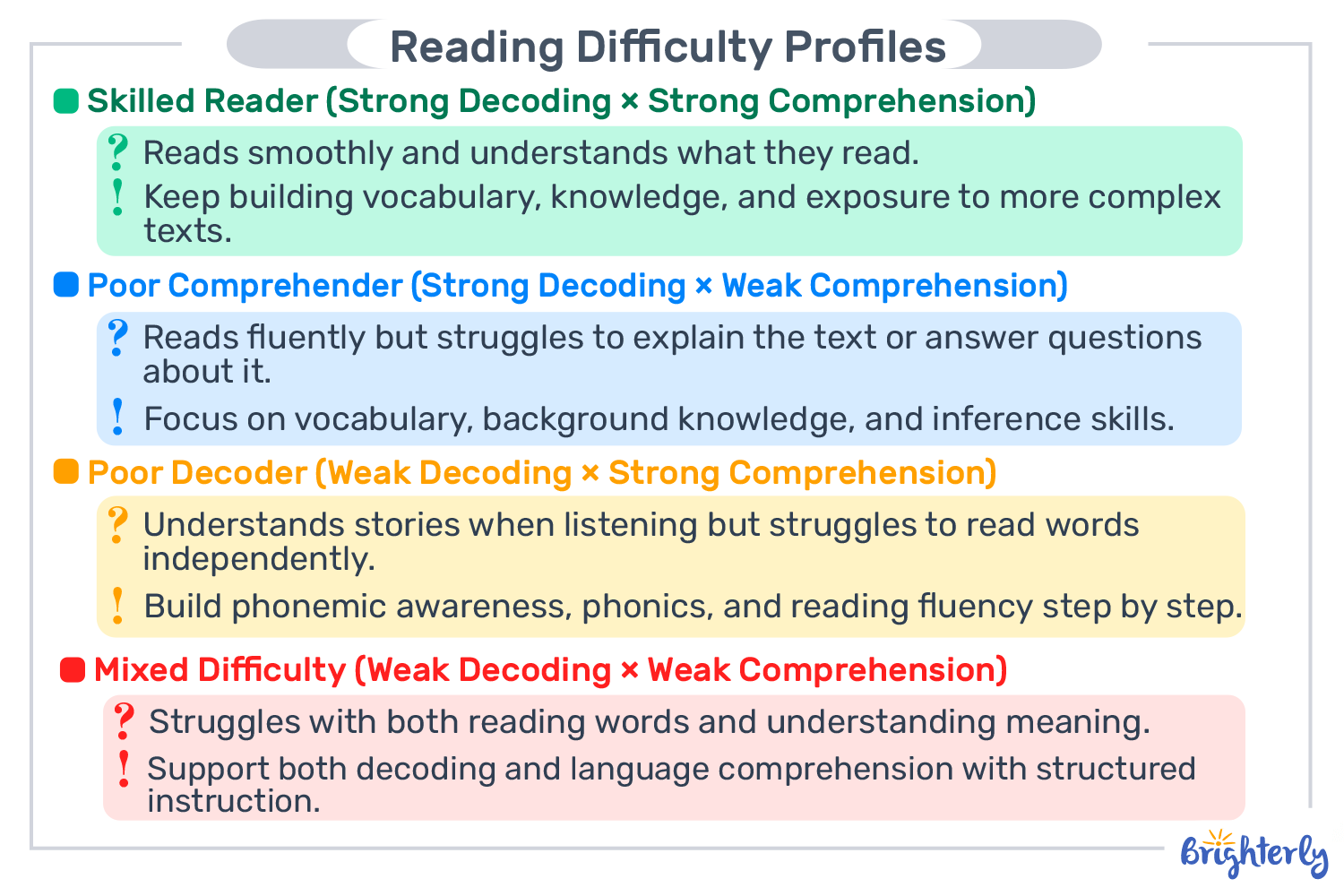
The simple view of reading outlines several common reader profiles based on strengths and weaknesses in decoding and language comprehension, and here they are, shortly:
Skilled Reader
A skilled reader moves through text with ease, reading words accurately and, at the same time, understanding what they mean. After reading a story, they can explain what happened, share opinions, and sometimes even try to guess what might come next. Skilled readers expose both strong decoding and solid language comprehension, working together as one wonderful mechanism.
Poor Comprehender
These types of readers sound fluent when they read, but, unfortunately, understanding doesn’t quite follow. They move through sentences smoothly, yet when you ask them what the text was about, they can hardly explain it.
For instance, a child might read, “The desert climate is characterized by low precipitation,” without hesitation. Meanwhile, if they don’t know what “precipitation” means, the meaning of the sentence will be lost. In this case, the issue isn’t decoding but, most likely, gaps in vocabulary, background knowledge, and the ability to make connections across ideas.
Poor Decoder
These readers show the opposite pattern. They understand language well but get stuck on individual words. When listening to a story, they can retell it in detail and even add their own thoughts, but when reading independently, they slow down, guess words, or lose track of the sentence, losing self-confidence. Such a child might understand a simple idea like “The cat ran home,” but will not be able to read it without stopping.
Here, language comprehension is strong, but decoding, including its parts phonemic awareness, phonics, and fluency, needs support and attention from adults.
Mixed Difficulty
In some complex cases, reading can be difficult for both sides: the reader struggles to recognize words and to understand what they read, so even short texts can cause significant confusion. For example, a child may read a sentence slowly, skip parts of it, and, finally, not be able to explain what it means afterward. Because the simple view of reading works as if a multiplication equation, so that weaknesses in both decoding and understanding the meaning can significantly limit overall reading comprehension.
Simple View of Reading and Scarborough’s Reading Rope
The simple view of reading model, as we already mentioned, presents reading as the interaction between decoding and language comprehension, the two crucial domains of reading. Meanwhile, let’s go a little bit deeper and check how this idea can be extended using the so-called Scarborough’s Reading Rope to have a better idea of how these abilities develop in practice.
A literacy researcher, Hollis Scarborough, developed this model back in 2001. She used the image of a rope to convey the idea that reading is not built on one or two skills, but on many smaller ones woven together. Each strand starts thin and weak on its own, but as they develop and connect, they form a tight, durable rope, which represents skilled reading.
On one side, the rope constitutes strands related to word recognition:
- phonemic awareness
- phonics
- sight word recognition
On the other side, the magic rope includes strands related to language comprehension:
- vocabulary
- background knowledge
- syntax
- verbal reasoning and inference
Each strand develops gradually, but skilled reading emerges only when they become tightly woven together.
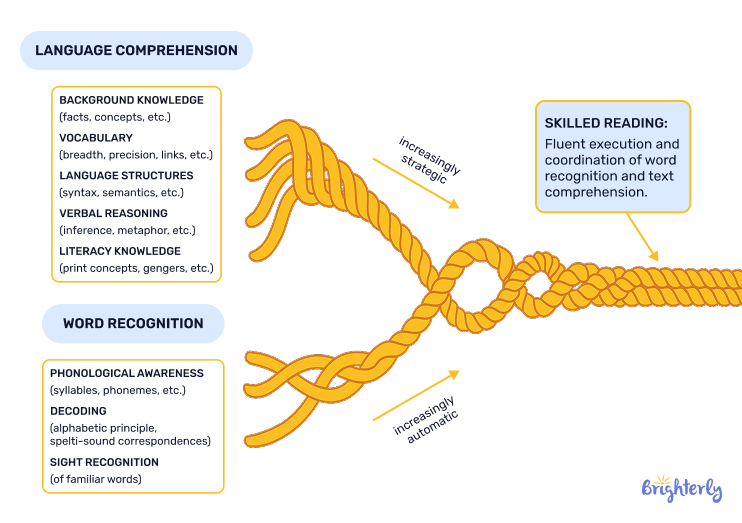
In the 2023 research by Cook M. and Hughes E., published in the Journal of College Academic Support Programs, scientists have suggested that this model was a bit more precise than the simple view of reading equation because it shows that each skill is made up of multiple processes that must be explicitly taught and practiced both at school and at home. Thanks to this model, educators and caregivers can identify specific gaps, such as weak phonics in decoding or limited background knowledge in comprehension, and address them.
Conclusion
The simple view of reading opens doors to understanding how reading works, and why it sometimes doesn’t. Thanks to this formula, it’s easier to see what’s holding a child back and where support is necessary.
If comprehension is the main challenge, focused reading comprehension support can help strengthen vocabulary, knowledge, and the ability to understand and explain texts.
In the end, reading progress doesn’t come from one big change, but from small, consistent steps in the right direction. Make your first step today and book free reading lesson at Brighterly to see where your child will grow first.
FAQ
Who Created The Simple View Of Reading?
The simple view of reading was developed by William A. Hoover and Philip B. Gough in 1986 to explain how decoding and language comprehension are linked in reading.
What Are The Three Types Of Reading Difficulties According To SVR?
The model highlights three main types: poor decoding (word reading problems), poor comprehension (understanding problems), and mixed difficulties (both areas are weak).
Is The Simple View Of Reading Still Relevant Today?
Yes, the simple view of reading remains a core part of the science of reading and is widely used in research, assessment, and instruction.
How Is SVR Used In Dyslexia Screening?
SVR in dyslexia helps identify whether a child’s difficulty is mainly in decoding, which is a key marker of dyslexia, or in language comprehension, or both.
What Is The Difference Between Decoding And Language Comprehension?
Decoding is a mechanical skill that refers to the ability to read words correctly, translating written signs into spoken language. Language comprehension is the ability to understand the meaning of spoken or written works, which follows decoding.


Both Homer and Reading Eggs rank among the top early literacy apps, though they take different paths to get there. Homer offers a personalized, calm, phonics-forward approach built for younger children ages 2–8, while Reading Eggs leans on heavy gamification and a linear map structure to cover a wider age range, from 2 all the […]

Oct 21, 2025

Phonics activities have always been my favorite way to teach kids how letters and sounds connect. Over the years, I’ve seen how a few fun games, stories, and worksheets can completely transform reading time. In this guide, I’ll share tried-and-true activities for kindergarten, 1st, and 2nd graders that make phonics learning easy, playful, and effective. […]

Oct 23, 2025
Math & reading from 1st to 12th grade
Looking for homework support for your child?
Choose kid's grade

Math & Reading for Grades 1–12
Build real confidence for your child with a Brighterly math or reading tutor.