Teaching Text Structure to Improve Reading Comprehension and Writing
reviewed by Franz Jerby Delos Santos
Updated on May 14, 2026
Key Points
When students struggle with reading comprehension, it’s not about not understanding words. Sometimes, it’s all about not knowing how the text is built and what text structures are. Teaching text structure can shift things around, making reading and writing simpler.
From this article, you’ll learn strategies for teaching text structure, 5 main types of text structure, a few classroom ideas, and a rough grade-by-grade breakdown.
What Is Text Structure in Reading?
Text structure is what authors use to organize information in a text. It acts as a roadmap that lays out ideas to make it easier for readers to see what the text is about and predict content.
Text structure goes beyond the beginning, middle, and end — it’s a system for understanding what’s coming next, identifying the main idea, and supporting details.
Note: Knowing the text organization, students can also sharpen their descriptive writing.
Explore Brighterly Learning Experience
Learn exactly how Brighterly helps students thrive through expert sessions, online tools, and proven feedback from thousands of satisfied parents
Why Teaching Text Structure Matters
Teaching informational text structure helps children remember, understand, and learn content. Text structures follow a distinct pattern, helping students to predict what they’re about to read. When kids know what to expect, their reading comprehension improves.
Note: Text structures work for informational and nonfiction texts, and one of the main types is description.
Here’s what many parents and teachers overlook: children understand the meaning of each individual word, but they walk away with little to no understanding of the whole text. This creates comprehension gaps, but they can easily be solved through activities for teaching text structure. A 2021 meta-analysis by Duke, Ward, and Pearson backs it up: the research has found that teaching text structure significantly improves reading comprehension strategies, which is a core skill.
And it’s not just about reading. When kids understand text structure, writing becomes intuitive, and words get more purposeful. The IES Practice Guide Teaching Secondary Students to Write Effectively (Graham et al., 2016) points to a text structure knowledge as a building block for writing skills in grades 6-12.
Text structure matters not only because of grades. Kids who understand text and paragraph structure become more confident readers and learners. Also, they read more actively, rather than passively skimming through text.
Brighterly teaches skills schools can’t.
Learning gaps the school can’t fix? We can. 

The 5 Types of Text Structure (with Signal Words)
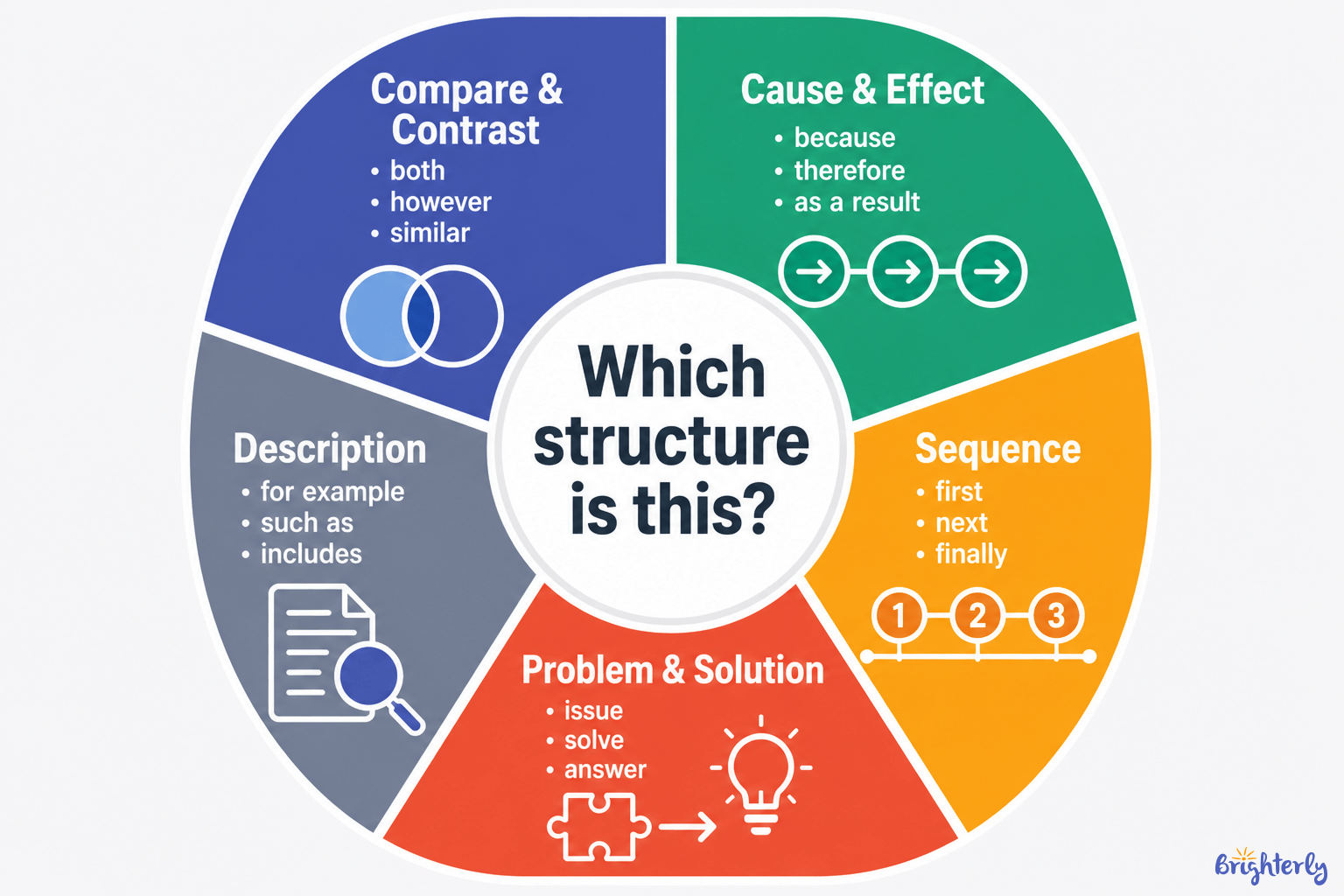
The 5 types of text structure are description, sequence, cause and effect, problem and solution, and compare and contrast. Most informational texts rely on these 5 structures.
Description
Descriptive text focuses on the main topic, person, place, or thing. It organizes info and lays out features, characteristics, and traits. This article is basically descriptive text because it explores a specific subject – text structure.
Students can look for signal words like: such as, for example, most importantly, in front, features include.
Example: A volcano is a vent or fissure in the crust of a planetary-mass object, such as Earth, that allows hot lava, volcanic ash, and gases to escape from a magma chamber below the surface.
Note: Most articles on Wikipedia are descriptive texts or expository texts.
Sequence
Sequence texts are texts that follow a specific, logical order. For example, chronological time, numerical ranking or even steps in a process (how to write a thesis statement, for example).
This structure is basically typical for historical timelines, explicit instructions, or experiments. Teaching chronological order text structure is usually easy because it follows clear logic.
The signal words are: first, second, next, then, now, before, and after.
Example: To identify a text structure, first analyze how an author organizes information, then look for signal words, and last use graphic organizers.
Note: You can find sequence texts in how-to articles or history books.
Cause and Effect
Cause and effect text explains why something happened and what the result of it is. The cause is the event, and the effect is the result.
When teaching cause and effect text structure, students can look for signal words like: as a result, because, and therefore.
Example: Because the temperature dropped, mountaineers couldn’t continue along the trail.
Note: Students can find cause-and-effect text in scientific texts, news articles, or editorials.
Problem and Solution
The author introduces a problem or a challenge, then offers one or more solutions. This text structure explains the issue and the effectiveness of its solution.
When teaching problem and solution text structure, signal words are: the problem is, this was resolved by, one approach, in response to.
Example: Air pollution is a serious health concern. One approach is to expand public transport.
Note: Problem and Solution show up in social studies, science text, and current events writing.
Compare and Contrast
Compare and contrast text structure compare two things, and look at how they are similar or different. Readers can better see the connection and comparison.
Common signal words when teaching compare and contrast text structure are: similarly, however, and likewise.
Example: Frogs and toads are amphibians. However, frogs live near water, unlike toads, who can survive in drier environments.
Note: You can find compare and contrast text structure in informational texts.
| Type | Definition | Signal Words |
| Description | Descriptive text focuses on the main topic, person, place, or thing. | Such as, for example, most importantly, in front, features include. |
| Sequence | Tells the order in which events occur in text. | First, second, next, then, now, before, and after. |
| Cause and Effect | Tells what happened and why it happened. | As a result, because, therefore. |
| Problem and Solution | Provides a problem and describes how it can be solved. | The problem is, this was resolved by, one approach, in response to. |
| Compare and Contrast | Shows similarities and differences between two or more things. | Similarly, however, and likewise. |
How to Teach Text Structure Step by Step
Text structure teaching strategies work best when they’re worked into real reading. If circling signaling words and writing the structure name is your approach – drop it. Here’s something that might get you better results.
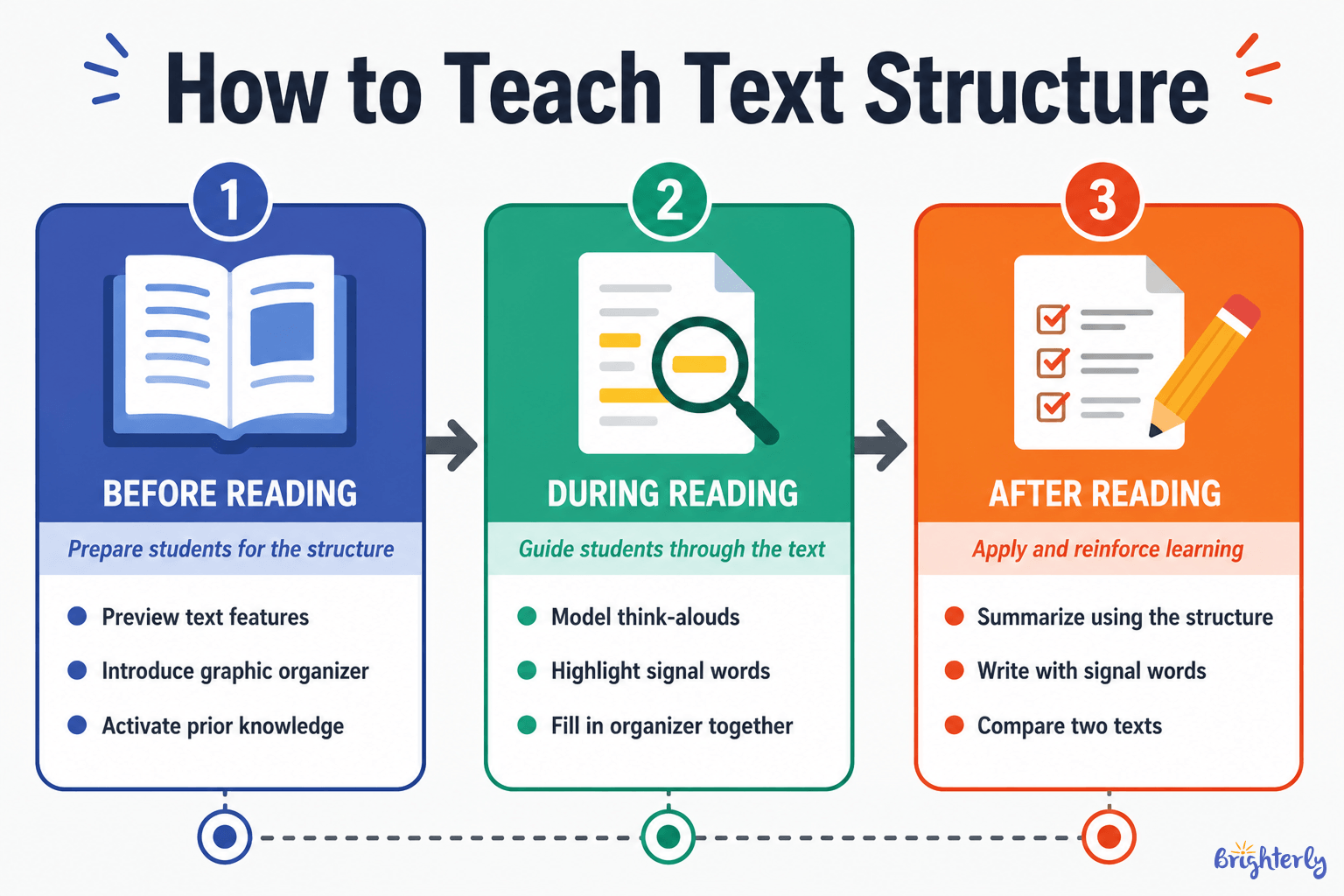
Before Reading – Build Awareness
Before reading anything, preview text features like headings, bold words, and captions. Have your students make a structure prediction and ask them: What cues tell you how this is organized?
Use this practical move: keep a graphic organizer with purpose and signal words (like the one we provided above) and don’t wait to hand it out until after reading, of course.
During Reading – Identify and Annotate
Now, teaching text structure activities does the actual work. A few methods can help:
- Have students highlight signal words as they read.
- Stop after each paragraph to ask questions like – What is happening structurally? Did the author focus on a specific thing, provide a problem and a solution, or present similarities?
- Print the graphic organizer and fill it in together with signal words and examples.
This works especially well for a visual learning style.
After Reading – Reinforce Through Writing
After reading, students can write a summary, a paragraph that uses signal words. This is where the material sticks better. It’s not about writing for the sake of writing. Instead, make sure children understand a text structure and can apply it in their writing.
You can also use paragraph writing worksheets.
Teaching Text Structure by Grade Level
| Grade | Text Structures | Level | Task Example |
| Grades 3-4 | Description, sequence, problem, and solution | One clear structure, shorter texts | Describe an animal, and create a timeline of an event |
| Grades 5-6 | All 5 types | Longer texts with one clear structure | Explain the cause and effect of an event |
| Grades 7-8 | Mixed text structures | Complex texts with mixed structures | Find text structures in editorial text |
The Common Core State Standards (RI.3–RI.8) follow the same progression.
Not sure where your child stands in reading?
Book a Brighterly lesson to find what's holding kids back.
Text Structure Activities and Graphic Organizers
Some activities for teaching text structure are lifesavers when kids feel lost. For example:
- Signal word sorting activity
Works best for grades 3-6. Write signal words on cards and have your students sort them into 5 text structure categories. Takes under 15 min and works well in pairs. - Graphic organizer matching game
Best for grades 3-5. Prepare a graphic organizer and a few paragraphs. Kids match the paragraph to the organizer they think fits best. - Structure scavenger hunt in nonfiction books
Best for grades 4-7 and teaching nonfiction text structure. Prepare some nonfiction texts like magazine articles, textbook pages, or stories. Have them find 1 example of each text structure.
Sometimes students need structured support. The Brighterly’s reading comprehension program offers 1:1 reading lessons for students in grades K-12 who need support with structured text structure lessons aligned to the Common Core standards. Besides, Brighterly provides a creative writing tutor for kids looking to expand their creative skills.
Conclusion
Text structures could be confusing for students – the signal words, the text features, and the reading strategies could easily melt into one. But with the right approaches at hand, it becomes part of how they read and write.
If your child is struggling with reading, don’t fret! Brighterly has everything students need for success – customized 1:1 lessons, a tailored plan, and fun tutors. Book your free reading test today!
Frequently Asked Questions (FAQ)
What Is the Difference Between Text Structure and Text Features?
Text features are headings, bold words, captions, or bullet points. They are visual parts of the text and help to structure it better. Text structure is the way authors organize ideas. They organize their ideas through 5 main types of text structure that have their own signal words and serve as a roadmap for readers.
At What Grade Do Students Typically Start Learning Text Structure?
Students basically start learning text structure in grade 3. They start with sequence and description first, and complete the full set by grade 6. Teaching text structure is important because it helps improve comprehension and navigate text early on.
How Do Graphic Organizers Help Students Understand Text Structure?
Graphic organizers provide visual cues to make understanding of the text structure easier. These tools make it easier for kids to transform abstract information into concrete frameworks.
Which Text Structure Is Hardest for Students to Identify?
Cause and effect is usually the hardest for most students. As it involves clear order, students may confuse it with sequence. Descriptive structure could also fall in the “hard” category because it lacks transition signals.
How Does Understanding Text Structure Improve Writing Skills?
When knowing text structure, students become better writers because it becomes easier for them to organize their ideas on paper. They can use different text structures and cue words to express their ideas better.
How Can Parents Help Kids Practice Text Structure at Home?
Parents can use activities for teaching text structure, like signal word sorting, a graphic organizer matching game, and a structure scavenger hunt in nonfiction books. This is especially useful when kids are struggling with basic text structures.


The Ukrainian-founded math and reading educational platform has been named a finalist in the 2025 EdTech Digest Awards. Las Vegas, NV – April 7, 2026 – Brighterly, a K-12 online learning platform designed to boost children’s foundational skills, has been named a finalist in the 2025 EdTech Digest Awards in two categories – Math Solution […]

May 14, 2026
The K–12 learning platform moves beyond math, blending personalized 1:1 tutoring and adaptive technology to help children build solid reading and writing skills. Las Vegas, NV – April 12, 2026 – Brighterly, a K–12 learning platform for math and reading, brings out a new English Language Arts (ELA) program to expand its curriculum. The new […]
May 18, 2026
Math & reading from 1st to 12th grade
Looking for homework support for your child?
Choose kid's grade

Math & Reading for Grades 1–12
Build real confidence for your child with a Brighterly math or reading tutor.