What Is Subitizing in Math and How It Boosts Early Number Skills
reviewed by Camille Ira B. Mendoza
Updated on July 16, 2026
Key Points
- Subitizing happens upon instant recognition of a small quantity without counting.
- Strong subitizing abilities support number sense, mental math, addition, and subtraction.
- You can divide this concept into two types: perceptual and conceptual subitizing.
- Children begin developing subitizing skills at the age of 2-3 and master it at 3-4 (Journal of Experimental Child Psychology, 2024).
- The best way to develop such skills is via regular practice and the use of dice, board games, and ten frames.
If you wonder “What is subitizing?”, it’s a skill of recognizing the exact number of objects in a small group at a glance. For children, these skills are one of the blocks that shape their number sense and early math skills. The development of subitizing allows kids to be more confident and better at mental arithmetic later.
What Is Subitizing in Math?
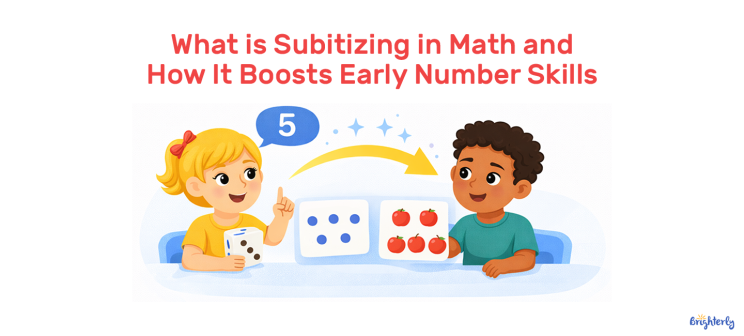
Subitizing is the ability of a person to recognize and perceive the number of objects accurately within a small group or set while doing no counting. For instance, when you roll a die, look at 4 dots on it, you know right away that’s four dots. And that’s subitizing. It’s a core math skill that helps children develop number sense, see numbers as groups, and process quantities.
Note: The subitizing definition has its roots in the Latin word “subitus”, which means “sudden.”
Explore Brighterly Learning Experience
Learn exactly how Brighterly helps students thrive through expert sessions, online tools, and proven feedback from thousands of satisfied parents
Subitizing Examples (How it Works)
You can find examples of subitizing almost everywhere in daily life. The examples may include fingers, dice patterns, dots, dominoes, or even groups of fruits or berries on the table.
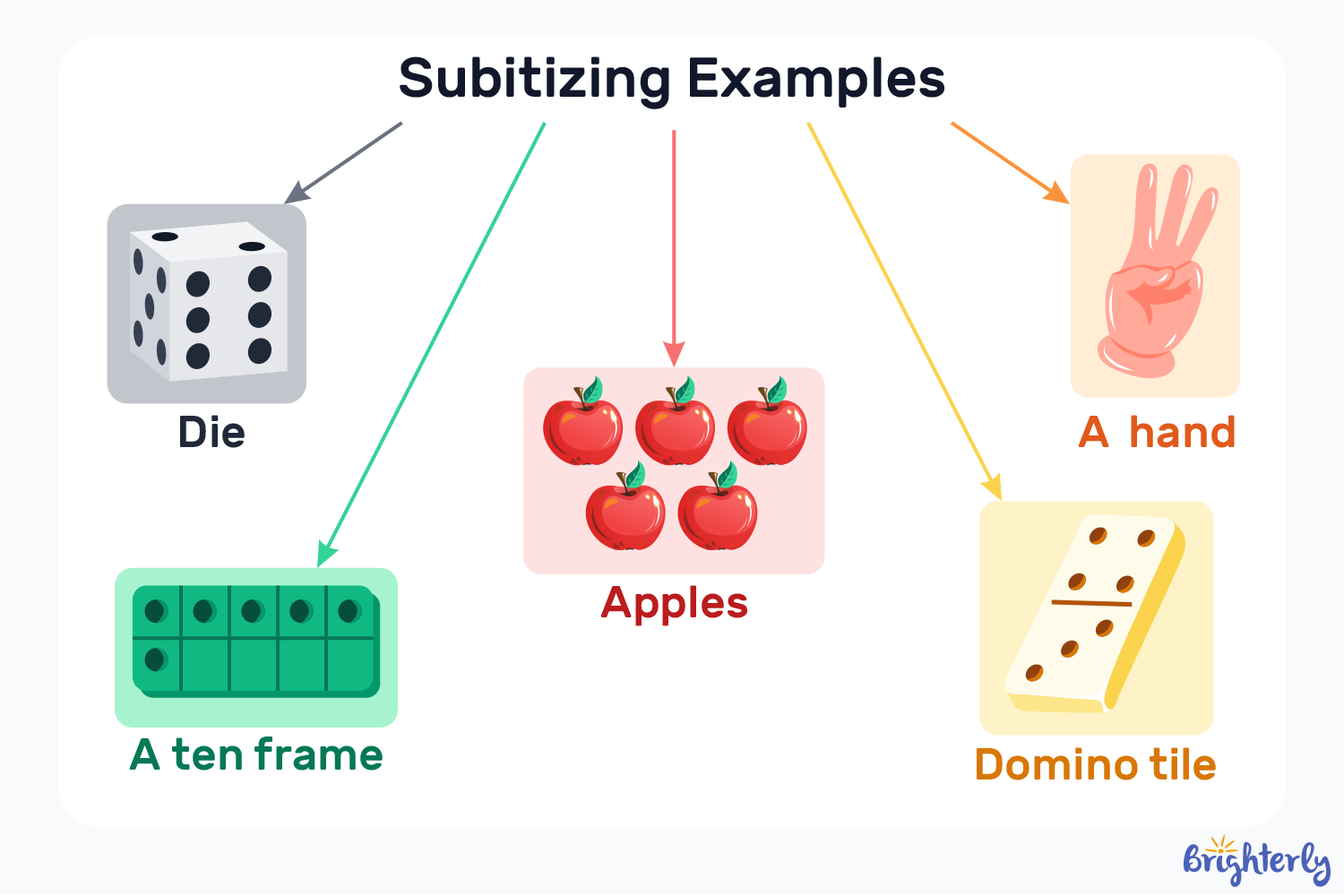
All a kid needs to subitize or recognize objects is a certain visual arrangement of them and an understanding of, or enough familiarity with, small quantities.
Let’s look at some of the common subitizing math examples below:
- Dice. Imagine you play a game, a kid is rolling a die and immediately knows the result, they don’t need to count each dot, they know it’s 6.
- Domino tiles. Your kid may not play domino often, but if they recognize the number on both parts of a domino without counting, it’s subitizing.
- Finger patterns. When you hold up 3 fingers, and your kid instantly says “five,” not counting each finger, it’s another example.
- Ten frames. When a kid recognizes that there are 6 manipulatives in a frame instantly, as a part of the frame is filled and another one has 4 empty spaces, it’s also a form of subitizing.
- Objects on a board or table. If your kid knows right away that there are 5 apples on the table, that’s also an example.
Types of Subitizing
There are two main types of subitizing in math: perceptual and conceptual. The first contemplates that the kid instantly recognizes a small number of objects. The second implies that a kid recognizes groups of objects in a larger set without decomposing them.
| Perceptual Subitizing | Conceptual Subitizing | |
| Subitize Meaning | Instant recognition, automatic | Recognition of a larger set by breaking it into subgroups |
| Quantity Range | 1-5 | 5+ |
| Working Memory | Very low | Moderate |
| Example | 3 dots on a die | Seeing a domino with 3 and 6 dots, grouping to get 9 |
| Linked Skills | Basic number sense | Number bonds, part-whole reasoning, and addition. |
Note: A 2021 study by Derya Can on Different Types of Subitizing Activity further categorizes perceptual and conceptual subitizing into subtypes by how kids recognize and subitize objects in subgroups and composite groups.
Perceptual Subitizing
Perceptual subitizing is the easiest form of the skill, when a kid instantly recognizes a small number of objects, like between 1 and 5, without any grouping.
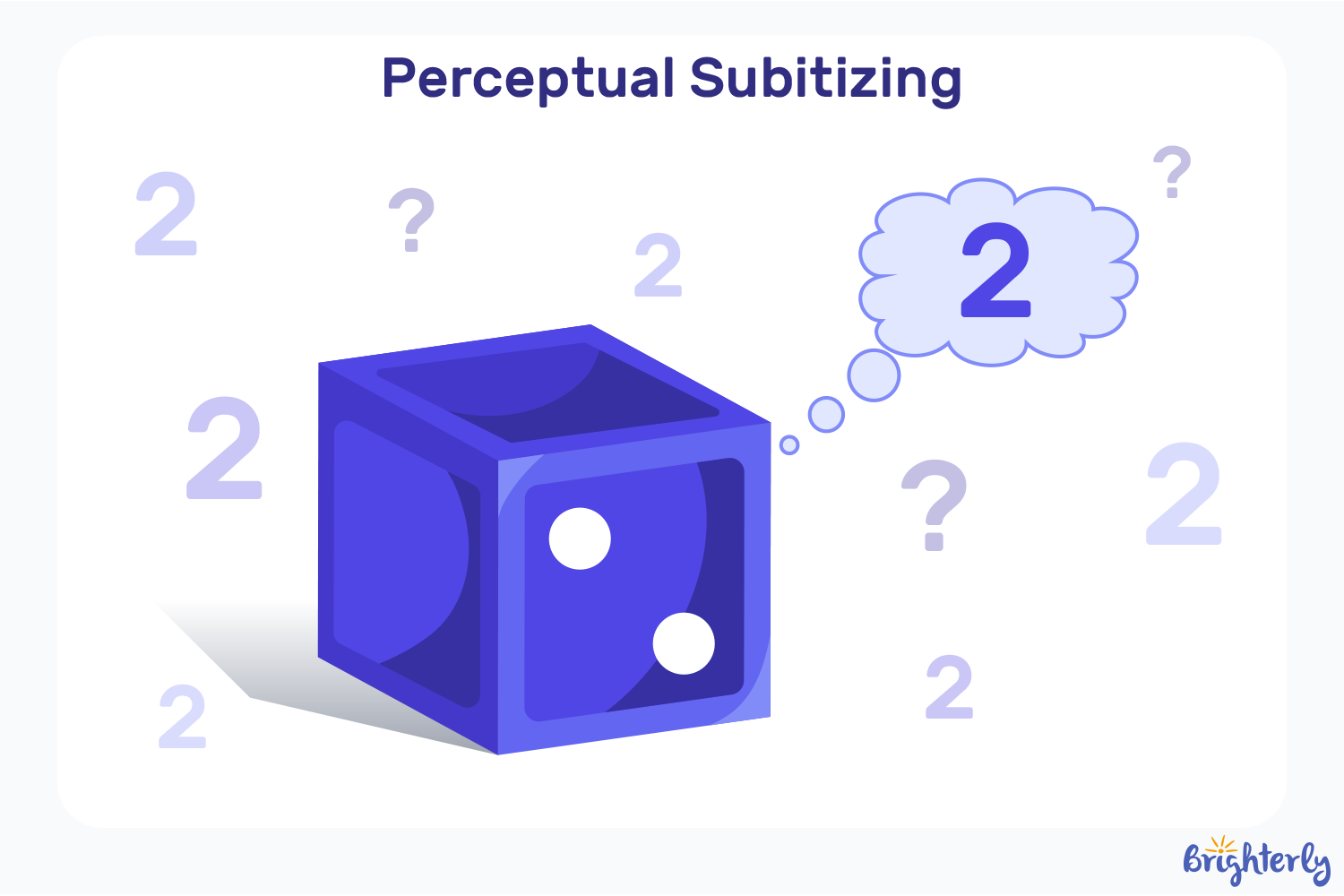
Usually, kids develop this skill naturally, even in kindergarten. When a kid sees 2 dots on a die, they don’t count; they know that’s 2 instinctively, without any thought. The recognition happens as a kid’s visual system automatically processes information that needs little working memory.
Conceptual Subitizing
Conceptual subitizing is a more advanced form, relating to the skill to recognize objects as subgroups or a combination of smaller amounts within a larger group.
For instance, when a kid looks at the domino tile, they may see 6 on the left tile and 3 on the right tile. They won’t know that 9 right away. However, they will see two groups: one of 6 and one of 3. And upon grouping, they will recognize that’s 9.
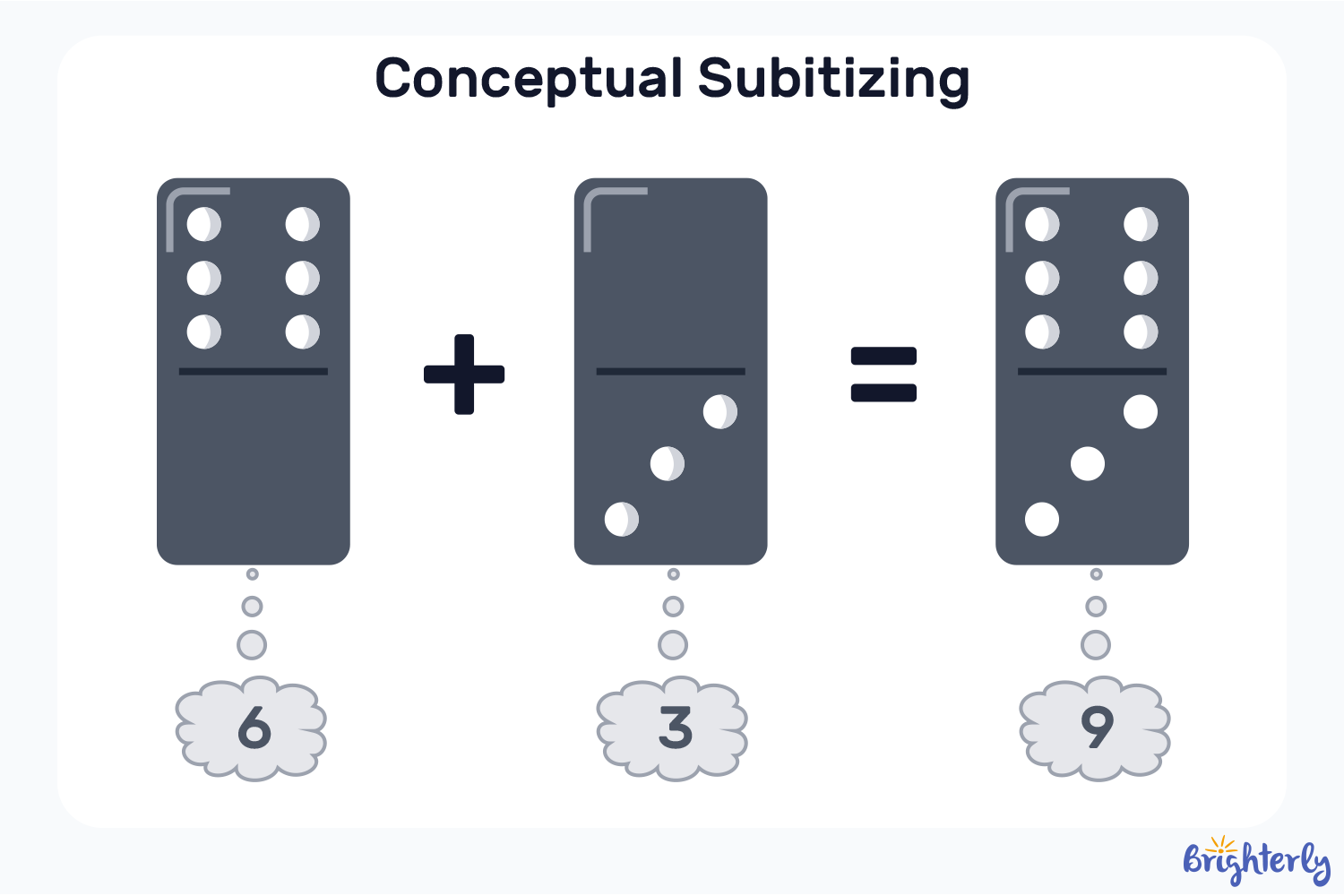
Yet, if we take a different example, not a domino tile, grouping can take place differently, like 4 and 5, or 3 and 6. This type of subitizing is concerned with using the number bonds, part-whole reasoning, and the level of early addition or subtraction skill.
Why Is Subitizing Important for Children?
Subitizing is important for kids as it allows building foundational number sense, introduces mental math, and supports the skill of kids to recognize patterns. Kids who have subitizing skills will spend less energy on basic quantity recognition.
The main reasons behind subitizing importance are:
- Development of number sense
- Improvement of mental arithmetic
- Part-whole reasoning practice
- Offers a foundation for counting, the cardinality principle, in particular.
Subitizing also affects the cognitive load of kids, as they won’t need to count every small group.
When Do Children Learn Subitizing?
Despite children differentiating small quantities from infancy to 2 years, they begin developing subitizing when they are 2-3 years old. They learn to recognize 1 to 3 objects instantly at this age. In contrast, they master conceptual subitizing at a bit older age, when they are 3 to 4 years old.
Note: According to the 2024 Journal of Experimental Child Psychology article on perceptual subitizing performance, 3-4 years is the critical period for the development of subitizing skills.
Brighterly elementary math tutors see subitizing, especially the conceptual one, as a foundational component in the development of early mathematical proficiency.
Even if kids are doing great in this part, we still include subitizing activities in our online math classes. They work as a great warm-up, but they also help us anticipate challenges or gaps in the future.
Boost Your Kids' Elementary Math Skills
Brighterly tutors identify math gaps, strengthen foundational skills and build confidence


Subitizing vs Counting: What’s the Difference?
Subitizing and counting are different in their operation. Subitizing is an immediate process when a kid recognizes objects instantly. Counting, in contrast, is sequential as a kid assigns a number to each object one by one. So, a kid perceives a quantity differently, either all at once or in a step-by-step process.
| Subitizing | Counting | |
| Speed | Instant (less than 1 second) | Sequential, thus slower |
| Method | Recognizing patterns | Enumerating one by one |
| Cognitive load | Low | High (if a set is large) |
| Used for | Small groups (up to 10 objects) | Large or unknown quantities |
| When to master | Begin at age 2-3 | Early elementary school |
“How can educators tell the difference between subitizing and counting during practice (what to look for)?”

How to Teach Subitizing
To teach subitizing, you should prioritize math activities that help kids instantly recognize small quantities with no counting. You should focus on showing kids patterns or collections repeatedly and encouraging them to recognize the amount.
Use Dot Collections and Subitizing Cards
One of the ways to practice subitizing regularly is via specific cards and collections with dot arrangements. They are ideal for kids to quickly recognize the number of objects.
How does it work?
- Firstly, show each card to a kid briefly. Then, ask them to name the quantity.
- When teaching young kids, start with small numbers and standard arrangements.
- For older kids, introduce different patterns or larger quantities.
Under this method, the brief exposure forces recognition and prevents counting. Short sessions, like 5 minutes a day, are enough to build a habit.
Incorporate Dice and Board Games
Rolling dice is a great tool and a natural way to make subitization a common concept for kids. You have two options: use dice for learning or incorporate them in board games.
In each case, a kid may roll a die and say the result instantly. Your goal is to encourage doing it without counting dots.
So, the best way to use dice at home is to:
- Play classic board and card games, including UNO or Shut the Box.
- Try dominoes every week.
- Use two dice at once during any game for conceptual subitizing.
- Keep a die on the table to play the “who rolls more, asks a question” game.
Insert Subitizing in Everyday Routines and Learning
Playing games and using dice can be quite effective for learning. Nevertheless, they are not the only ways to practice subitizing. You can use spontaneous situations and regular events to practice subitizing.
How to implement subitizing in a routine?
- During dinner preparation, ask a child, “At a glance, how many forks are on the table?”
- In a grocery store, ask how many tomatoes are in the bag, without counting.
- When settling a table, get out napkins and ask the kid to subitize.
- While doing homework, place a few pencils on the desk and ask the child to quickly subitize numbers instead of counting them one by one.
If kids have learning gaps in early math skills, you may want to add more structure and guidance. In this regard, using online personalized tutoring options is a decent strategy for families. First of all, they have the necessary strategies. Secondly, they may set habits to prevent gaps in the future.
Brighterly is one of the learning platforms that offers 1:1 math tutoring for K-12 students. Our tutors customize a math program for kids depending on their level, pace, and needs.
If we see that a kid needs to improve mental arithmetic skills, we’ll adapt lessons to focus on subitizing or pattern recognition.
Support your kids’ early math learning with structure
Let Brighterly tutors customize lessons to match your kids’ needs and goals
Work with Ten Frames
They are rectangular grids halved into two that teachers often use in elementary math classrooms. And parents bring them to kids for homeschooling or within-home practice.
You can use printable templates, magnetic dots, or even a DIY ten-cup carton. These hands-on manipulatives are easy to use. You just need dots to fill free empty frames and ask kids to recognize how many dots are there.
With them, you help your kids adopt the structure that they can use for mental math or addition and subtraction in the future.
Ask Follow-up Questions to Support Conceptual Thinking
Conceptual subitizing may seem easy, but you should make sure that a kid is not guessing and succeeds in pattern recognition. One of the teaching moves is to support a subitizing instruction with well-timed questions like “How do you know?”
It’s a great technique to complete the shift from perceptual to conceptual subitizing. If kids answer such questions regularly, they’d better identify sub-groups and articulate number bonds at later stages.
Common Mistakes When Teaching Subitizing
Common mistakes in teaching subitizing refer to showing images or cards in a way that leads to counting, skipping basic subitizing steps, and offering not enough practice.
Other common subitizing mistakes refer to:
- You move too fast to larger numbers. Perceptual subitizing may seem easy, so parents may switch to higher numbers. Yet, if recognition is not automatic, kids begin to count.
- You show cards for too long. If parents show cards for too long and not briefly, kids would rather count than recognize patterns.
- You limit the use of arrangements to dots. Parents may use dice and dots, but overreliance on them would fail to make the subitizing skill flexible.
- You treat subitizing as a test. Kids may disengage when subitizing exercise is a source of pressure or anxiety, so frame learning subitizing as a playful activity.
- You skip conceptual subitizing. Don’t stop at perceptual subitizing, as the conceptual subitizing opens the path to real math.
Conclusion
Subitizing is among the foundational skills that parents may underestimate, but it quietly shapes how children experience mathematics in the future.
Thus, as a parent, you should pay equal attention to both perceptual and conceptual subitizing. Make subitizing short but regular practice for your kid, whether it’s playing board games, incorporating dice, or a targeted practice with ten frames.
Yet, if you feel your kid has gaps or requires a more structured approach, Brighterly can help by creating a personalized curriculum to meet specific math needs.
Frequently Asked Questions
How Is Subitizing Different From Estimation?
Subitizing is exact and instant, as a kid perceives a certain quantity without counting, and estimation is about guessing a larger quantity. Besides, subitizing applies to small groups, while estimation applies when subitizing doesn’t work.
Can Subitizing be Improved with Practice?
Yes, kids can improve subitizing skills with practice. The secret is in exposing kids to subitizing activities around dot cards, ten frames, board games, and dice. The same goes for conceptual subitizing,g but with larger quantities.
Why Do Some Children Struggle with Subitizing?
Children struggle with subitizing because of limited early exposure to higher number activities, visual processing style, and foundational learning gaps in understanding numbers. Dyscalculia, a learning difficulty related to math, is another reason why kids struggle with subitizing.
Are Subitizing Skills Important for Later Math Learning?
Yes, they are important for later math learning as they provide the basis for the development of arithmetic. They support teaching number sense, understanding part-whole relationships, number bonds, and offer ground for problem solving, addition, and subtraction skills.
What Tool Helps Children Practice Subitizing at Home?
A set of different tools can help children practice subitizing at home, including dot cards, printable subitizing cards, standard dice, dominoes, and dice. The ten-frame is an effective tool as it offers many variations. Parents and kids also may use board games and objects like coins, buttons, or fruits.


Online tutoring connects students with tutors remotely via video; in person tutoring takes place face to face at home or in a learning center. Choosing between online tutoring vs in person tutoring requires comparing several practical factors. This guide highlights the main differences between the two formats in terms of setup, requirements, cost, flexibility, and […]

May 09, 2026

Debates help children develop critical thinking and public speaking skills, but finding the right debate topics for kids is not always easy. This guide gives you 80+ ideas to hold productive, engaging discussions at home or school – sorted by grade. Choose questions that match your child’s grade, knowledge, and interests. What Are Debate Topics […]

May 10, 2026
Math & reading from 1st to 12th grade
Looking for homework support for your child?

Choose kid's grade

Math & Reading for Grades 1–12
Build real confidence for your child with a Brighterly math or reading tutor.