What Math Do You Take in 12th Grade? Common Courses and Options
reviewed by Jo-ann Caballes
Updated on September 24, 2026
Key points:
- The choice of senior math depends on the previous grade course and the student’s desired major.
- Common 12th-grade math options are Precalculus/AP Precalculus, AP Calculus AB or BC, Statistics, College Algebra, and Integrated Math IV.
- Most colleges expect four years of high school math, so a senior math course is a must for admissions.
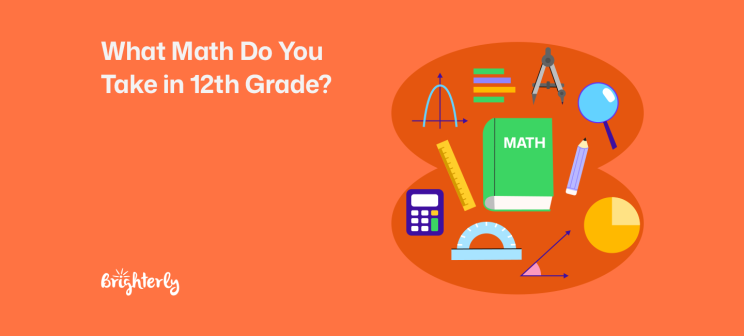
What math do you take in 12th grade, in particular? The short answer is that everything depends on what you’ve finished in 11th grade and what your plans are after graduation. This guide sheds light on the most common 12th grade math options, from Precalculus to Integrated Math, and brings tips on how to pick one.
What Math Do 12th Graders Usually Take?
Usually, 12th graders take different courses, as the math paths differ by school, state, and students. The options can include:
- Precalculus or AP Precalculus
- AP Calculus AB or BC
- Statistics or AP Statistics
- College Algebra
- Integrated Math IV
- Less traditional ones like Financial Math, Quantitative Reasoning, or dual-enrollment college courses
The choice depends on the math class they completed in 11th grade and college 12 grade math subject preferences, especially if a student wants to target the subject related to the major.


Boost your child’s math confidence before college
Our tutors identify gaps and personalize plans based on needs
Explore Brighterly Learning Experience
Learn exactly how Brighterly helps students thrive through expert sessions, online tools, and proven feedback from thousands of satisfied parents
Why Senior-Year Math Depends on Previous Courses and College Plans?
Senior-year math depends on previous courses and future college plans, as it builds in a specific sequence, while different careers require different skill levels.
- For instance, traditional sequences imply moving from Algebra 1 through Geometry, Algebra II, and Precalculus.
- In terms of college plans, STEM majors need a higher level of math coursework than Humanities majors, for whom a basic course may suffice.
In most cases, math is a ladder, where math builds on the courses the children take. Schools require a passing grade, so when students miss the steps, it won’t bring them to the next level.
Therefore, the best way to predict what a senior student would learn is to check what came in the 11th grade and what is available for the senior year.
After Algebra II: Precalculus, AP Precalculus, Statistics, or College Algebra
Students who finish Algebra II in 11th grade often take a Precalculus or AP Precalculus course during 12th grade. These courses allow building the functions and trigonometry skills needed for Calculus.
On the other hand, some students choose Statistics instead. The reason may be that they won’t take Calculus in college.
The third option is to take College Algebra, which seems to be a lighter version where children focus on reviewing math.
Note. If your child plans to take any of these courses, they’re likely to master skills such as factoring or solving quadratics from Algebra II. At home, your children can refresh or practice them with Algebra II worksheets or more specific factoring quadratics or solving quadratic equations worksheets.
After Precalculus: Calculus, AP Calculus AB or BC, or Statistics
Those 12th graders who managed to complete Precalculus in 11th grade usually take one of the following: AP Calculus AB, AP Calculus BC (a faster-paced course that covers more material), or a non-AP Calculus course. Students often choose this advanced path if they are aiming to major in STEM.
Nevertheless, some choose Statistics after Precalculus. The rationale often lies in the fact that their desired major leans toward data and research, not pure math.
Note. As this path requires advanced math understanding, students may need support and guidance. In this regard, our Calculus tutors help identify limits, assess needs, and personalize sessions to meet learning goals.
Integrated Math Sequence: Math IV or an Advanced Integrated Math Course
Some schools provide an Integrated Math curriculum covering Math I to III. For 12th grade, they offer a Math IV or an advanced integrated course.
It combines algebra, geometry, statistics, and precalculus topics instead of separating them into distinct classes. If comparing it to other courses or paths, the content overlaps with the traditional Precalculus course.
Other Options: Algebra II, Quantitative Reasoning, Financial Math, or Dual-Enrollment Math
At the same time, not every 12th-grade student takes a Precalculus track. They may have a gap to close or earn some credits:
- A student may take Algebra II if they haven’t completed it before, due to a school change or illness, to meet graduation requirements.
- They can also choose Quantitative Reasoning or Financial Math to focus on practical, real-world problem-solving instead of preparing for Calculus.
- Some students take a dual-enrollment math course within a local college to earn extra credit.
What Students Learn in Precalculus and AP Precalculus
Now, look at how courses differ from one another. In particular, Precalculus focuses on the function types, along with graphs and transformations, that students need before Calculus. They refer to such types:
- Polynomial
- Rational
- Exponential
- Logarithmic
- Trigonometric
Other than that, students work with interval notation, complex numbers (that include imaginary numbers), sequences and series, and an introduction to limits.
AP Precalculus follows the same core topics but at a significantly faster pace. Importantly, the AP Precalculus exam can qualify for college credit at some schools.
Note. If you’re considering this path, our Precalculus tutors can help you develop a flexible learning plan for your child and improve their confidence with customized sessions.
What Students Learn in AP Calculus AB and BC
Students have every reason to ask “What do you do in Calculus?” before signing up. Briefly, it builds on Precalculus and covers limits, derivatives and their applications (including related rates and optimization), integrals, and the fundamental theorem of Calculus.
As for AP Calculus AB or BC, the first covers almost a semester of college Calculus. In comparison, AP Calculus BC takes an accelerated approach and adds topics like sequences, series, and parametric equations. So it covers a full year of the material taught in college.
What Students Learn in Statistics and AP Statistics
- Collect and organize data
- Interpret data
- Apply concepts of probability and standard deviation.
The AP Statistics course implies more advanced learning. It goes into hypothesis testing, confidence intervals, and regression. It can also qualify for college credit depending on scores.
Note: AP Statistics focuses on real-world data, so students find it more approachable, and it suits those who target psychology or business majors.
Should Students Take Math in 12th Grade?
Yes, students should take math in 12th grade, as it’s usually necessary for admission. Most colleges expect four years of high school math, so it’s not an optional credit. That’s why students often think about how to get good grades in high school. The other points in favor of taking math are:
- Skill retention. A math class in 12th grade keeps skills sharp.
- Ensuring there are no gaps. Skipping math in 12th grade can leave a gap, especially for STEM-oriented students.
Note. According to the 2026 EdWeek post on readiness of high school graduates by Sarah Schwartz, most state have graduation rates at around 80-95% , yet students’ math proficincy is often below 50%, meaning they are not ready for college.
How Senior-Year Math Affects College Readiness and Admissions
When a student takes a math course in their senior year, they increase their admission profile and lower the need for extra classes aimed at closing gaps.
- First of all, admissions officers in colleges look at the courses the senior-year students take. In their eyes, a person who has taken Calculus is ready to pursue an engineering or physical science major.
- Secondly, the course may signal academic rigor. For instance, an AP course shows the readiness of a student to be thorough in studies.
- Lastly, strong math grades, alongside test scores, support the college application.
Note. Learn more about financial planning and scholarships for high school students, or get an answer to the question “Is the ACT easier than the SAT?”
Want to improve your child's admission profile?
Improve their math skills with our personalized learning plans
How to Choose the Right 12th Grade Math Course?
To choose the right 12th-grade math course, you should match the course to your major and evaluate your performance. An easy way to do so is by answering three main questions:
- What course did the student just finish?
- What does the intended major require?
- How confident does the student feel in math right now?
You should also remember these field-specific requirements:
- STEM fields – Calculus
- Business and Economics – Statistics or Data Management
- Humanities and Arts – Quantitative Reasoning and Financial
Note: To assess the student’s confidence and clarify readiness, you can try 12th grade math worksheets or a 12th grade math test. If the student feels stuck during completion, it may be a reason to resort to tutoring.
Conclusion
What math class do you take in 12th grade? There’s no single course that suits every student. Much depends on their prior coursework, current skill level, and future college plans. Importantly, Precalculus, Calculus, Statistics, College Algebra, and Integrated Math, they all lead to different results.
Looking to improve any of these math areas and prepare for college? Book a free demo at Brighterly for a customized learning plan targeted at your specific objectives.
Frequently Asked Questions
What Math Should a Senior Take for College?
A senior should take a math course that relates to the intended major. If they want to go for a STEM major, they will benefit from Calculus. Statistics will fit well for those who are interested in business, social science, or health-related fields. In any case, a fourth year of math is required by colleges.
Should a 12th Grader Take Calculus or Statistics?
For a 12th grader, taking Calculus or Statistics is a decent choice. Calculus suits those who aim to have a career in engineering, math, or the physical sciences. Statistics is a good choice for majors that relate to data or social science; besides, it’s less demanding.
Can a 12th Grader Take Algebra II?
Yes, a 12th grader can take Algebra II. Students who haven’t completed it before often take it to meet graduation requirements. Yet, you should understand that it may limit access to more advanced courses like Calculus.
Is Calculus Required for College Admission?
Calculus isn’t required everywhere; it’s not a strict rule. However, some competitive educational institutions expect students to have Calculus, especially if they go for STEM majors. For other majors, Statistics or strong Precalculus seems to be an acceptable alternative.
What Math Course Comes after Precalculus?
Most students will start an AP Calculus AB, AP Calculus BC, or a non-AP Calculus after completing Precalculus. It’s a traditional sequence for students who finish Precalculus in 11th grade. At the same time, some may choose a Statistics course as well if it is preferable for their intended major.



By 11th grade, math is not the same for every student, as courses usually depend heavily on the ones a student started earlier. Still, what math do you take in 11th grade, and what are the options? Some juniors are deep into Algebra II; others have already started Precalculus or AP Calculus. This guide on […]

Sep 03, 2026

Some of the best apps for homework include tools like Photomath, Socratic, Gauth, Grammarly, EasyBib, Quizlet, and Khan Academy. Each app serves a different purpose — to solve an equation, create a bibliography, check grammar, or practice across subjects. However, when a child’s homework struggles are constant, and an app alone can’t solve it, it […]
Sep 04, 2026
Math & reading from 1st to 12th grade
Looking for homework support for your child?

Choose kid's grade

Math & Reading for Grades 1–12
Build real confidence for your child with a Brighterly math or reading tutor.