What Is a Failing Grade? The US Grading System Explained
reviewed by Maila Caliao
Updated on October 7, 2026
Key Points:
A failing grade means a student’s work falls below the passing standard for an assignment or course. Schools use different cutoffs, so check your child’s grading policy before interpreting a low score. The guide below explains letter grades, GPA, school differences, and what parents can do to handle a poor mark.
What Is a Failing Grade?
A failing grade indicates that a student has not achieved the minimum standard required for passing an exam or course. As of October 2026, the official failing score is an F, which typically corresponds to a standard grade below 60%, but some differences occur across schools and states.
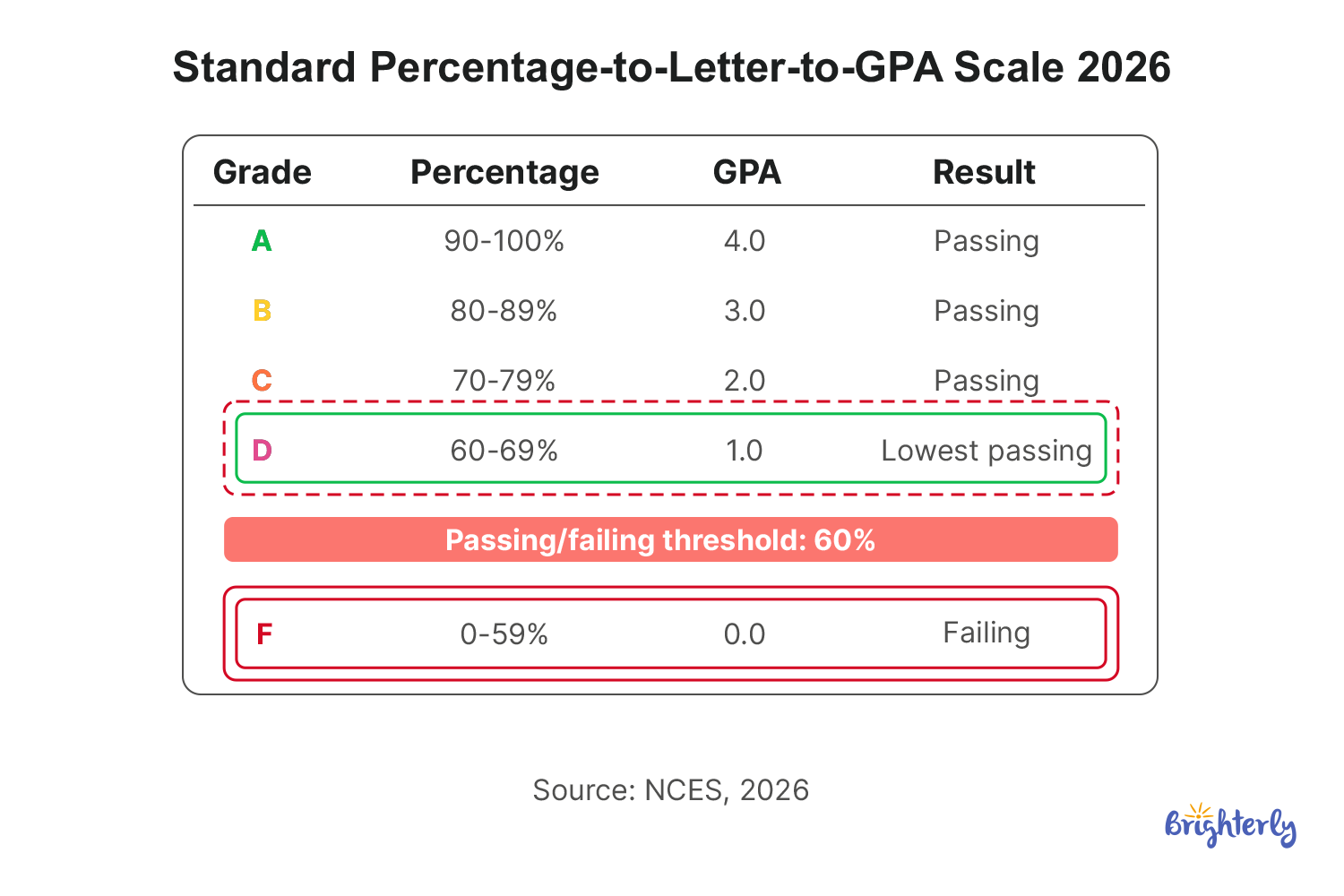
The Standard Percentage-to-Letter-to-GPA Scale
Percentage Grade Letter Grade Grade Point Average (GPA) 90-100 A 4.0 80-89 B 3.0 70-79 C 2.0 60-69 D 1.0 0-59 F 0.0
Source: National Center for Education Statistics (NCES), 2009 HSTS Study
While many districts and schools apply the standard percentage to letter grade scale, you can find differences in local systems.
Is a D a Failing Grade or a Passing Grade?
In most K-12 schools, a D, equivalent to a percentage grade of 60-69%, is the lowest passing grade, while an F, or less than 60%, is a failing grade. However, a minority of schools set the passing bar at a C, or 70%+, where a D doesn’t suffice to pass a test or course.
Explore Brighterly Learning Experience
Learn exactly how Brighterly helps students thrive through expert sessions, online tools, and proven feedback from thousands of satisfied parents
What Percentage Is Considered Failing?
No single percentage serves as the cutoff failing/passing point throughout the US. Teachers, schools, districts, and states can set their own passing vs failing scores. For instance, South County High School places the D/F boundary at 60% for the 2026/2027 academic year, while Houston Independent School District (HISD) considers grades under 70% as unsatisfactory.
In most cases, the answer to “Is 60 a failing grade?” is yes. The question is whether 70 is also a non-passing score.
Note: Check out your child’s school policies to know what grade is a failing grade. Also, know whether the school rounds grade up or down.
Evaluate your child’s math & reading skills!
Free grade-appropriate K-12 diagnostic tests to identify your child’s learning gaps. 

Do Failing Grade Cutoffs Vary by State or School District?
Local laws rather than federal rules regulate educational policies. As the U.S. Department of Education confirms in October 2026, state and local authorities govern education-related issues, so grading policies and failing grade cutoffs vary. In states like New York, districts and even individual schools can determine failing score levels, as seen on the New York State Education Department website.
School District Failing Grade Cutoff Source Tennessee Uniform Grading System Failing: 69 & below Passing: 70 & above Oxford Area High School, Pennsylvania Failing: 64 & below Passing: 65 & above Prince William County Public Schools, Virginia Failing: Below 60 Passing: 60 & above
*Info verified as of October 2026
Additionally, some states use standards-based grading (SBG) rather than traditional grading for elementary schools. This system applies a 1-4 proficiency scale to measure students’ mastery of specific learning goals. The score shows how many of the grade-level expectations the child covers.
How Does a Failing Grade Affect GPA?
A failing grade adds 0.0 points to your cumulative score, whether you look at the standard 4.0 scale or another weighted scale, which lowers your subject GPA. Actually, a single F grade can pull down your average score more than a single A grade can raise it.
Example: If in math your child has two Bs and a C, their GPA is 2.67, calculated as (3.0 + 3.0 + 2.0)/3. In case your kid gets a failing mark, their GPA will go down by 0.67 to 2.0 = (3.0 + 3.0 + 2.0 + 0.0)/4. But if instead your child received an A, their GPA will increase by only 0.33 to 3.0 as (3.0 + 3.0 + 2.0 + 2.0)/4 = 3.0.
What GPA Is Considered Failing?
The US educational system typically considers an average score of less than 1.0, equivalent to less than 59%, a failing GPA. So, 1.0 is the minimum passing grade for a course, though you might encounter differences across states, districts, and schools. Also, usually you need a cumulative GPA of 2.0 or more to pass a grade level.
Now that you know what is a failing GPA, what happens if your child gets such a grade? Receiving less than a passing GPA can lead to academic probation, course failure redemption, dismissal, and sometimes even grade retention.
Boost math & reading skills to avoid failing grades!
Brighterly tutors combine teacher-led instruction with gamified practice to build foundational knowledge.
Do Failing Grades Look Different in Elementary, Middle, and High School?
What is considered a failing grade looks different in elementary, middle, and high school. While a failing score sends a signal that a student struggles academically, the way in which it gets recorded and how it impacts the student’s future at school is distinct.
Many elementary schools apply standards-based grading, which assigns proficiency levels rather than percentages or letters. The system measures students’ progress towards the educational objectives set for their grade level. SBD gives a score on a scale of 1-4, so a failing grade in elementary school usually looks like 1 instead of 50% or F, and doesn’t lead to retention.
In middle school, students transition from standards-based grading to a percentage grading system and GPA scale, so you can see a mix, depending on your child’s grade and district. So, for middle school students, failing grades can look as either 1 or an F for getting less than 60%.
So, what is a failing grade in high school? Grading becomes stricter at high school, where teachers apply percentages. Failing at high school means getting an F, which leads to major academic repercussions. A non-passing grade in 9-12 severely affects your GPA, graduation, college acceptance, and scholarships.
You can check out this free SAT Math practice test and SAT Reading practice test to see how prepared your high schooler is for a college application.
What Should Parents Do If a Child Gets a Failing Grade?
Here is what Claire Smizer, Brighterly Education Advisor, recommends parents to do if their child gets a poor mark:
“In case your child receives a failing mark, don’t panic or put extra stress on them.”

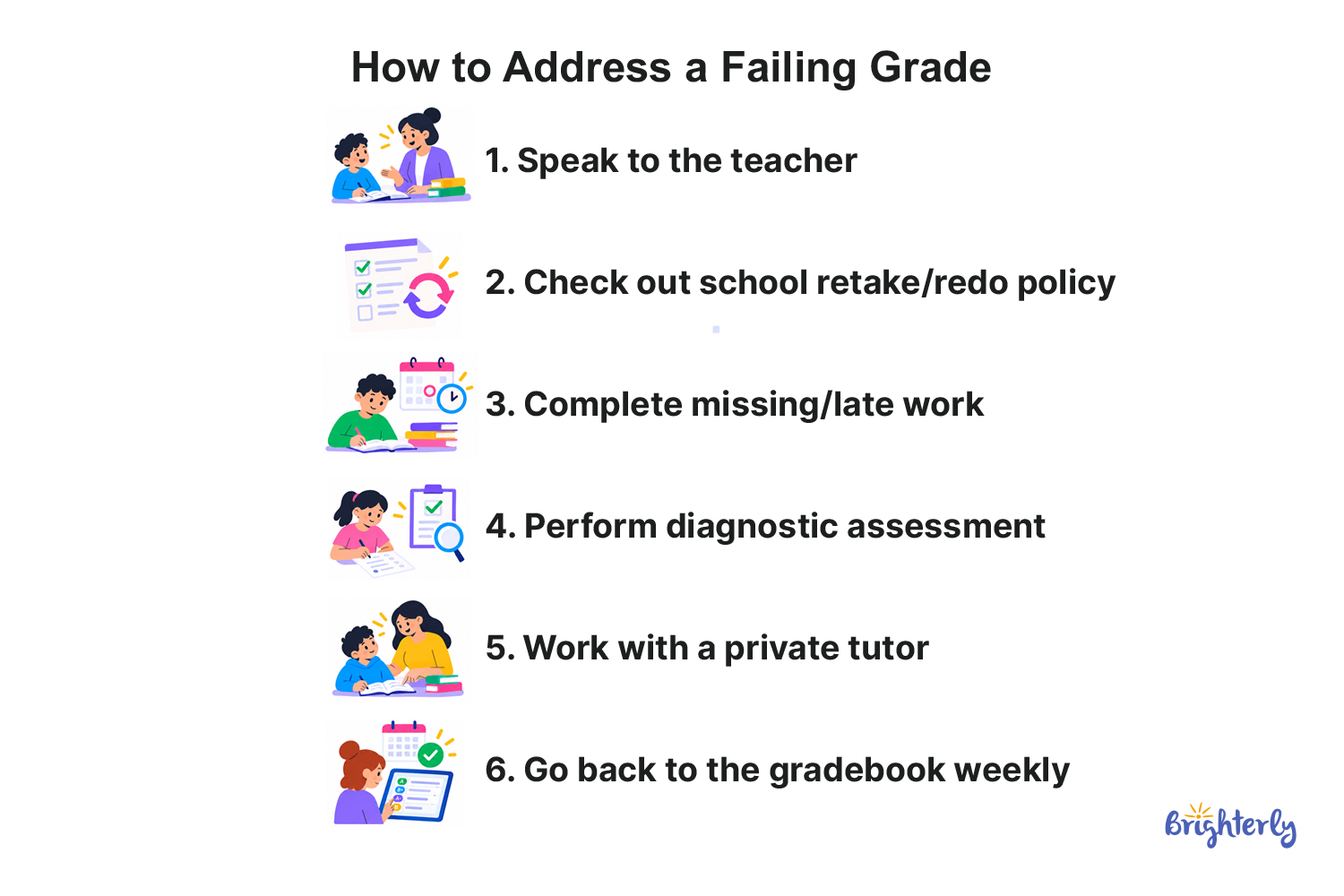
- Contact the course teacher: Ask which assignments or learning gaps contributed to the failing score. Discuss together the first steps your child should take to improve their grades and when you should review progress.
- Ask about the school retake or redo policy: Find out whether your child can retake a test or revise an assignment that led to failing. Confirm the deadline, preparation requirements, and how the new score will affect the overall grade.
- Check for missing or late work: Review the gradebook with your kid to identify incomplete assignments or work marked as missing. Ask the teacher which items your child can still submit and what penalties apply.
- Consider a diagnostic assessment: Ask the teacher whether a diagnostic test could help identify the specific skills on which your child needs to focus. You can also use our free grade-organized math tests and reading tests to find out which capabilities to emphasize.
- Set a regular study or tutoring routine: A private tutor can diagnose your child’s gaps and develop a learning plan to close them. Our high school math tutors and high school reading tutors target your kid’s specific needs to improve knowledge and facilitate college acceptance.
- Check the gradebook every week: While working with an essay writing tutor and implementing other strategies to improve your child’s performance, keep track of progress. Review new grades and upcoming assignments, follow up on missing work, and acknowledge advancements.
Can a Failing Grade Be Turned Around Before It’s Final?
A failing grade can usually be turned around before it becomes final on your child’s report card as long as there’s enough time and graded work left in the semester to make this mathematically possible. The first step is to get in touch with the teacher before the grading period closes to discuss the remaining assignments, their weights, and the score needed to pass.
Check with your school whether they allow extra credit, test retakes, assignment revisions, or grade replacement and see how each option affects the average grade. If your child has an incomplete, check the deadline for submitting work and receiving a grade. The available options to get a D grade depend on the school rules.
Conclusion
Regardless of your school district’s cutoff point, a failing grade is not something you want to see on your child’s report card. There are usually options to reverse an F, but it’s best to avoid this situation by helping your kid build fundamental skills that support academic progress and success across K-12.
If you’re looking for guided support emphasizing 1:1 instruction from real teachers, you can book a free lesson with us to check out the tutoring style.
Frequently Asked Questions
Does a Failing Grade Mean a Student Repeats the Grade?
An unsatisfactory grade doesn’t necessarily mean that the student has to repeat the year, as it depends on the grade level and the school’s institutional policies. Many US schools practice social promotion, allowing failing students to move to the next level along with their classmates to avoid long-term social and developmental consequences from being left behind.
Can Extra Credit Fix a Failing Grade Before Report Cards Are Final?
Getting extra credit can help fix a failing grade before a student’s report card is final. However, extra credit alone isn’t usually enough to turn a poor mark into a passing grade; you need to combine it with retaking tests, revising assignments, and other options permitted by the school policy.
Does a Failing Grade Ever Get Removed From a Transcript?
A failing mark is not usually removed from an official transcript, as schools treat it as a permanent part of a student’s academic record. However, improving performance after a poor grade helps enhance a student’s record and increase their chances for acceptance into a good college, provided they also get a high score on the SAT.
How Many Failing Grades Lead to Summer School or Retention?
Failing one core subject or two non-core subjects usually leads to summer school in order to recover credit, gain missing knowledge, and be able to move forward next academic year. Meanwhile, not passing two core subjects or three general subjects typically demands grade retention.
Is a 59% Always Considered an F?
While grading scales vary across the US educational system, a 59% is generally considered an F in the majority of US schools and districts. However, getting a 59% on a single assessment doesn’t necessarily translate into a failing GPA if the rest of the student’s grades are good enough to bring the average above the failing threshold.
Does a Failing Grade Affect College Applications?
A failing grade negatively impacts a student’s college applications by lowering their GPA and raising concerns about their academic readiness and skills required for higher education. The size of the effect depends on the grade (fixing a poor mark in 9th or 10th grade is easier than in 11th or 12th grade), the course type, and the competitiveness of the college the student is applying to.


Does your child still count on their fingers? Or do they understand long division but freeze on 7 × 8? This pause is what math fluency is about, and it can be a worry for parents. This guide shows what math fact fluency is about, what to expect from Kindergarten to 5th grade, and why […]

Oct 06, 2026
Math & reading from 1st to 12th grade
Looking for homework support for your child?

Choose kid's grade

Math & Reading for Grades 1–12
Build real confidence for your child with a Brighterly math or reading tutor.