Where Can I Find Algebra Help for Kids Near Me?
reviewed by Mary Grace Carlos
Updated on October 8, 2026
Key points:
Lots of kids struggle with algebra. The abstract nature, missing foundational skills, and the teaching pace are all common reasons for kids to underperform when it comes to this math course. If you’re asking yourself, ‘where can I find algebra help for kids near me?’ then this guide can help you to figure out what help your kid needs and what options are available.
Why Do Kids Struggle With Algebra?
Kids can struggle with algebra because of poor foundational skills, the abstract nature of algebra, a fast teaching pace, struggles decoding word problems, or math anxiety.
- Weak foundational math skills. Kids who already struggle with fundamental math skills like addition, subtraction, multiplication, and division will find algebra harder.
- Abstract concepts. Algebra often introduces abstract concepts, and some kids struggle to understand and interpret them.
- Struggling with word problems. Algebra frequently uses word problems; decoding what they mean is a common struggle for kids.
- Teaching pace or style. For some kids, the teaching pace can be too fast, or the method doesn’t work for them. Some kids need hands-on, interactive lessons to help them connect algebraic concepts to real-life examples in order for it to click.
- Lack of practice or useful resources. Algebra requires lots of practice to master, as well as access to diverse resources.
- Math anxiety. Lots of children struggle with confidence in math and a fear of getting it wrong; this can impede progress and ability.
Note: According to the 2024 National Assessment of Educational Progress, just 27% of eighth-graders scored at or above the proficient level in math — a sign that struggling with algebra-level material is common, not a reflection of a child’s ability.
Explore Brighterly Learning Experience
Learn exactly how Brighterly helps students thrive through expert sessions, online tools, and proven feedback from thousands of satisfied parents
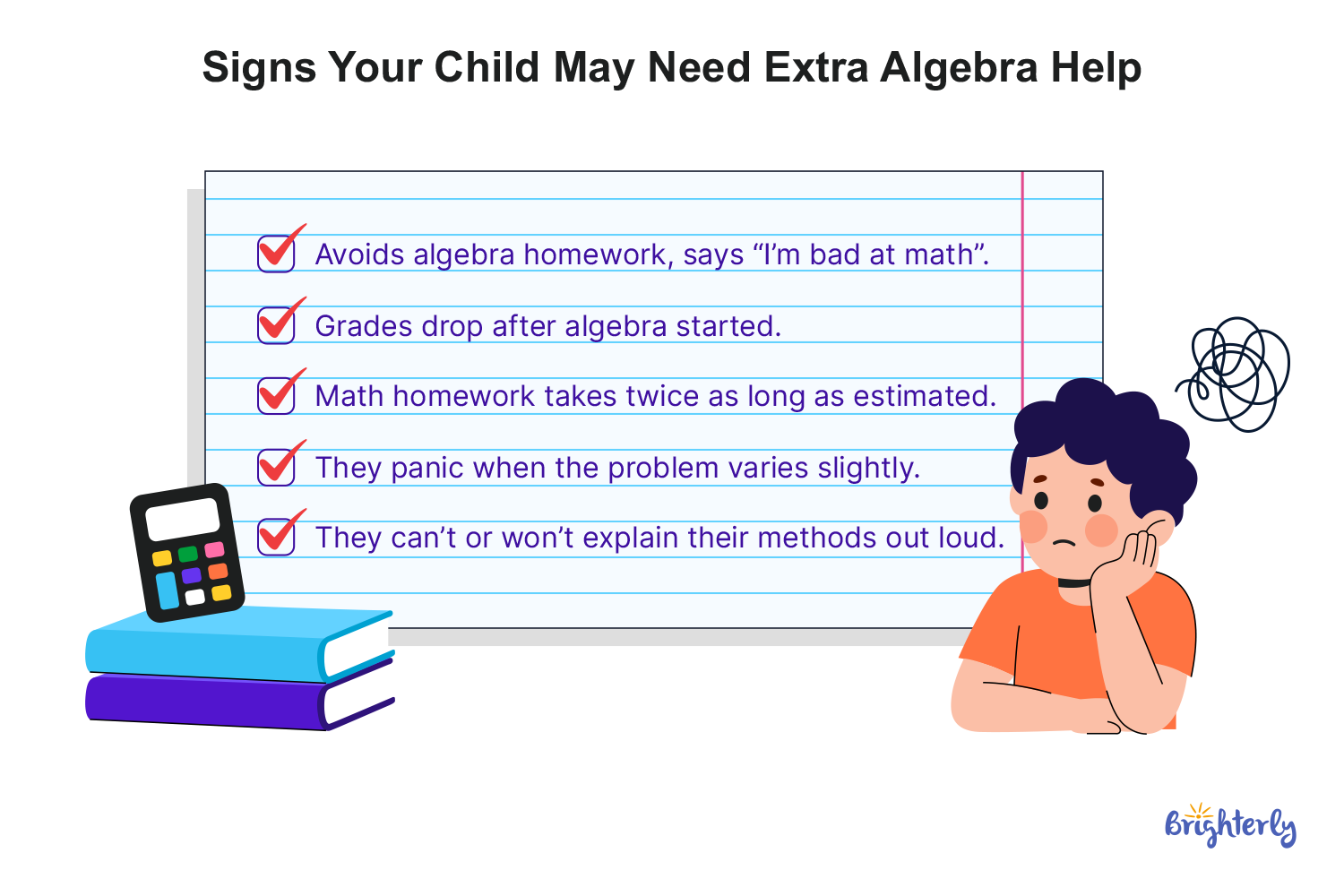
Signs Your Child Needs Extra Algebra Help
If your child is struggling with algebra, you may find that they start to avoid math homework, claim they’re ‘bad’ at math, their grades start to drop, homework takes a long time, or they panic when the problems change.
Need help catching up in algebra?
Our tutors break down algebra into small steps to help kids master it 

Where to Find Algebra Help for Kids
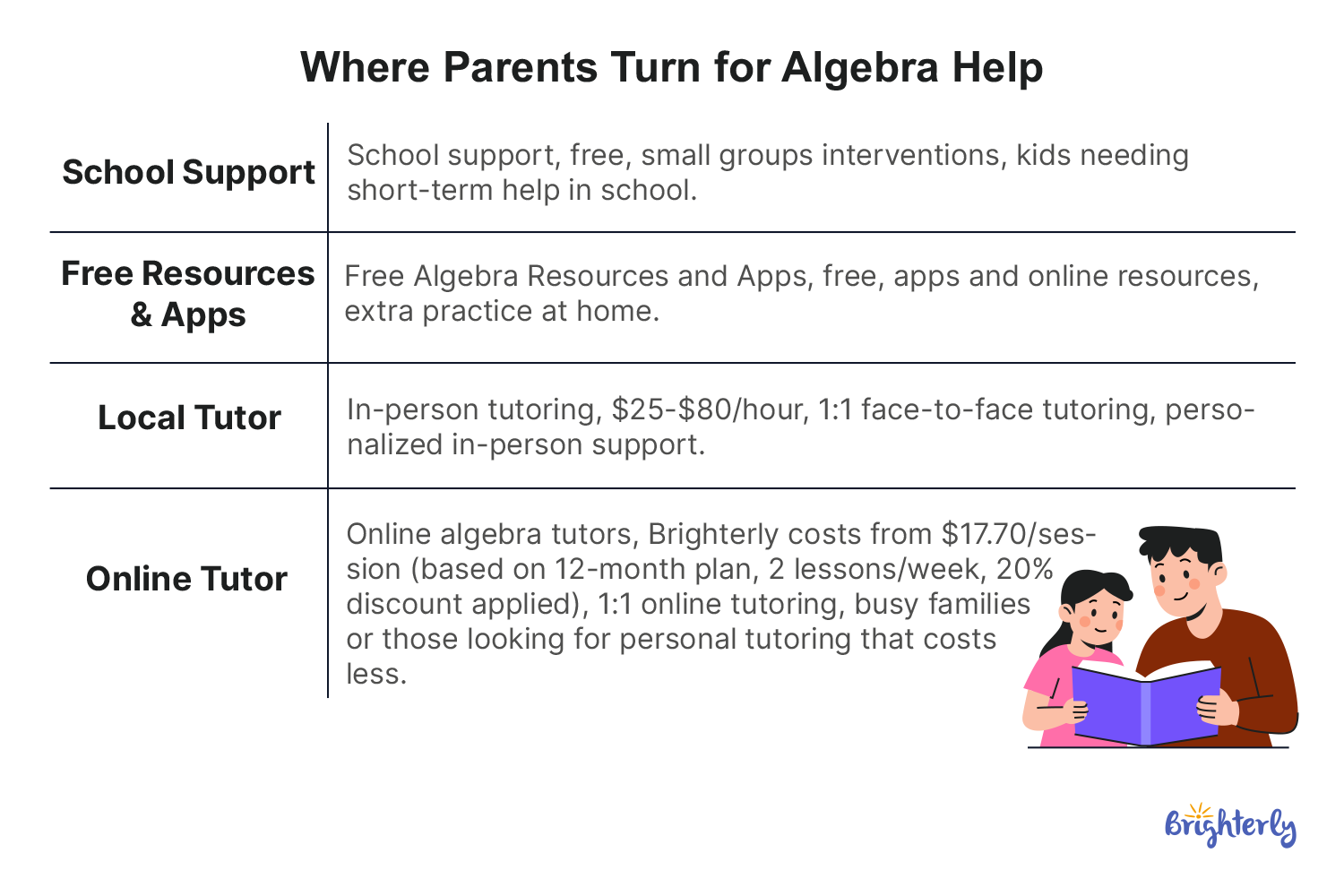
Finding the right algebra help will depend on what type of support you’re looking for, where you live, your budget, and your child’s learning preferences. Algebra help can be found in schools, through free resources and apps, from in-person tutors near you, and through online Algebra 1 and Algebra 2 tutors.
Support at School
Best for: Understanding the problem
Schools can offer extra support, like math interventions, to kids who are struggling with Algebra 1, 2, or pre-algebra. Depending on the level of difficulty, this could be in small-group sessions or provided as a 1:1 intervention. If your child has special educational needs, then they may also have an IEP, which lays out what additional support the school should provide.
Pros:
✅Teachers can tell you why your child is struggling
✅Interventions are performed during school hours
✅Specialist help with qualified teachers
Cons:
❌Sometimes teachers miss kids who are struggling
❌Interventions are often performed in small groups and not truly personalized to your child
❌Some kids view it as a punishment or may have attached a stigma to needing extra support
❌Not available for anyone homeschooling
Typical cost: Free
Free Algebra Resources and Apps
Best for: Using at-home to supplement interventions
Free algebra resources and apps consist of things like: worksheets, videos and guides, interactive problem-solving games, algebra practice tests, and free math apps. These can be a great option as you can take them up anytime and anywhere, so they can be easily slotted into your family’s schedule. However, the quality of teaching can greatly vary; they rely heavily on parental support, and they don’t typically provide a comprehensive program.
Pros:
✅Can be easily fitted into your schedule
✅Often gamified and fun, so kids enjoy doing it
✅Huge variety of free algebra resources to choose from online
✅Good for extra practice at home
Cons:
❌Quality of teaching varies between resources
❌Not usually a comprehensive algebra curriculum
❌Heavily relies on parents being involved and explaining tricky concepts
❌Not personalized to your child’s struggles or learning style
Typical cost: Free
Local, In-Person Tutors
Best for: Personalized in-person support
Local tutors can be a great option for families wanting face-to-face math tutoring near them. You can find a tutor either through personal recommendations or by searching online. When considering this option, it’s important to assess the tutor’s knowledge and experience, ask for references, and find out what methods they use to teach.
Pros:
✅1:1 personalized teaching
✅Can be adapted to your child’s learning style
✅Comprehensive teaching
Cons:
❌Quality and experience of tutors can vary
❌Often expensive
❌Requires significant time commitment and travel
How to find an in-person tutor:
- Recommendations: Ask your child’s school or other parents if they have used tutors and whether they would recommend them.
- Search online: Ask for recommendations in local groups or use a ‘near me’ search. This works by matching your location with local businesses in the region.
- Use a tutoring agency or math program company: Agencies can connect you to a tutor in your area, although they may charge additional fees. Some math platforms offer in-person centres where you can receive either 1:1 tutoring or small group support.
Typical cost: Tutoring rates will vary greatly depending on the area you live in, the experience of the tutor, and how long you use them for. Typical tutoring rates, as of August 2026, vary from $25-$80/hour.
Online 1:1 Algebra Tutors
Best for: Convenient personalized algebra teaching.
Many parents choose to look for online 1:1 tutoring for the convenience, cost, and personalized nature. Brighterly offers experienced one-to-one tutors who identify your child’s learning gaps and weaknesses and build a learning plan just for them. Our tutors use techniques matched to your child’s learning style, pace, and interests to keep them engaged and progressing. The personalized structure lets kids build their math skills in private, giving them more confidence in the classroom.
Pros:
✅Typically cheaper than in-person tutoring
✅Convenient and doesn’t require travel
✅Personalised to your kids’ needs
✅Specialist math support available, e.g algebra homework help or support for ADHD
Cons:
❌Quality of tutors can vary if you book from a non verified provider
❌Requires consistent internet access and a device
Typical cost: As of October 2026, Brighterly pricing starts from $17.70/lesson (based on a 12-month plan, 2 lessons/week, 20% discount applied)
How to Choose the Right Kind of Algebra Help
Before choosing what type of algebra help your kid needs, find out first what level they’re currently at. You can do this by speaking to their teacher or by using a diagnostic math test. Then decide on your budget, availability, and how your child learns best. Use our decision checklist below to help you make the right choice.
Option Best when… Consider if… School Your child’s struggles are directly linked to their current classwork. They can attend school interventions, or they need a little extra support or attention during class At-home free resources Your kid generally understands but needs some extra practice and a little guidance You can work through resources with your child, or they can work independently without getting frustrated In-person tutoring Your child is really struggling and needs hands-on guidance They work best with face-to-face instruction, and you have the time and budget to make it happen Online tutoring Your child is struggling and needs consistent, regular, individual tutoring Your family has a busy schedule, and your child is comfortable communicating online, but they need personalized teaching
How to Help Your Child with Algebra
To help your child learn math, try these algebra study tips to improve their math skills.
Find The Gaps
You have to know where to start before you can help your child catch up. Algebra builds on earlier skills, like fractions and negative numbers, so any gaps in knowledge will affect how hard they find it.
What to do
Have your child do a skills check through a diagnostic math test or by using other resources that pinpoint problems.
Break Problems Down
One of the algebra tips and tricks is to change the way your child approaches tricky problems by teaching them how to break them down into manageable steps until it becomes second nature.
What to do
Here’s a simple example of how to break an algebra problem down:
Solve for x
2x + 6 = 14
Step 1: Get rid of the +6
Subtract 6 from both sides.
2x + 6 − 6 = 14 − 6
2x = 8
Step 2: Get x by itself
Divide both sides by 2.
2x ÷ 2 = 8 ÷ 2
x = 4
Answer: x = 4
Use Scaffolding
There are many different scaffolding techniques that can be used in algebra, for example, guided learning practice.
What to do
First, get your child to ask themselves what do I know and what do I need to find. Then guide them through problems, keeping expectations light, until they are doing more and more of the explaining.
Practice, Practice, Practice
The best way to learn algebra is often through consistent practice in a low-pressure and fun environment.
What to do
Create a consistent routine consisting of short, regular practice sessions based around the problem area. Keep the sessions fun and reward positive participation. Use at-home algebra worksheets for kids and algebra practice tests to consolidate skills and prepare for school tests.
Consider Outside Help
Often, kids learn best when they are taught by someone who is not related to them.
What to do
Look for outside help like online tutoring or through math programs or apps. A good, experienced tutor will find the best learning strategies for your child, keep learning light and fun, and build their confidence as well as their skills.
Is algebra causing anxiety at home?
Take a diagnostic math test and we will tell you the next step
Managing Algebra-Related Math Anxiety
Math anxiety is a feeling of fear, tension, or panic that arises when a child (or adult) has to do math. It can affect performance and hinder your child’s academic success. Often, a person with math anxiety has the knowledge to do the math, but the fear or tension takes over their cognitive processes and hinders their ability to do it.
Signs Your Kid Might Have Math Anxiety
- They avoid math homework or practice
- They experience physical symptoms like sweating, nausea, or an increased heart rate
- They tell you they’re bad at math
- They freeze or ‘go blank’ during tests
- They score poorly on algebra tests and quizzes
How to Deal With Math Anxiety
Recognize it. Help your child recognize and verbalise what they’re feeling when they approach math. You can also explain that it’s common; according to a 2023 American Psychological Association article, between 20-25% of kids experience math anxiety, and lots of adults also have it.
Ease into it. Make sure your child is in a calm, distraction-free environment and is able to work at their own pace. Tackle it in short sessions and don’t force them to finish every problem.
Seek help. If your child’s math anxiety is significantly affecting them, then speak to their teacher and/or health provider. Additional support at school or certain therapies can help.
Conclusion
Learning algebra can be tough, but that doesn’t mean you have to do it alone. Lots of kids require extra support when it comes to this tricky math course, but with time and practice, your kid can build both their skills and confidence. Every child learns differently and works at a different speed, which is why personalized one-to-one tutoring is so effective.
Depending on your budget, schedule, and how your kid learns, consider using specialist online math tutors or ask for recommendations for an in-person tutor near you. Book your free lesson today and test our approach.
Frequently Asked Questions
What Grade Do Kids Usually Start Learning Algebra?
While kids formally start Algebra 1 in 8th or 9th grade, the foundations for algebra are built throughout the early years. In grades 1-5, kids learn early algebraic thinking through word problems and by solving missing-number equations. In middle school (grades 6-8) children can take pre-algebra, where they learn basic variables, ratios, and negative numbers.
How Much Does Algebra Tutoring Typically Cost?
In-person algebra tutoring is typically more expensive than online tutoring and costs between $25-$80/hour. Costs vary greatly based on location and the tutor. Online algebra tutoring often works out cheaper, especially if you purchase a subscription. For example, Brighterly costs from $17.70 per session when you purchase a 12-month subscription plan of 2 sessions/week (20% discount applied)
Can My Child Get Algebra Help for Free?
Yes, schools can offer free algebra help in the form of math interventions to students who are struggling. These are typically in a small group format, but some children may receive one-to-one support. Other free help available includes resources and apps online which can help build some skills, although they aren’t usually fully comprehensive and often rely heavily on parental support.
How Fast Will My Child See Improvement With Extra Help?
That depends on your child and what support they are receiving. Kids who receive multiple one-on-one sessions a week can start to see improvements quickly, while those doing infrequent sessions will likely take longer. One thing parents often forget is that improvement doesn’t just mean better grades. 1:1 support helps kids build their confidence as well as their understanding; this is hard to measure but has a huge positive impact on future learning and academic success.
My Child Understands Algebra With a Tutor but Still Struggles on Tests — Why?
This is a common problem and might be linked to math anxiety. Not scoring well on tests doesn’t mean your child isn’t good at math; often, it can mean they experience a lot of stress over tests, and this results in them scoring poorly. Other problems, like rushing through questions or not understanding what the question is asking, can also result in low grades, even though the foundational math skills are all there. If you’re concerned, speak to your child’s teacher, who should be able to offer insight and advice.
Is Online Algebra Tutoring as Effective as In-Person Tutoring?
Yes, it can be. The effectiveness of tutoring is more about how the tutor adapts to the student, their needs, learning styles, and knowledge gaps. A good tutor can teach both in person and online as there are learning strategies that can be used for both. For example, interactive online ‘classrooms’ can provide different learning strategies, including the use of visual aids and algebra games for kids.


A failing grade means a student’s work falls below the passing standard for an assignment or course. Schools use different cutoffs, so check your child’s grading policy before interpreting a low score. The guide below explains letter grades, GPA, school differences, and what parents can do to handle a poor mark. What Is a Failing […]

Oct 07, 2026
Brighterly helps K-12 students improve their math and reading skills in 1:1 online classes with professional tutors. Russian School of Math is a K-12 after-school group-class program with a competition-math focus. This Brighterly vs Russian School of Math comparison covers key features, pricing differences, and pros and cons for each platform. Brighterly vs Russian School […]
Oct 08, 2026
Math & reading from 1st to 12th grade
Looking for homework support for your child?

Choose kid's grade

Math & Reading for Grades 1–12
Build real confidence for your child with a Brighterly math or reading tutor.